

Bottle and Tumbler Printing Machines: Choosing Between Rotary UV and Labels
- by John White
Curved surfaces? Print straight onto bottles, tubes and cylinders — no labels needed.

The decision between a label and a printed container is usually made on the wrong page. Brand owners compare unit cost at the run length they hope to reach, then discover that their actual orders arrive in batches of twenty with a different design each time. Decorators compare machine speed, then discover that changeover time, not print speed, sets their output on short mixed runs.
This guide works through the variables that decide it: when direct printing is the right route, the diameter and taper range a rotary UV printer covers, the output you can realistically plan per hour, why taper compensation exists, what fixtures cost in practice, how piece cost is published, and where the technology stops.
On short runs, premium containers and label-averse designs.
Direct printing removes the label substrate, its adhesive and its registration, which suits small batches and containers where a film edge spoils the finish.
Labels win on very long runs and on containers where the substrate is unsuitable for direct printing. Direct printing wins wherever the order pattern is irregular: seasonal designs, personalised runs, brand collaborations and product launches that need a small quantity quickly and may never repeat. In those cases the label's tooling and minimum order become the constraint rather than the print cost.
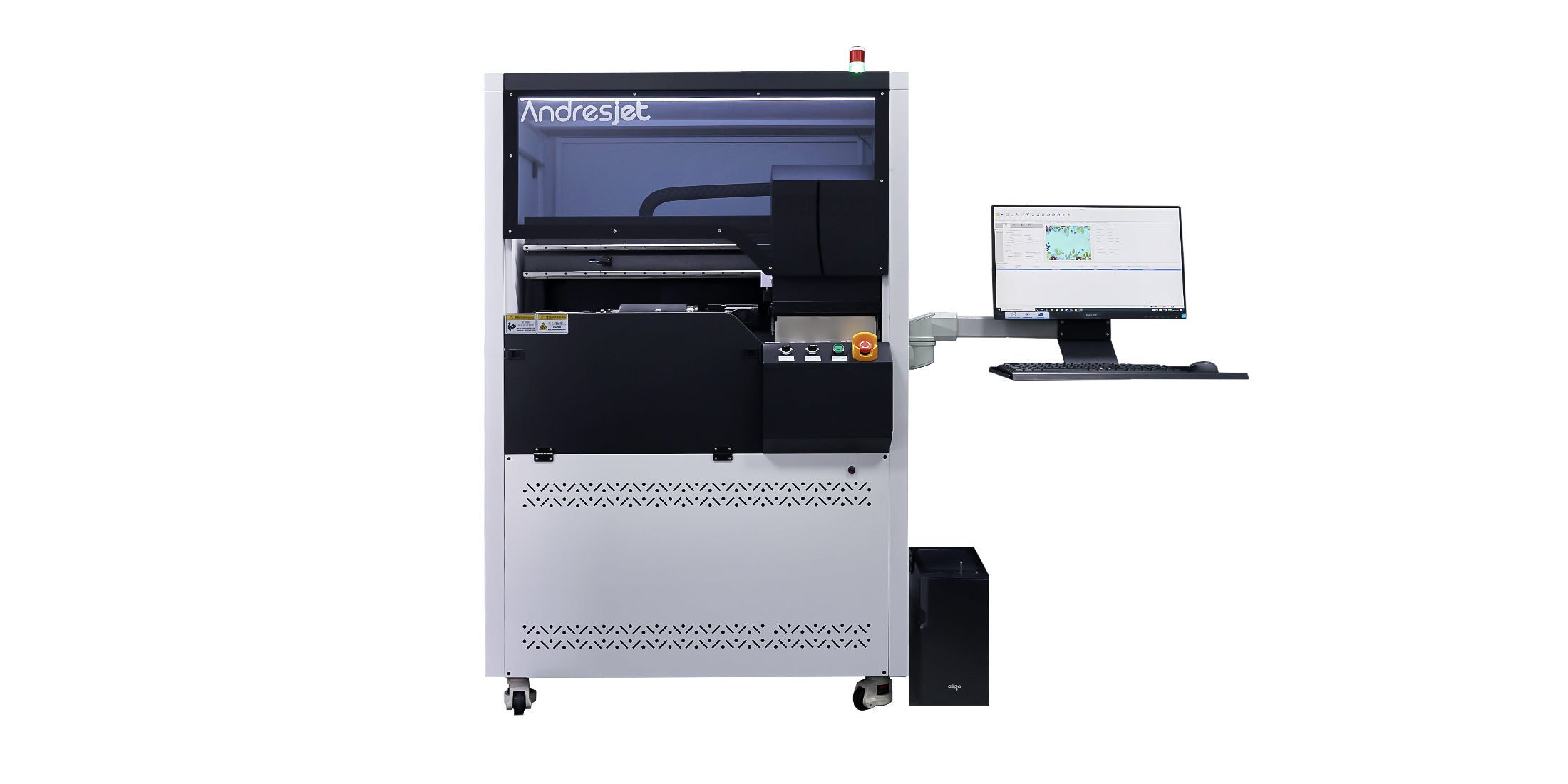
There is also a design argument. A printed container can carry a full 360-degree wrap with no visible seam and no film edge, which is a different product from a labelled container even when the graphics are identical. The AJ360i is published as a direct-to-object printer that handles straight-walled cylinders and tapered vessels with CMYK, white and varnish, and its published application range covers glassware, tumblers, bottles and cosmetic tubes.
Read the diameter, taper and length limits before the price.
The AJ360i is published with a standard part diameter range of 60 to 170 mm, optional ranges of 10 to 60 mm and 170 to 240 mm, a taper angle range of 0 to 7 degrees and a print length of 40 to 270 mm.
Those four numbers decide whether the machine can run your product at all, and they are the first thing to check against your container list rather than the last. The published object weight limit is 3 kg, which covers most beverage, cosmetic and household containers but excludes heavy carafes and filled vessels.
| Parameter | Published specification |
|---|---|
| Part diameter | Standard base 60–170 mm; optional 10–60 mm and 170–240 mm |
| Taper angle range | 0–7° |
| Print length | 40–270 mm |
| Object weight | Up to 3 kg |
| Print resolution | 720 × 1200 dpi |
| Ink configuration | K, C, M, Y, white and varnish; LED UV ink type |
| Print modes | Stepping or helix |
| Power supply | 50/60 Hz, AC 220/110 with a requirement above 10 A and a ground wire |
| Operating environment | 20–30 °C at 30–60 % humidity |
| Net weight and dimensions | 350 kg; 1160 × 870 × 1800 mm (L × W × H) |
Plan on published hourly output, not the per-piece figure.
Andresjet publishes the AJ360i at 60 items per hour in production mode and 40 items per hour in high quality, with 15 minutes of setup per product changeover.
The nominal print speed is published as 60 seconds per piece based on 3.14 inch (80 mm) in CMYK, but the hourly figures are the ones to plan with because they already account for the cycle rather than the pass alone. On a run of a single design the hourly rate is approximately what you will achieve. On mixed runs, changeover dominates: at 15 minutes per changeover, four design changes in a day consume an hour of production before any printing happens.
That arithmetic changes what the machine is for. It favours businesses whose order book is a series of short runs with reasonable batch sizes, and it argues against accepting single-piece orders without pricing the setup into them. Where personalised or variable data is part of the offer, the published file support for TIFF, JPG, EPS, PDF, PNG, AI and PSD formats matters as much as the hourly rate, because the workflow has to absorb a new design per piece without a manual reset.
Because a cone and a cylinder need different motion.
The published taper angle range of 0 to 7 degrees covers most commercial drinkware, and the machine's stepping or helix print modes are what keep the image square on a tapered wall.
On a straight cylinder, the surface speed at the print position is constant, so the image can be laid down in a continuous wrap. On a tapered cup the circumference changes with height, so a wrap printed at constant rotation speed stretches or compresses towards the narrow end. Taper compensation adjusts the relationship between rotation and carriage travel so that the image stays dimensionally correct, which is why the taper specification is a machine capability rather than a software setting.
This is also where substrate choice interacts with the fixture. A tapered vessel needs to be held on a surface that matches its cone, so the clamping solution has to suit the object rather than the printer's centreline. Buyers who run a mix of straight and tapered drinkware should confirm the taper range against the specific products they sell, not only against a general statement that the machine handles cones.

Fixtures decide your real hourly output.
The AJ360i is published with a pneumatic clamping system, seven standard fixtures covering 60 to 170 mm diameters and a tool-free quick-change design with setup in under 12 minutes.
Fixture strategy is where a rotary printer either becomes flexible or becomes a single-product machine. The published position is that two custom fixtures are provided at no extra cost for unique shapes and the extended diameter range of 10 to 240 mm, with custom fixture design typically completed within 7 to 10 business days. That matters commercially because it means a new container does not automatically become a capital project.
It is worth asking two questions before ordering. Which fixtures are included in the quoted configuration, and what is the price and lead time for the ninth or tenth fixture once the initial allocation is used. Buyers who run many container types should also ask how a fixture change is validated, since a fixture swap changes the object's position relative to the print head and therefore needs a repeatable registration step rather than an operator judgement.
Start from published piece cost, then add labour and margin.
Andresjet publishes approximately USD 0.05 to 0.12 per piece for small items, USD 0.12 to 0.30 for medium objects such as water bottles and cups, and USD 0.30 to 0.65 for large items.
Those figures are print cost, not selling price. The commercial calculation adds the container, the operator time per piece, the changeover amortised across the batch, and the rejection rate. Costs depend on size, coverage and the colours used, so the published range is a starting point rather than a quotation, and a test print of your own artwork through the machine's software is what produces the exact ink consumption for your design.
Two published capabilities affect how a job can be priced. White ink is available as a base with four white channels, which matters on dark or opaque containers, and the machine is published to produce spot varnish, raised effects up to 0.15 mm and metallic finishes. Those finishes are usually sold at a premium rather than absorbed into a standard rate, so they belong in the price list as separate line items rather than as free options.
Parts outside the published diameter, taper or length.
The published limits are 60 to 170 mm diameter, 0 to 7 degrees of taper, 40 to 270 mm print length and 3 kg object weight; parts beyond them need a different fixture or machine.
Beyond the dimensional limits, three categories are worth flagging. Very small parts, such as lip balm tubes, fall inside the extended 10 to 60 mm optional range but need fixtures built for that diameter. Flat-sided containers with a curved face are not cylinders at all, and are usually better run on a flatbed with a jig. And wall thickness matters: a thin-walled container that flexes under clamping pressure will not register consistently, which is why clamping design matters as much as diameter range.
Where a product line mixes cylinders and flat parts, the range includes flatbed models that can run jig-mounted small items, and the collection covering UV printers for bottles and tumblers sets out how the different architectures map to product families.
The container, the artwork and the finish, before the order.
Send the actual vessel and design, state the intended ink configuration and finish, and ask for the result to be recorded with the resolution and measured output.
Three tests cover most of the commercial risk on drinkware. Adhesion on glass, coated metal and treated plastics is assessed with the ASTM D3359 tape test (ASTM D3359). Resistance to handling, dishwashing and stacking is assessed by abrasion testing under ASTM D4060 (ASTM D4060). And colour consistency between pieces in the same run is a colour-management question, which depends on the profiles built for that container rather than on the machine alone (International Color Consortium).
Andresjet publishes a free sample service for the first three samples, which is the cheapest way to test adhesion and finish on your own container before committing to a fixture. Waste ink and cleaning materials carry operator-level handling obligations in most markets, so confirm the disposal route at the same time (US EPA), alongside the extraction and operator-protection duties that apply where the machine is installed (OSHA).

When does direct printing beat a label or shrink sleeve?
When the container carries a premium claim, when runs are short or variable, or when the label itself is the objection. Direct printing removes the liner, the adhesive and the registration of a separate substrate, which suits small-batch craft and cosmetic work. Labels remain cheaper at very high volume or where a substrate change is impractical, so the crossover is a volume and design question rather than a technology question.
What diameters and tapers can a rotary UV printer handle?
The AJ360i is published with a standard base range of 60 to 170 mm part diameter, optional ranges of 10 to 60 mm and 170 to 240 mm, a taper angle range of 0 to 7 degrees, and a print length of 40 to 270 mm. Published limits also include an object weight up to 3 kg. Parts outside those ranges need a different fixture or a different machine rather than a different price.
How fast does cylindrical printing actually run?
Andresjet publishes the AJ360i at 60 items per hour in production mode and 40 items per hour in high quality, with 15 minutes of setup per product changeover, and a nominal print speed of 60 seconds per piece based on 3.14 inch (80 mm) in CMYK. Speed varies with object size and print coverage, so changeover time often dominates on short mixed runs.
What does a printed bottle or tumbler cost per piece?
Andresjet publishes guidance of approximately USD 0.05 to 0.12 per piece for small items such as lip balm tubes and small bottles, USD 0.12 to 0.30 for medium objects such as water bottles, cups and cosmetic bottles, and USD 0.30 to 0.65 for large items such as large tubes and sports bottles. Costs depend on size, coverage and the colours used.
How are fixtures handled for unusual container shapes?
The AJ360i is published with an advanced pneumatic clamping system and seven standard fixtures covering 60 to 170 mm diameters, using a tool-free quick-change design with setup in under 12 minutes. Two custom fixtures are provided at no extra cost for special shapes and an extended diameter range of 10 to 240 mm, with custom fixture design typically completed within 7 to 10 business days.
Rotary UV printing is a short-run and premium-finish technology, and it should be bought against your container list rather than against a speed figure. Check each vessel against the published diameter, taper, length and weight limits. Count the design changes you expect per day and multiply by the published changeover time. Then confirm the fixture allocation and the piece cost with a test on your own container, because those two numbers decide whether the machine is flexible or whether it belongs to one product.
Specification detail for the AJ360i is published on the product page, and the wider cylinder range is set out within the digital cylinder printer collection.
Send us three containers from your product list with the artwork you intend to print. We will confirm the diameter range and fixture requirement, and return printed samples with the ink configuration used.
Request a container test

