

Flatbed vs Roll-to-Roll vs Hybrid: Which UV Platform Fits Your Work
- by John White
Print bigger, print faster — wide-format UV flatbed printers for signs, decor and industrial work.

The platform question is usually settled by material rather than by print quality. A rigid composite panel and a vinyl banner are printed with similar ink on similar heads, but one has to be held stationary and the other has to be moved past the print position under tension. Choosing the wrong architecture means the machine cannot position your material accurately, whatever the specification says.
This article compares the three routes — flatbed, roll-to-roll and hybrid — on the variables that decide the purchase: what each can physically hold, which products belong to each, what a hybrid really costs, how handling and waste differ, and how to decide from your own order book rather than from a brochure.
It is a media-positioning difference, not a quality one.
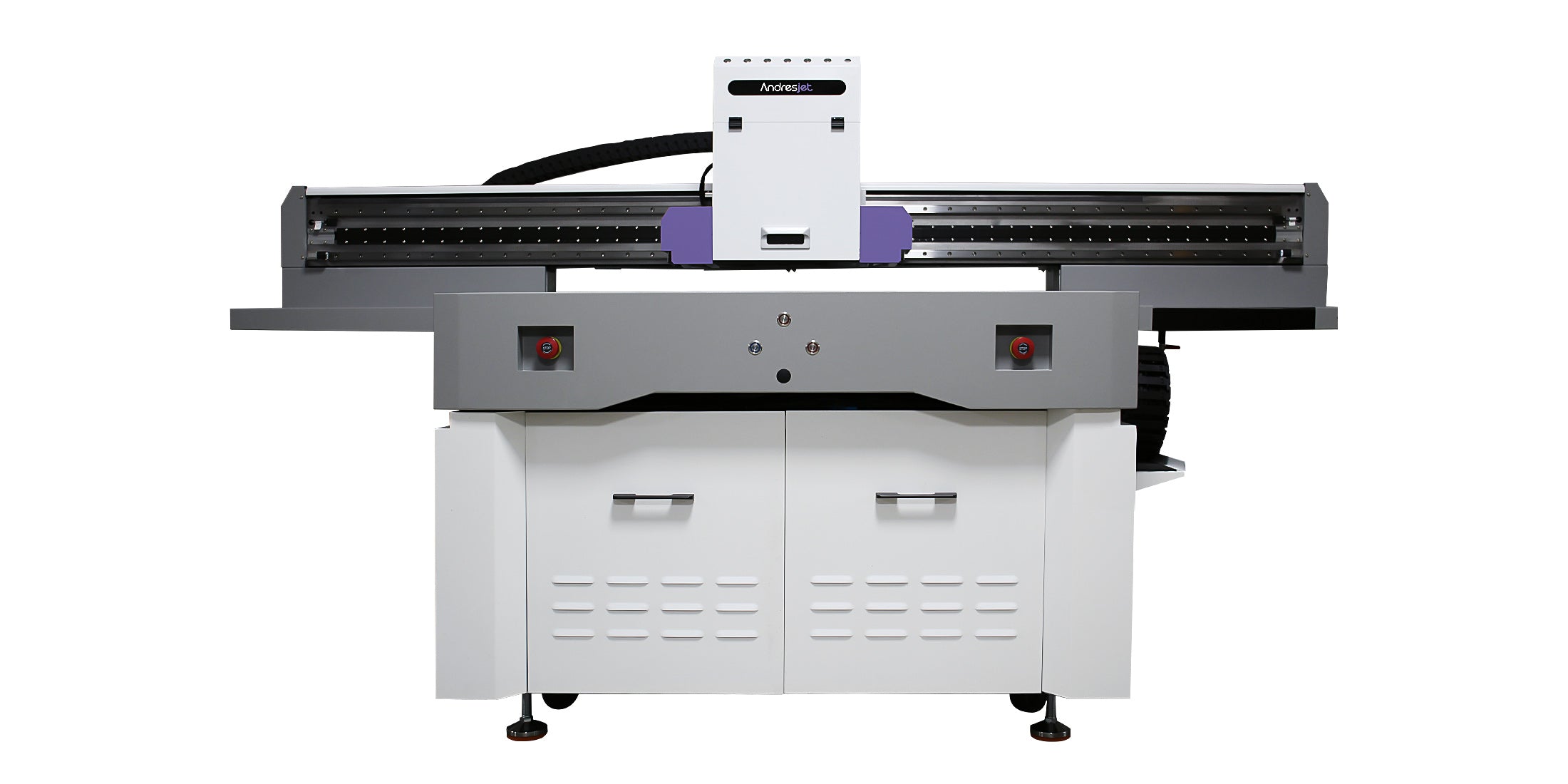
A flatbed holds the sheet still on a vacuum platform and moves the print assembly over it; a roll machine pulls a web past a fixed position and controls tension instead.
Both architectures use the same class of UV-curable ink and the same printheads, and both cure with UV energy at the print position. What changes is how the machine keeps the material in register. A flatbed relies on vacuum hold-down and the rigidity of the sheet: the published platform across this range is hard-anodised aluminium with a four-zone vacuum system, and the media range is 1 to 100 mm thick at up to 50 kg/m² on the AJ2130 series, AJ2513G/R and AJ3220EX. A roll machine relies on tension, dancer control and edge guidance, none of which help with a rigid board.
That difference propagates through the whole purchase. It determines what you can buy as a raw material, how you handle it, how much waste you generate, and what floor space the operation needs. It does not determine whether one machine prints better than the other.
Anything rigid, thick or pre-formed.
Panels, signage boards, doors, nameplates, jig-mounted small parts and drinkware cannot pass through a roll system, so those products belong to a flatbed or to a cylinder printer.
Rigidity is the deciding property. The AJ3220G/R is published to accept material up to 90 mm thick with a maximum media weight of 80 kg, and the wider flatbed family accepts 1 to 100 mm at up to 50 kg/m². Nothing in that range can be fed as a web. The published substrate list — PVC and ABS board, foam board and Sintra, acrylic and Plexiglass, wood, MDF and plywood, glass and ceramic tiles, metals, leather — is a list of rigid or semi-rigid materials, and it describes the class of work a flatbed exists to do.
The second flatbed-only category is pre-formed objects. Where the part is not a sheet at all, vacuum hold-down is replaced by a fixture. This is why the range also includes cylinder machines for bottles, cups and tubes, and small-part platforms with visual positioning for items such as medals and coins, where the item is placed on the bed and located by camera rather than by an edge.

Long, flexible and continuous work.
Banners, wallcoverings, vehicle wrap film, textiles and self-adhesive vinyl belong to a roll machine because their length is limited only by the roll, not by the bed.
Three advantages are structural rather than marginal. Length: a ten-metre banner cannot be produced on any bed, so it is not a matter of cost but of feasibility. Material cost: roll media is generally cheaper per square metre than the equivalent rigid board. Storage and shipping: a rolled banner is cheaper to transport and store than a rigid panel of the same printed area.
Against that, roll work needs finishing that flatbed work does not. Banners require hemming and eyeleting, adhesive films require application, and textiles may require a different ink chemistry entirely. A shop entering roll work is buying a finishing line as well as a printer, and the finishing labour usually exceeds the printing time on small orders.
A hybrid can, but as a compromise rather than two machines.
Hybrid platforms add web handling to a flatbed, which increases footprint and media-handling complexity while rarely matching a dedicated roll machine on long runs.
The economics of a hybrid depend on the proportion of roll work in the order book. Where rigid boards are the majority and flexible jobs are occasional, subcontracting the banners is often cheaper than carrying a second material system, because the hybrid brings web tension control, edge guidance and additional material storage into a workshop that does not use them daily.
Where the print mix is genuinely balanced, two dedicated machines often beat one hybrid on throughput, because each runs at its own optimum rather than being reconfigured. The honest boundary for a flatbed is that flexible material can be handled when it is laid flat and held by vacuum — short sheets and panels behave well — but a flatbed is not a banner machine, and buyers whose revenue depends on banners should specify a roll machine. The range described here is flatbed, cylinder and small-format flatbed equipment, and the substrate collections such as UV printers for signage reflect that focus.
Flatbed work is lifting; roll work is tension control.
A full-size rigid board has to be lifted, aligned and removed without dragging, while a roll has to be loaded, tensioned and rewound, so the labour profile differs before any ink is applied.
Handling is where flatbed buyers most often underestimate the requirement. A dense 10 mm composite panel at 2500 × 1300 mm is a two-person lift, and dragging it across the bed abrades the platform and risks marking existing prints. This is one reason the published platform is hard-anodised, and it is the reason a loading aisle wide enough to swing a full sheet belongs in the site plan rather than in a later renovation.
Roll handling is lighter per square metre but demands consistency. A web that loses tension mid-run produces banding and registration error, so the operator's task shifts from lifting to monitoring. In both cases, the machine's rated throughput assumes the material is being presented correctly, which is why the loading and unloading arrangement is part of the capacity calculation rather than a detail of it.
Ink is similar; material and waste decide it.
Andresjet publishes an ink cost of approximately $0.80 to $1.20 per square metre for a full-colour print, which applies to the printed area whether the substrate arrived on a roll or a pallet.
What differs is everything around the print. Roll media is usually cheaper per square metre, but a printed banner needs hemming and eyeleting, and the roll leaves edge trim. Rigid board costs more per square metre and leaves off-cut, but off-cut is reusable for small parts if the nesting is planned, and a rigid printed panel often requires no further finishing beyond trimming.
Where the materials are comparable, waste is the deciding factor rather than price per sheet. Ask the same question of each platform: what proportion of the material I buy ends up as a sellable square metre? A flatbed with careful nesting can score well on that measure because off-cuts become smaller products, whereas a roll that is trimmed to width on every job loses the same margin repeatedly.
Count revenue by substrate class, not by number of jobs.
If the majority of revenue comes from rigid panels, that is the machine to buy first, and the flexible work should be handled as an exception.
A practical method is to sort the last twelve months of invoices by substrate rather than by customer or by job type, then total the revenue in each class. The class with the largest total sets the first machine, because that is where the capital will be busy. The second-largest class then decides whether the next investment is a second platform, a hybrid or a subcontracting arrangement.
Two further tests are worth applying before the decision is fixed. First, does the largest size in the dominant class fit inside the bed you are considering, with trimming allowance? Published maximum print areas across this range are 2500 × 1300 mm on the AJ2513G/R, 2100 × 3000 mm on the AJ2130 series and 3200 × 2000 mm on the AJ3220 series. Second, is the printer genuinely the bottleneck in the workflow, or does the queue form at finishing? Buying throughput to relieve a bottleneck that sits downstream simply moves the queue.
| Decision variable | Flatbed | Roll-to-roll | Hybrid |
|---|---|---|---|
| Rigid panels and thick board | Yes, up to the published media limits | Not possible | Yes, with flatbed mode |
| Length of continuous output | Limited by bed size | Limited by roll length | Depends on web handling |
| Pre-formed objects | With fixtures or cylinder configuration | Not possible | Only in flatbed mode |
| Material cost per square metre | Higher per sheet | Lower per square metre | Mixed |
| Finishing requirement | Trimming and edge work | Hemming, eyeleting or application | Both |
| Floor area and handling | Large footprint, sheet lifting | Compact, web monitoring | Largest footprint |
Power, extraction and space, sized to the architecture.
The flatbed models are published at AC 220 V, 50/60 Hz with more than 20 A required on the AJ2130 series and AJ3220EX, and the machine mass alone dictates the delivery route.
Site requirements should be settled against the published figures rather than by rule of thumb. The AJ2130 series is published at 4172 × 4250 × 1390 mm at 1850 kg and the AJ3220EX at 5272 × 2842 × 1390 mm at 1850 kg, with operating conditions published as 20–30 °C at 40–60 percent relative humidity for several models. Extraction duties follow national regulation: in the United States the OSHA printing-industry guidance covers ventilation and exposure control (OSHA), and in the United Kingdom the HSE printing pages set out the equivalent duties (HSE). Waste ink and cleaning materials carry their own handling obligations (US EPA).
Where the machine is placed on the EU market, the applicable machinery framework sets out the manufacturer's obligations and the documentation that should accompany it (European Commission, machinery). Before the order, confirm durability on your own material using the relevant physical test — adhesion under ASTM D3359 (ASTM D3359) and wear under ASTM D4060 (ASTM D4060).
What is the physical difference between flatbed and roll-to-roll UV printing?
A flatbed holds the substrate stationary on a vacuum platform while the carriage or gantry moves over it. A roll-to-roll machine moves a flexible web past a fixed head position, with tension and edge control replacing vacuum hold-down. The difference is not print quality: it is which class of material the machine can position accurately enough to print.
Which products can only be printed on a flatbed?
Anything rigid, thick or pre-formed. The published media range for this flatbed family accepts material from 1 to 100 mm thick at up to 50 kg/m², with the AJ3220G/R specified to 90 mm and a maximum media weight of 80 kg. Panels, signs, doors, nameplates and jig-mounted parts cannot be fed through a roll system at all.
Can one machine cover both rigid and flexible work?
A hybrid platform can, at the cost of more complex media handling and a larger footprint. A flatbed handles flexible material only if it is laid flat and held by vacuum, which works for short sheets but not for long webs. Where most revenue comes from rigid boards, adding roll capability often costs more than subcontracting the occasional banner.
Which platform has the lower running cost per square metre?
Ink consumption is broadly similar for the same coverage, so the difference sits in material cost and waste. Roll media is usually cheaper per square metre than rigid board, but requires trimming and leaves edge waste. Rigid board costs more and leaves off-cut, which can often be reused for small parts if the workflow is planned for it.
What does a flatbed require on site that a roll machine does not?
Floor area, floor loading and sheet handling. The AJ2130 platform is published at 4172 × 4250 × 1390 mm at 1850 kg, and the AJ3220EX at 5272 × 2842 × 1390 mm at the same 1850 kg, with both specified at AC 220 V, 50/60 Hz above 20 A. A flatbed also needs clear space to swing a full board on and off the bed.
Sort your revenue by substrate class and the platform decision usually makes itself. Rigid boards point to a flatbed, long flexible output points to a roll machine, and a genuinely balanced mix is the only case where a hybrid earns its complexity. Then check the largest item in the dominant class against the published maximum print area, with a trimming allowance, and confirm the site can deliver and support the machine before the specification is fixed.
Format and configuration detail for the flatbed models referenced here is published within the wide format UV flatbed range.
Tell us what proportion of your revenue comes from rigid board, and the largest panel you sell. We will confirm which platform removes the most cost from your workflow and which configuration matches your materials.
Discuss your platform choice
 UV Printing on Acrylic: Distortion, White Ink and Light Transmission
Knowledge
UV Printing on Acrylic: Distortion, White Ink and Light Transmission
Knowledge
 Industrial Nameplates and Control Panels: Printing Legends and Safety Marks
Knowledge
Industrial Nameplates and Control Panels: Printing Legends and Safety Marks
Knowledge
 Starting a Signage Production Line: Which UV Flatbed Printer Fits First
Knowledge
Starting a Signage Production Line: Which UV Flatbed Printer Fits First
Knowledge
 Inside a UV Printer Factory: What the Build Process Should Look Like
Knowledge
Inside a UV Printer Factory: What the Build Process Should Look Like
Knowledge