

New vs Refurbished vs Used UV Flatbed Printers: Real Risk and Real Savings
- by John White
Print bigger, print faster — wide-format UV flatbed printers for signs, decor and industrial work.

A used flatbed printer is a legitimate purchase, and for some businesses it is the right one. The mistake is comparing a used price against a new price without comparing what is included: remaining printhead life, the state of the geometry, the spares position and the cost of the downtime if the machine stops in the middle of a contract.
This article is not an argument against used equipment. It is a method for pricing it. It covers what is actually being sold in the second-hand market, which parts set the value, how to inspect a machine properly, what a refurbishment claim should contain, when used is rational, and when a new machine turns out to cost less over five years.
Three different things, priced as though they were one.
The second-hand market contains traded-in production machines, ex-demonstration units and genuine rebuilds, and each carries a different risk profile despite looking similar in a photograph.
A traded-in machine is sold as it stands, with its maintenance history as the only predictor of remaining life. An ex-demonstration or low-usage unit has had little production time but may have been moved several times, and moving stresses geometry. A rebuild has had parts replaced and, in the best cases, geometry restored and measured. The three should be priced differently because they are different products.
Buyers also confuse refurbishment with servicing. Cleaning the machine, replacing filters and fitting new wipers is maintenance. Restoring platform flatness and gantry squareness is refurbishment, and it is the part that determines whether the machine can hold tolerance. Ask which of the two you are being offered before discussing price.
Printheads first, then platform geometry.
Heads carry the largest replacement cost and sit outside the published warranty cover on new machines, so their condition dominates the valuation of a used unit.
The published warranty position on Andresjet machines covers non-consumable mechanical and electrical parts for two years, and excludes ink, ink tubes, filters and printheads as consumables. That exclusion is normal across the industry, and it is the reason a used purchase should be valued from the head set upwards rather than from the machine's age. A machine with a recent head set is worth materially more than an identical unit with heads at the end of their life, even where the hour meters match.
Geometry comes second because it is the cost that cannot always be fixed. A platform that has lost flatness or a gantry that is no longer square can sometimes be corrected by adjustment, and sometimes requires machining or replacement. Published platform construction across this range is hard-anodised aluminium with a four-zone vacuum system on a frame that carries 1850 kg on the AJ2130 series and the AJ3220EX, so the geometry question is a measurement question rather than an opinion.

Print under load, then measure the machine.
Run a solid fill in each colour, a fine line pattern and a full-colour artwork in your intended mode, then check bed flatness, gantry squareness and curing output against the machine's own records.
Print tests reveal most of what matters. A solid fill exposes nozzle dropout and banding, a fine line pattern exposes alignment and bidirectional error, and a full-colour artwork exposes colour management and curing problems. Insist on running them in the mode you will use in production rather than in draft, because draft masks defects that appear at quality settings.
Measurement comes next and cannot be skipped. Ask for bed flatness and gantry squareness to be measured, and for the curing module to be measured at the substrate plane rather than assessed from lamp hours, since LED output falls with temperature and age. If the seller cannot demonstrate those three checks, the price should reflect the cost of restoring them. Where the printed part will be handled or cleaned, adhesion and wear are the customer-facing risks, assessed with the ASTM D3359 tape test (ASTM D3359) and the ASTM D4060 abrasion method (ASTM D4060) respectively.
Part numbers, measured values and who did the work.
Without those three, a refurbishment claim is indistinguishable from a service visit, and the price premium it justifies is unverifiable.
A credible rebuild record lists the parts replaced with their identifiers, states the measured values obtained after reassembly, and names the organisation that performed and signed off the work. Where heads were replaced, the record should identify the head generation and batch, because mixing generations inside one machine changes drop behaviour and makes future spares ordering ambiguous. Across this range, the AJ2130EX, AJ2130Ultra and AJ3220EX are published with Ricoh GEN5 heads while the AJ2130G/R and AJ2513G/R are published with Ricoh GEN6 heads, with GEN5 offered as an option on the AJ2130G/R.
Two further documents belong with a used sale. The first is a spares position: which wear parts are available, at what price and lead time. The second is the compliance file, because the declaration of conformity that accompanies a machine is tied to the manufacturer and the product rather than to the owner, and a used buyer importing into a regulated market should confirm what documentation travels with the unit (European Commission, machinery).
Whatever the seller agrees in writing; nothing is automatic.
A used sale is a commercial negotiation, so the parts and labour position, the response time and the excluded items should be stated in the order documents rather than assumed from the original sale.
For comparison, the published position on new Andresjet machines is a two-year warranty covering non-consumable mechanical and electrical parts, with ink, ink tubes, filters and printheads excluded, plus guaranteed parts availability for eight years on the AJ360i cylinder printer and a support model that resolves more than 80 percent of issues remotely with technician dispatch targeted within 48 hours.
A used buyer should ask what part of that position transfers, if any, and what it costs to keep. The most valuable clause in a used purchase is rarely the warranty itself; it is the availability of paid support from an organisation that knows the machine, because a warranty that nobody can service is worth less than a service contract that somebody will honour.
When the format is stable and the volume is already proven.
A used machine makes sense where the product mix is established, the operator is experienced, and the capital saved can absorb a head replacement or a calibration event without disrupting delivery.
Three situations fit that description. A shop adding capacity on a proven process, where the second machine does the same work as the first and the team already knows the maintenance routine. A shop buying a format it intends to grow into, where the used machine is a stepping stone rather than a long-term asset. And a shop with in-house technical capability, where calibration and minor repair are handled internally rather than bought in.
The common thread is tolerance for downtime. Where the machine is the only one of its kind in the building and a stopped machine stops the business, the value of the new-machine warranty and support structure is at its highest. Where it is the second or third unit, or where delivery dates are flexible, that value falls and the used price becomes more attractive.
When a head set or geometry fix lands inside the period.
Add the expected consumable events and downtime to each option's purchase price, and the difference between used and new frequently narrows to the point where it disappears.
A five-year comparison has four lines that are easy to omit. Expected head replacement, priced at the local cost of a head and the labour to fit and recalibrate it. Curing module output loss, which shows first as adhesion complaints rather than as a lamp failure. Calibration time, which is a production cost rather than a parts cost. And idle days, valued at the contribution margin the machine would have produced. Published running-cost guidance helps here: Andresjet publishes an ink cost of approximately $0.80 to $1.20 per square metre for a full-colour print, which gives a reliable figure for the printing element while the other four lines are estimated per machine.
The comparison also has a revenue side. A newer machine with a higher published throughput can take work the older one cannot, and where the order book supports that, the additional contribution belongs in the calculation rather than being treated as a bonus. Published speeds across this range run from 13.02 m²/h on the AJ2513G/R in high-quality mode to 154.3 m²/h on the AJ3220EX in draft mode, so the capacity difference between generations is often the largest single number in the five-year comparison.
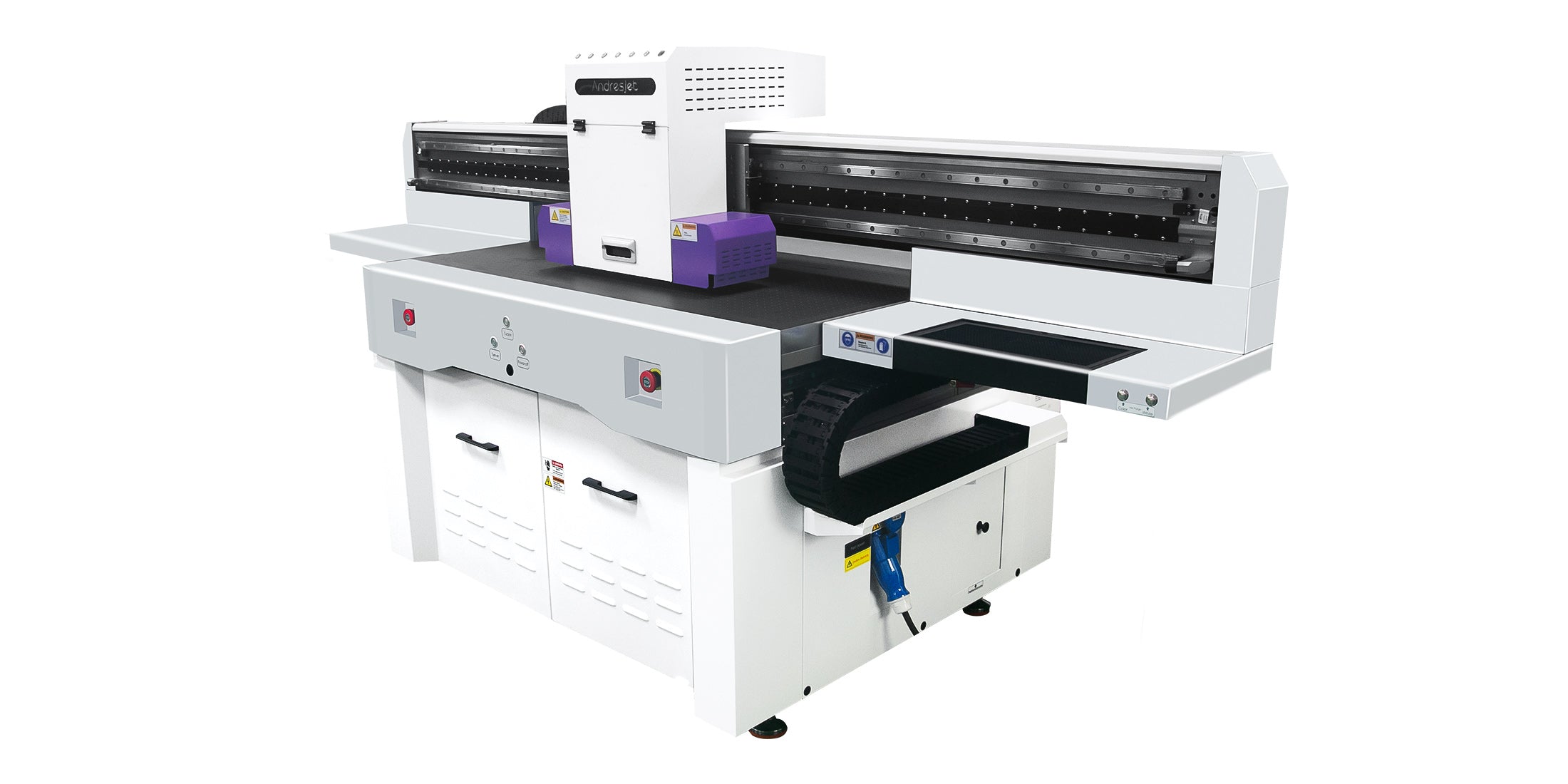
Five-year cost including downtime, per square metre sold.
The useful metric is cost per sellable square metre, not cost per machine, because it brings throughput, waste and downtime into the same number.
| Cost line | How to estimate it | Why it is usually omitted |
|---|---|---|
| Purchase price and delivery | Quoted figure plus freight, duty and installation | Usually included |
| Expected head replacement | Local head cost plus fitting and recalibration labour | Heads are consumables excluded from warranty, so the cost is deferred rather than visible |
| Curing module service | Output measurement against specification, and replacement if short | Shows first as adhesion complaints rather than as a fault code |
| Calibration and alignment time | Hours per event multiplied by the shop's hourly rate | Absorbed into production rather than recorded |
| Downtime | Expected idle days multiplied by contribution margin per day | Notional until a delivery date is missed |
| Ink and consumables | Published ink cost per square metre applied to actual volume | Often compared as a rate rather than as a total |
| Waste and off-cut | Material purchased minus sellable output, for each machine's nesting behaviour | Seldom measured per machine |
Two operational checks complete the picture. Confirm the site can support either machine, since the AJ2130 platform is published at 4172 × 4250 × 1390 mm at 1850 kg with a requirement above 20 A at AC 220 V, 50/60 Hz. And confirm the disposal and waste route, because used ink and cleaning materials carry operator-level handling obligations in most jurisdictions (US EPA), with extraction duties set nationally, such as the OSHA printing-industry guidance in the United States (OSHA) and the HSE printing pages in the United Kingdom (HSE).
Which parts decide the value of a used UV flatbed printer?
The printheads and the platform geometry, in that order. Heads carry the largest replacement cost and they are excluded from the published warranty cover on new machines, so their remaining life is the biggest single variable in a used purchase. Platform flatness and gantry alignment come second, because they determine whether the machine can be brought back into tolerance at all.
How should a used machine be inspected before purchase?
Print a solid fill in each colour, a fine line pattern and a full-colour artwork in the mode you intend to use, then examine the results against the machine's own baseline record. Check bed flatness and gantry squareness, verify the ink system for leaks and filtration history, and confirm the curing module output at the substrate plane rather than relying on lamp hours.
What should a refurbishment claim actually include?
A list of replaced parts with part numbers, the measured values after reassembly, and the identity of who performed the work. Replacing wear items is maintenance; restoring geometry is refurbishment. Without measured values, a refurbishment claim cannot be distinguished from a clean and a service.
What warranty applies to a used or refurbished machine?
That is a commercial term agreed with the seller, not an automatic right. Andresjet publishes a two-year warranty on its machines covering non-consumable mechanical and electrical parts, with ink, ink tubes, filters and printheads excluded, and publishes guaranteed parts availability for eight years on the AJ360i. A used sale should state its own parts and labour position in writing.
When does a new machine cost less over five years?
When the used machine needs a head set, a curing module or a geometry correction within that period, and when the downtime is counted at the value of lost production. Add expected head replacement, calibration time and any idle days to the purchase price of each option, then compare; the gap between the two often narrows to the point where the newer machine is cheaper.
Used equipment is a pricing exercise, not a moral one. Price the machine from its head set and its geometry, require measured values rather than assurances, and put the spares and support position in writing before money changes hands. Then compare the two options on cost per sellable square metre over five years, with downtime counted as a real cost, and the decision usually becomes clear.
Where the comparison points towards new equipment, the entry-level configuration within the compact UV printer for small business collection and the compact UV flatbed printers range is the closest new equivalent to a used production model, and the support terms are set out on the support page.
If you are comparing a used machine against a new one, send us the specification and the quoted price. We will provide the corresponding new configuration and the wear-part list so both can be priced on the same five-year basis.
Compare like for like


