

- by John White
What Drives 4×8 UV Flatbed Printing Operating Cost?
- by John White
Print bigger, print faster — wide-format UV flatbed printers for signs, decor and industrial work.

Operating cost in 4×8 rigid-sheet production is driven by accepted sheet area, ink-layer coverage, board utilization, loading labor, setup, rejected sheets, maintenance and productive utilization. Because a single damaged full sheet can carry substantial material and processing value, cost should be measured per accepted sheet or accepted square area—not by rated printer speed alone.
Include rigid substrate, pretreatment, ink and cleaning consumption, labor, equipment allocation, utilities, fixture or masking material, inspection, handling, rework and downstream losses. Choose accepted sheet when jobs use standard full boards; choose accepted area when sheet sizes and nesting vary.
The 4×8 capacity planning guide explains accepted-output capacity. The cost model adds money to that measured workflow.
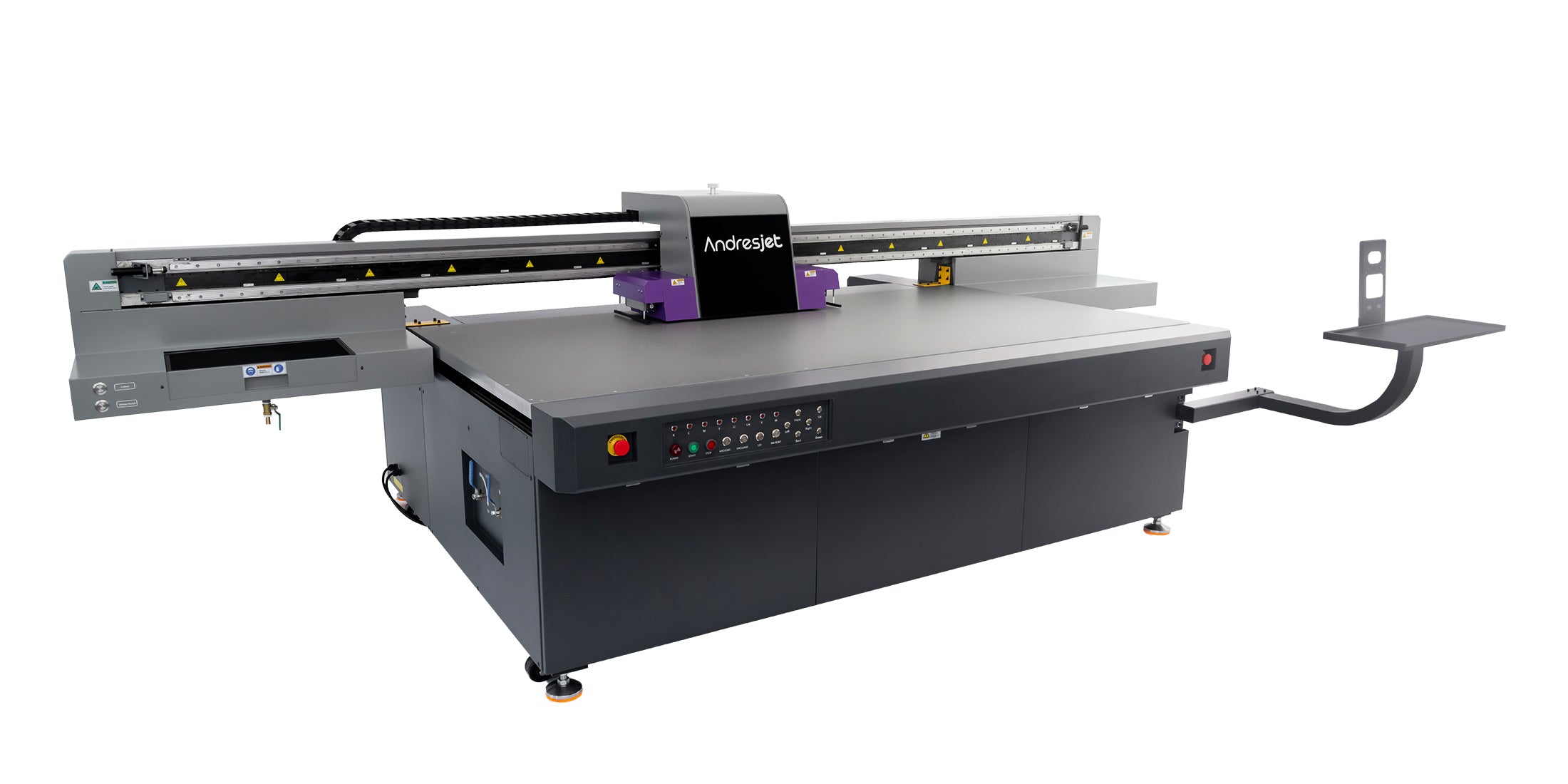
Track purchased board area, printable area, nested image area and accepted delivered area. Offcuts may have recoverable value only if they are identified, stored and likely to be used. Counting every offcut as inventory can understate waste.
Illustrative inputs for a ten-sheet job: boards $320, ink and consumables $86, labor $150, equipment allocation $110, packing and handling $34. Total job cost is $700. At ten accepted sheets, cost is $70 each. If one printed sheet is rejected and cannot be recovered, nine accepted sheets carry the same $700, or $77.78 each.
| Case | Accepted sheets | Cost per accepted sheet |
|---|---|---|
| Full acceptance | 10 | $70.00 |
| One rejection | 9 | $77.78 |
| Two rejections | 8 | $87.50 |
These are illustrative inputs, not AndresJet performance data. Replace them with measured substrate, layer and workflow information.
Record material retrieval, surface preparation, alignment, vacuum or hold-down checks, file release, first article, unloading and inspection. Large sheets can require more handling and risk than print-cycle data suggests. Separate repeat-run labor from one-time setup.

Fixed allocation per productive hour rises when work is unavailable, sheets wait for preparation or downstream cutting constrains the cell. Validate the entire route. A faster printer does not reduce cost when loading, curing acceptance, cutting or packing is the bottleneck.
Review the 4×8 UV flatbed collection and AJ2513G/R product page, then request a sustained sample using the buyer’s board and layer structure.
Scheduled nozzle checks, cleaning, waste ink, replacement consumables and preventive maintenance belong in the operating model. Record them across a meaningful period rather than forcing one maintenance event into a single customer job. Unplanned stops also consume opportunity: the cost is not only maintenance labor but accepted work that cannot be delivered during the lost productive window.
After a representative job, compare estimated and actual board quantity, accepted area, layer structure, labor, setup, run time, consumables and downstream loss. Use a variance threshold that triggers review. If the estimate was wrong, update the model; if production was abnormal, create corrective action without turning the abnormal result into the new standard.
Keep three cost cases. The conservative case should include lower yield and longer handling, the base case should use demonstrated normal production, and the improvement case should include only changes that have already been verified. This prevents an aspirational speed or perfect yield from becoming the purchasing baseline.
A defensible 4×8 operating-cost estimate starts with accepted sheets and the complete rigid-board workflow. Material yield and rejection risk deserve the same attention as ink and print time.
Use the unit that matches the sellable output and job mix.
Only when their identity, storage and realistic future use are controlled.
Board usage, layers, setup, labor, accepted output, rejected causes and downstream handling.
 UV Printer Installation, Commissioning and Operator Training: What Buyers Must Plan For
Knowledge
How a Pre-Order UV Printer Sample Test Works: What to Send and What You Get Back
Knowledge
UV Printer Installation, Commissioning and Operator Training: What Buyers Must Plan For
Knowledge
How a Pre-Order UV Printer Sample Test Works: What to Send and What You Get Back
Knowledge
 Order to Delivery: How UV Printer Lead Time Is Actually Built
Knowledge
Order to Delivery: How UV Printer Lead Time Is Actually Built
Knowledge
 What MOQ Applies to a UV Printer Order, and When Customisation Changes It
Knowledge
What MOQ Applies to a UV Printer Order, and When Customisation Changes It
Knowledge