

- by John White
How Much 4×8 UV Printing Capacity Is Needed?
- by John White
Print bigger, print faster — wide-format UV flatbed printers for signs, decor and industrial work.

A B2B factory should size 4×8-foot UV printing capacity from accepted square area and the real rigid-sheet job mix, not a headline speed. List sheet sizes and coverage, separate setup from run time, apply measured acceptance yield, model peak demand and shifts, identify the bottleneck, and validate the limiting job in a sustained sample run before procurement.
Capacity planning starts with order families: finished dimensions, sheets or nested parts per order, artwork changes, substrate, coverage, ink layers, quality mode, due date and seasonal peak. Convert the demand into accepted square metres or square feet, while keeping unusually slow jobs visible rather than hiding them inside one average.
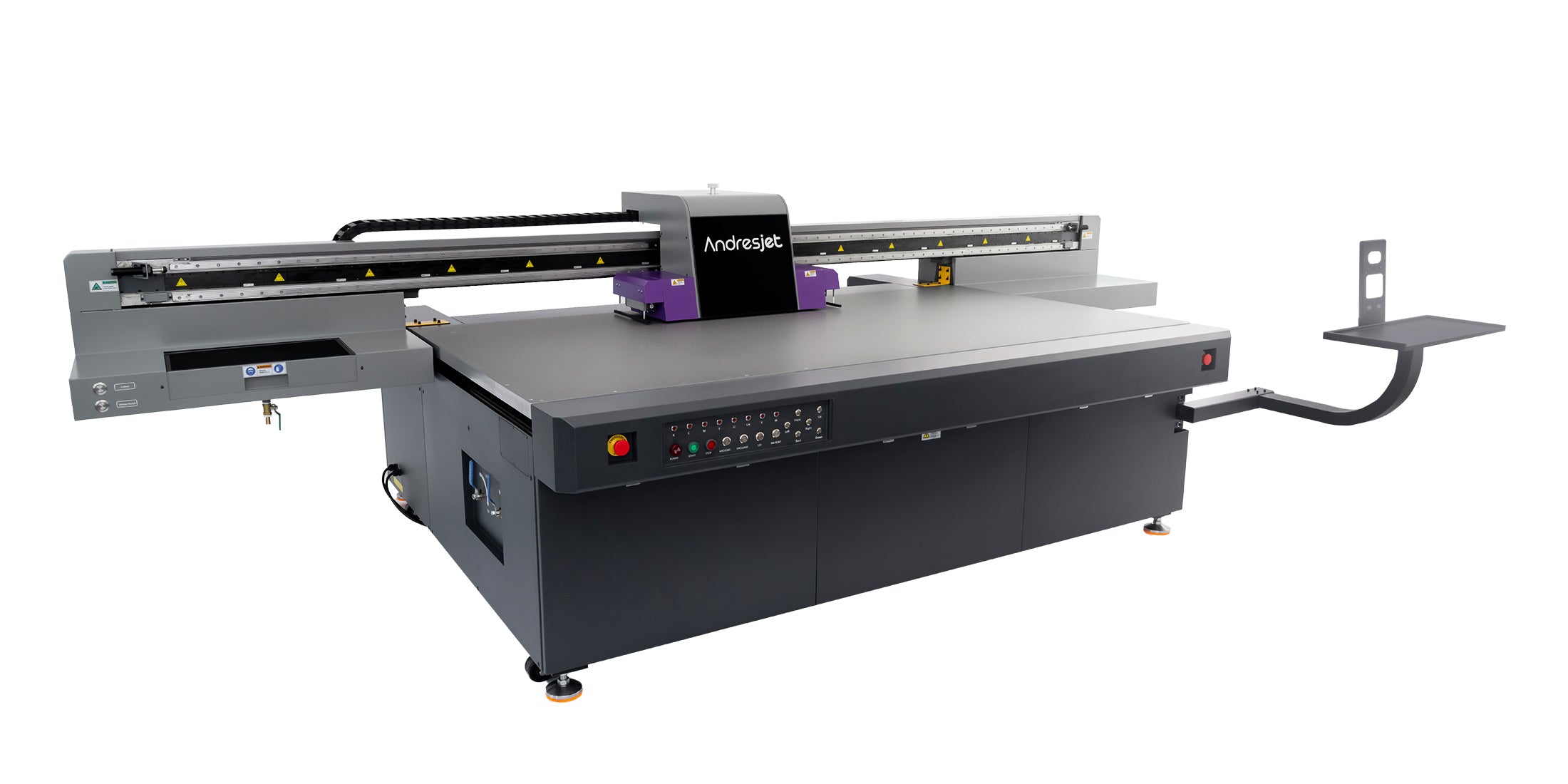
For format and application context, the AndresJet 4×8 UV flatbed printer collection shows where this equipment category fits rigid-sheet production.
Create typical, high-mix and peak cases. The high-mix case carries more setup and first-article approvals; the peak case includes credible reprints, planned maintenance and rush work. Sales and production should agree on the same accepted-output definition before a machine comparison.
Practical accepted capacity = loaded area per productive hour × productive hours × acceptance rate. Required shifts = forecast accepted area ÷ demonstrated accepted area per shift. Productive hours should include normal loading, print, inspection and changeover losses required by the job, but exclude breaks and planned maintenance from available time.
A smaller-shop example is available in the UV printing capacity planning guide; use it for methodology, not as a substitute for 4×8 production data.

Illustrative example: six 1.22 × 2.44 m (4 × 8 ft) sheets occupy about 17.9 m² (192 ft²). If the complete cycle is 50 minutes, 6.5 productive hours allow 7.8 cycles, or about 139.4 m² loaded. At 94% acceptance, practical output is about 131 m² (1,410 ft²). Demand of 220 m² therefore requires 1.68 shifts. These are teaching inputs, not AndresJet performance claims.
| Input | Illustrative value | Planning result |
|---|---|---|
| Load | 6 full sheets | 17.9 m² / 192 ft² |
| Complete cycle | 50 minutes | 1.2 cycles/hour |
| Productive time | 6.5 hours | 139.4 m² loaded |
| Acceptance | 94% | About 131 m² accepted |
| Demand | 220 m² | 1.68 shifts |
Time artwork release, material preparation, loading, printing and curing, unloading, inspection, finishing and packing separately. Printer carriage time matters only when it is the constraint. If sheets wait for files, cutting or forklift access, a faster print mode will not clear the backlog.

A commissioning team should record stoppage reason and duration during a sustained run. Removing setup, rejected sheets or difficult changes produces a theoretical figure that cannot support promised lead times.
Overtime can cover short peaks but should not become the base capacity model. A second shift uses existing capital but requires trained operators, maintenance coverage and material flow. Parallel equipment can add redundancy but also changes floor space, power, staffing and spare-parts planning.
Choose the response that removes the measured constraint and preserves an agreed capacity buffer. No universal spare percentage applies; the buyer should model order variability, recovery time and service risk.
Use the limiting substrate, coverage, white/varnish build, resolution and loading method. Record setup, pieces or area loaded, cycle time, stops, accepted output, rejection causes, inspection and operator. Repeat the run when the procurement decision depends on a narrow margin.
Published machine information can be checked on the AJ2513G/R product page, while practical capacity still needs a sustained run with the buyer’s job mix.
Ask each shortlisted manufacturer to run the same file, substrate lot, loading plan, quality mode and acceptance method. Require loaded and accepted output, complete elapsed time, changeover assumptions and configuration. A speed value without those boundaries cannot be compared fairly.
AndresJet can scope a Custom Digital Printing Solution and sample test, but capacity depends on coverage, pass count, substrate, curing, operator workflow and downstream handling. Do not infer guaranteed production from this illustrative worksheet.
A useful 4×8 capacity plan converts the real sheet mix into accepted area, times the complete cycle, exposes the limiting operation and tests the narrowest case under sustained conditions. Procurement should retain the calculation assumptions, run record and acceptance rule with the equipment specification. AndresJet can help scope an AJ2513 sample run, but the buyer should approve capacity against production substrates, artwork and downstream handling.
No. Use accepted output from a representative sustained run that includes normal loading, setup and inspection.
Use the unit that matches order control. Full-sheet work often uses area; nested repeated products may need both accepted pieces and area.
Only after evidence shows machine availability is the constraint and the additional capacity, redundancy and staffing support the demand model.
 UV Printer Installation, Commissioning and Operator Training: What Buyers Must Plan For
Knowledge
How a Pre-Order UV Printer Sample Test Works: What to Send and What You Get Back
Knowledge
UV Printer Installation, Commissioning and Operator Training: What Buyers Must Plan For
Knowledge
How a Pre-Order UV Printer Sample Test Works: What to Send and What You Get Back
Knowledge
 Order to Delivery: How UV Printer Lead Time Is Actually Built
Knowledge
Order to Delivery: How UV Printer Lead Time Is Actually Built
Knowledge
 What MOQ Applies to a UV Printer Order, and When Customisation Changes It
Knowledge
What MOQ Applies to a UV Printer Order, and When Customisation Changes It
Knowledge