

- by John White
How Should UV Printing Fixtures Be Designed for Medals, Coins and Buttons?
- by John White
Print bigger, print faster — wide-format UV flatbed printers for signs, decor and industrial work.

A fixture for medals, coins and buttons should locate each part from stable datums, prevent rotation, maintain safe printhead clearance and allow repeat loading without damaging the finish. Good fixture design is measured by positional repeatability, loading speed, part protection and changeover control—not by how tightly a prototype can hold one object.
Control X-Y position, rotation, height and seating. Raised rims, recesses, domed faces, pins, clasps and thickness variation can change how a part rests. The fixture must also keep the printable face level and accessible to curing while avoiding contact with decorative surfaces.
The medal, coin and button collection frames the application family; each part geometry still needs its own datum review.
A circular edge controls center but not rotation. Add a key feature, flat, notch, seam or secondary stop when artwork orientation matters. For a medal with a top loop, the loop may control rotation while the main outer diameter controls center. The fixture should make incorrect loading visibly difficult.
Design for the tallest allowed part plus measured variation and required safety margin. Restraint should prevent movement during carriage travel without bending pins, marking plating or covering the print zone. Vacuum alone may not control small, uneven or perforated parts; pockets and mechanical datums may be more repeatable.

Balance part count with loading access, artwork mapping, fixture stiffness and inspection. Number every pocket and keep the same numbering in the artwork file and traveler. Position-specific defects can then be traced to a pocket rather than treated as random printer variation.
| Prototype check | Pass evidence |
|---|---|
| Wrong-way loading | Prevented or immediately visible |
| Repeat position | Grid or target remains within tolerance |
| Height variation | All approved parts maintain clearance |
| Surface protection | No marks after repeated loads |
| Changeover | Fixture identity and origin can be verified |
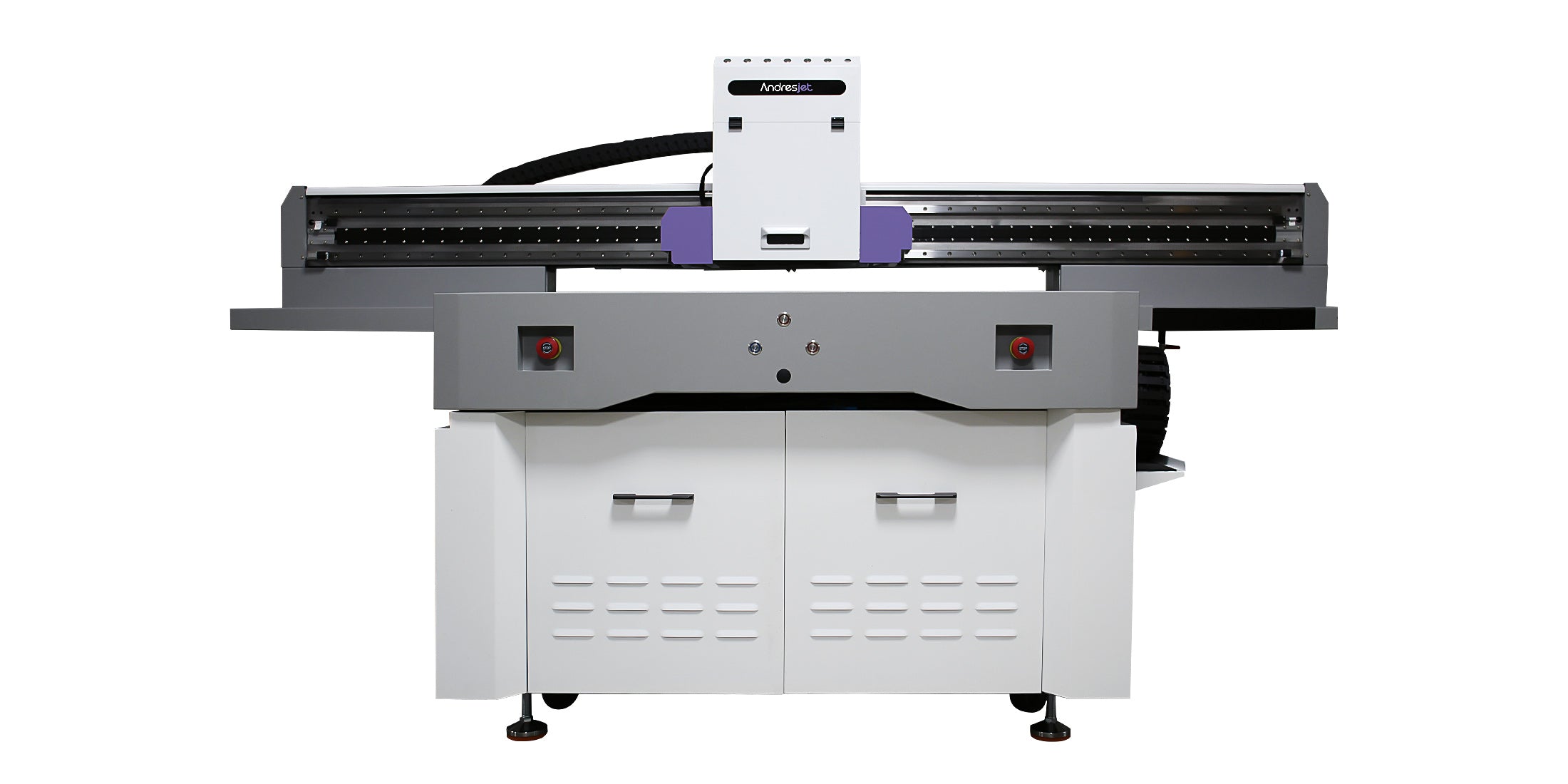
Published machine information is available on the AJ1206 product page. Final clearance and multi-up capacity require the actual objects and fixture.
If every part shifts in the same direction, verify origin and fixture position. If one pocket repeatedly fails, inspect that pocket’s datum and seating. If rotation varies randomly, the fixture may control center without orientation. If image focus changes by part, measure height variation and debris under the parts before changing print settings.
These patterns should be recorded on the pocket map. Correcting the fixture is more reliable than adding artwork offsets for every recurring mechanical error.
A production fixture is a repeatability tool. Stable datums, controlled height, numbered pockets and a documented acceptance test turn small-object alignment from operator judgment into a measurable process.
It controls center but not rotation unless artwork is rotationally symmetric.
Select for stiffness, dimensional stability, cleanability, surface protection and compatibility with the production environment.
After repair, wear, origin change, new part variation or any repeated position-specific defect.
 UV Printer Installation, Commissioning and Operator Training: What Buyers Must Plan For
Knowledge
UV Printer Installation, Commissioning and Operator Training: What Buyers Must Plan For
Knowledge
 How a Pre-Order UV Printer Sample Test Works: What to Send and What You Get Back
Knowledge
How a Pre-Order UV Printer Sample Test Works: What to Send and What You Get Back
Knowledge
 Order to Delivery: How UV Printer Lead Time Is Actually Built
Knowledge
What MOQ Applies to a UV Printer Order, and When Customisation Changes It
Knowledge
Order to Delivery: How UV Printer Lead Time Is Actually Built
Knowledge
What MOQ Applies to a UV Printer Order, and When Customisation Changes It
Knowledge