

How Should Promotional Products Be Adhesion-Tested?
- by John White
Print bigger, print faster — wide-format UV flatbed printers for signs, decor and industrial work.

Reliable UV ink adhesion on promotional-product substrates begins with identifying the actual printable surface, not relying on the product name. An industrial B2B workflow should inspect the material, remove contamination with a compatible method, compare untreated and prepared samples, verify curing and adhesion, and approve one written recipe before production. Primer is a test variable, not an automatic requirement.
UV ink can release when contamination, low or variable surface energy, a weak coating, excessive ink deposit or an unsuitable cure condition prevents a stable interface. For promotional-product substrates, mould-release residue, plasticizer, paint, protective coating and supplier changes can alter adhesion without changing the product name. The failure may occur within the ink, between ink and coating, or between the coating and base material; each failure location points to a different corrective action.
Operators should label an untreated control, preserve the failed specimen and record whether lifting begins at an edge, a textured high point or a contaminated patch. Changing cleaner, primer and cure together destroys that evidence and can turn a correctable process issue into recurring scrap.
Material qualification should record supplier, grade, color, finish, coating, lot, storage condition and protective-film history. Promotional products may use ABS, acrylic, coated metal, wood, glass or mixed plastics; the exact molding resin, paint or topcoat must be recorded. A sales description such as stone, slate or display panel is not a technical surface specification.
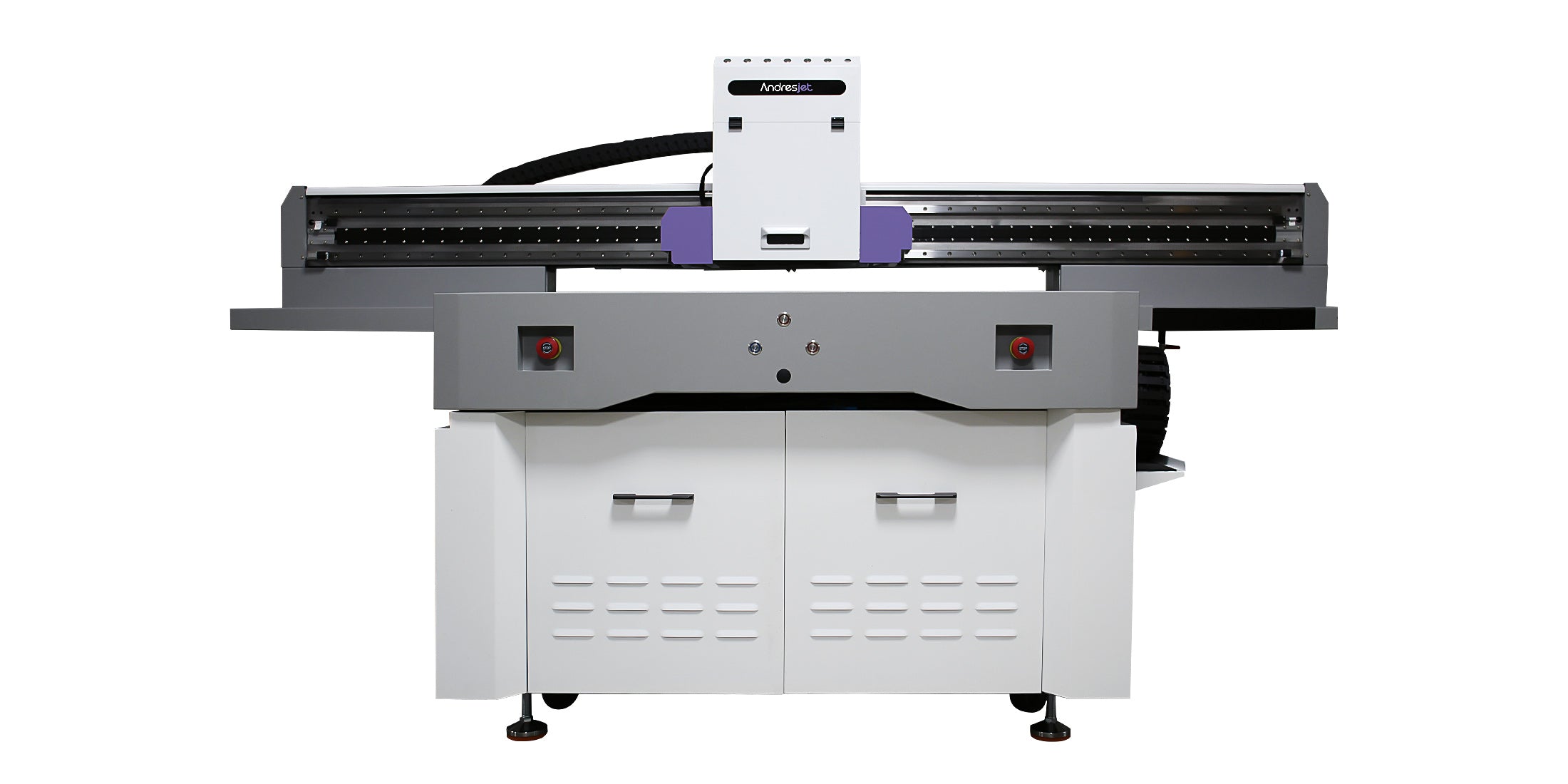
The AndresJet promotional-product printer collection helps define the equipment category after the object geometry and surface family are known.
The procurement team should request the same production lot for qualification whenever possible. If multiple suppliers are permitted, each defined surface family needs its own boundary sample because visually similar materials may react differently to cleaners, primers, ink deposit and LED-UV energy.
A controlled sequence is: inspect and photograph the incoming surface; remove loose debris; test the proposed cleaner on a hidden area; clean with a lint-free method; allow complete drying; prevent hand contact; print the untreated control; then test only the minimum additional treatment needed. Clean and test each product family separately, including curved edges or fixture contact where handling differs from a flat coupon.
Review safety data and workplace controls before introducing a cleaner or primer. AndresJet does not treat a chemical name as a universal recipe: application engineering should document concentration, application amount, drying or activation condition and the maximum allowed interval before printing.
Primer is worth testing when the clean untreated control fails the agreed adhesion or handling requirement. Compare no primer with one verified candidate while holding file, ink layers, print mode, cure condition and evaluation method constant. A stronger initial tape result is not sufficient if the primer changes color, gloss, texture or later handling.
The practical recommendation is to approve the least complex process that repeatedly passes. Adding an unnecessary primer increases material cost, operator variation, safety controls and changeover work; omitting a needed treatment creates rejection and field-failure risk.
The matrix below separates variables so a factory can identify which preparation step changes the result. Sample count and pass/fail thresholds must be agreed for the actual end use; the table does not claim that AndresJet equipment has passed a particular standard.
For published flatbed specifications, review the AJ1206 product page, then qualify the actual promotional item with a controlled sample matrix.
| Test cell | Preparation | What stays fixed | Evidence |
|---|---|---|---|
| Control | No additional treatment | File, mode, cure | Initial appearance and adhesion |
| Cleaning candidate | Approved cleaner | Ink build and substrate lot | Surface damage and adhesion |
| Primer candidate | Documented application | Cleaner, file and cure | Adhesion, color and texture |
| Repeat | Approved candidate | All recorded settings | Repeatability and failure mode |
The approval package should include material identity, preparation steps, file version, layer order, RIP preset, cure setting, sample photographs, test method, result, limitations and approver. Include realistic rub, scratch, packing and customer-handling checks in addition to initial adhesion.
Promotional-product adhesion is a qualification problem, not a universal material claim. Identify the printable surface, preserve an untreated control, vary one preparation factor at a time and approve the least complex repeatable recipe. AndresJet can help design the sample matrix, while the buyer defines end-use handling, pass/fail criteria and the production lots covered by the approval.
No. Each defined substrate and coating family needs its own controlled qualification and boundary conditions.
Not by itself. Add realistic rub, scratch, cleaner or packing tests based on the product’s use.
Only after the clean untreated control fails the agreed requirement, while all other variables remain controlled.
UV Printer Installation, Commissioning and Operator Training: What Buyers Must Plan For
Knowledge
 How a Pre-Order UV Printer Sample Test Works: What to Send and What You Get Back
Knowledge
How a Pre-Order UV Printer Sample Test Works: What to Send and What You Get Back
Knowledge
 Order to Delivery: How UV Printer Lead Time Is Actually Built
Knowledge
Order to Delivery: How UV Printer Lead Time Is Actually Built
Knowledge
 What MOQ Applies to a UV Printer Order, and When Customisation Changes It
Knowledge
What MOQ Applies to a UV Printer Order, and When Customisation Changes It
Knowledge