

Promotional products come in many different shapes. Some are flat, such as plaques, keychains, tokens, phone cases and nameplates. Others are cylindrical, including bottles, tumblers, cups and tubes. Because the printing surface can vary so much, choosing the right UV printer is not simply a matter of comparing print size or speed.
For most promotional-product businesses, the first decision is whether a flatbed UV printer or a cylinder UV printer better matches the products they plan to manufacture.
This guide explains the practical differences between the two systems and how to choose a suitable UV printer for promotional products.
Why Product Shape Determines the Printing Method
A UV printer must maintain a consistent relationship between the printhead and the printable surface. Flat and cylindrical objects therefore require different ways of moving and positioning the product.
A flatbed UV printer keeps the object on a level printing platform while the print carriage moves across the printable area. A cylinder printer rotates the object during printing so that the artwork can continue around its circumference.
The correct choice depends primarily on the product’s geometry:
- Flat or mostly flat printing surface: use a flatbed UV printer.
- Round object requiring wraparound printing: use a cylinder UV printer.
- Mixed product catalog: evaluate whether the business needs both printing methods.
When to Use a Flatbed UV Printer
A flatbed UV printer is suitable when the area receiving the design can remain level during printing. It can print directly on many promotional blanks without transferring the image through a separate film or label.
Common flat promotional products include:
- Phone cases
- Keychains and tags
- Coins, tokens and medals
- Promotional plaques
- Small signs and display panels
- Awards and recognition products
- Flat gift items
- Metal, acrylic, plastic or wooden promotional pieces
For this type of work, the AndresJet AJ1206 small UV flatbed printer provides a 1200 × 600 mm printing area. This allows users to print a single larger piece or position multiple smaller promotional products on the bed.
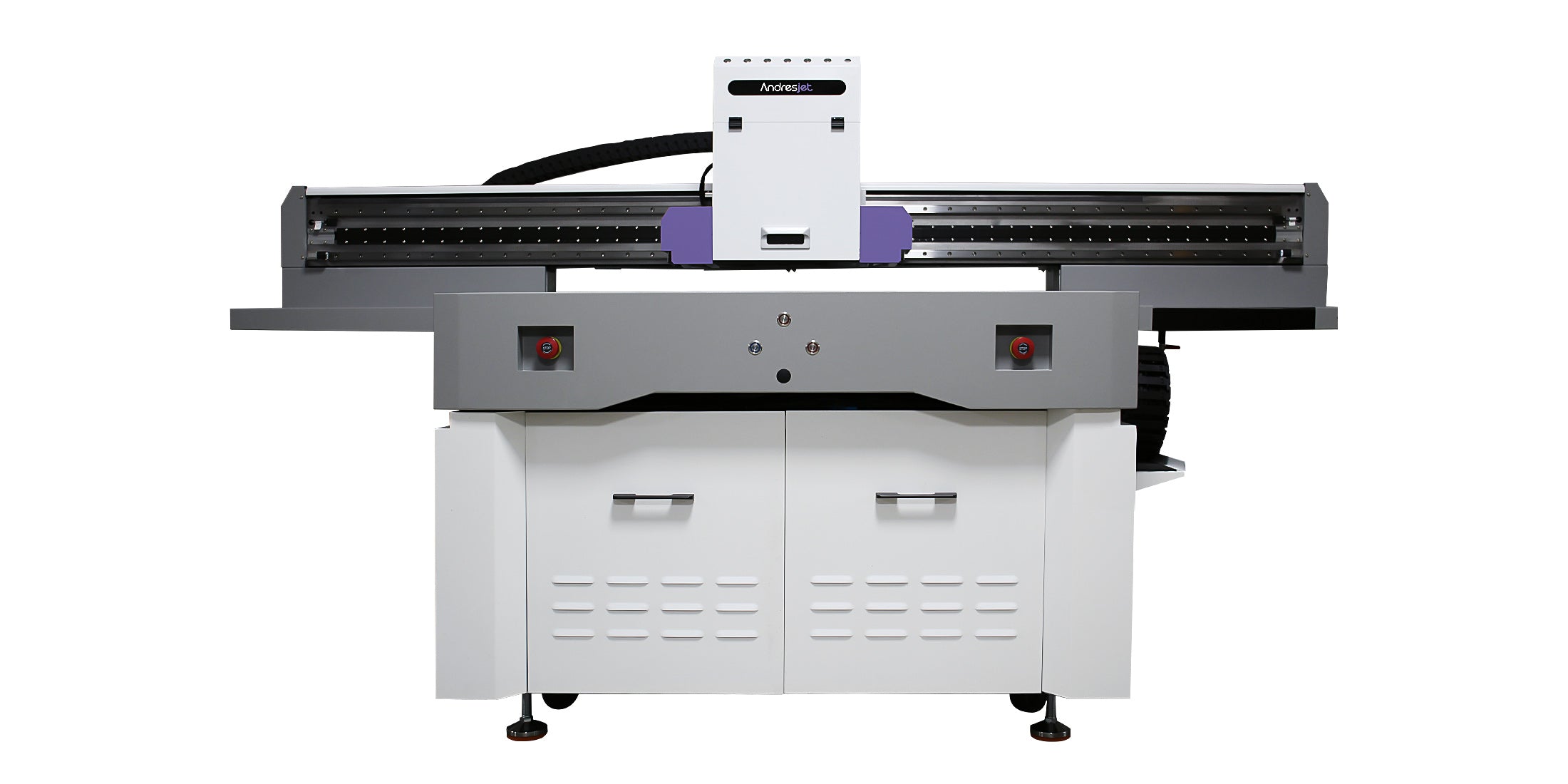
For repeat orders, a fixture can hold several identical items in fixed positions. Instead of manually aligning every keychain, token or phone case, the operator can load a prepared group of products and match the artwork to the fixture layout.
This is especially useful for short-run personalization. The same fixture may hold products with different names, numbers, logos or event information, provided that the artwork and product positions are prepared correctly.
When to Use a Cylinder UV Printer
A cylinder UV printer is designed for products that must rotate while the image is being printed. It is the more appropriate solution when a customer wants a logo, pattern or design to extend around a bottle, tumbler, cup or other round promotional object.
Typical applications include:
- Promotional drink bottles
- Insulated tumblers
- Reusable cups
- Cylindrical containers
- Cosmetic and personal-care packaging
- Tubes and round product components
- Selected tapered promotional products
The AndresJet AJ360i digital cylinder printer is built for direct-to-shape printing on cylindrical products. The product rotates during production, helping the printer create continuous graphics instead of printing only one small area on the front.
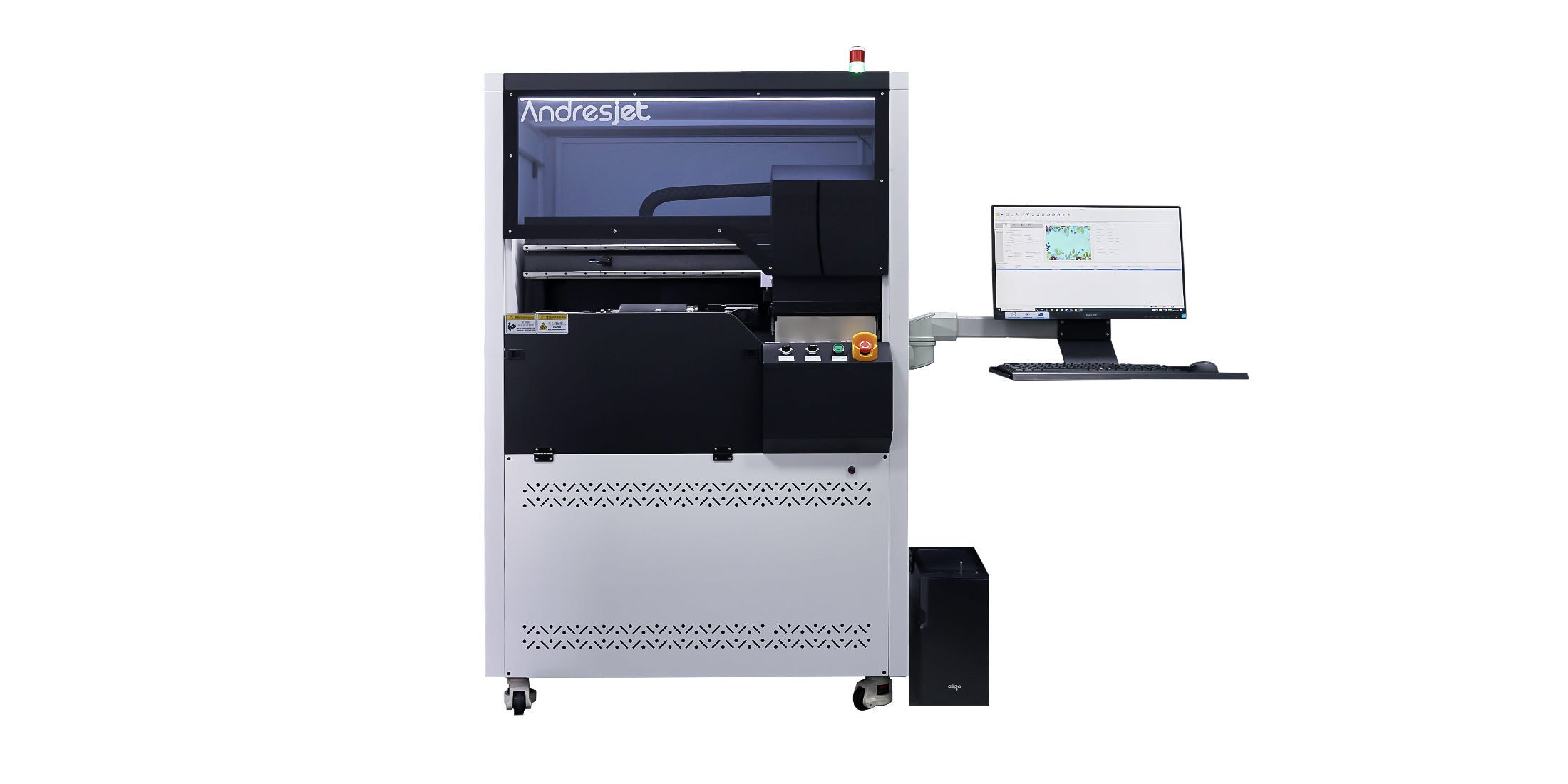
The AJ360i supports standard product diameters from 60 to 170 mm, with optional configurations for smaller or larger diameters. It can also accommodate a limited taper, making it suitable for a wider range of bottles and drinkware than a system intended only for perfectly straight cylinders.
However, not every curved item is automatically suitable for cylinder printing. Handles, large protrusions, highly irregular contours and rapidly changing diameters can interfere with rotation or printhead clearance. These products should be evaluated individually before production.

Flatbed vs. Cylinder UV Printing: Key Differences
| Decision Factor | Flatbed UV Printer | Cylinder UV Printer |
|---|---|---|
| Best product shape | Flat or mostly flat items | Straight or moderately tapered round items |
| Product movement | Product remains on the printing bed | Product rotates during printing |
| Typical applications | Cases, plaques, tags, tokens and flat gifts | Bottles, cups, tumblers and tubes |
| Fixture requirement | Often used for repeat positioning of multiple items | Requires stable support and accurate rotational positioning |
| Printable coverage | One or more flat-facing areas | Continuous or near-wraparound cylindrical graphics |
Can a Flatbed Printer Print Cylindrical Promotional Products?
A flatbed printer may print a small front-facing area on certain cylindrical products if the object can be held securely and the printable section remains within an acceptable height range. However, this does not provide the same result as true rotational printing.
If the design needs to wrap around a bottle or tumbler, a dedicated cylinder printer is normally the better choice. Attempting a full circumferential design without controlled rotation can lead to alignment problems, incomplete coverage and an inconsistent distance between the printhead and the surface.
Can One Printer Cover Every Promotional Product?
Promotional-product suppliers often sell both flat and round products, but one machine may not provide the best production method for every item.
A business mainly producing phone cases, plaques, tags and small awards may begin with a flatbed system. A company specializing in customized drinkware may obtain greater value from a cylinder printer. A supplier serving a broad product catalog may eventually use both systems.
Before selecting equipment, separate the planned products into three groups:
- Products with a flat printable area
- Products requiring rotational printing
- Irregular products that need individual testing
This simple classification prevents the printer from being selected only according to its maximum size or advertised speed.
Material Compatibility Still Requires Testing
Correct product shape does not automatically guarantee ink adhesion. Promotional blanks can be made from acrylic, glass, coated metal, stainless steel, plastic, wood and many other materials. Surface coatings and manufacturing residues can also vary between suppliers.
Before accepting a production order, test the actual blank product that will be used. The test should confirm:
- Ink adhesion after curing
- Scratch and handling resistance
- White ink opacity on transparent or dark materials
- Color appearance on the real product
- Varnish appearance, if varnish is included
- Artwork alignment and printable boundaries
Cleaning, pretreatment or a suitable primer may be necessary for some materials. A successful test on one plastic or coating should not be treated as proof that every visually similar product will perform in the same way.
Consider Fixtures and Workflow Before Production
Fixtures are an important part of promotional-product printing because many orders contain multiple small objects. A good fixture reduces movement, simplifies positioning and makes repeated loading more consistent.
For flat products, the fixture should keep every blank in the same location without lifting its printable surface. For cylindrical products, the support system should keep the object centered and stable while allowing smooth rotation.
Operators should also check that handles, lids, raised edges or other components will not contact the printer during movement.
How to Select the Right UV Printer
Before choosing between a flatbed and cylinder UV printer, prepare the following information:
- Photographs of each promotional product
- Product length, width, height or diameter
- Whether the product is straight, tapered or irregular
- Printable area required by the customer
- Product material and surface coating
- Expected order quantity
- Required colors, white ink and varnish effects
- Whether every piece uses the same design or variable information
These details make it easier to confirm whether the product should be printed on a flatbed system, a cylinder system or tested as a special application.
Choosing a UV Printer for Promotional Products
The main difference between flatbed and cylinder UV printing is how the printer handles the product’s surface.
Choose a flatbed UV printer when the promotional item has a stable, flat printable area. Choose a cylinder UV printer when the product must rotate to receive continuous artwork around its body. For businesses serving both categories, a combination of the two technologies can provide greater production flexibility.
Explore AndresJet’s UV printers for promotional products, or provide your product photographs, dimensions, materials and expected order quantities for application evaluation.
See More AndresJet Printing Applications
Follow AndresJet’s official social media pages to see additional UV printing applications, product demonstrations and equipment updates:
Share:
Do You Need White Ink on Clear Acrylic?
Which Phone Case Materials Can Be UV Printed?