

- by John White
Direct UV Printing vs. Screen Printing and Labels for Bottles
- by John White
Curved surfaces? Print straight onto bottles, tubes and cylinders — no labels needed.

Bottles and tumblers can be decorated using direct UV printing, screen printing or applied labels. Each process can produce commercially useful results, but they are suited to different artwork, order quantities, product shapes and production workflows.
A company producing personalized drinkware may prioritize rapid artwork changes and variable designs. A packaging manufacturer with one design and a stable high-volume order may make a different decision. The most appropriate process therefore depends on the actual job rather than on one technology being universally better.
This guide compares the three methods and explains when manufacturers should consider UV printers for bottles and tumblers.
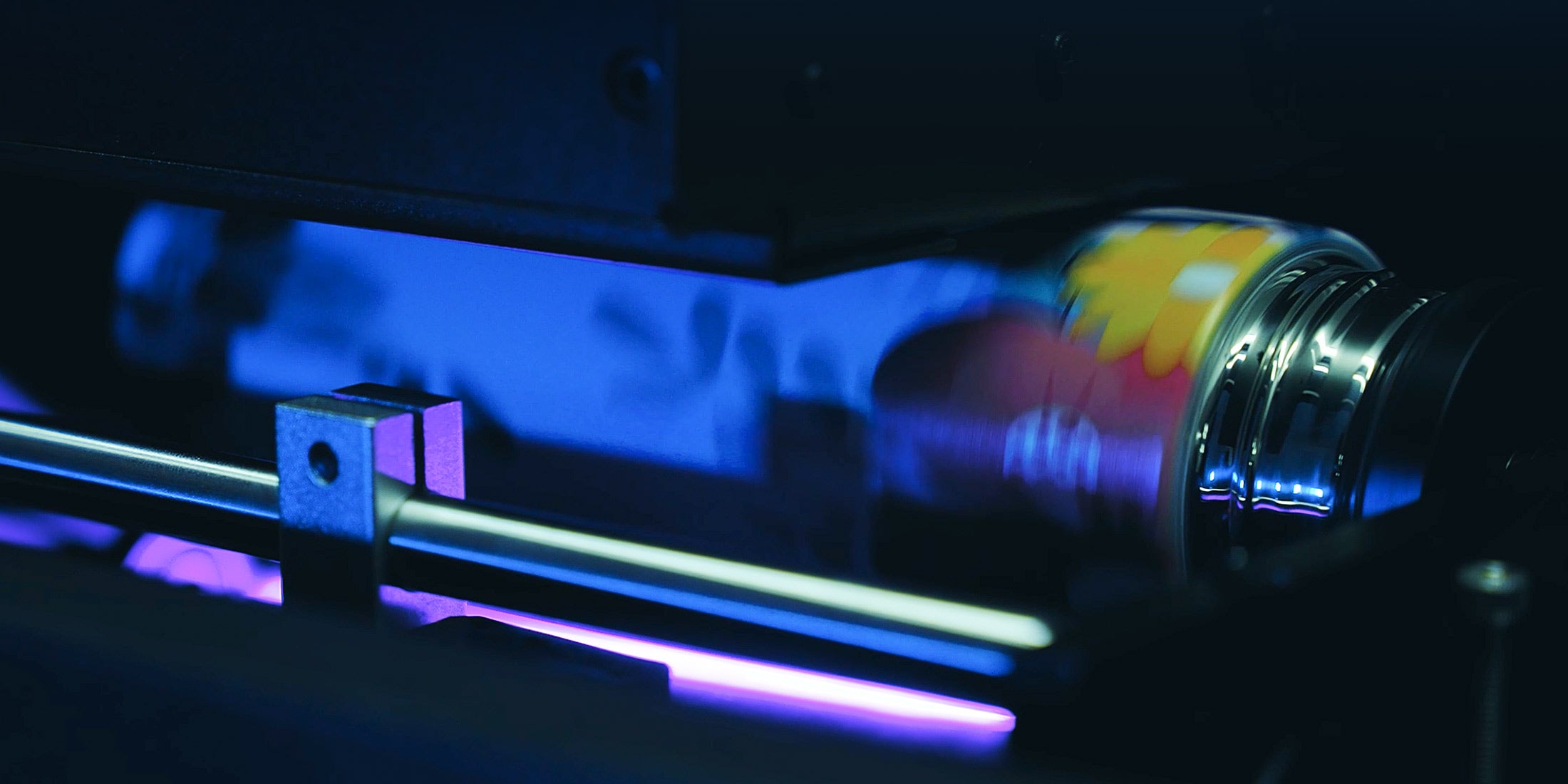
Direct UV printing applies ink directly to the bottle or tumbler surface. In a dedicated cylinder printer, the product rotates while the printheads deposit the image. UV LED light cures the ink during the printing process.
The method can support:
Because the image is produced from a digital file, artwork can be changed without preparing a separate screen for each color or design.
Screen printing transfers ink through a prepared screen onto the product. A separate screen and setup may be required for each color or artwork version.
It is a familiar process for bottles, cups and promotional drinkware, particularly when an order uses a limited number of solid colors and the same artwork is repeated across a large quantity.
The practical suitability of screen printing depends on the equipment, ink, curing process, product shape and number of colors. Setup requirements can become more significant when orders contain many different designs or frequent artwork changes.
Labels are printed separately and then attached to the bottle or container. Depending on the application, these may include pressure-sensitive labels, wraparound labels or other preprinted decorative materials.
Labels can be useful when the packaging workflow already includes labeling equipment or when regulatory, product-information or supply-chain requirements make replaceable printed media desirable.
However, labels introduce an additional material and application step. Their appearance and durability also depend on the label stock, adhesive, product surface, application accuracy and final use environment.
| Decision factor | Direct UV printing | Screen printing | Labels |
|---|---|---|---|
| Artwork preparation | Digital print file and product setup | Screen preparation and registration | Separate label printing and application setup |
| Multiple colors and photographic images | Well suited to detailed full-color artwork | Each color may add setup and registration requirements | Depends on the label-printing process |
| Variable information | Can support different names, numbers or images | Usually less convenient for frequent design changes | Possible if variable labels are produced |
| Additional applied material | No separate label layer | No separate label layer | Requires label stock and adhesive |
| Typical production strength | Short runs, customization and multiple designs | Stable repeated designs with limited colors | Packaging workflows already designed around labeling |
Direct UV printing is especially useful when orders do not contain only one repeated design. It allows the manufacturer to change the digital file while retaining the same general product setup.
Consider direct UV printing when:
Direct UV printing may also shorten the path between approval of a digital file and production, but the product still requires measurement, positioning, adhesion testing and sample approval.
Screen printing remains a practical option for suitable bottle and tumbler orders. It may be considered when the same artwork is repeated across a stable production quantity and the design uses a limited number of solid colors.
Possible examples include:
The comparison should include the complete workflow. Preparing screens, registering colors, cleaning equipment and changing artwork all affect production time even when the actual printing stage is fast.
Labels can be appropriate when the bottle is part of an established packaging and labeling line or when information must be changed separately from the bottle itself.
A label may also be considered when:
Before selecting labels, evaluate edge lifting, bubbles, wrinkles, seam appearance and adhesion under the product’s expected storage and use conditions.
Order quantity matters, but it should not be considered by itself. Two orders containing the same number of bottles may have completely different production requirements.
For example:
A useful calculation should therefore include the number of designs, number of colors, print coverage, setup time, inspection requirements and expected repeat frequency.
Digital UV printing can process detailed artwork without separating every image into individual physical screens. This is helpful for photographic graphics, gradients, small text and frequent design changes.
It also supports variable artwork workflows. A promotional drinkware order may contain the same background design with a different employee name on every tumbler. A bottle manufacturer may produce several language or regional versions in smaller quantities.
Variable artwork still requires controlled file preparation. Each design must be linked to the correct product, and the operator needs a clear method for loading, printing and inspecting the order.
CMYK inks are not completely opaque. On a black tumbler, colored artwork printed without a white base may appear weak or be strongly influenced by the product color. On a clear bottle, the design may remain translucent.
Direct UV printing can use white ink as:
The white layer should be planned during artwork preparation. More white ink is not automatically better: the correct coverage depends on the required appearance, product color and approved sample.
A cylindrical design has a starting and ending position. When the image approaches a complete wrap, the artwork and printer setup must manage the meeting point between those two edges.
The seam may be less noticeable when it is placed away from the primary viewing area or incorporated into the design. Artwork containing a continuous pattern requires different planning from a front-facing logo with blank space around it.
Before production, confirm:
A straight-sided bottle rotates differently from a tapered tumbler. On a tapered object, the circumference changes along the printable length. If the equipment and artwork do not compensate for that geometry, the design may distort or fail to align correctly.
The AndresJet AJ360i digital cylinder printer is designed for both cylindrical and selected tapered products. Its standard configuration supports diameters from 60 to 170 mm, with optional ranges for smaller or larger objects. It supports a taper angle from 0 to 7 degrees and a print length from 40 to 270 mm.
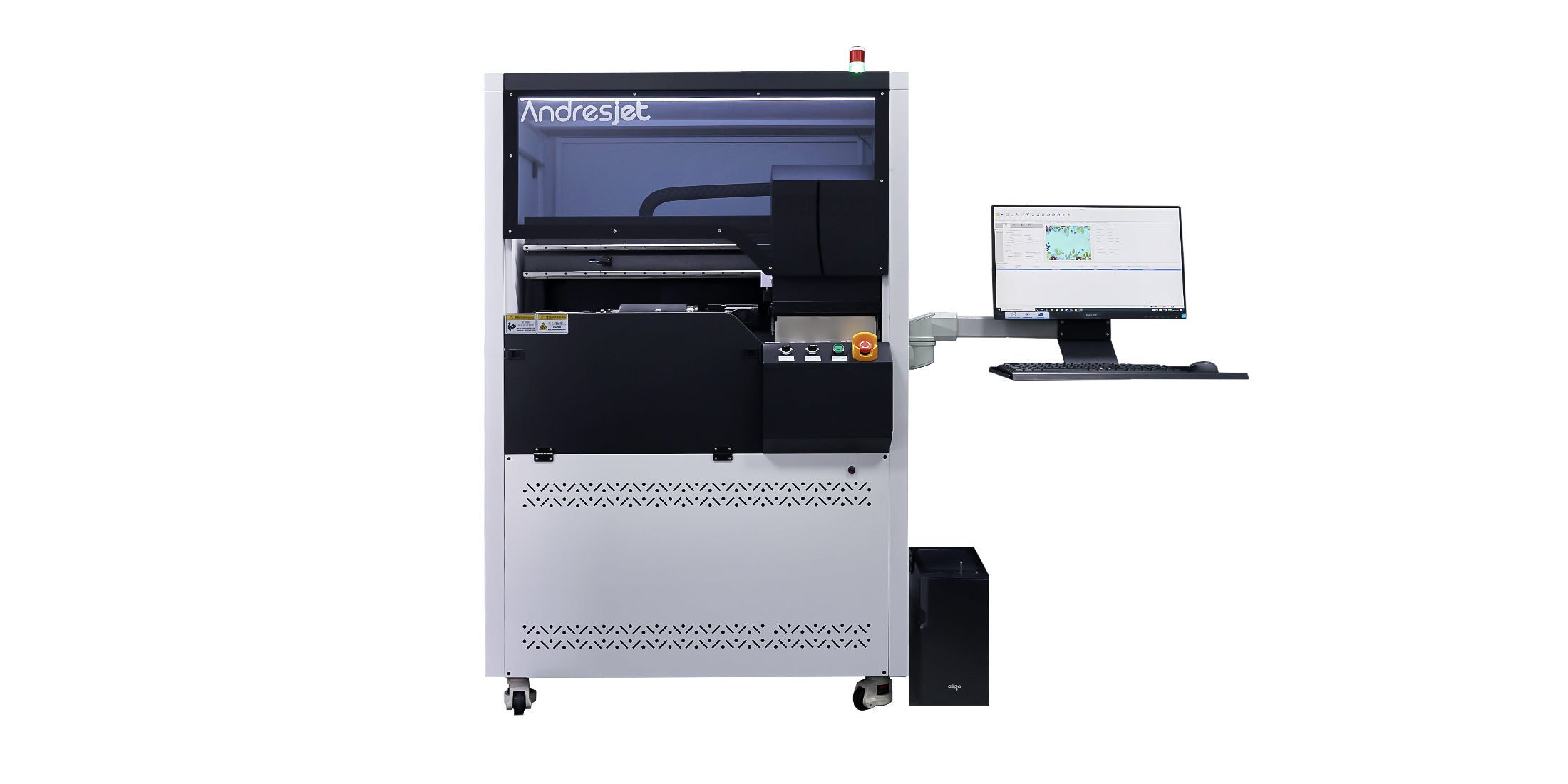
These specifications define the machine’s available working range, but the actual product must still be evaluated. A bottle may fall within the diameter range while having a handle, raised seam, shoulder or base shape that interferes with printing.
Bottles and tumblers can be made from glass, coated metal, stainless steel, plastic or other materials. Even products described using the same material name may have different surface coatings.
Before approving direct UV printing, test the actual production item for:
Cleaning or pretreatment may be required for some products. No general statement about glass, plastic or metal should replace testing of the actual surface.
Published printing speed represents only one part of production. The usable output of a bottle-decoration process also depends on:
The AJ360i’s official production information is based on defined product dimensions and print conditions. Actual output changes with the object size, artwork coverage, quality mode and production workflow.
Before deciding between direct UV printing, screen printing and labels, answer the following questions:
These answers provide a more useful comparison than choosing a process according to order quantity alone.
Direct UV printing is particularly useful for full-color graphics, short and medium runs, personalization and frequent artwork changes. Screen printing may remain efficient for stable orders with limited colors and established production procedures. Labels are suitable when a separate applied graphic is part of the intended packaging workflow.
The final decision should consider the complete cost and workflow: preparation, materials, artwork changes, loading, printing, inspection and finishing.
Explore AndresJet’s UV printers for bottles and tumblers, or submit sample products, dimensions, artwork and expected order quantities for process and equipment evaluation.
Follow AndresJet’s official social media channels for cylinder-printing demonstrations, product applications and equipment updates:
For the complete decision path, continue with the uv packaging & label prototyping guide.

