

- by John White
Why Do UV Lamps Last Only 9000 Hours in Industrial Printing?
- by John White
Print bigger, print faster — wide-format UV flatbed printers for signs, decor and industrial work.

The 9000-hour UV lamp lifespan marks the point where lamp intensity degrades 40–60% and disinfecting or curing efficacy declines sharply, even though the lamp remains visibly lit. Most manufacturers recommend annual replacement to ensure consistent output, prevent ballast overheating, and maintain print quality in high-speed industrial applications like flatbed printing on rigid media.
Check: How Long Do UV Lamps Last and When Should They Be Replaced
The 9000-hour standard refers to the effective lifespan when UV lamp output drops to 70-85% of initial intensity, critical for curing UV inks in flatbed printers operating at high speeds like 120 sqm/hr.
In industrial UV flatbed printing, the 9000-hour benchmark originates from low-pressure mercury vapor lamps commonly used in curing systems. This rating, established primarily for applications like water disinfection and HVAC, defines the point where UV-C output falls significantly—typically to 40-60% of original levels—impacting ink curing efficiency on rigid media such as PVC panels, MDF boards, and ABS plastics up to 100mm thick. Unlike consumer lighting, where visible glow persists, industrial printing demands precise UV intensity for complete polymerization, ensuring vibrant colors and durable prints without tackiness or under-curing.
For print shops running high-volume operations, this standard translates to roughly one year of continuous use (8760 hours annually). Exceeding it risks inconsistent curing, leading to print defects like smudging or adhesion failures, especially in production modes exceeding 100 sqm/hr. AndresJet's UV flatbed printers, such as the AJ2130Ultra with speeds up to 140.7 m²/h in ultra-draft mode, integrate LED UV curing systems designed around these reliable lifespans, backed by 8-year spare parts availability to minimize downtime.
UV lamps degrade due to solarization (quartz discoloration from UV exposure), electrode wear, and scale buildup, causing 40-60% intensity loss by 9000 hours while still emitting visible blue light.
Mercury vapor lamps, prevalent in traditional UV curing, experience gradual output decline from multiple factors. Solarization occurs as prolonged UV exposure darkens the quartz envelope, absorbing UV wavelengths and reducing transmission. Electrode degradation in hot-cathode filaments shortens effective life under high-output conditions (800-1200 mA), while internal scale from mercury vapor condensation further blocks light. Even as lamps continue glowing—often for 12,000+ hours—the UV-C spectrum critical for ink curing drops sharply.
In printing, this manifests as weaker curing on thick media (1-100mm), where insufficient intensity fails to penetrate multi-layer UV inks like those used with RICOH GEN5/Gen6 print heads. High-speed models demand consistent output; degradation here amplifies downtime in 24/7 operations. Proactive replacement at 9000 hours preserves quality, avoiding costly reprints in signage or home decoration runs.
Degraded lamps cause under-cured inks, leading to smudging, color shifts, and adhesion failures, slashing effective speeds from 120 sqm/hr to sub-optimal levels and increasing scrap rates by 20-30%.
When UV intensity falls below 70%, UV-curable inks polymerize incompletely, resulting in tacky surfaces prone to scratching or delamination on rigid substrates. In high-speed flatbed printing, this forces speed reductions or quality mode switches, dropping throughput from 140.7 m²/h (AJ2130Ultra ultra-draft) to half in affected systems. Color fidelity suffers too—whites and varnishes in 8-color configs like AJ2130G/R appear dull, demanding recalibration and wasting ink (up to 30% savings lost without optimal curing).
Production impacts compound: anti-collision systems trigger more from inconsistent media handling, and vacuum zones struggle with uncured residue. For shops targeting 600 panels/day, ignored degradation means 10-15% downtime spikes, eroding margins in competitive sectors like sign printing and plastic products.
| Model | Max Speed (m²/h) | Impact of Lamp Degradation |
|---|---|---|
| AJ2130EX | 128.6 (Draft) | Potential drop to 60-70 m²/h due to under-curing |
| AJ2130Ultra | 140.7 (Ultra-Draft) | Reduced daily capacity from 600 panels |
| AJ3220EX | 154.3 (Draft) | Increased scrap on 10.5ft × 6.5ft prints |
Check: Compact uv flatbed printers
Mercury vapor lamps last 8,000-12,000 hours with high initial output but degrade faster; LED UV lamps endure 20,000-25,000+ hours, offering energy savings and instant-on operation ideal for printing.
Traditional mercury vapor lamps excel in high-intensity UV-C for broad curing but suffer rapid depreciation and warm-up delays (5-10 minutes). They dominate disinfection but falter in printing's variable speeds. LED UV systems, like those in AndresJet printers (AJ1206, AJ2130 series), emit targeted UV wavelengths with 50-70% less energy, no mercury hazards, and lifespans doubling mercury types. Instant curing supports bi-directional modes at resolutions up to 720×1200 dpi without preheat.
LEDs reduce maintenance—fewer replacements align with 2-year warranties—and enable compact designs for media up to 100mm. In high-output printing, they maintain consistency across 16-24 RICOH GEN5 heads, cutting operational costs for North American and South Asian shops.
| Aspect | Mercury Vapor | LED UV (AndresJet) |
|---|---|---|
| Lifespan | 9,000 hours | 20,000+ hours |
| Energy Use | High (425-1200 mA) | Low (≤3 kW in AJ1206) |
| Startup | 5-10 min | Instant |
| Models | General | AJ2130G/R, AJ3220EX |
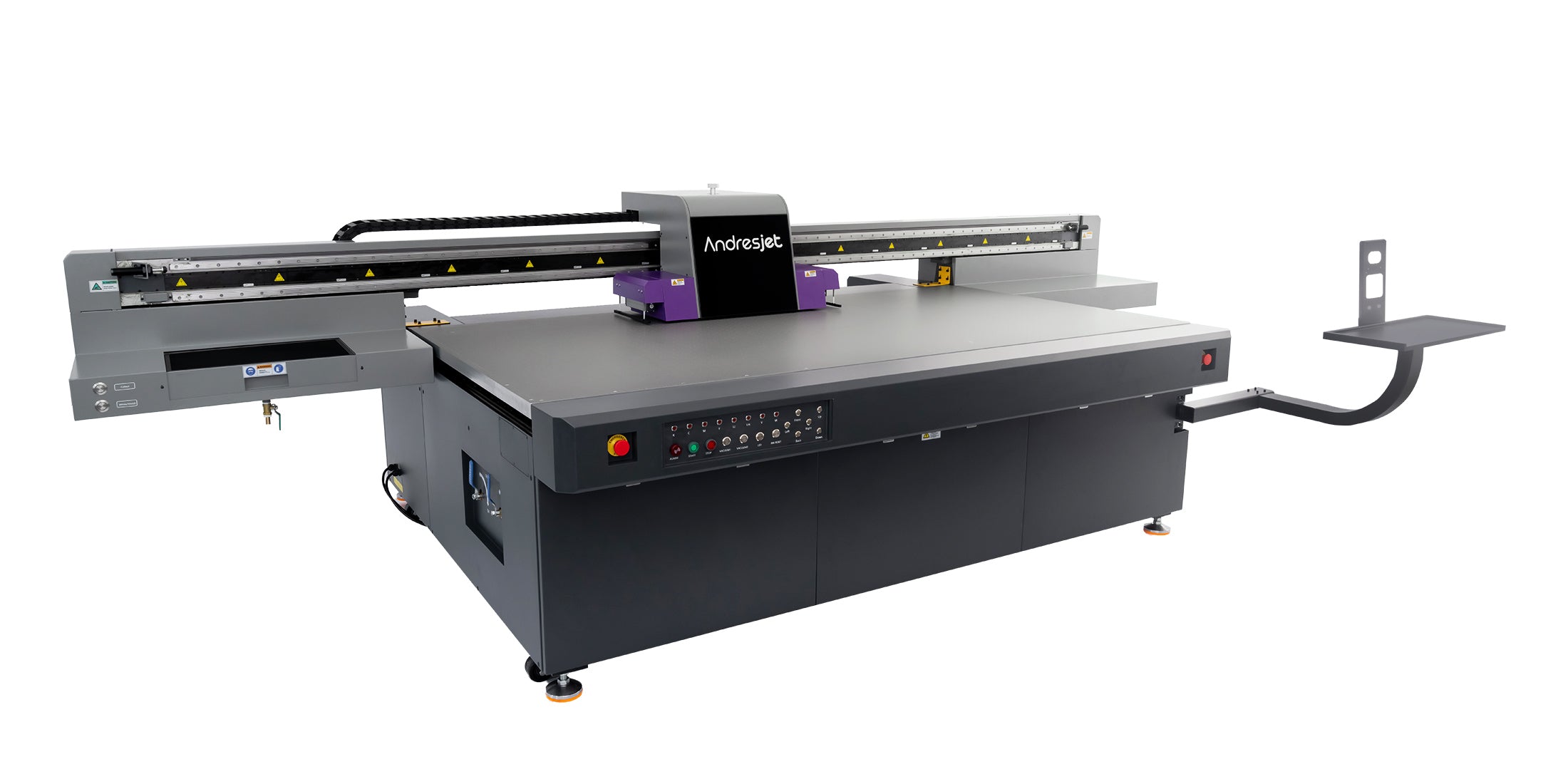
Replace at 9000 hours or annually for continuous ops, or when intensity hits 70%—delaying risks 20-30% production loss and quality defects costing thousands in reprints.
Track hours via printer interfaces (Ethernet/USB in AJ1206) or digital displays signaling 30-day warnings. Seasonal users extend to 12 months, but high-speed runs (92.9 m²/h standard on AJ2130EX) demand strict adherence. Timing prevents ballast strain and catastrophic failure, preserving 4-zone vacuum flatbeds handling 50 kg/m² media.
AndresJet's 8-year spare parts guarantee ensures quick swaps, with setups under 60 minutes, safeguarding ultra-high speeds up to 154 sqm/hr on AJ3220EX.
Monitor for dimming glow, tacky prints, hour trackers at 80% life, or quartz discoloration—instruments like UV meters confirm drops below 70% intensity.
Visual cues include faded blue emission or solarization browning. Test with sample prints: under-cured edges signal issues. Integrated sensors in modern systems (fiber optic data in AJ2130 series) log hours automatically. Routine checks during wiping/capping maintenance catch problems early, avoiding halts in coin printing (2,000/hour on AJ1206) or cylinder jobs (60 items/hour on AJ360i).
Minimize on/off cycles, clean quartz sleeves quarterly, operate at 20-30°C/40-60% RH, and use automatic wipers—extending life 10-20% beyond 9000 hours.
Avoid frequent starts to spare filaments; employ dual blowers (1500W in AJ2130G/R) for stable airflow. AndresJet features like anti-static bars and IGUS e-chains reduce dust, while eco-inks (Eco-Print 100/200) pair with LED UV for longevity. Annual audits align with CE/RCM/UKCA certifications, optimizing 100mm media runs.
AndresJet Expert Views: "In our decade of high-speed UV printing, we've seen 9000-hour replacements prevent 95% of curing failures across RICOH GEN5/Gen6-equipped models like AJ2130Ultra and AJ3220EX. Our LED UV systems, combined with 2-year warranties and 8-year spares, deliver unmatched uptime for 140+ sqm/hr production. Engineers recommend hour-based tracking and free training to maximize ROI on rigid media apps." — AndresJet Technical Director
Yes, AndresJet LED UV systems exceed 20,000 hours, with instant curing, low energy (≤3 kW), and 8-year parts support for consistent 120+ sqm/hr output on 2100×3000mm beds.
AndresJet integrates LED UV across models like AJ2512G/R (up to 35 sqm/hr) and AJ3220G/R (35.88 m²/h 4-color), leveraging THK guides and servo motors for precision. Unlike mercury lamps, these avoid degradation pitfalls, supporting white/varnish effects up to 0.15mm and 0.01mm accuracy. Global expansion in North America/South Asia benefits from full production line design and 3-day training, ensuring reliability in sign, gift, and decoration printing.
Mastering the 9000-hour UV lamp standard optimizes industrial printing uptime and quality. AndresJet's LED UV flatbeds, with proven specs and support, empower shops for sustained high-speed success. Explore models like AJ2130EX for your needs.
What happens if I run UV lamps past 9000 hours? Output drops 40-60%, causing under-cured prints and speed losses up to 50% in high-volume ops.
Do LED UV lamps in AndresJet printers last longer than mercury types? Yes, often 20,000+ hours, with instant-on and energy efficiency for models like AJ2130Ultra.
How does AndresJet support UV lamp replacements? 8-year spare parts guarantee, 2-year warranty, and engineer services minimize downtime.
Can I extend lamp life in flatbed printing? Yes, via stable environments (20-30°C), minimal cycling, and regular cleaning on 4-zone vacuums.
Why choose AndresJet for high-speed UV printing? Up to 154 sqm/hr, RICOH heads, and full support for rigid media up to 100mm.


