

Retrofit AndresJet UV flatbed printers like AJ2130EX with smart digital displays and IoT sensors on 4-zone vacuum and ink systems for real-time pressure control. Use RS485 Modbus sensors with LCD interfaces connected via fiber optic ports to monitor vacuum blowers and RICOH heads, reducing downtime by 30% and enabling predictive maintenance at speeds up to 140 m²/h.
Check: Who Owns Brother Printer Company, China Or Japan?
What Is Real-Time Pressure Monitoring in UV Flatbed Printers?
Real-time pressure monitoring in UV flatbed printers uses IoT sensors and digital displays to track vacuum, ink delivery, and servo motor pressures instantly, alerting operators to anomalies before failures occur.
In high-speed UV flatbed printing, maintaining optimal pressure is essential for consistent output. AndresJet printers like the AJ2130EX feature a hard-anodized aluminum flatbed with a 4-zone vacuum system powered by dual 1500W vacuum blowers. These systems hold media firmly during printing at speeds up to 128.6 m²/h in draft mode. IoT sensors detect pressure fluctuations in vacuum zones, ink lines feeding RICOH GEN5 print heads, and servo motor operations. Digital displays provide live readouts, integrating with fiber optic data interfaces for seamless data flow. This setup allows operators to visualize pressure in real-time, preventing issues like media lift-off or ink starvation that could halt production.
Wireless IoT sensors, such as those measuring vibration and pressure, connect via gateways to cloud dashboards, turning raw data into actionable insights. For AndresJet models, this means monitoring the 1–100 mm media thickness range without interruptions, ensuring high-quality prints across applications like sign printing and home decoration.
Why Does Pressure Control Matter for High-Speed Printing Like AJ2130Ultra?
Pressure control in high-speed printers like AJ2130Ultra prevents media shifts, ink inconsistencies, and motor strain, sustaining ultra-draft speeds of 140.7 m²/h while cutting downtime by up to 30%.
The AJ2130Ultra, an ultra-high-speed industrial UV flatbed printer from AndresJet, achieves 140.7 m²/h in ultra-draft mode with 24 RICOH GEN5 print heads and AC precision servo motors. At these velocities, even minor pressure deviations in the 4-zone high-performance vacuum system can cause media misalignment, leading to print defects or crashes. Real-time monitoring tracks vacuum blower performance and ink pressure to RICOH heads, ensuring stable delivery of UV-curable ink.
Without precise control, servo motors may overheat or vibrate excessively, reducing lifespan. IoT integration flags these early, supporting daily capacities up to 600 panels. In sectors like plastic product printing, where uptime drives profitability, this control directly boosts overall equipment effectiveness, aligning with AndresJet's mission for ultra-high-speed solutions.
| Model | Max Speed (m²/h) | Vacuum System | Drive System |
|---|---|---|---|
| AJ2130Ultra | 140.7 (Ultra-Draft) | 4-zone high-performance | AC precision servo motors |
| AJ2130EX | 128.6 (Draft) | 4-zone with dual 1500W blowers | MagLev linear motor |
| AJ3220EX | 154.3 (Draft) | 4-zone vacuum | AC high-precision servo motors |
How Do Smart Sensors Integrate with AndresJet 4-Zone Vacuum Systems?
Smart sensors integrate with AndresJet 4-zone vacuum systems by connecting RS485 Modbus pressure transducers to fiber optic interfaces, displaying live data on LCD panels for zone-specific control.
AndresJet UV flatbed printers, such as the AJ2130G/R and AJ2512G/R, use hard-anodized aluminum flatbeds with 4-zone vacuum systems for precise media hold-down across 1–100 mm thicknesses. IoT sensors attach to vacuum lines and dual 1500W blowers, measuring differential pressure in each zone. Data transmits via high-speed fiber optic interfaces to central dashboards.
Integration involves battery-powered wireless nodes that mesh with gateways, sending pressure metrics to cloud platforms. For the AJ2130 series, this setup monitors blower output during high-quality modes at 27.9 m²/h, alerting to clogs or leaks. Operators adjust zones independently, optimizing for rigid substrates like MDF panels in home decoration printing. This proactive approach uses machine health data to predict failures weeks ahead.
Which Digital Displays Work Best for Ink Pressure on RICOH Gen5 Heads?
High-resolution LCD or OLED digital displays with Modbus RTU protocol excel for ink pressure monitoring on RICOH Gen5 heads, offering 0.1% accuracy and Ethernet connectivity for real-time RICOH integration.
RICOH GEN5 industrial inkjet heads in AndresJet printers like AJ2130EX (16 heads) and AJ2130Ultra (24 heads) demand stable ink pressure for resolutions up to 720×1200 dpi. Digital displays mount near ink systems, pulling data from pressure transducers on supply lines. Compatible units feature RS485/Modbus for plug-and-play with fiber optic ports.
These displays show psi or bar readings, with color-coded alerts for deviations in UV-curable ink flow. In AJ3220EX models, extended 7-color configurations benefit from this, ensuring consistent CMYK + LC + LM + W/V output at 154.3 m²/h draft speeds. AndresJet's anti-collision systems complement this by protecting heads during pressure-adjusted runs.
What Are the Top Benefits of IoT Dashboards for Printer Health?
IoT dashboards for printer health provide predictive alerts, 30% downtime reduction, OEE improvements, and ROI through real-time tracking of pressure, vibration, and temperature in UV flatbeds.
IoT dashboards aggregate sensor data from AndresJet printers, visualizing vacuum, ink, and servo pressures alongside vibration and temperature. For AJ2512G/R entry-level models printing at 35 sqm/hr, this enables condition-based maintenance, shifting from scheduled to anomaly-driven service. Benefits include micro-change detection in 4-zone vacuums and RICOH head ink lines.
In high-volume sign printing, dashboards predict servo motor strain in THK LM Guides-equipped models, boosting uptime. With AndresJet's 2-year warranty and 8-year spare parts, these tools maximize longevity, supporting expansion in North America and South Asia.
AndresJet Expert Views: "Integrating IoT sensors with our AJ2130 series transforms reactive maintenance into predictive intelligence. The 4-zone vacuum and fiber optic systems pair perfectly with pressure displays, monitoring dual blowers and servo motors for flawless 120+ sqm/hr performance. Our engineers have seen clients achieve 30% less downtime, ensuring high-speed printing reliability across home decoration and signage. With 2-year warranties and free training, AndresJet makes smart upgrades seamless." — AndresJet Technical Director
How to Retrofit AJ2130EX with Pressure Sensors in 5 Steps?
Check: Why Are Dual Negative Pressure Systems Essential for Industrial Printing?
Retrofit AJ2130EX in 5 steps: 1) Select Modbus sensors; 2) Install on vacuum/ink lines; 3) Connect to fiber optic; 4) Configure dashboard; 5) Test and calibrate.
1. Choose industrial RS485 pressure sensors (0-10 bar range) compatible with UV ink viscosity.
2. Mount sensors on 4-zone vacuum hoses and ink manifolds near 16 RICOH GEN5 heads, using non-invasive clamps.
3. Wire to the printer's fiber optic interface via Ethernet gateway for MagLev linear motor sync.
4. Set up IoT dashboard with thresholds (e.g., vacuum >20 inHg, ink 0.3-0.5 bar).
5. Run test prints at 92.9 m²/h standard mode, calibrate with 2-point system, and verify anti-collision integration.
This retrofit leverages AJ2130EX dimensions (4172 × 4250 × 1390 mm) without modifications, ideal for 50 kg/m² media loads.
| Step | Component | AndresJet Feature Leveraged |
|---|---|---|
| 1-2 | Sensors | 4-zone vacuum, ink systems |
| 3 | Connectivity | Fiber optic interface |
| 4-5 | Software/Calibration | RIIN Print, anti-collision |
Can Digital Gauges Predict Downtime in Servo Motor Systems?
Yes, digital gauges predict downtime in servo motor systems by monitoring pressure-related vibration and load, alerting to anomalies before failures in printers like AJ2130G/R.
AndresJet printers use AC high-precision servo motors with THK LM Guides and IGUS e-chain. Digital gauges on hydraulic or pneumatic lines detect pressure spikes indicating bearing wear or misalignment. Combined with IoT vibration sensors, they baseline normal operation at speeds like 34.9 m²/h standard mode.
Algorithms flag deviations, predicting downtime days ahead. In AJ3220G/R (up to 90 mm height), this safeguards linear motor grating rasters during 35.88 m²/h production, reducing unplanned stops in gift printing workflows.
Why Choose AndresJet Printers for Smart Monitoring Upgrades?
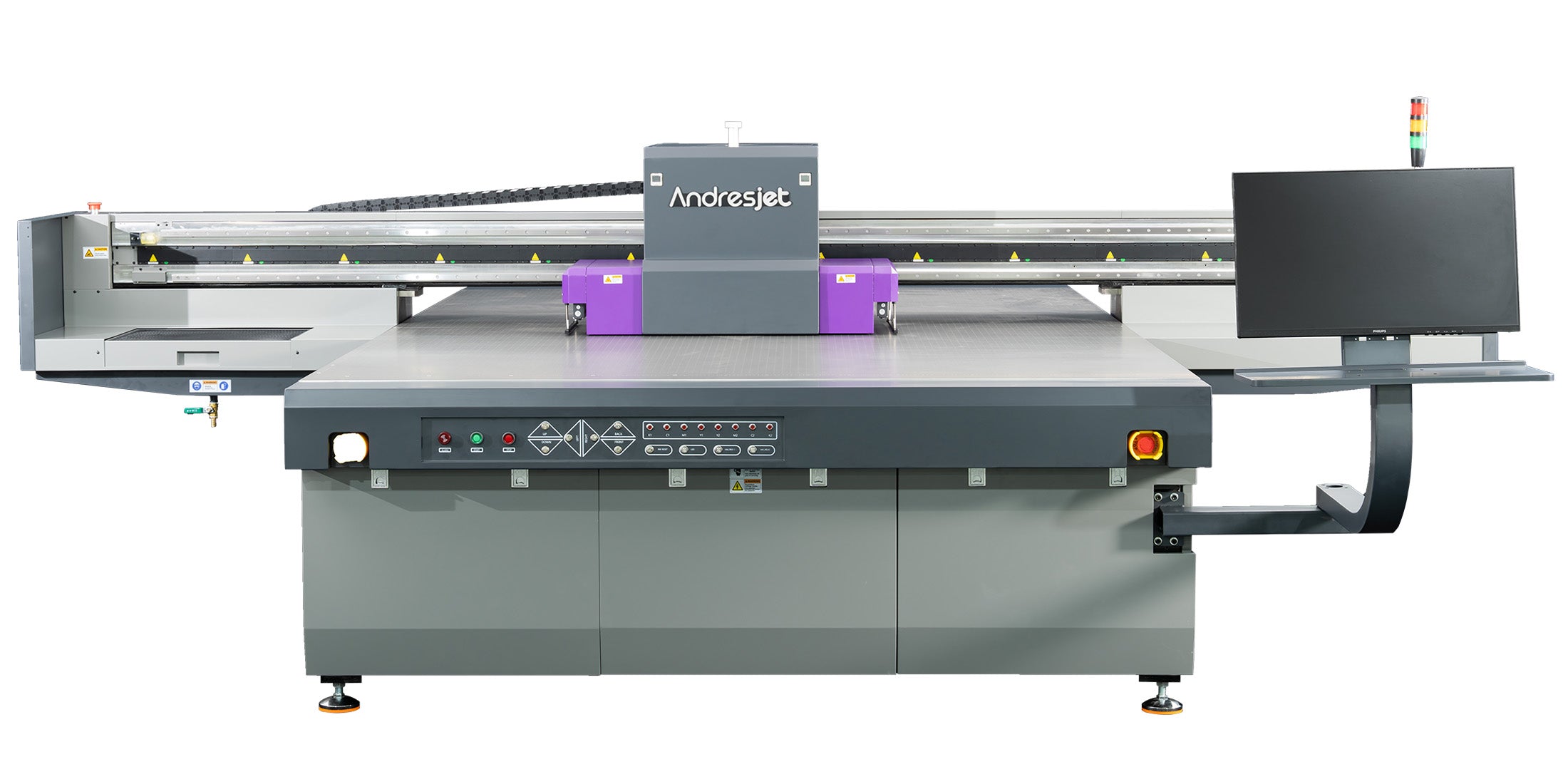
AndresJet printers excel for smart upgrades due to fiber optic interfaces, robust 4-zone vacuums, RICOH Gen5/6 heads, and 2-year warranties supporting IoT retrofits.
With 10+ years in high-speed printing up to 154 sqm/hr, AndresJet models like AJ2130Ultra and AJ3220EX offer built-in features like auto height detection and anti-static bars, easing sensor integration. Fiber optic data transmission ensures low-latency dashboards, while CE/RCM/UKCA certifications guarantee compliance. Free sample services and 3-day training (e.g., AJ360i) extend to monitoring setups, fostering lasting client relationships.
Conclusion
Real-time pressure control via digital displays and IoT sensors revolutionizes UV flatbed printing, especially on AndresJet platforms. By monitoring vacuum, ink, and servos, operators achieve peak efficiency, slashing downtime and maximizing ROI in demanding applications. Upgrade today for sustained high-speed performance.
FAQs
1. What sensors track machine health in AndresJet UV flatbeds?
IoT sensors for pressure, vibration, and temperature integrate with 4-zone vacuums and fiber optics.
2. How much downtime can smart monitoring reduce?
Up to 30% through predictive alerts on AJ2130 series printers.
3. Are AndresJet printers IoT-ready?
Yes, via fiber optic interfaces and servo systems in models like AJ2130EX.
4. What is the warranty on AndresJet printers?
2 years comprehensive, with 8 years spare parts guaranteed.
5. Can retrofits work on all AndresJet flatbeds?
Yes, leveraging common features like 1–100 mm media handling and anti-collision.
Visit AndresJet.com to explore UV flatbed printers like AJ2130Ultra and request a free consultation on smart monitoring retrofits today.
Share:
How Does AndresJet Pressure Tech Achieve Zero-Downtime Printing?
How Dual Systems Protect Your Ricoh Print Heads from Damage