


- by Andresjet
Promotional Products and Corporate Gifts: Short-Run UV Printing Economics
- by Andresjet
Print bigger, print faster — wide-format UV flatbed printers for signs, decor and industrial work.

A promotional order rarely consists of one product. A single campaign arrives as pens, phone cases, medals, buttons, tumblers and a few acrylic awards, each with a different surface, a different fixture and a different quantity, and the deadline is set by an event that will not move. The printer handles the ink; the money is made or lost in how that mixed list is organised before printing starts.
This guide covers the sequence that makes mixed promotional work predictable: separating products by geometry, routing them to the right platform, planning fixtures and positioning, controlling artwork versions, and timing the whole order rather than the print cycle alone.
Because flat and rotating items need different machines.
Supported flat items and cylindrical or tapered vessels require different transport, holding and image-mapping methods, so the product list has to be split by shape before anything else is decided.
The split matters commercially because the two routes carry different setup economics. A flat item can be nested and printed several at a time on a platform, so the cost per piece falls quickly with quantity. A cylindrical item is printed one at a time against a fixture, so the changeover and handling time per piece stays much higher whatever the quantity. Quoting both from a single per-piece assumption is how a promotional job ends up profitable on the flat items and loss-making on the vessels.
The published planning sequence for this application begins with shape for exactly that reason: record whether the item is flat, cylindrical or tapered, then dimensions, weight, printable area, surface interruptions and the required image orientation.

Flat goes on the bed; round and tapered go on a fixture.
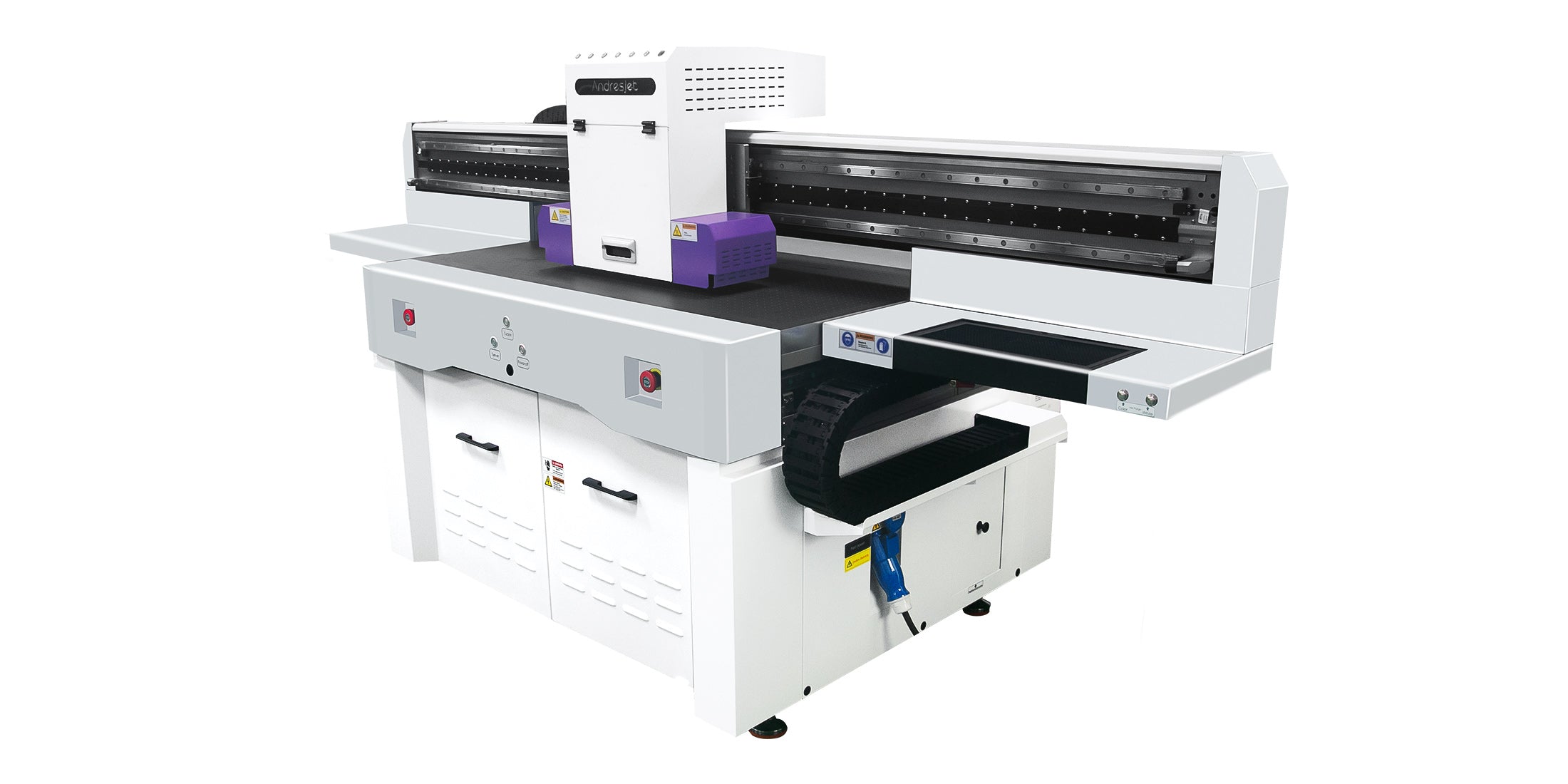
The AJ1206 covers supported flat items within its 1200 × 600 mm print area, while the AJ360i handles cylindrical and tapered vessels within its published diameter and taper ranges.
The two routes are published side by side for this application. The AJ1206 is specified with a 1200 × 600 mm maximum printing area, media from 0 to 35 mm thick, up to 36 kg load and an optional wide-beam CCD scanning camera for locating parts. Its published capabilities include a positioning tolerance of 0.01 mm using dual Y-axis motors, support for up to eight colours including light cyan, light magenta and light black, and throughput of up to 2,000 coins per hour on suitable items.
The AJ360i is specified as the cylinder and taper route, with a standard part diameter range of 60 to 170 mm, optional ranges of 10 to 60 mm and 170 to 240 mm, a taper angle range of 0 to 7 degrees and a print length of 40 to 270 mm, using CMYK, white and varnish. Those two sets of numbers describe two different production systems, and the published guidance is explicit that they are not interchangeable.
Decide how each item is located, supported and identified.
The published holding step requires a defined method for each item — without movement, interference, or confusion between artwork versions — before a job is quoted.
Fixtures are the part of promotional work that buyers most often treat as an afterthought and suppliers most often price separately. Three questions resolve them. What physical feature locates the item, and is that feature present on every variant the customer may send later? What contact points touch the printed area, and will they mark a freshly printed surface during loading? And can the operator tell one variant from another while it sits in the fixture, or does the job depend on remembering which item went where?
The last question is the one that decides whether a mixed order is profitable. When a fixture position carries an artwork version, the fixture plus the job ticket together are the control system, and identification marks or a checklist at the printer prevent a correct print reaching the wrong item.
With a version matrix, not with memory.
The published control matches SKU, colourway, personalisation field, white or varnish layers, orientation and approved proof to the correct physical item.
A promotional campaign typically multiplies artwork versions in several directions at once: one design per item family, then colourways, then personalisation, then a second language or region. What begins as one design becomes dozens of files that must not be confused. The version matrix is simply a table that connects each file to the item, the fixture position and the approved proof, and it is worth building before the first sample rather than after the first mismatch.
White and varnish layers belong in that table because they change the file rather than the design. A white underlay on a dark item, or a selective varnish on a coated surface, is a different data set for the same visual, and a version matrix that records only the design cannot distinguish them. Colour repeatability across the campaign then depends on the profiles maintained for each item surface (International Color Consortium).
Everything around the print cycle.
The published flow covers receiving, sorting, cleaning, loading, printing, unloading, inspection, assembly, packing and kit completion — and on mixed orders those steps dominate.
Printing is usually the shortest step on a promotional job. Sorting a mixed delivery into item families takes time. Cleaning is per piece and cannot be batched reliably on small items. Loading a fixture is per piece. Unloading and inspection are per piece. Assembly and kit completion are per order and often per recipient, which is where a corporate gift programme differs from a product run: the unit of delivery is a kit, not a pallet.
That has a direct effect on how a job should be quoted. A timed pilot on the real item mix gives a defensible figure for the complete cycle, and the published guidance for this application says the same thing: time receiving, setup, printing, inspection and packing before setting order targets.
Per item family, not per order.
Andresjet publishes per-piece print cost guidance for cylindrical items, from approximately USD 0.05 to 0.12 for small items and 0.30 to 0.65 for large ones.
The published figures describe print cost by object size, with the caveat that actual cost depends on size, coverage and the colours used. A quotation has to add the item itself, the handling time per piece, the fixture cost amortised over the order, inspection, assembly and packing. On a mixed order those additions differ by item family, which is why a single blended rate understates the small items and overstates the large ones.
The practical method is to build the quotation from the version matrix: one line per item family, quantity and artwork version, with the print element taken from the printed sample and the handling element from the timed pilot. Where the customer sends the items rather than buying them from you, the incoming material check belongs in the quote as well, because a mixed delivery of unknown condition is a sorting and rejection risk that the printer cannot absorb.
The real item, the real surface and the real finish.
A representative sample should confirm adhesion on the actual item, the appearance of white or varnish layers, and the durability the finished product needs in use.
Adhesion is assessed with the tape method under ASTM D3359 (ASTM D3359) and resistance to handling and cleaning under ASTM D4060 (ASTM D4060). Running both on the actual promotional item is what turns a supplier assurance into a result the customer's brand team can accept, and it is also the evidence that wins the next order. Where the item will be handled repeatedly or exposed to moisture, resistance to humid conditions under ASTM D2247 is the relevant additional test (ASTM D2247).
For work exported into regulated markets, the destination's customs and documentation requirements should be confirmed before the quote rather than after the order (US Commercial Service). The broader trade guidance on print process selection is a useful companion when the customer asks why direct printing was chosen over a screen or transfer route (PRINTING United Alliance).
Start with the item mix, then split the platforms.
A business with mostly flat items starts on the compact flatbed; a business with drinkware and cosmetic containers starts on the cylinder platform and adds the flatbed later.
| Route | Published range | Suited to |
|---|---|---|
| AJ1206 flatbed | 1200 × 600 mm print area; 0–35 mm thickness; up to 36 kg; CMYK + white + varnish; optional CCD | Flat items, nested batches, medals, coins, buttons, cards, acrylic pieces |
| AJ360i cylinder | 60–170 mm diameter standard; 10–60 and 170–240 mm optional; 0–7° taper; 40–270 mm print length | Bottles, tumblers, cups, rigid tubes and tapered vessels |
Published dimensions do not confirm material compatibility, fixture suitability or finished pieces per shift, so the recommendation should follow a representative product test rather than a dimension comparison alone.
Can one UV printer handle every promotional product shape?
No. Supported flat items and rotating cylindrical or tapered items require different transport, holding and image-mapping methods. The product list should be separated by geometry first, then confirmed against dimensions, fixtures, surface preparation and representative samples before a configuration is chosen.
When is a cylinder printer the relevant route for promotional work?
It is the cylinder-focused option when the actual vessel fits the published diameter, taper and print-length ranges. Product weight, surface, cap or handle interference, image seam, fixture contact and finished-use requirements still need to be reviewed and tested on the real item.
Is a camera positioning system required for every flat promotional item?
No. The benefit depends on product shape, fixture, pre-cut item tolerance, artwork position and how often the job repeats. A controlled fixture workflow and the optional camera-assisted route should be compared using the representative parts rather than assumed either way.
How should personalised names and many artwork versions be controlled?
With a version matrix that connects the order record, physical item, fixture position, artwork file, white or varnish layers and approved proof. Identification and inspection steps before printing and before packing are what reduce mismatches when one order carries dozens of variants.
What determines real output on a promotional order?
Sorting, cleaning, fixture loading, artwork changes, resolution, passes, ink coverage, white or varnish layers, unloading, inspection, assembly and packing. A timed representative order is a more useful basis for a quotation than a single headline speed figure.
Promotional work is won on organisation rather than on ink. Split the list by geometry, route each family to the right platform, decide the fixture and the identification method before quoting, and keep a version matrix that connects every file to a physical item and an approved proof.
Then price the order from a timed pilot on the real mix, because on a campaign of five item families the handling steps, not the print cycle, decide whether the job was worth taking. The published planning route for this application is set out in the UV printers for promotional products collection, with platform detail on the AJ1206 and AJ360i pages.
Send a representative sample of each item family in the order, with the artwork versions and quantities. We will separate the production routes, confirm the fixtures and return a timed costing basis.
Request product testing


