

Promotional products include many different shapes: flat awards, phone cases, keychains, tags, bottles, tumblers, cosmetic containers and tapered drinkware. Because these products move through different printing workflows, one printer is not automatically suitable for all of them.
The AndresJet AJ1206 and AJ360i are both designed for direct-to-object UV printing, but they solve different production problems. The AJ1206 is a compact flatbed printer for compatible flat products, while the AJ360i is a dedicated cylinder printer for straight and tapered vessels.
The first question should therefore be about product geometry—not headline speed.
What Is the Main Difference Between the AJ1206 and AJ360i?
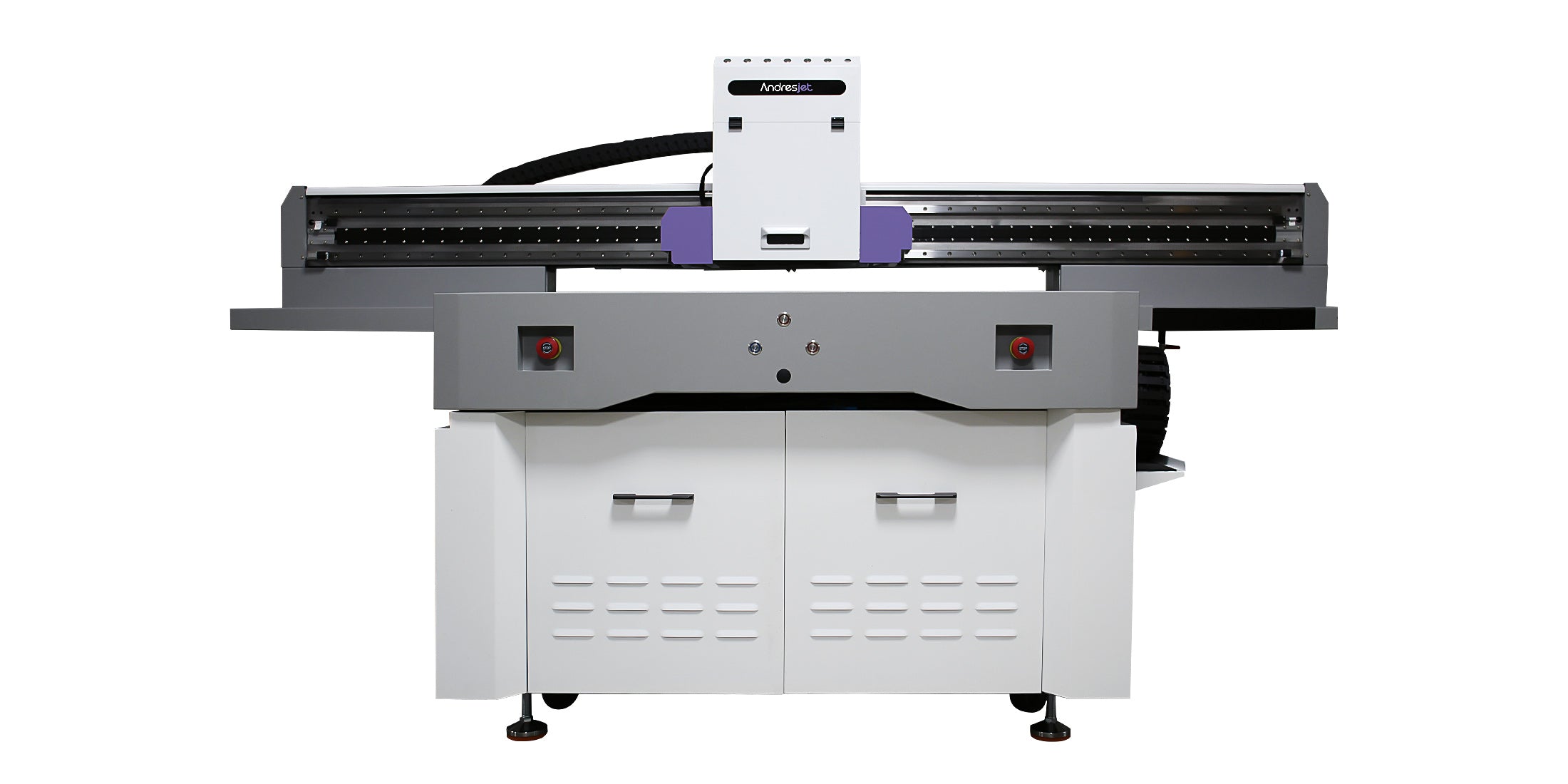
The AJ1206 Small UV Flatbed Printer places products on a 1200 × 600 mm flatbed. It is designed for compatible flat or relatively shallow products such as medals, badges, phone cases, plaques, tags and small promotional components.
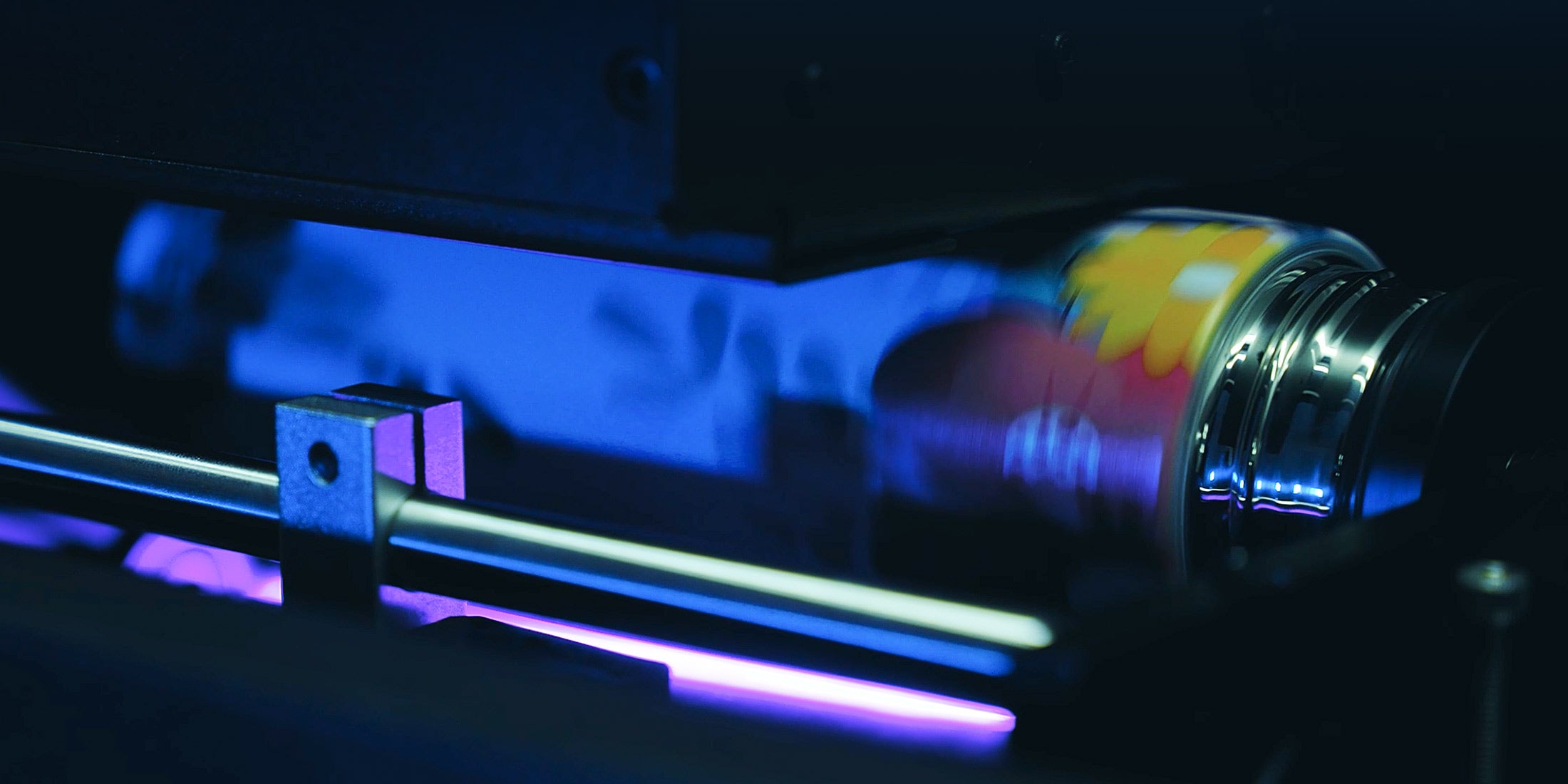
The AJ360i Digital Cylinder Printer holds and rotates bottles, tumblers, tubes and other cylindrical or tapered objects so that artwork can be printed around the surface.
| Factor | AJ1206 | AJ360i |
|---|---|---|
| Printer type | Compact UV flatbed | Dedicated digital cylinder printer |
| Primary product geometry | Flat and compatible shallow objects | Cylinders, tapers, cones and vessels |
| Working dimensions | 1200 × 600 mm bed; products up to 35 mm thick | 40–270 mm print length; standard 60–170 mm diameter |
| Positioning method | Fixture, bed layout or optional CCD positioning | Rotary fixture and product calibration |
| Typical artwork | Front-facing or flat-surface graphics | Partial or seamless 360-degree wraps |
Which Promotional Products Fit the AJ1206?
The AJ1206 is the more relevant starting point when the printable surface can be positioned horizontally on a flatbed.
Potential applications include compatible:
- Phone cases
- Medals and coins
- Badges and name tags
- Acrylic awards
- Keychains
- Small plaques
- Coasters
- Flat gift components
- Promotional signs and display pieces
Products must remain stable and within the printer’s supported dimensions and weight. Raised edges, curved surfaces and recesses should be checked because they may change the available print area or printhead clearance.
Which Promotional Products Fit the AJ360i?
The AJ360i is designed for products that need to rotate while printing. Typical applications include compatible:
- Water bottles
- Tumblers
- Sports bottles
- Cosmetic bottles
- Tubes
- Cups without interfering handles
- Conical containers
- Tapered promotional vessels
The standard AJ360i configuration supports diameters from 60 to 170 mm, with optional ranges covering smaller and larger products. It supports print lengths from 40 to 270 mm and taper angles from 0 to 7 degrees.
The exact product should be reviewed because the outside diameter alone does not determine fixture compatibility. The neck, base, opening, weight and internal structure can all affect how the product is held.
Can the AJ1206 Print Directly Around a Bottle?
A flatbed printer and a dedicated cylinder printer move products differently. A bottle placed horizontally on a flatbed does not automatically rotate in synchronization with the print process.
If a promotional product requires continuous artwork around most or all of its circumference, a dedicated cylindrical workflow is generally the more appropriate option. The AJ360i rotates the product so the artwork can follow the curved surface.
The AJ1206 should be evaluated for flat or suitably presented print surfaces rather than assumed to replace a dedicated 360-degree cylinder printer.
Can the AJ360i Print Flat Promotional Products?
The AJ360i is designed around cylindrical and tapered product rotation. Flat products such as medals, phone cases, flat tags and plaques are better matched to a flatbed workflow.
Choosing the AJ360i for a production line dominated by flat products would not use the machine according to its main geometry and fixture system.
If a business produces both flat gifts and drinkware, it may eventually require both production methods rather than trying to force every product through one printer.
How Does Artwork Coverage Affect the Choice?
Consider how much of the product must be decorated.
Front-facing artwork
A small logo or image printed on one flat face is usually suitable for a flatbed workflow, provided the product can be positioned safely and the printable surface remains within the approved height range.
Partial curved artwork
A logo covering only part of a bottle’s circumference may still require a cylinder printer if the surface curves significantly across the printed area.
Full 360-degree artwork
A complete wrap requires controlled rotation, circumference measurement and seam alignment. This type of job is better matched to the AJ360i.
How Do Order Mix and SKU Count Affect the Decision?
A promotional-products company should analyze both quantity and variety.
The AJ1206 may be useful for a high-mix collection of compatible flat items because fixtures, bed templates or optional CCD positioning can support different layouts.
The AJ360i may be appropriate when the product catalog is concentrated around bottles, tumblers and containers. However, each product shape must still be matched to a suitable rotary fixture.
| Order pattern | Likely starting point |
|---|---|
| Mixed flat gifts and small promotional parts | AJ1206 |
| Phone case personalization | AJ1206 |
| Full-wrap bottle and tumbler decoration | AJ360i |
| Tapered promotional vessels | AJ360i, subject to taper testing |
| Flat gifts plus cylindrical drinkware | Evaluate two complementary workflows |
How Do Positioning and Fixtures Differ?
On the AJ1206, products can be arranged on the flatbed using a repeatable fixture or an optional CCD visual-positioning workflow. This is relevant for products such as medals, tags and phone cases.
On the AJ360i, the fixture performs a different function. It must hold the product on its rotational axis and prevent slipping while the surface moves beneath the printheads.
A cylinder fixture must be evaluated according to:
- Product diameter
- Neck and base shape
- Opening dimensions
- Weight
- Taper
- Rotational stability
Flatbed positioning accuracy cannot replace correct rotary clamping, and a rotary fixture cannot turn the AJ360i into a general flatbed printer.
How Do White Ink and Varnish Compare?
Both printers support workflows involving color, white ink and varnish. The required layer structure depends on the product color, transparency, artwork and finish.
White ink may be used to:
- Provide opacity on dark products
- Support color on transparent materials
- Create selected white design elements
- Build approved raised effects
Varnish can add selective gloss or decorative detail. Every product should be tested because ink adhesion depends on the actual material and coating, not only on whether the object is flat or cylindrical.
How Should Production Speed Be Compared?
The AJ1206 and AJ360i use different units to describe production because they process different product geometries. The AJ1206 may be evaluated according to the number of small products placed on its bed and the cycle required for that layout. The AJ360i is evaluated per cylindrical item.
The AJ360i product information lists approximately 60 items per hour in production mode and approximately 40 items per hour in high-quality mode. Actual output varies with diameter, print length, coverage, white ink and varnish.
The AJ1206 is listed as capable of producing up to 2,000 coins per hour under the corresponding application conditions. That figure should not be applied directly to phone cases, plaques or every other promotional product.
For a useful comparison, time the complete workflow using the intended products:
- Artwork preparation
- Fixture or bed setup
- Loading
- Positioning and calibration
- Printing
- Unloading
- Inspection
- Changeovers
What If Your Product Catalog Includes Both Shapes?
A company selling flat promotional products and drinkware should calculate the percentage of monthly orders assigned to each geometry.
For example:
- 70% phone cases, medals and flat gifts may justify starting with the AJ1206.
- 80% tumblers, bottles and cosmetic containers may justify starting with the AJ360i.
- A balanced catalog may require two production systems or a staged investment plan.
Do not choose only according to the product with the highest selling price. Compare the recurring order volume, number of SKUs, setup requirements and available workshop capacity.
What Samples Should You Send Before Choosing?
Send representative products rather than only photographs. Include:
- Actual flat and cylindrical blanks
- Material and coating information
- Product dimensions
- Expected artwork coverage
- White ink and varnish requirements
- Average and maximum order quantities
- Number of product variations
- Required adhesion and durability tests
If your catalog includes both product types, request separate sample tests on the AJ1206 and AJ360i. Compare the finished result and complete workflow rather than assuming the same printer should handle both.
Final Recommendation
Choose the AJ1206 when the promotional-products business mainly prints compatible flat items such as phone cases, medals, tags, plaques and small gift components. Its 1200 × 600 mm flatbed and optional CCD positioning support flexible small-product layouts.
Choose the AJ360i when the business mainly decorates bottles, tumblers, tubes and tapered vessels that require controlled rotation and partial or complete 360-degree artwork.
If your catalog includes both flat merchandise and cylindrical drinkware, the two printers should be evaluated as complementary systems.
Explore AndresJet’s compact UV flatbed printers for flat promotional products and digital cylinder printers for bottles and vessels. Send your actual product samples and monthly order mix to AndresJet for a workflow recommendation.
Frequently Asked Questions
Is the AJ1206 suitable for bottles?
It is primarily a compact flatbed printer. Products requiring continuous printing around a cylindrical surface are better evaluated using the AJ360i.
Can the AJ360i print phone cases and flat plaques?
The AJ360i is designed for cylindrical and tapered products. Flat phone cases and plaques are better matched to the AJ1206 flatbed workflow.
Which printer is better for a new promotional-products business?
The answer depends on the initial product catalog. Choose according to the geometry and order volume of the products the business expects to produce most often.
Do both printers support white ink and varnish?
Yes, both support white-ink and varnish workflows. The appropriate ink sequence and adhesion must be tested on the actual product.
What if the business sells both tumblers and flat gifts?
Calculate the production volume for each category. A staged investment or two complementary printing systems may be more appropriate than forcing all products through one workflow.
Follow AndresJet:
Share:
How to Align Artwork Around Camera Holes and Phone Case Edges?
First-Surface vs. Reverse UV Printing on Glass