

- by John White
Can UV Printers Print Directly on PVC and ABS Panels?
- by John White
Print bigger, print faster — wide-format UV flatbed printers for signs, decor and industrial work.

UV flatbed printers can print directly on many PVC and ABS panels, allowing manufacturers to produce graphics without first transferring the design through a separate label or film. However, successful direct printing depends on more than simply identifying the sheet as PVC or ABS.
Surface treatment, material formulation, static electricity, sheet flatness and ink adhesion can all affect the final result. A panel that prints successfully from one supplier may behave differently from a visually similar panel purchased elsewhere.
This guide explains what manufacturers should check before choosing UV printers for PVC and ABS panels or beginning batch production.
Many rigid PVC sheets can be printed directly with a UV flatbed printer. The printer deposits UV-curable ink onto the panel and cures it with UV LED light during the printing process.
Direct printing is commonly considered for applications such as:
Nevertheless, PVC is a broad material category. Rigid PVC, expanded PVC foam board, laminated PVC and coated decorative panels do not necessarily have the same surface properties.
Before production, the actual panel should be checked for ink adhesion, surface contamination, flatness and compatibility with the selected print settings.
UV flatbed printing can also be used on many ABS sheets and molded ABS components. ABS is widely used for industrial housings, decorative panels, appliance components, point-of-sale displays and other manufactured products.
As with PVC, the material name alone does not guarantee a particular result. ABS sheets may contain additives or have painted, laminated, glossy, matte or textured surfaces.
The ink comes into contact with the outermost surface—not with the material hidden beneath a coating. Therefore, the coating and manufacturing process may influence adhesion more than the general ABS designation.
Some PVC and ABS panels accept UV ink after appropriate cleaning, while others may require additional surface treatment or a compatible primer. The correct process must be determined using the actual production material.
Factors that can reduce adhesion include:
A primer should not be applied automatically to every plastic panel. Unnecessary or incompatible pretreatment may change the panel’s color, gloss or appearance. Testing should determine whether cleaning alone is sufficient or whether an additional process is required.
PVC and ABS panels are often supplied with a protective film. The film helps prevent scratches during transportation and fabrication, but it can create several production mistakes.
If the operator prints on a removable film, the graphic will be removed with the film. If only part of the film is removed, the remaining edges may change the media height or affect the vacuum holding force.
Before loading a sheet, verify:
Cleaning should remove contaminants without damaging, softening or discoloring the panel. The cleaning method must therefore be compatible with the specific PVC or ABS formulation and coating.
A practical preparation process may include:
Do not assume that a strong solvent provides better preparation. An unsuitable cleaner can affect the appearance or structure of a plastic surface. Test any cleaning agent on a small, non-critical area first.
PVC and ABS sheets can accumulate static electricity during transport, film removal, cleaning and loading. Static charge can attract airborne dust and interfere with the controlled placement of ink droplets.
Possible symptoms include:
Static behavior is influenced by the material, humidity, handling process and production environment. Manufacturers processing large quantities of plastic panels should evaluate static control as part of the complete workflow rather than treating every defect as an ink or printhead problem.
A wide-format UV flatbed printer must maintain a controlled distance between the printheads and the panel surface. Warped sheets, lifted corners or uneven stacks can create inconsistent print quality and increase the risk of contact with the print carriage.
The panel should lie securely on the printing bed. A zoned vacuum system can help hold rigid sheets, but its effectiveness still depends on sheet size, flatness, surface condition and how much of the bed is exposed.
Before printing, operators should inspect:
A printer’s maximum allowable material thickness does not mean that every warped panel within that thickness can be loaded safely.
CMYK inks are not completely opaque. When an image is printed directly on a dark or strongly colored plastic panel, the substrate color can influence the appearance of the design.
White ink may be used as:
The appropriate white ink strategy depends on the panel color, image requirements and intended viewing distance. A full white underbase can produce stronger color opacity but also adds ink layers and production time.
For transparent or translucent PVC panels, the artwork must also account for viewing direction and what will appear behind the finished panel.
A panel should not be approved only because the image looks good immediately after printing. The test should evaluate whether the printed layer remains attached during the handling and fabrication expected for the finished product.
A useful sample evaluation includes:
If the panel supplier, coating or production batch changes, repeat the test before releasing another large order.
The correct sequence depends on the product and workflow.
Printing before cutting can make it easier to process full sheets and arrange multiple designs efficiently. However, the cutting system must accurately locate the printed artwork.
Cutting before printing can simplify the final shape and eliminate post-print cutting, but multiple smaller pieces may require fixtures or careful positioning. Cutting can also introduce dust that must be removed before printing.
Manufacturers should consider:
Printer selection should be based on the real panel dimensions, production volume, color configuration and workflow—not only on the printer’s maximum advertised speed.
Important selection factors include:
For high-volume panel applications, the AndresJet AJ2130EX UV flatbed printer is designed for materials including PVC doors and ABS panels. Its maximum printing area is 2100 × 3000 mm, and its hard-anodized flatbed uses a four-zone vacuum system.
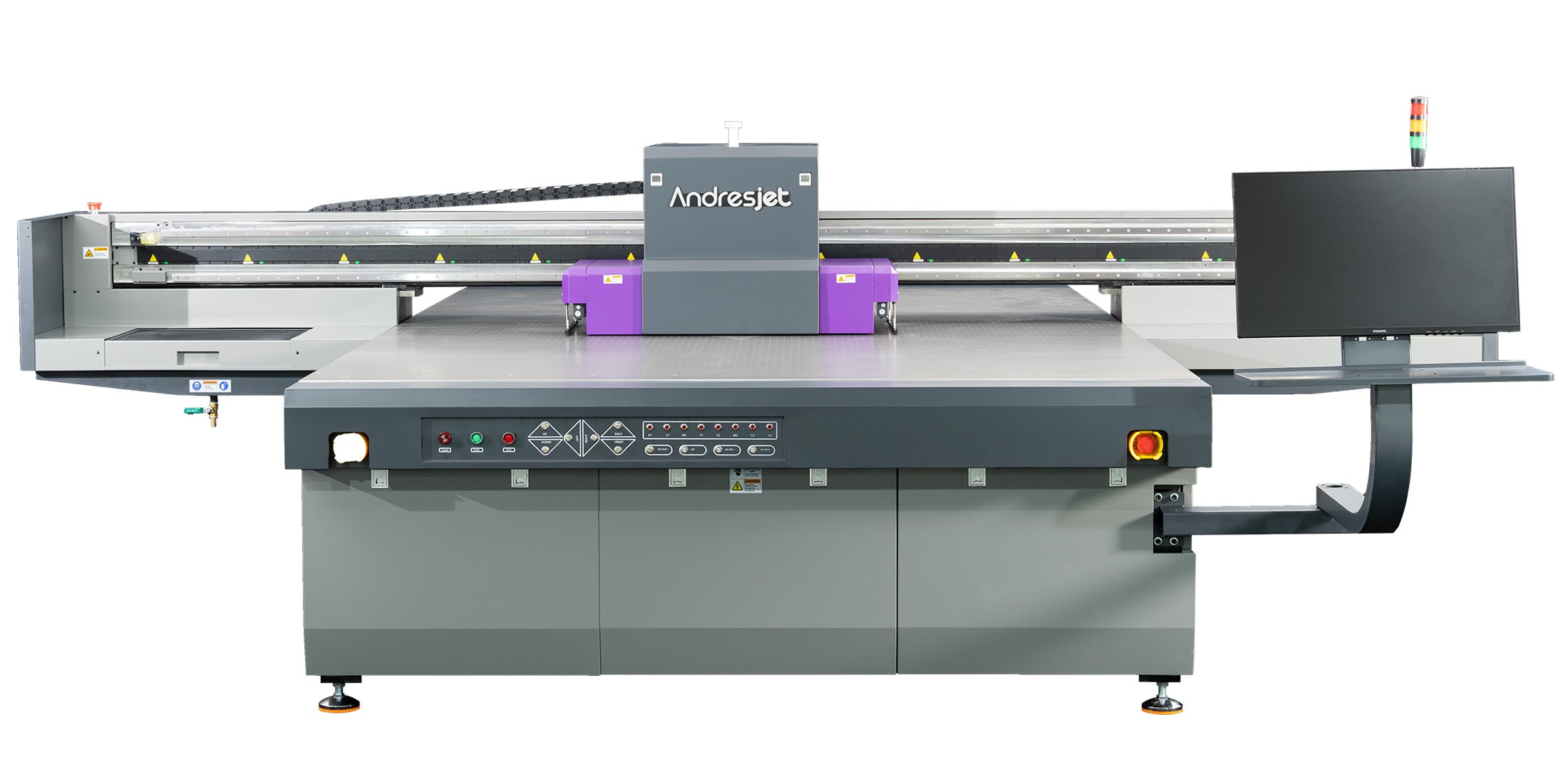
The AJ2130EX is configured with 16 Ricoh GEN5 printheads and supports media from 1 to 100 mm thick, subject to the machine’s loading and media-weight limits. The appropriate production mode should be selected according to the required output quality rather than treating draft speed as the expected speed for every order.
Provide the following information when asking AndresJet to evaluate a PVC or ABS panel:
Sending the real production panel is more reliable than testing a generic sheet with the same broad material name.
Yes, many PVC and ABS panels can be printed directly with a suitable UV flatbed printer. However, direct printing should be treated as a verified production process rather than a universal material promise.
The actual panel must be evaluated for surface contamination, coating, static electricity, flatness, adhesion and downstream fabrication. Once the material and workflow have been approved, the settings and preparation steps should be recorded for repeat production.
Explore AndresJet’s UV printers for PVC and ABS panels, or submit representative sheets, dimensions, production quantities and artwork requirements for sample testing and printer selection.
Follow AndresJet’s official social media channels for UV printing demonstrations, application examples and equipment updates:
For the complete decision path, continue with the uv printing acrylic & plastics guide.


