

- by John White
Why Blue Light Fails UV Flatbed Printer Curing: Test UV-C Power?
- by John White
Print bigger, print faster — wide-format UV flatbed printers for signs, decor and industrial work.

Blue light (405-470nm) in UV flatbed printers is visible but ineffective for curing; true germicidal UV-C (200-280nm, peak 254nm) polymerizes ink by damaging bonds. Test with UV-C strips under the lamp—if no color change, output is low, causing tacky prints. AndresJet UV LED systems like AJ2130Ultra require 254nm verification for 120+ sqm/hr reliability on thick media.
Check: How Long Do UV Lamps Last and When Should They Be Replaced
Blue light (405-470nm) is visible and produces minimal curing via oxidative stress, while germicidal UV-C (200-280nm, peak 254nm) directly damages DNA/RNA bonds for rapid ink polymerization in UV flatbed printers.
In UV printing systems, blue light and germicidal UV-C serve distinct roles. Blue light falls in the visible spectrum around 405-470nm, often emitted by LED UV lamps as a byproduct. It appears bright blue to the human eye, leading operators to assume the system is functioning. However, this light primarily induces reactive oxygen species (ROS) in microbes, which is too slow and weak for effective ink curing in industrial applications.
Germicidal UV-C, conversely, operates at shorter wavelengths of 200-280nm, with peak effectiveness at 254nm. This energy penetrates ink layers to trigger photochemical reactions, forming cross-links in UV-curable inks used in AndresJet printers. AndresJet models like the AJ2130EX and AJ2130Ultra rely on UV LED curing systems optimized for this range to handle high-speed production up to 140.7 m²/h on media from 1-100mm thick.
The key distinction lies in energy and penetration: UV-C's higher photon energy disrupts molecular bonds instantly, essential for curing thick ink layers on rigid substrates like PVC or MDF panels in sign printing and home decoration.
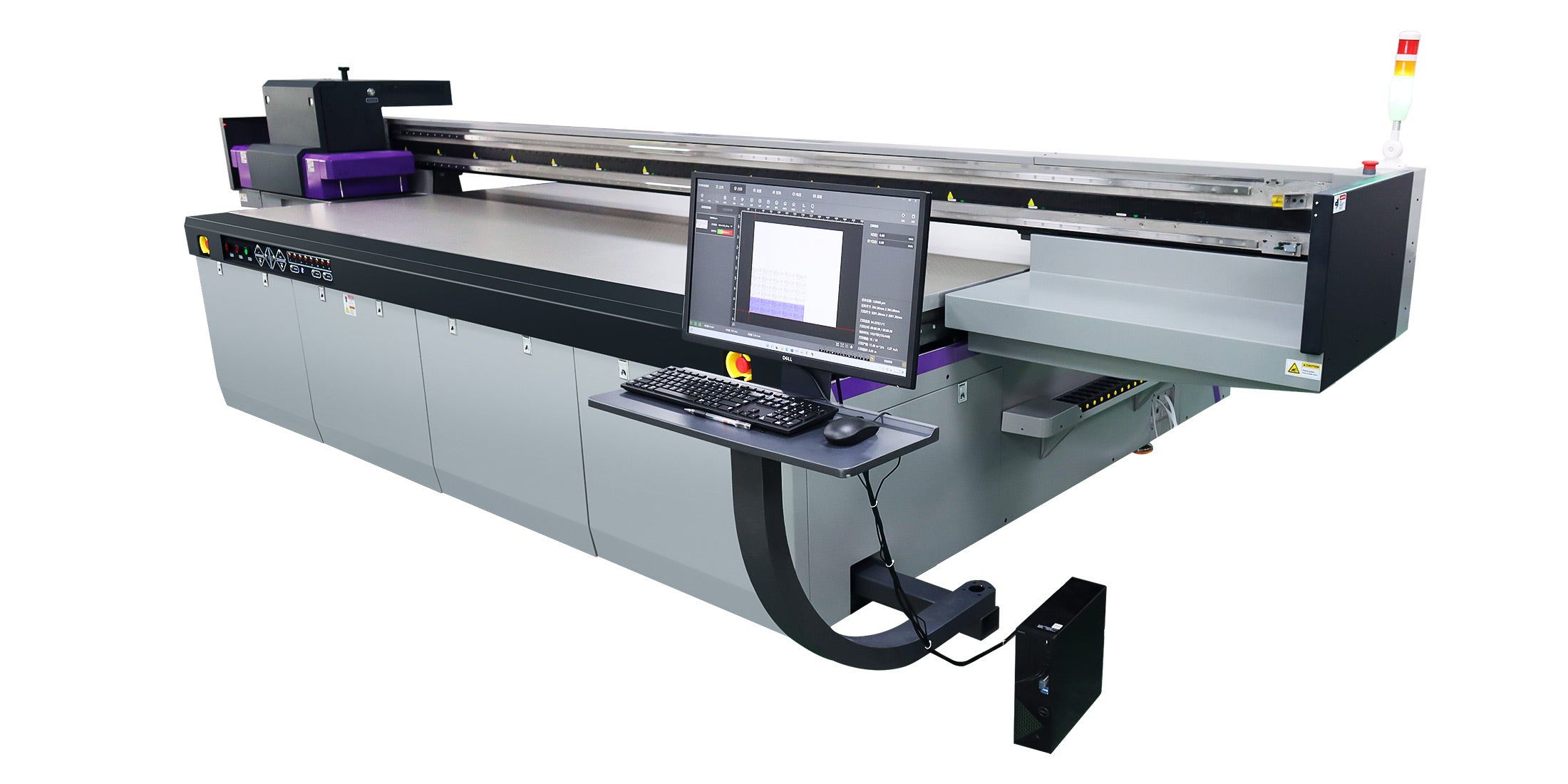
Blue light lacks the energy to polymerize UV ink monomers, causing incomplete curing and tacky prints; only UV-C at 254nm initiates the necessary cross-linking reactions.
The misconception that "if it's blue, it's working" stems from LED UV lamps emitting visible blue light alongside UV output. In flatbed printers, this visible glow reassures operators, but blue light (405-470nm) cannot break the chemical bonds in UV-curable inks like those in AndresJet systems.
UV ink curing requires photoinitiators activated precisely by UV-C wavelengths. Blue light's longer waves trigger only surface-level effects, insufficient for full polymerization, especially on dense substrates. This results in soft, smudgy prints prone to scratching—common in high-volume runs exceeding 100 sqm/hr.
AndresJet UV flatbed printers, equipped with industrial RICOH Gen5 or Gen6 print heads and UV LED curing, demand true UV-C intensity to maintain quality across 1-100mm media thickness. Relying on blue light alone leads to production downtime and wasted materials in applications like plastic product printing.
UV-C (254nm) penetrates ink layers to activate photoinitiators, forming durable polymer chains for scratch-resistant prints on thick media in high-speed UV flatbeds.
True UV-C power is the backbone of reliable curing in industrial UV printing. At 254nm, it excels at nucleic acid damage in microbes but, crucially for printing, excels at exciting photoinitiators in UV-curable inks. This initiates free radical polymerization, hardening ink instantly under the lamp path.
In AndresJet printers like the AJ3220EX, capable of 154.3 m²/h in draft mode, consistent UV-C output ensures even curing on uneven surfaces up to 100mm high. Features like hard-anodized aluminum flatbeds with 4-zone vacuum systems hold media steady, allowing UV-C to deliver uniform exposure without shadows or defects.
Without adequate UV-C, inks remain tacky, leading to adhesion failures on MDF or ABS panels. AndresJet's fiber optic data interfaces and anti-collision systems complement this by minimizing interruptions, supporting uninterrupted high-speed operation.
Tacky or smudgy ink, fingerprint marks, poor adhesion, and odor persistence indicate low UV-C output; blue light presence alone confirms nothing.
High-speed UV flatbeds like AndresJet's AJ2130Ultra (140.7 m²/h ultra-draft) show UV-C failure through telltale print defects. Tacky surfaces post-curing signal incomplete polymerization, worsened on thick media where UV penetration is critical.
Other signs include ink bleeding under handling, reduced gloss from varnish layers, and lingering solvent smells indicating uncured monomers. In production environments like sign printing, these lead to rejects and costly reprints.
AndresJet models mitigate risks with auto media height detection and 360° printhead protection, but operators must monitor UV-C independently of visible blue light to sustain speeds over 120 sqm/hr.
Place UV-C test strips (sensitive to 254nm) directly under the LED lamp for 15-30 seconds; color change to black/purple confirms sufficient output— no change means replace the lamp.
Testing UV LED lamps in flatbed printers is straightforward with germicidal UV-C strips, designed for 254nm detection. Power on the printer's UV system in curing mode, ensuring full intensity without printing.
Position strips flat under each lamp segment, 10-20mm from the source, for the recommended exposure time (typically 15-30 seconds per strip instructions). A strong color shift indicates healthy UV-C output; faint or no change reveals degradation.
For AndresJet printers like AJ2512G/R (up to 35 sqm/hr), test across the print width to catch uneven wear. Clean lamps first to avoid dust interference, and log results for maintenance tracking. This method outperforms visual blue light checks, preventing curing failures on 1-100mm media.
| Step | Action | Tips for AndresJet Models |
|---|---|---|
| 1 | Power UV lamps to full | Use service mode on AJ2130G/R |
| 2 | Place strips under lamps | Cover full width for 2100×3000mm beds |
| 3 | Expose 15-30s | Note zones on 4-zone flatbeds |
| 4 | Check color change | Compare to control strip |
| 5 | Log and replace if failed | Leverage 8-year spares guarantee |
High-speed models like AJ2130Ultra (140.7 m²/h), AJ3220EX (154.3 m²/h), and AJ2130EX (128.6 m²/h) gain maximum uptime from UV-C testing on UV LED systems handling 1-100mm media.
AndresJet's UV flatbed lineup excels in industrial applications, but UV-C verification is vital for peak performance. The AJ2130Ultra, with 24 RICOH GEN5 heads and speeds up to 140.7 m²/h, demands precise curing to avoid defects in ultra-high-volume runs.
Similarly, the AJ3220EX (3200×2000mm bed, 154.3 m²/h draft) and AJ2130EX benefit on large-format sign printing, where low UV-C causes widespread tackiness on PVC panels.
| Model | Max Speed (Draft) | Print Size | Media Thickness | UV System |
|---|---|---|---|---|
| AJ2130Ultra | 140.7 m²/h | 2100×3000mm | 1-100mm | UV LED |
| AJ3220EX | 154.3 m²/h | 3200×2000mm | 1-100mm | UV-curable |
| AJ2130EX | 128.6 m²/h | 2100×3000mm | 1-100mm | UV LED |
| AJ2512G/R | 27.46 m²/h | 2500×1200mm | 1-100mm | UV LED |
These CE-certified machines, backed by 2-year warranties and 8-year spares, integrate UV-C testing seamlessly for reliable output in home decoration and plastic printing.
Check: Compact uv flatbed printers
UV-C ensures deep penetration for curing on thick, irregular media (1-100mm), preventing defects in high-speed printing of MDF, PVC, and tapered parts.
Industrial printing on rigid media up to 100mm thick, as supported by AndresJet flatbeds, requires robust UV-C to cure through layers and contours. Blue light scatters on surfaces, but 254nm UV-C delivers energy uniformly, vital for sign printing and gifts.
In models like AJ3220G/R (up to 90mm height), inadequate UV-C leads to under-cured undersides, causing delamination. AndresJet's 4-zone vacuum and auto height detection optimize exposure, but true power verification sustains quality at speeds over 100 sqm/hr.

Schedule monthly UV-C strip tests, clean lamps weekly, monitor ink settings, and use AndresJet's 8-year spares for rapid lamp swaps to minimize downtime.
Preventive maintenance in AndresJet UV flatbeds focuses on UV-C integrity. Integrate strip testing into weekly routines, especially for high-use models like AJ2130G/R with fiber optic interfaces and THK LM guides.
Clean lamp surfaces, calibrate via RIIN Print software, and leverage anti-static bars to avoid dust buildup. AndresJet's 2-year warranty and free training (e.g., 3 days for AJ360i) equip operators for zero-downtime production in North America and South Asia.
AndresJet Expert Views: "In our decade of high-speed UV printing, we've seen blue light fool too many operators into overlooking UV-C decay, spiking defect rates on 100mm media. Routine germicidal strip testing on AJ2130Ultra and AJ3220EX ensures 140+ sqm/hr reliability with RICOH Gen5/6 heads. Our engineers recommend integrating it with anti-collision checks—combined with 8-year spares, it delivers unmatched uptime for sign and decoration printers." – AndresJet Technical Director
Debunking the blue light myth empowers UV flatbed operators to verify true germicidal UV-C power, ensuring flawless curing across AndresJet's high-speed lineup. Implement UV-C strip testing today for sustained productivity on diverse media. Contact AndresJet at www.andresjet.com for a free UV curing consultation or demo on models like the AJ2130Ultra.
Q: Can blue light ever cure UV ink?
A: Minimally on thin layers, but not reliably—UV-C is essential for industrial depths and speeds.
Q: How often should I test UV-C in AndresJet printers?
A: Monthly for high-volume use; weekly if defects appear.
Q: Do all AndresJet UV flatbeds use the same UV system?
A: All feature UV LED or UV-curable systems optimized for 1-100mm media.
Q: Where to source UV-C test strips?
A: Industrial suppliers; request AndresJet's branded checklist for models.
Q: Does low UV-C affect warranty?
A: No—AndresJet's 2-year coverage includes UV components with proper maintenance.
For the complete decision path, continue with the uv curing, adhesion & durability guide.


