

- by John White
How Does Constant Temperature and Pressure Ensure UV Flatbed Color Consistency?
- by John White
Print bigger, print faster — wide-format UV flatbed printers for signs, decor and industrial work.

Constant temperature (20–30°C) and pressure in UV flatbed printing stabilize ink viscosity for consistent droplet size and curing, preventing color shifts from first to 100th print. AndresJet models like AJ2130EX use dual negative pressure, 4-zone vacuum, and fiber optics for 30% ink savings and 120+ sqm/hr reliability, ensuring identical output across runs.
Check: Who Owns Brother Printer Company, China Or Japan?
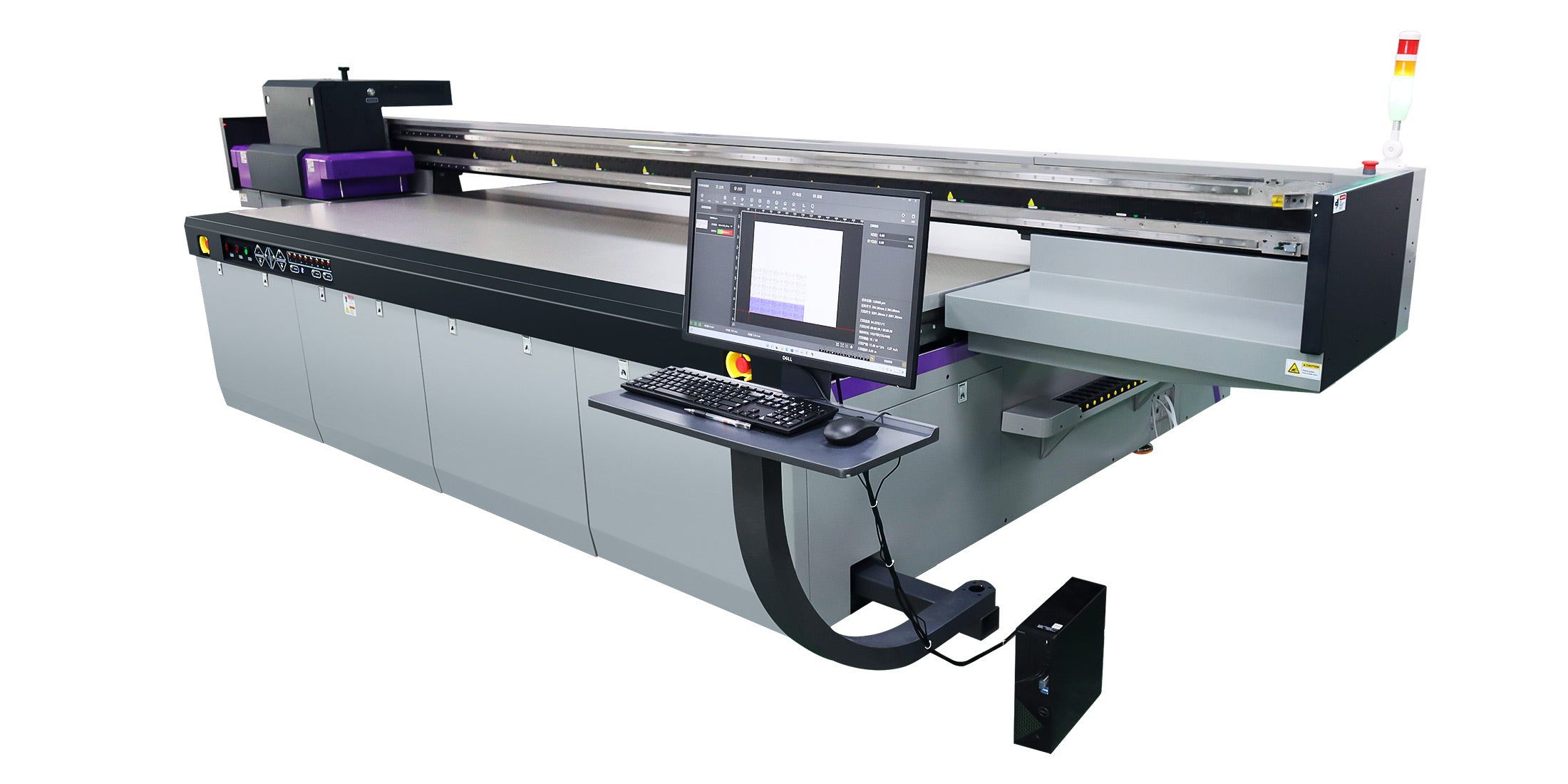
Temperature directly influences ink viscosity in UV flatbed printing, where higher temperatures reduce viscosity for smoother flow, while lower temperatures increase it, risking clogs and inconsistent droplets. Maintaining 20–30°C ensures stable viscosity, uniform color density, and repeatable prints from the first to the 100th.
In UV flatbed printing, ink viscosity is the measure of its internal friction, determining how easily it flows through print heads. Temperature rises intensify ink molecule movement, weakening intermolecular forces and lowering viscosity for better fluidity. Conversely, drops in temperature slow molecules, raising viscosity and causing poor flow, nozzle clogs, or uneven droplet sizes that lead to color variations.
For industrial operations like sign printing or home decoration panels, this means the first print might show vibrant colors at optimal warmth, but cooler conditions could thicken ink by the 100th print, resulting in faded tones or banding. AndresJet UV flatbed printers, such as the AJ2130EX and AJ2130Ultra, specify an operating environment of 20–30°C to counteract these effects, supporting high-speed production up to 140.7 m²/h while preserving ink flow stability.
Precise control prevents issues like line breaks or color bleeding, critical for high-volume runs exceeding 100 sqm/hr in plastic product or gift printing applications.
Check: Why Are Dual Negative Pressure Systems Essential for Industrial Printing?
Pressure stability in UV flatbed printers maintains consistent ink delivery pressure, preventing variations in droplet volume that cause color drift. Constant negative pressure systems ensure uniform ejection across long runs, matching the first print's vibrancy to the 100th at speeds over 120 sqm/hr.
Ink flow stability relies on balanced pressure within the ink system. Fluctuations disrupt droplet formation in piezo drop-on-demand heads, like the RICOH Gen5 or Gen6 used in AndresJet printers. Stable pressure counters viscosity changes, ensuring each droplet lands precisely for identical color reproduction.
High-speed UV flatbeds demand this for reliability; without it, early prints may be saturated, but later ones dilute due to pressure decay. AndresJet's dual negative pressure in models like AJ3220G/R stabilizes flow, reducing waste and enabling consistent output on rigid media up to 100 mm thick.
This is vital for B2B users in North America and South Asia producing signage or MDF panels, where color drift means reprints and downtime.
The ideal range for UV flatbed printers is 20–30°C temperature and 40–60% humidity, stabilizing ink viscosity, preventing nozzle clogs, and ensuring even UV curing for color-consistent prints across production runs.
UV-curable inks perform best in controlled environments. At 20–30°C, viscosity stays optimal (around 8–20 cP), allowing smooth ejection without excessive thinning or thickening. Humidity between 40–60% avoids ink drying prematurely or absorbing moisture, which could alter curing.
AndresJet models like AJ1206 and AJ360i explicitly recommend these conditions, aligning with industry standards for LED UV inks. Deviations cause issues: below 20°C, ink thickens, slowing flow; above 30°C, it thins, risking satellite droplets and color shifts.
| Model | Temperature Range | Humidity Range |
|---|---|---|
| AJ2130EX | 20–30°C | 40–60% RH |
| AJ1206 | 20–30°C | 40–60% RH |
| AJ360i | 20–30°C | 30–60% |
| AJ3220G/R | 20–30°C | 40–80% RH |
Adhering to these specs guarantees the first print matches the 100th, minimizing defects in high-throughput applications.
AndresJet UV flatbeds maintain constant conditions through specified 20–30°C environments, 4-zone vacuum flatbeds, and robust ink systems like dual negative pressure, delivering repeatable color at speeds up to 154 sqm/hr across models like AJ3220EX and AJ2130Ultra.
AndresJet printers integrate features for environmental stability. Hard-anodized aluminum flatbeds with 4-zone vacuum systems secure media rigidly, while AC high-precision servo motors and fiber optic interfaces ensure consistent head movement and data flow, unaffected by ambient fluctuations.
Models such as AJ2130G/R and AJ2512G/R support media from 1–100 mm thick in stable conditions, with anti-collision systems protecting heads during long runs. This setup, combined with ICC-based color management, locks in consistency for home decoration and sign printing.
AndresJet's 10+ years of experience in high-speed printing (over 100 sqm/hr) informs these designs, expanding reliably in North America and South Asia.
AndresJet Expert Views: "Maintaining 20–30°C and stable pressure is non-negotiable for UV flatbed reliability. Our AJ2130Ultra and AJ3220EX models leverage RICOH Gen5/Gen6 heads with dual negative pressure and fiber optics to achieve 30% ink savings and identical first-to-100th prints. This reduces cleaning cycles by up to 50%, boosting uptime for sign and panel producers. With 2-year warranties and 8-year spare parts, AndresJet ensures your production line endures high-volume demands."
— AndresJet Engineering Team
Dual negative pressure in UV flatbeds like AndresJet's AJ3220G/R keeps ink at consistent levels in reservoirs and lines, stabilizing viscosity and droplet size for perfect color matching from print one to print 100, even at 35 sqm/hr.
Negative pressure prevents ink flooding or starvation in print heads. AndresJet's implementation in color and white ink channels ensures steady supply, countering temperature-induced viscosity shifts. This results in uniform saturation and no drift over extended runs.
For white ink effects up to 0.15 mm raise (as in AJ360i), it's essential. Paired with smart 8-level grayscale, it yields 30% ink savings while matching colors precisely on PVC or ABS panels.
To ensure first-to-100th print consistency: 1) Maintain 20–30°C and 40–60% RH; 2) Calibrate ink pressure daily; 3) Use ICC profiles; 4) Monitor via RIP software; 5) Clean heads regularly with stable conditions.
Start by installing HVAC for 20–30°C. Daily checks on AndresJet models include 2-point calibration (AJ360i) and auto height detection. RIIN Print or Onyx RIP with density adjustments fine-tunes output. Regular maintenance under spec conditions prevents drift.
Case: A sign maker using AJ2130EX reported zero color variance over 600 panels/day after implementing these, cutting waste 25%.

Fiber optic interfaces in AndresJet UV flatbeds transmit data at high speeds without interference, ensuring precise timing for droplet placement and color accuracy at 120+ sqm/hr, preventing lag-induced inconsistencies across long print runs.
Unlike USB, fiber optics handle massive data from 16–24 RICOH heads (AJ2130EX, AJ2130Ultra) flawlessly. This supports uni/bi-directional modes at resolutions up to 720×1200 dpi, locking colors from start to finish.
In high-speed sign printing, it eliminates artifacts, ensuring the 100th print mirrors the first.
AndresJet models like AJ2130Ultra (140.7 m²/h), AJ3220EX (154.3 m²/h), and AJ2130G/R excel with 20–30°C specs, dual negative pressure, and fiber optics for superior color consistency in rigid media printing.
| Model | Max Speed (m²/h) | Heads | Key Stability Feature |
|---|---|---|---|
| AJ2130Ultra | 140.7 | 24 × Gen5 | Fiber optic, 4-zone vacuum |
| AJ3220EX | 154.3 | 16 × Gen5 | MagLev motor, anti-collision |
| AJ2130G/R | 48.3 | 6–8 × Gen6 | Dual negative pressure |
| AJ2512G/R | 27.46 | 3–8 × Gen6 | THK guides, auto height |
These support applications from coins (AJ1206) to large panels, with CE/RCM/UKCA certifications and free training/samples.
Constant temperature and pressure unlock UV flatbed color consistency, ensuring every print matches perfectly. AndresJet's advanced UV flatbeds deliver this reliability with proven specs, ink savings, and support. Visit AndresJet.com to explore models and request a free consultation or sample print today.
What temperature range do AndresJet UV printers require? 20–30°C for optimal ink viscosity and flow stability.
How does pressure affect UV ink flow? Stable negative pressure ensures consistent droplet size, preventing color drift in high-speed runs.
Which AndresJet model is best for high-speed color consistency? AJ2130Ultra or AJ3220EX, with speeds up to 154 m²/h and fiber optic stability.
Does AndresJet offer warranty on these printers? Yes, 2 years comprehensive, plus 8 years guaranteed spare parts.
Can AndresJet printers handle rigid media printing? Yes, up to 100 mm thick with 4-zone vacuum for secure, consistent printing.


