

How Should Nameplates and Control Panels Be Prepared?
- by John White
Print bigger, print faster — wide-format UV flatbed printers for signs, decor and industrial work.

Reliable UV ink adhesion on industrial nameplates and control panels begins with identifying the actual printable surface, not relying on the product name. An industrial B2B workflow should inspect the material, remove contamination with a compatible method, compare untreated and prepared samples, verify curing and adhesion, and approve one written recipe before production. Primer is a test variable, not an automatic requirement.
UV ink can release when contamination, low or variable surface energy, a weak coating, excessive ink deposit or an unsuitable cure condition prevents a stable interface. For industrial nameplates and control panels, machining oil, conversion coatings, paint variation and protective lacquers can change the failure interface and field-cleaning resistance. The failure may occur within the ink, between ink and coating, or between the coating and base material; each failure location points to a different corrective action.
For a nameplate or control panel, map adhesion loss against cut edges, punched holes, bends, coated zones and printed legends. Preserve both the failed panel and an unprinted reference from the same lot. This distinguishes contamination or coating weakness from damage introduced during cutting, fastening or enclosure assembly.
Material qualification should record supplier, grade, color, finish, coating, lot, storage condition and protective-film history. Industrial marking parts may use anodized aluminum, coated metal, plastics, laminates or painted panels; coating system and end-use cleaner must be specified. A sales description such as stone, slate or display panel is not a technical surface specification.
The industrial nameplate and control-panel printer collection provides category context after the panel construction and print area are defined.
Qualification should identify the base metal or plastic, paint or anodized layer, gloss level, protective film and supplier lot. If the drawing permits multiple panel suppliers or coatings, approve a boundary sample for each construction; visually similar powder coats can differ in texture, release residue and ink response.
A controlled sequence is: inspect and photograph the incoming surface; remove loose debris; test the proposed cleaner on a hidden area; clean with a lint-free method; allow complete drying; prevent hand contact; print the untreated control; then test only the minimum additional treatment needed. Control fingerprints, machining oil, protective-film adhesive and fabrication debris, and test any cleaner against legends, coatings and surrounding finishes.
Select cleaning materials that do not soften paint, cloud windows, attack adhesives or leave residue around apertures. Record wipe material, direction, drying time and the maximum clean-to-print interval. Any primer trial must also consider masked zones, electrical labels and later assembly operations.
Test primer only after a clean untreated panel fails the agreed requirement. Compare the same coating lot with and without primer while fixing file, ink build and cure. Approval must include edge definition, legend readability and surface appearance—not only an initial tape result.
For repeat control panels, the preferred process is the simplest one that protects adhesion and fine-text legibility through assembly and expected handling. An unnecessary primer can contaminate masked areas and add variation; an omitted required treatment can create peeling around holes, edges or fasteners.
Build the qualification matrix around panel construction and service risk: untreated control, approved cleaning, optional primer and a repeat run on a second panel. Record coating lot, small-text quality, edge adhesion and post-assembly handling. The matrix defines a buyer test; it does not claim certification for AndresJet equipment.
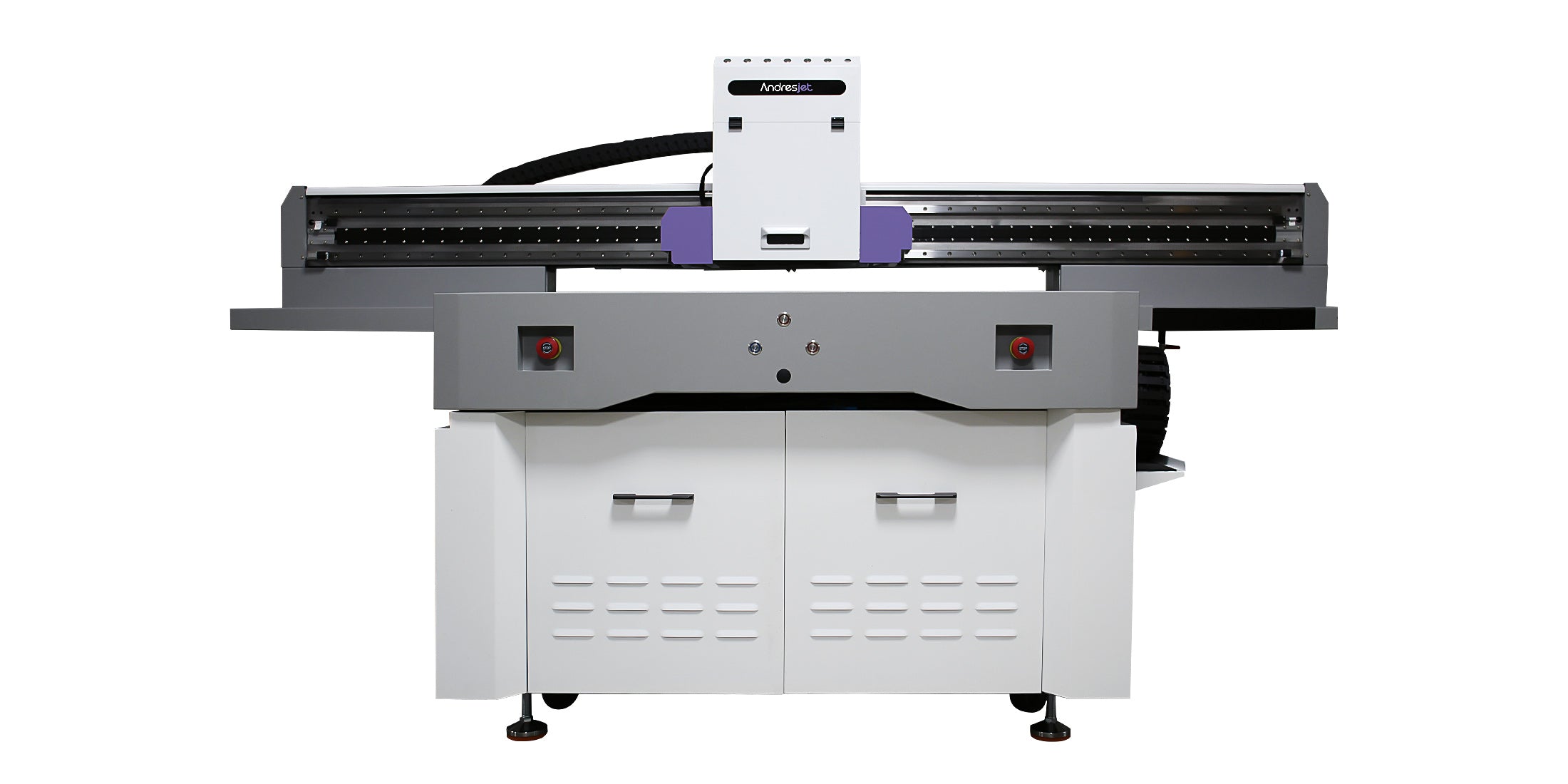
Use the AJ1206 product page to review published machine limits, then approve adhesion on the exact production coating.
| Test cell | Preparation | What stays fixed | Evidence |
|---|---|---|---|
| Control | No additional treatment | File, mode, cure | Initial appearance and adhesion |
| Cleaning candidate | Approved cleaner | Ink build and substrate lot | Surface damage and adhesion |
| Primer candidate | Documented application | Cleaner, file and cure | Adhesion, color and texture |
| Repeat | Approved candidate | All recorded settings | Repeatability and failure mode |
The approval package should include material identity, preparation steps, file version, layer order, RIP preset, cure setting, sample photographs, test method, result, limitations and approver. Include the agreed cleaner, abrasion, assembly and label-legibility requirements; do not infer regulatory compliance from print appearance.
Nameplate and control-panel preparation must protect legibility, registration and adhesion across the specified coating and service environment. Qualify the exact panel construction, cleaning method and any primer as one controlled recipe, then retain samples for repeat orders. AndresJet can support flatbed sample production; the buyer should define marking tolerances, handling tests and requalification triggers.
No. Define cleaner, abrasion, assembly and environmental risks for the actual installation and test them separately.
Not automatically. Their surfaces and failure modes differ, so qualify each approved construction.
Material/coating identity, preparation, file revision, ink build, recipe, test methods, results, sample and authorized approval.
 How Should a UV Substrate Qualification Library Be Built?
Knowledge
How Should a UV Substrate Qualification Library Be Built?
Knowledge
 UV Printer Installation, Commissioning and Operator Training: What Buyers Must Plan For
Knowledge
How a Pre-Order UV Printer Sample Test Works: What to Send and What You Get Back
Knowledge
UV Printer Installation, Commissioning and Operator Training: What Buyers Must Plan For
Knowledge
How a Pre-Order UV Printer Sample Test Works: What to Send and What You Get Back
Knowledge
 Order to Delivery: How UV Printer Lead Time Is Actually Built
Knowledge
Order to Delivery: How UV Printer Lead Time Is Actually Built
Knowledge