

- by John White
How Should Canvas UV Print Durability Be Tested?
- by John White
Print bigger, print faster — wide-format UV flatbed printers for signs, decor and industrial work.

UV print durability on canvas and art panels must be defined by end use rather than one generic pass/fail claim. A B2B factory should identify handling and exposure risks, qualify adhesion first, select only relevant abrasion, cleaner, moisture or light tests, condition repeat specimens, and agree acceptance criteria before testing. The result applies only to the documented material and print recipe.
The test plan begins with installation, handling, cleaning and expected service conditions. Canvas may be stretched, rolled, framed, wiped or displayed near daylight; rigid art panels may face edge handling, cleaning and surface abrasion. An indoor decorative sample and a frequently handled or outdoor product need different evidence.
Procurement and the customer should rank credible risks before choosing methods. Testing every possible exposure wastes time, while testing only initial appearance can miss the failure that matters after converting, packing, installation or cleaning. Canvas qualification must reproduce stretching, rolling or framing when specified.
Adhesion screening should use conditioned specimens, a documented method and an agreed rating. Record whether failure occurs within the ink, at the ink-to-surface interface, or in the substrate coating. ASTM D3359 provides tape-test context for suitable coating systems, but its scope and geometry limitations must be respected. Art-panel edge handling should be represented in the test plan.
A single successful specimen does not prove universal compatibility. Keep an untreated or previously approved control, use repeats and document substrate lot, preparation, file, ink build and cure condition. Record whether damage follows coating, ink or substrate movement.
Abrasion and chemical tests are required only when those stresses are credible in service. For canvas, include bending or stretching at the realistic radius and inspect cracking or whitening. For panels, include the actual cleaner and mounting/packing contact. Define tool, load, cycles, cleaner concentration, dwell, conditioning and inspection before the test so the result can be repeated.
Light or weather exposure must also match the commercial claim. Do not convert a brief internal screening into an outdoor-life statement. When the contract depends on a recognized method, use qualified equipment or an independent laboratory. The approved control should use the same weave or panel finish.
| End-use risk | Candidate evaluation | Evidence to retain |
|---|---|---|
| Ink-to-surface bond | Documented adhesion method | Rating and failure location |
| Routine handling | Scratch or rub screening | Tool, load and visible change |
| Cleaning | Actual cleaner exposure | Concentration, dwell and result |
| Outdoor/light claim | Relevant standardized exposure | Method, duration and limitation |
| Converting or flexing | Application simulation | Cracking, lift or distortion |
There is no universal sample count for every contract. Use enough specimens to reveal material and process variation, include an approved control, and repeat any borderline result. A test that cannot be repeated by a trained operator is not a dependable production gate. Canvas qualification must reproduce stretching, rolling or framing when specified.
During qualification, engineers should photograph the same evaluation area, record conditioning time and prevent sample mix-ups. Procurement should ask every shortlisted manufacturer to use the same substrate lot, artwork, preparation and acceptance method. Art-panel edge handling should be represented in the test plan.
The matrix should identify risk, method, owner, specimen count, acceptance rule, result and limitation. Release production only after the customer or authorized owner approves the required cells. Changes to material, coating, primer, ink build or cure should trigger a defined level of requalification. Record whether damage follows coating, ink or substrate movement.
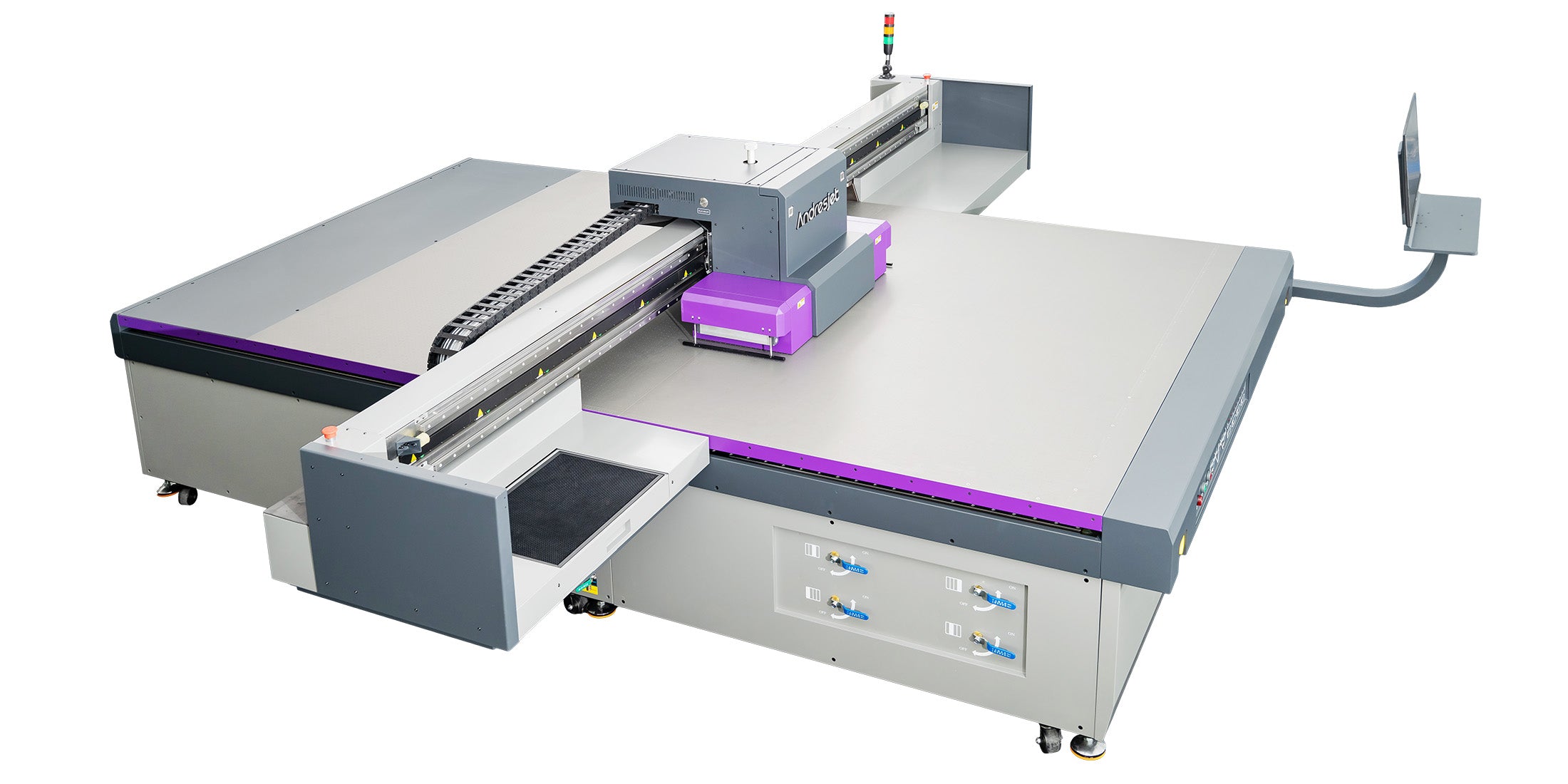
The AndresJet application collection supports the machine-category discussion, while the AndresJet product page supports configuration review and a representative sample request. Published model information cannot substitute for measured durability on the buyer’s production material.
Store the customer-approved sample with material identity, preparation, production file, RIP preset, print and cure settings, test records, photographs and approver. Define storage life for the reference and how a later order will be compared. The approved control should use the same weave or panel finish.
The most common purchasing mistake is accepting an attractive sample without agreeing on the durability question. The consequence is a dispute after handling or installation; prevention is a written end-use matrix before equipment acceptance or batch production. Canvas qualification must reproduce stretching, rolling or framing when specified.
For B2B production, the defensible decision is the one supported by identified material, controlled artwork, a documented print recipe, representative samples and written acceptance criteria. Ask the UV printer manufacturer which specifications are published, which configuration points remain application-specific, how the sample will be evaluated, and what commissioning, operator training, spare-parts planning and After-Sale Service are included. AndresJet can review the application and arrange a sample test, but the final process must be approved on the buyer’s production material and real artwork. Art-panel edge handling should be represented in the test plan.
For the complete decision path, continue with the uv printer components & engineering guide.
No. Adhesion and flex resistance are separate. Simulate the specified rolling or stretching condition and inspect cracking, whitening and lift.
No. A lightfastness or outdoor-life claim requires a defined exposure method and the complete substrate, ink and protective construction.
Keep material identity, preparation, file, layer order, print mode, conditioning, test methods, results, photographs and customer approval.


