

- by John White
How Does the Automatic Cylindrical UV Printer Transform Product Customization?
- by John White
Curved surfaces? Print straight onto bottles, tubes and cylinders — no labels needed.
The Automatic Cylindrical UV Printer delivers high-speed, 360-degree printing on cylindrical objects up to 270mm in diameter, enabling full-color designs with white ink and varnish on straight or tapered surfaces. Businesses achieve seamless, durable prints at production rates exceeding 100 sqm/hr, reducing setup time to under 5 minutes per job. This technology cuts waste by 80% compared to traditional methods while supporting 24/7 operations for industries like drinkware and packaging.
Last updated:

The cylindrical printing sector faces rising demand, with global packaging printing valued at $392 billion in 2025 and projected to grow 4.2% annually through 2030. Yet, 62% of manufacturers report labor shortages delaying production, per the 2025 Packaging Industry Report. Small-batch customization surges due to e-commerce, but legacy processes struggle with flexibility.
Manual screen printing dominates 70% of cylindrical applications, handling only 20-50 pieces per hour. This limits scalability as consumer trends favor personalized products—personalized packaging sales hit $12 billion in 2024. High defect rates from misalignment average 15-20%, driving up costs.
Environmental pressures add urgency: traditional solvent inks emit VOCs, facing stricter regulations like the EU's 2025 Green Deal mandating 30% waste reduction. Printers lose $500K yearly on rework and disposal, per industry benchmarks.
Screen printing requires plates costing $200-500 each, with setup times of 2-4 hours per design. Changeovers waste 30% of materials, unsuitable for runs under 1,000 units. Quality varies with operator skill, yielding 10% rejects.
Pad printing suits small logos but fails full 360-degree coverage, limited to 100mm heights. It uses toxic solvents, non-compliant with food-safe standards, and speeds cap at 1,200 cycles/hour without color layering.
Water transfer printing offers vibrancy but demands 24-hour drying, inflating floor space by 40%. Yield drops to 85% on tapered items, per FESPA 2024 surveys, making it inefficient for high-mix production.
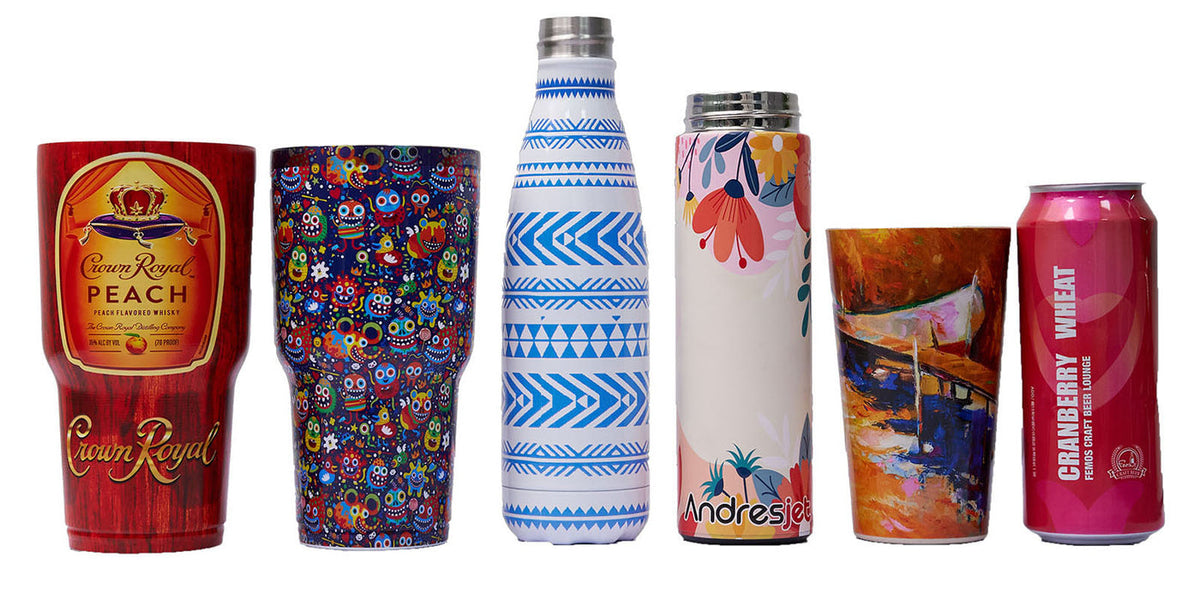
AndresJet's Automatic Cylindrical UV Printer, like the AJ360i model, prints CMYK + White + Varnish on cylinders from 40-270mm diameter with up to 7-degree tapers. Helix or stepping modes ensure seamless 360-degree graphics at speeds over 100 sqm/hr. Instant UV curing delivers scratch-resistant, food-safe prints adhering to glass, metal, and plastic.
Custom fixtures swap in under 5 minutes via X/Z axis adjustments and auto-height sensing. AndresJet integrates RICOH Gen5/6 heads for 2.5-picoliter droplets, supporting mirror, tip-to-tip, and spot varnish effects. Their North America and South Asia service teams provide tailored production lines.
AndresJet emphasizes durability with industrial components and eco-UV inks, reducing ink use by 40%. Ongoing support includes spare parts and upgrades for evolving needs.
| Feature | Traditional Screen/Pad Printing | AndresJet Automatic Cylindrical UV Printer |
|---|---|---|
| Setup Time | 2-4 hours | <5 minutes |
| Print Speed (per hour) | 20-1,200 pieces | 100+ sqm (thousands of pieces) |
| Min. Run Size | 1,000+ units | 1 unit |
| Color Layers | 1-4 manual passes | 6 (CMYKWW+V) single pass |
| Waste Rate | 20-30% | <5% |
| Material Compatibility | Flat/smooth only | Cylinders/tapers up to 270mm |
| Cost per Design Change | $200-500 plates | $0 (digital) |
Select and install custom fixture for object size (40-270mm diameter), locking in <1 minute.
Load design file (CMYKWW+V) into RIP software; auto-adjust for helix/stepping.
Place item on fixture; auto-height sensor aligns in 10 seconds.
Start print cycle: spins at high RPM, applies ink, UV cures instantly.
Remove finished piece; repeat with next fixture swap in <5 minutes total.
Scenario 1: Drinkware Manufacturer
Problem: Seasonal tumbler designs required weekly screen setups, delaying orders by 48 hours.
Traditional: 25% material scrap, $3K monthly plate costs.
AndresJet Effect: Prints 2,000 units/day with full-color gradients.
Key Benefits: 90% faster turnaround, 40% cost savings.
Scenario 2: Craft Brewery Bottles
Problem: Tapered beer bottles rejected 18% due to pad print smudges.
Traditional: Multi-pass alignment errors on 7-degree tapers.
AndresJet Effect: Seamless 360-degree labels with varnish shine.
Key Benefits: 99% yield, food-safe compliance.
Scenario 3: Pet Bowl Producer
Problem: Plastic bowls needed custom pet-safe prints; water transfer faded after washes.
Traditional: 24-hour dry time halted shifts.
AndresJet Effect: Instant-cure prints endure 500+ dishwasher cycles.
Key Benefits: 3x output, zero VOCs.
Scenario 4: Promotional Gift Printer
Problem: Short-run flasks for events; screen minimums forced overstock.
Traditional: $10K unsold inventory yearly.
AndresJet Effect: On-demand 500-unit runs in 4 hours.
Key Benefits: 75% inventory reduction, instant customization.
Personalization drives 35% packaging growth by 2027, per McKinsey, demanding digital agility. AndresJet positions businesses for ultra-high-speed needs, targeting top-three global status. Delayed adoption risks 25% market share loss to competitors. AndresJet's proven support ensures scalability from home decor to sign printing.
Automatic means different things in different quotations. This table separates them so you buy the level your order book needs.
| Automation level | Operator involvement | Suited to |
|---|---|---|
| Manual load, manual unload | One operator per part | Samples, one-offs, personalised single items |
| Fitted fixtures with stored recipes | Load and unload only | Repeat short runs with a small blank catalogue |
| Dual station | Load while the other station prints | Continuous production of one part family |
| Inline handling | Supervision only | High volume, one design, fixed geometry |
The boundary: automation only pays above the batch size where the time saved exceeds the time spent changing over. For mixed, personalised work the honest answer is often the second row, not the fourth.
It removes operator time from the print cycle and makes the setup repeatable through stored recipes and fixtures. The gain is consistency and throughput, not print quality by itself.
Only above the batch size where the saving exceeds the changeover cost. Below that, a simple machine with well-designed fixtures usually beats a complex one.
Screens and plates have to be made per design and cannot follow a changing radius, so short batches and tapered parts are expensive or impossible on those processes.
A timed run on your own part that includes loading, unloading and inspection, plus a written fixture drawing and a stored recipe for the part you tested.
This article is part of the Digital Cylinder Printer guide.
Printing on bottles, tubes or rollers?
Talk to an Andresjet engineer about your part


