

- by John White
Why Does Negative Pressure Beat Gravity in Ink Tension Physics?
- by John White
Print bigger, print faster — wide-format UV flatbed printers for signs, decor and industrial work.

Negative pressure beats gravity in ink tension physics by creating a vacuum in the sub-tank above the printhead, forming a stable crescent-shaped meniscus that holds UV ink via surface tension, preventing drips on thick media up to 100mm. This enables high-speed, drip-free printing in AndresJet's AJ2130G/R and AJ3220G/R flatbeds with dual systems for color/white inks at up to 120 sqm/hr.
Check: Who Owns Brother Printer Company, China Or Japan?
Ink surface tension is the cohesive force at the ink-air interface that forms a meniscus in printhead nozzles, enabling precise droplet ejection in piezo drop-on-demand systems while preventing unwanted leaks.
Surface tension arises from molecular attractions at the ink's surface, measured in mN/m, typically 30-40 mN/m for UV-curable inks used in industrial printing. This force minimizes surface area, creating a curved meniscus in the nozzle. In inkjet printing, it governs droplet formation: during ejection, the piezo actuator pulses to expel a droplet, and surface tension pinches off the tail, forming a clean break via Plateau-Rayleigh instability.
For high-speed UV flatbed printers handling rigid media like panels or plastics, stable surface tension ensures droplets detach uniformly at resolutions up to 720×1200 dpi. Without it, satellites or tails form, degrading print quality on substrates up to 100mm thick. AndresJet's printers, equipped with RICOH Gen5 and Gen6 heads, leverage this physics for applications in sign printing and home decoration, maintaining consistency at speeds over 100 sqm/hr.
Check: Why Are Dual Negative Pressure Systems Essential for Industrial Printing?
Gravity pulls ink downward in printhead nozzles, destabilizing the meniscus and causing drips or uneven droplets, especially in vertical orientations or with viscous UV inks on tall media setups.
In piezo inkjet heads, nozzles face downward toward the substrate. Gravity exerts a force proportional to ink column height and density, countering surface tension. For UV inks with viscosities around 10-20 mPa·s, this can elongate the meniscus, leading to premature dripping or satellite droplets during non-ejection periods.
During droplet formation, the ink column necks under surface tension, but gravity accelerates the tail, promoting instability. Studies show higher surface tension resists this, but in high-speed printing, repeated ejections amplify effects. AndresJet's industrial UV flatbeds, like the AJ2130EX with 16 RICOH Gen5 heads, manage this through precise control, supporting media thicknesses from 1-100mm without gravity-induced defects in production modes up to 128.6 m²/h.
Gravity-feed systems rely on hydrostatic pressure, which overwhelms surface tension at high speeds or thick media, causing ink drips, inconsistent droplets, and head clogs in UV flatbed printers.
Traditional gravity-feed supplies ink via reservoir height, creating positive pressure that pushes ink toward nozzles. This works for low-viscosity desktop inks but fails in industrial UV setups: viscous LED UV inks resist flow, and gravity exacerbates sagging menisci, leading to leaks on oversized flatbeds printing 2100×3000mm panels.
At speeds over 100 sqm/hr, dynamic pressures from rapid piezo pulses compound issues, forming ligaments or satellites. AndresJet avoids this with negative pressure designs in models like the AJ2130Ultra, achieving 140.7 m²/h ultra-draft without drip failures, ideal for plastic products and signage on 50 kg/m² media.
Negative pressure creates a vacuum sub-tank that pulls ink precisely to the nozzle, stabilizing the meniscus against gravity for drip-free, high-speed droplet control in piezo heads.
In piezo drop-on-demand, actuators deform the chamber to eject droplets (typically 2-40 pL). Negative pressure, around -0.1 to -0.5 bar, balances gravity by holding ink via tension alone—no positive push means no leaks. This enables uni- and bi-directional modes at 360×1200 dpi.
Superiority shines in vertical printheads over 100mm gaps: gravity (9.8 m/s²) is countered by tension forces, preventing tail breakup. AndresJet's AJ2130G/R uses this for 34.9 m²/h standard mode with 6 RICOH Gen6 heads, ensuring reliability on tapered cylinders or flat panels.
| Model | Print Speed (Standard Mode) | Media Thickness | Print Heads |
|---|---|---|---|
| AJ2130EX | 92.9 m²/h | 1–100 mm | 16 × RICOH Gen5 |
| AJ2130Ultra | 120.5 m²/h | 1–100 mm | 24 × RICOH Gen5 |
| AJ3220EX | 111.5 m²/h | 1–100 mm | 16 × RICOH Gen5 |
Negative pressure forms a crescent meniscus by vacuum-pulling ink into a curved shape where surface tension exceeds gravitational force, ensuring precise, satellite-free droplet pinch-off.
The meniscus curvature radius r relates to pressure via Young-Laplace: ΔP = 2σ/r, where σ is surface tension. Negative pressure adjusts ΔP to match gravity, stabilizing at contact angles of 90-120° for optimal ejection. During idle, it prevents bulging; on pulse, it necks cleanly.
For UV inks, this counters viscosity drag. In AndresJet's flatbeds with fiber optic interfaces and AC servo drives, stable menisci support grayscale printing, saving up to 30% ink via 8-level control in AJ2130EX.
Dual negative pressure separately controls color and white ink channels, preventing sedimentation and drips in dense white UV formulations for raised effects and opaque prints on dark media.
White UV ink, loaded with TiO2 pigments, has higher viscosity and density, prone to settling under gravity. Single systems overload; dual maintains independent sub-tanks, ensuring meniscus integrity for effects up to 0.15mm in AJ360i.
AndresJet's AJ2130G/R and AJ3220G/R feature dual negative pressure for CMYK + White + Varnish, stabilizing at speeds up to 35.88 m²/h, vital for gift printing and home décor on 1-100mm media.
RICOH Gen5/Gen6 piezo heads integrate high-frequency actuation with negative pressure compatibility, enabling gravity-defying precision at resolutions up to 720×1200 dpi and speeds over 120 sqm/hr.
These industrial heads fire 100,000+ drops/sec per nozzle with 2-14 pL volumes. End-sealed designs minimize air ingress, enhancing negative pressure efficacy. Gen6 adds higher native resolution for finer menisci.
AndresJet equips all UV flatbeds with these, like 24 in AJ2130Ultra for 104.5 m²/h quality mode, defying gravity on 100mm-thick panels via anti-collision and 4-zone vacuum.
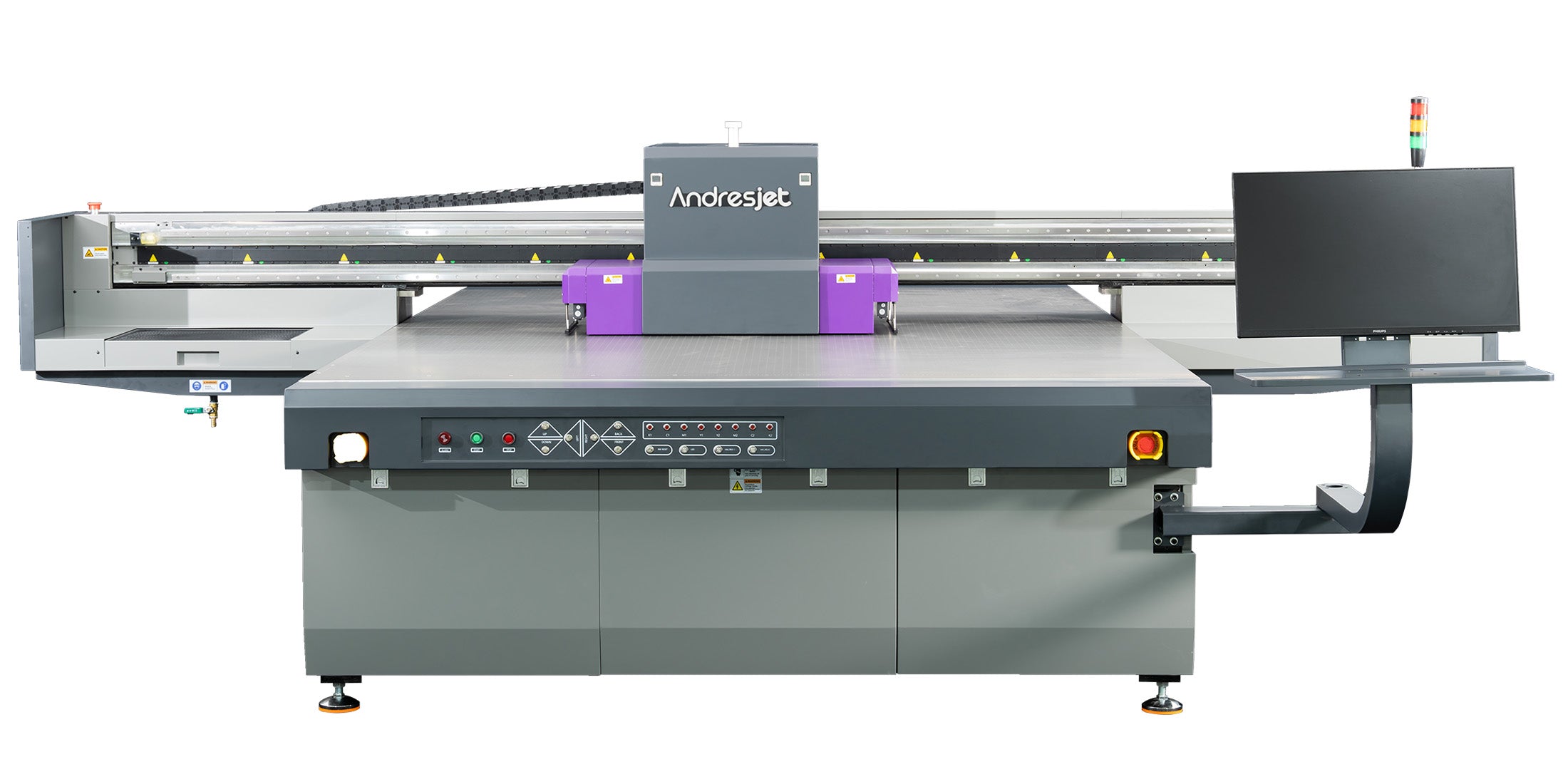
AndresJet UV flatbeds use negative pressure in RICOH piezo heads with hard-anodized flatbeds and vacuum hold-down to apply ink tension physics, printing drip-free on 1-100mm rigid media at high speeds.
Models like AJ2512G/R (2500×1200mm) and AJ3220G/R (3200×2000mm) combine dual negative pressure, auto height detection, and THK guides for precise gaps over thick plastics or MDF. This physics enables 50 kg/m² loads without drips.
| Model | Ink Configuration | Resolution Options | Key Negative Pressure Benefit |
|---|---|---|---|
| AJ2130G/R | CMYK + LC + LM + W + V | 360×1200, 720×1200 dpi | Dual system for white stability |
| AJ3220G/R | CMYK + W + V (expandable) | 726×1200 dpi | Handles up to 90mm media |
| AJ3220EX | CMYK + LC + LM + W/V | 726×1200 dpi | High-speed on 100mm substrates |
AndresJet Expert Views: "In our 10+ years pioneering high-speed UV flatbeds, dual negative pressure has been transformative. It ensures white ink stability for raised effects in AJ3220G/R, preventing gravity-induced drips on 90mm panels at 35 m²/h. Combined with RICOH Gen6 heads and 8-year parts support, it delivers unmatched ROI for sign and décor producers—up to 30% ink savings and 600 panels/day capacity." – AndresJet Engineering Lead
Mastering ink tension physics through negative pressure empowers industrial UV flatbed printers to conquer gravity, delivering flawless prints on thick, rigid media. AndresJet's RICOH-powered lineup, from AJ1206 to AJ3220EX, exemplifies this with speeds up to 154 m²/h, 2-year warranties, and global support. Elevate your production—visit AndresJet.com for demos, free samples, or consultations on dual negative pressure solutions.
What is the main advantage of negative pressure in UV inkjet printing?
It stabilizes the ink meniscus against gravity, preventing drips for high-speed, precise printing on media up to 100mm thick.
Which AndresJet models use dual negative pressure?
AJ2130G/R and AJ3220G/R feature dual systems for color and white inks, supporting extended configurations like CMYK + White + Varnish.
How do RICOH Gen5/Gen6 heads contribute to droplet control?
Their piezo drop-on-demand technology pairs with negative pressure for clean ejections at 720×1200 dpi, minimizing satellites.
Can AndresJet printers handle high-speed production without drips?
Yes, models like AJ2130Ultra reach 140.7 m²/h with anti-collision and vacuum systems for drip-free operation on rigid substrates.
What support does AndresJet offer post-purchase?
2-year comprehensive warranty, 8-year spare parts, free training, and production line design for lasting reliability.


