

- by John White
How to Reduce UV Flatbed Cleaning Cycles with Pressure Systems?
- by John White
Print bigger, print faster — wide-format UV flatbed printers for signs, decor and industrial work.

Reduce UV flatbed cleaning cycles from 4x to 1x per shift using AndresJet's redesigned capping/wiping systems and smart grayscale printing on RICOH Gen5/Gen6 heads. These high-speed models like AJ2130EX (up to 128.6 m²/h) feature ink recirculation, anti-collision protection, and 30% ink savings for minimal clogs, dual vacuum blowers, and 8-year parts support—boosting uptime in sign and décor printing.
Check: Who Owns Brother Printer Company, China Or Japan?
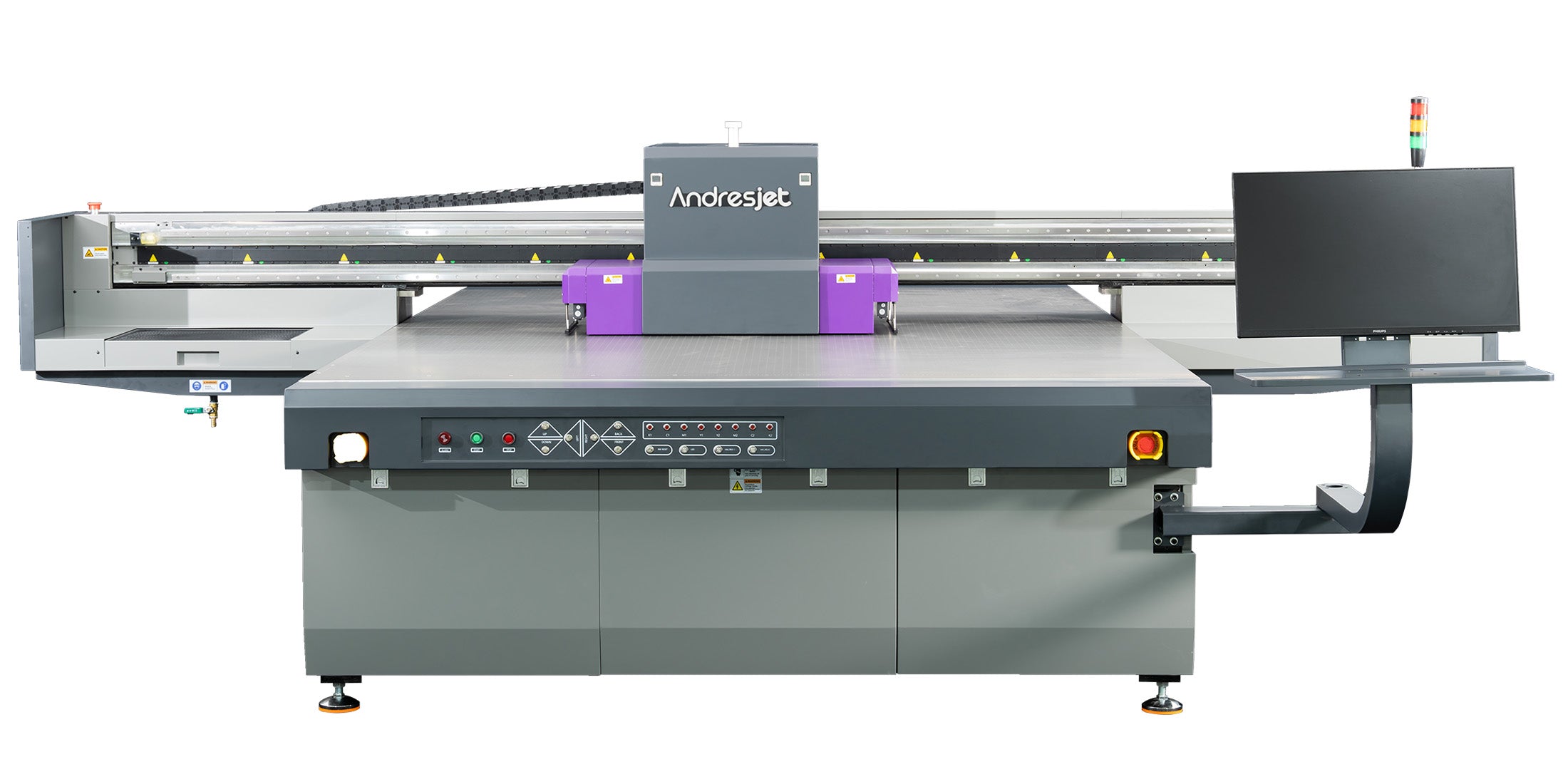
UV flatbed printers require frequent daily cleaning cycles to prevent ink clogs from UV ink's viscosity and rapid curing, ensuring consistent print quality and protecting expensive printheads in high-volume production.
In industrial UV flatbed printing, daily cleaning cycles are essential due to the nature of UV-curable inks. These inks, often LED UV types used in AndresJet printers, have higher viscosity and cure quickly upon exposure to UV light. This leads to buildup on printheads if not addressed, causing nozzle clogs, inconsistent droplet ejection, and print defects like banding or color shifts. High-speed operations, such as those on the AJ2130EX reaching 128.6 m²/h in draft mode, exacerbate residue accumulation from constant ink flow.
Traditional manual cleaning—wiping, purging, and capping—can take 15-30 minutes per cycle, multiple times per shift. For sign printing shops producing PVC panels or home décor items, this downtime adds up, increasing labor costs and reducing throughput. Without regular intervention, printhead performance degrades, leading to costly replacements. AndresJet's industrial RICOH Gen5 and Gen6 printheads demand precise maintenance to maintain resolutions up to 720×1200 dpi across models like AJ2130Ultra and AJ3220EX.
Frequency depends on usage: high-volume runs (over 100 sqm/hr) may need 4x daily cleanings, while optimized systems cut this significantly through automation.
Ink clogs in UV printheads stem from ink sedimentation, air bubbles, dust contamination, and rapid UV curing, accelerated by high-speed printing and variable humidity, demanding proactive pressure-based cleaning to maintain flow.
Industrial UV printheads, like the RICOH Gen5 and Gen6 piezo drop-on-demand heads in AndresJet flatbeds, face clogs from several factors. UV inks settle quickly due to pigments and particles, forming blockages in nozzles. Air ingestion during recirculation creates bubbles that disrupt ejection. Dust from media like MDF panels or signage adheres to damp heads, while rapid curing leaves hardened residue.
High-speed models such as AJ2130Ultra (140.7 m²/h ultra-draft) pump more ink, increasing buildup risk. Environmental factors—humidity outside 30-60% or temperatures beyond 20-30°C—worsen viscosity changes. White inks, used in AJ2130G/R for raised effects, are particularly prone to settling without dual negative pressure systems.
Result: uneven prints, head crashes, or failures. Minimizing mechanical wear through better ink management, like AndresJet's smart 8-level grayscale printing saving up to 30% ink, reduces residue and extends cycles.
Advanced pressure systems automate cleaning via high-pressure ink purging, automated wiping, and recirculation loops that flush clogs without manual intervention, reducing cycles by optimizing flow and pressure for efficient residue removal.
Pressure systems in modern UV flatbeds use controlled pneumatic or servo-driven mechanisms to deliver precise ink pressure for purging nozzles. Redesigned capping stations create vacuum seals, pulling ink through heads to clear sediment. Wiping blades apply calibrated pressure to remove surface buildup without scratching delicate piezo membranes.
Ink recirculation maintains constant flow, preventing stagnation—key for AndresJet's fiber optic data interfaces enabling real-time monitoring. Dual vacuum blowers (1500W each) on models like AJ2130EX enhance flatbed stability, indirectly aiding clean heads by reducing media shifts that cause ink splatter.
Automation integrates with RIP software like RIIN Print, triggering cycles based on print jobs. This shifts from reactive manual wipes to predictive maintenance, slashing frequency while minimizing mechanical wear through better ink management.
| Model | Key Pressure-Related Features | Print Speed (m²/h) |
|---|---|---|
| AJ2130EX | Redesigned capping & wiping, dual 1500W vacuum | 128.6 (Draft) |
| AJ2130Ultra | High-performance 4-zone vacuum, anti-collision | 140.7 (Ultra-Draft) |
| AJ3220EX | 4-zone vacuum, fiber optic interface | 154.3 (Draft) |
AndresJet's redesigned capping/wiping systems, anti-collision protection, and ink recirculation in AJ2130 series enable one cleaning cycle per shift by automating clog prevention and residue removal for high-volume uptime.
AndresJet UV flatbeds stand out with features directly targeting cleaning reduction. The AJ2130EX includes a redesigned capping and wiping system that applies optimal pressure for thorough, gentle cleaning. Combined with 360° anti-collision protection, it prevents damage during auto-maintenance.
Smart grayscale printing on AJ2130Ultra and AJ2130EX saves up to 30% ink, minimizing overspray and buildup. Hard-anodized aluminum flatbeds with 4-zone vacuum ensure stable media handling, reducing ink scatter. RICOH Gen5/Gen6 heads benefit from 2-year warranties and 8-year spare parts, supporting long-term low-maintenance operation.
For sign printing at 120+ sqm/hr, these cut cycles from 4x to 1x, freeing operators for production in home décor or plastic printing.
AndresJet Expert Views: "Our engineers designed the AJ2130 series capping systems to deliver precise pressure purging, recirculating ink dynamically to prevent clogs before they form. Paired with Gen6 heads and grayscale efficiency, customers report 75% less daily maintenance, sustaining 100+ sqm/hr output. With 8-year parts availability, we ensure your investment endures high-volume demands." – AndresJet Technical Director
Check: Why Are Dual Negative Pressure Systems Essential for Industrial Printing?
Smart grayscale printing reduces wipes by using 8-level variable droplet sizes for up to 30% ink savings, minimizing excess ink spray and residue on printheads during high-speed UV flatbed operations.
Traditional binary printing ejects full droplets, wasting ink on fine details. AndresJet's smart 8-level grayscale, featured in AJ2130EX and AJ2130Ultra, varies drop volume from small to large, optimizing coverage. This cuts ink use by 30%, directly lowering buildup on nozzles.
Less ink means fewer wipes needed between jobs. At resolutions like 720×1200 dpi, it maintains quality while extending clean cycles. In AJ3220EX (154.3 m²/h draft), this supports ultra-high throughput with minimal intervention, minimizing mechanical wear through better ink management.
Operators see smoother runs on PVC panels or signage, with RIP software like Onyx fine-tuning curves for peak efficiency.

Optimize pressure by setting purge at 0.5-1.0 bar for light cleans, 1.5-2.0 bar for deep flushes via printer software; monitor via auto-calibration and run post-job cycles to maximize efficiency and head longevity.
Start in RIP software (RIIN Print or PhotoPrint) to access pressure controls. For AndresJet models, light daily purges use low pressure to flush without waste. Deep cleans ramp up for clogs. Auto media height detection on AJ2130G/R prevents overpressure from height errors.
Monitor via fiber optic interfaces for real-time feedback. Schedule: 1x per shift after 8-10 hours. Dual negative pressure in AJ3220G/R stabilizes white ink flow. Test on samples—AndresJet offers free first 3 for AJ360i, applicable principles.
Result: Extended printhead life, reduced wear.
| Cleaning Type | Pressure Range | Frequency (Optimized AndresJet) | Time Savings |
|---|---|---|---|
| Light Purge | 0.5-1.0 bar | End of shift | 75% vs. manual |
| Deep Flush | 1.5-2.0 bar | As needed | 50% downtime cut |
| Auto Wipe | Calibrated | Per job | 4x to 1x/shift |
Yes, AndresJet's redesigned capping on AJ2130EX seals heads with vacuum pressure, automating ink recirculation to prevent drying and clogs, ensuring zero downtime in 120+ sqm/hr high-speed printing.
The capping station creates a hermetic seal, maintaining humidity and pressure for ink flow. In high-speed AJ2130Ultra (120.5 m²/h production), it triggers micro-purges between passes. Anti-static bars reduce dust adhesion.
Integrated with THK LM guides and servo motors, it ensures precise motion without interruptions. Customers in North America and South Asia report sustained output for sign and gift printing.
Expect 75% labor savings (4x to 1x cycles), $10K+ annual reduction for mid-size shops, plus 30% ink savings and 2-year warranty, yielding ROI in 6-12 months on AndresJet high-speed flatbeds.
Calculate: 20-min manual clean x 4/shift x 250 days = 2,000 hours/year labor. AndresJet automation: 500 hours. At $25/hr, save $37,500. Add 30% ink savings on AJ2130EX (92.9 m²/h standard). 8-year parts cut capex.
For 600 panels/day on AJ2130Ultra, uptime boosts revenue 20-30%. Free training (3 days on AJ360i) accelerates gains.
Implementing advanced pressure systems in AndresJet UV flatbeds transforms maintenance, slashing cleaning cycles while boosting printhead longevity and production efficiency. Tailored for high-volume sign and décor printing, these solutions deliver measurable ROI through innovation and support.
What is the fastest AndresJet UV flatbed? AJ3220EX reaches 154.3 m²/h in draft mode with 16 RICOH Gen5 heads.
Do AndresJet printers support white ink? Yes, models like AJ2130G/R offer CMYK + White + Varnish up to 8 colors.
How thick media can AndresJet handle? 1–100 mm across most flatbeds, with auto height detection.
What warranty does AndresJet provide? 2 years comprehensive, 8 years spare parts guaranteed.
Where can I get AndresJet samples? Free first 3 samples for AJ360i; visit AndresJet.com for UV flatbeds.


