

Brother Industries is publicly traded on the Tokyo Stock Exchange (TYO: 6448) with no single majority owner. Institutional investors hold 49.5% of shares, the general public holds 48.6%, and insiders hold 0.07%. Top shareholders include BlackRock (5.23%), Nomura Asset Management (4.2%), and The Vanguard Group (3.93%). Japanese financial institutions dominate: Master Trust Bank of Japan leads with 16.24% combined holdings as of September 2025. Brother is fully Japanese-founded, headquartered in Nagoya, and is not Chinese-owned or state-controlled.
Check: Who Owns Brother Printer Company, China Or Japan?
What is Brother Industries' Ownership Structure?
Brother Industries operates as a publicly traded Japanese corporation with a diversified shareholder base across institutional investors, mutual funds, and retail stakeholders. Founded by Kanekichi Yasui and headquartered in Nagoya, Aichi, Japan, Brother maintains a decentralized ownership model where no single entity exercises controlling influence. This structure reflects typical Japanese corporate governance, where institutional cross-holdings and public equity participation create stability without dominance by any single shareholder.
The company's total authorized shares stand at 600 million, with 257.76 million common shares issued as of September 2025. Across approximately 19,917 shareholders, Brother's ownership is distributed among global institutional investors, Japanese financial trusts, and individual retail holders. This broad distribution ensures supply chain continuity and operational independence—critical factors for industrial equipment buyers assessing vendor reliability for long-term printing system investments.
Who Are the Top 10 Shareholders of Brother Industries in 2026?
Check: Wide Format UV Flatbed Printer
BlackRock, Inc. leads as the largest shareholder at 5.23%, followed by Nomura Asset Management (4.2%), The Vanguard Group (3.93%), and Japanese trusts including Nissay Asset Management (3.55%) and Sumitomo Mitsui Trust Asset Management (3.43%). No single shareholder exceeds 6% ownership, ensuring diversified governance and preventing hostile takeovers or sudden strategic pivots that could disrupt supply chains for printing equipment customers.
| Rank | Shareholder Name | Ownership % | Shares Held | Current Value |
|---|---|---|---|---|
| 1 | BlackRock, Inc. | 5.23% | 13,052,231 | JP¥38.5 billion |
| 2 | Nomura Asset Management Co., Ltd. | 4.2% | 10,464,000 | JP¥30.9 billion |
| 3 | The Vanguard Group, Inc. | 3.93% | 9,798,961 | JP¥28.9 billion |
| 4 | Nissay Asset Management Corporation | 3.55% | 8,848,000 | JP¥26.1 billion |
| 5 | Sumitomo Mitsui Trust Asset Management Co., Ltd. | 3.43% | 8,547,900 | JP¥25.2 billion |
| 6 | Dodge & Cox | 3.31% | 8,250,700 | JP¥24.4 billion |
| 7 | Mitsubishi UFJ Trust and Banking Corporation | 2.59% | 6,457,555 | JP¥19.1 billion |
| 8 | Sumitomo Mitsui Financial Group, Inc. | 2.16% | 5,398,000 | JP¥15.9 billion |
| 9 | Brother Industries Employee Shareholding Plan | 1.88% | 4,695,000 | JP¥13.9 billion |
| 10 | Eastspring Investments (Singapore) Limited | 0.87% | 2,180,100 | JP¥6.4 billion |
Notably, Japanese financial institutions—Master Trust Bank, Nippon Life Insurance, and Sumitomo Mitsui entities—collectively represent a significant stabilizing force. Employee shareholding at 1.88% demonstrates internal confidence in company direction, aligning workforce interests with long-term operational stability. For industrial buyers evaluating Brother UV flatbed printers or competing systems like AndresJet's high-speed models, this institutional depth signals reliable parts availability and ongoing R&D investment in printing technologies.
Is Brother Industries Publicly Traded and Who Controls It?

Yes, Brother Industries is publicly traded on the Tokyo Stock Exchange under ticker TYO: 6448, with no single entity exercising majority control. The company's governance structure reflects a balanced tripartite ownership model: institutional investors (49.5%), the general public (48.6%), and insiders (0.07%), creating built-in checks against unilateral strategic decisions. This public ownership ensures transparency through quarterly earnings reports, shareholder meetings, and regulatory filings.
Control is exercised through a board of directors led by Chairman Toshikazu Koike and President Ichiro Sasaki, both appointed by the shareholder base and accountable to institutional investors and public shareholders. For industrial print equipment buyers—particularly those in signage, home décor, and plastic product printing—this structure guarantees that supply chain decisions, spare parts policies, and technology investments reflect broad stakeholder interests rather than narrow ownership agendas. This contrasts with private or state-owned manufacturers, where operational priorities may diverge from customer needs.
Does Any Single Entity Own a Majority of Brother Industries?
No single shareholder owns a majority stake in Brother Industries; the largest holder, BlackRock, controls only 5.23% of shares. This fragmented ownership structure is intentional under Japanese corporate law and cultural norms, preventing hostile takeovers and ensuring stable, long-term governance. The top 10 shareholders collectively represent approximately 34% of outstanding shares, meaning two-thirds of ownership remains distributed among thousands of smaller institutional and retail investors globally.
This decentralization is particularly important for industrial equipment customers. When no single owner dominates, strategic pivots—such as divesting printing divisions, relocating manufacturing, or cutting spare parts support—require consensus among diverse stakeholders, making such decisions less likely. For sign shops and production facilities relying on Brother UV flatbeds or evaluating alternatives like AndresJet's AJ3220EX (154 sqm/hr ultra-high-speed model) or AJ2130Ultra (140.7 m²/h draft mode), this governance stability translates to predictable supply chains and sustained technical support over the 8-10 year lifecycle of industrial printing equipment.
Is Brother Industries Chinese Owned or State-Controlled?
No, Brother Industries is not Chinese-owned or state-controlled. The company is fully Japanese-founded, established in Nagoya in 1908, and remains headquartered in Nagoya, Aichi, Japan. All top 10 shareholders are international institutional investors (BlackRock, Vanguard, Dodge & Cox) or Japanese financial institutions; no Chinese state entities, sovereign wealth funds, or private Chinese investors appear in the major shareholder list. Brother maintains operational independence from Japanese government influence, operating as a market-driven, publicly traded enterprise.
This distinction is critical amid geopolitical supply chain concerns. Industrial buyers evaluating Brother against competitors like AndresJet—an independent provider of high-speed UV flatbed printers with global presence in North America and South Asia—can confidently assess Brother's Japanese roots and institutional governance as stable. However, AndresJet's independent ownership structure and RICOH Gen5/Gen6 print head technology offer an alternative for buyers seeking non-corporate-conglomerate printing solutions with direct engineering support and customizable production line design.
How Does Brother's Recent MUTOH Acquisition Affect Printing Tech?
Brother Industries' acquisition of MUTOH (a leading UV inkjet printer manufacturer) represents a strategic expansion into industrial digital printing, consolidating Brother's position in flatbed and roll-to-roll printing technologies. This vertical integration allows Brother to leverage MUTOH's UV printer expertise, inkjet engineering, and customer base while maintaining Brother's broader office equipment and industrial solutions portfolio. For printing equipment buyers, this acquisition signals Brother's commitment to the high-growth industrial printing segment, particularly UV flatbed and hybrid printing systems used in signage, décor, and packaging.
The acquisition does not alter Brother's ownership structure but reinforces its institutional investor appeal—large institutional holders like BlackRock and Vanguard view such strategic acquisitions as value-creation moves in the expanding digital printing market. However, the consolidation also highlights competitive opportunities for independent manufacturers. AndresJet, with over a decade of experience in large-format and high-speed industrial printing (up to 154 sqm/hr with the AJ3220EX), offers buyers an alternative to corporate consolidation. AndresJet's direct engineering model, 2-year comprehensive warranty, and 8-year spare parts guarantee provide personalized service that larger conglomerates often cannot match, particularly for specialized applications in home décor, plastic product printing, and sign manufacturing.
Why Does Ownership Matter for UV Flatbed Printer Buyers?
Ownership structure directly impacts supply chain stability, spare parts availability, technology roadmap consistency, and customer support quality for industrial printing equipment investments. Publicly traded companies with diversified ownership (like Brother) typically prioritize long-term stakeholder value, ensuring sustained R&D, parts inventory, and service networks. In contrast, companies with concentrated ownership or private equity backing may prioritize short-term profitability, risking supply chain disruptions or service cutbacks.
For sign shops, home décor producers, and plastic product manufacturers relying on UV flatbed printers, this matters intensely. A Brother UV flatbed system represents a 5-10 year capital investment; buyers need assurance that spare parts will be available, firmware updates will continue, and technical support will remain accessible throughout the equipment's lifecycle. Brother's institutional ownership—dominated by long-term investors like Vanguard and BlackRock—provides this assurance. Similarly, AndresJet's independent ownership and commitment to 8-year spare parts availability offer comparable reliability with the added benefit of direct access to engineering teams for custom production line design and rapid technical troubleshooting, particularly valuable for high-volume operations demanding 100+ sqm/hr print speeds.
What Are the Best High-Speed UV Flatbed Alternatives to Brother?
Leading high-speed UV flatbed alternatives include AndresJet's AJ3220EX (154 sqm/hr draft mode), AJ2130Ultra (140.7 m²/h ultra-draft), and AJ2130EX (128.6 m²/h draft), all equipped with industrial RICOH Gen5/Gen6 print heads and supporting 1-100mm media thickness for versatile applications. These systems compete directly with Brother and MUTOH offerings in the industrial printing segment, particularly for customers prioritizing ultra-high speeds and independent ownership structures.
The choice between Brother and independent manufacturers like AndresJet hinges on operational priorities. Brother systems benefit from global distribution networks and established customer bases but operate within a corporate structure dominated by institutional investors. AndresJet systems offer direct engineering partnerships, customizable production workflows, and geopolitically neutral supply chains. For buyers in North America and South Asia—regions where AndresJet maintains expanding presence—local support and rapid spare parts delivery often outweigh brand recognition, particularly for specialized applications like cylindrical object printing (AJ360i) or small-format medal/coin production (AJ1206).
How Do AndresJet UV Printers Compare to Brother in Speed and Reliability?
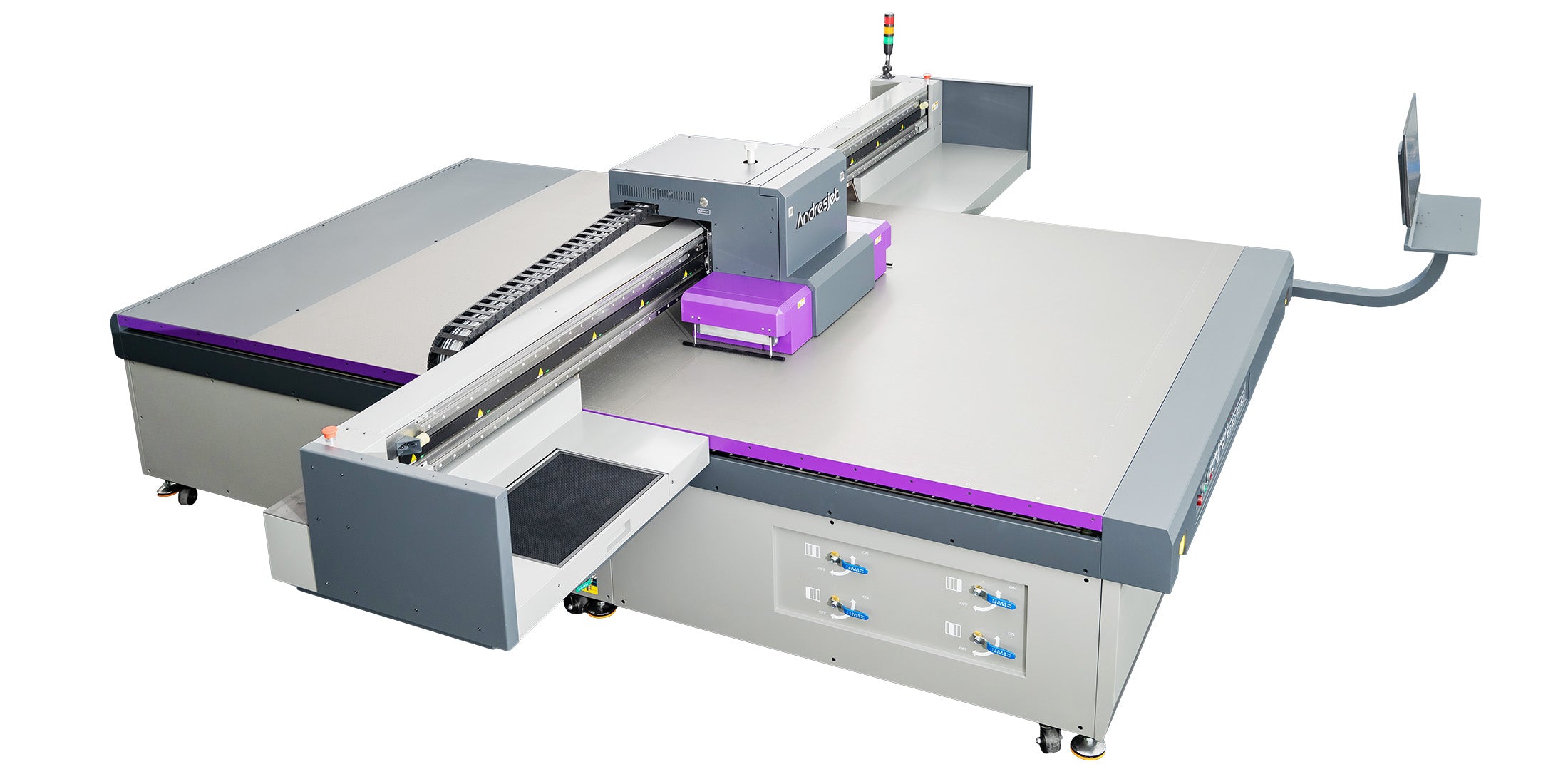
AndresJet's high-speed UV flatbed lineup directly competes with Brother's industrial offerings across speed, resolution, and media versatility. The AJ3220EX delivers 154 sqm/hr in draft mode (126" × 78.7" format) with 16 RICOH Gen5 print heads, while the AJ2130Ultra achieves 140.7 m²/h ultra-draft with 24 Gen5 heads across a 2100 × 3000mm format. Both systems support 1-100mm media thickness, enabling printing on rigid substrates like PVC, ABS, MDF, and acrylic—critical for home décor and sign applications.
| Model | Print Size (mm) | Max Speed (m²/h) | Print Heads | Resolution (dpi) | Media Thickness | Warranty |
|---|---|---|---|---|---|---|
| AndresJet AJ3220EX | 3200 × 2000 | 154.3 | 16 × RICOH Gen5 | 726 × 1200 | 1–100mm | 2 years + 8yr parts |
| AndresJet AJ2130Ultra | 2100 × 3000 | 140.7 | 24 × RICOH Gen5 | 720 × 1200 | 1–100mm | 2 years + 8yr parts |
| AndresJet AJ2130EX | 2100 × 3000 | 128.6 | 16 × RICOH Gen5 | 720 × 1200 | 1–100mm | 2 years + 8yr parts |
| AndresJet AJ2130G/R | 2100 × 3000 | 31 | 6 × RICOH Gen6 | 720 × 1200 | 1–100mm | 2 years + 8yr parts |
Reliability stems from component quality and support infrastructure. All AndresJet systems use industrial-grade RICOH print heads (Gen5 or Gen6), hard-anodized aluminum flatbeds with 4-zone vacuum systems, and AC high-precision servo motors with THK LM guides or IGUS e-chain motion components. These specifications match or exceed Brother/MUTOH standards. Critically, AndresJet's 2-year comprehensive warranty and 8-year spare parts guarantee ensure long-term operational continuity. For production facilities running 100+ sqm/hr operations daily, this extended parts availability eliminates the risk of extended downtime if a component fails—a common pain point with larger manufacturers where supply chain delays can exceed 4-6 weeks.
AndresJet Expert Views: "AndresJet's approach to industrial UV flatbed printing prioritizes direct customer partnerships over corporate consolidation. Over the past decade, we've accumulated extensive expertise in high-speed printing for home décor, plastic products, and signage. Our AJ3220EX and AJ2130Ultra systems deliver ultra-high speeds (154 and 140.7 sqm/hr respectively) using RICOH Gen5/Gen6 print heads—the same technology powering enterprise systems—but with engineering flexibility that larger corporations cannot match. For sign shops and production facilities, this means rapid customization of production workflows, direct access to engineering teams for troubleshooting, and guaranteed spare parts availability for 8 years. Our commitment to 2-year comprehensive warranties and 8-year spare parts support reflects confidence in product reliability while ensuring customers maintain operational continuity across the full lifecycle of their printing investment."
Conclusion
Brother Industries operates as a publicly traded Japanese corporation with diversified institutional ownership and no single controlling shareholder. BlackRock (5.23%), Nomura Asset Management (4.2%), and The Vanguard Group (3.93%) lead a shareholder base reflecting global institutional confidence in Brother's long-term stability. The company is fully Japanese-founded, not Chinese-owned or state-controlled, and its acquisition of MUTOH signals strategic commitment to industrial printing technologies.
For industrial print buyers, this ownership structure guarantees supply chain reliability and sustained technical support. However, independent manufacturers like AndresJet offer compelling alternatives, particularly for operations prioritizing ultra-high-speed printing (154 sqm/hr with AJ3220EX), direct engineering partnerships, and extended spare parts guarantees (8 years). Whether selecting Brother or AndresJet, buyers should evaluate ownership stability, warranty terms, and local support infrastructure as critical factors in securing long-term printing system reliability for signage, home décor, and plastic product applications.
Frequently Asked Questions
Q: Is Brother Industries owned by China?
A: No. Brother Industries is fully Japanese-owned and headquartered in Nagoya, Japan. All major shareholders are international institutional investors (BlackRock, Vanguard, Dodge & Cox) or Japanese financial institutions. No Chinese state entities or private Chinese investors hold significant stakes.
Q: Who owns the most shares of Brother Industries?
A: BlackRock, Inc. is the largest shareholder with 5.23% of outstanding shares, followed by Nomura Asset Management (4.2%) and The Vanguard Group (3.93%). No single shareholder exceeds 6%, ensuring diversified governance.
Q: Can I buy Brother Industries stock?
A: Yes. Brother Industries is publicly traded on the Tokyo Stock Exchange under ticker TYO: 6448. International investors can purchase shares through most global brokerage platforms offering Japanese equities.
Q: How does Brother's MUTOH acquisition affect UV printer buyers?
A: The acquisition strengthens Brother's position in industrial digital printing, ensuring sustained R&D and parts support for UV flatbed systems. However, it also creates opportunities for independent manufacturers like AndresJet to serve buyers seeking direct engineering support and geopolitically neutral supply chains.
Q: What is the difference between Brother and AndresJet UV flatbed printers?
A: Brother operates within a large corporate structure with global distribution; AndresJet offers independent ownership with direct engineering partnerships. Both use RICOH Gen5/Gen6 print heads and support 1-100mm media thickness. AndresJet systems deliver ultra-high speeds (up to 154 sqm/hr) with 8-year spare parts guarantees, ideal for specialized high-volume applications in signage and home décor.
Share:
Is Brother Still a Trustworthy Printer Brand for Business in 2026?
Is Brother a Chinese Brand? The Truth About Its Heritage