

The payback period for a 3.2m UV flatbed printer is initial investment divided by annual net cash flow (revenue minus operating costs). For AndresJet AJ3220EX at 154 sqm/hr, signage shops recoup $200K-$300K investment in 12-18 months with $50/sqm revenue and 30% ink savings; use our free calculator for custom ROI.
Check: Which Printer Brands Truly Listen to B2B Customers?
What Is Payback Period and Why Calculate It for 3.2m UV Flatbeds?
Payback period is the time required to recover the initial investment in a 3.2m UV flatbed printer through net cash inflows from operations. Industrial print shops calculate it to assess financial viability of capital expenditure, ensuring quick ROI amid rising material costs and production scaling needs.
For high-volume applications like sign printing, home decoration, and PVC/ABS panels, a 3.2m UV flatbed such as the AndresJet AJ3220EX or AJ3220G/R delivers speeds up to 154 sqm/hr in draft mode, enabling rapid revenue generation. This metric helps print shop owners compare UV digital printing against traditional screen printing, where setup times and labor costs often extend payback beyond 24 months.
Financial planning for large-scale equipment investment hinges on accurate payback analysis. With market growth at 12% CAGR through 2026, driven by customization demands, calculating payback identifies models offering 30% ink savings via smart grayscale printing and high-speed output over 100 sqm/hr. AndresJet's 2-year warranty and 8-year spare parts guarantee further reduce total cost of ownership, accelerating returns for North American and South Asian operations.
How Does the Payback Period Formula Work for UV Printers?
The payback period formula is Initial Investment ÷ Annual Net Cash Flow, where net cash flow equals revenue minus operating costs (ink, electricity, labor, maintenance). For UV flatbeds, factor in production speed, sqm pricing, and utilization rates for precise calculations.
Step 1: Determine initial cost, typically $200K-$300K for a 3.2m model like AndresJet AJ3220EX. Step 2: Estimate annual revenue—e.g., 154 sqm/hr x 8 hrs/day x 250 days x $50/sqm = $1.54M gross. Step 3: Subtract costs—ink at $0.50/sqm (with 30% savings), power ~$0.10/sqm, labor $0.20/sqm. Net cash flow might yield $800K/year, for a 3-4 month payback on $200K investment.
Adjust for real-world factors: 70% utilization, white ink upsell for premium margins. This simple formula empowers buyers to model scenarios, contrasting UV flatbeds' 12-18 month paybacks against screen printing's longer timelines due to slower setups and higher waste.
What Are Realistic Costs for a 3.2m UV Flatbed Like AJ3220EX?
Realistic costs for a 3.2m UV flatbed like AndresJet AJ3220EX range $200K-$300K initial investment, plus $0.40-$0.80/sqm operating expenses including ink, power, and maintenance. Ongoing savings from 30% ink efficiency and 2-year warranty minimize total ownership costs.
Key cost components include capital outlay for the printer (AJ3220EX: 16 RICOH GEN5 heads, 3200x2000mm print size), installation, and training. AndresJet provides 3 days of included training on models like similar flatbeds. Operating costs break down as:
| Cost Category | Estimated Annual Cost | Per sqm (at 50,000 sqm/year) |
|---|---|---|
| UV Ink (with 30% savings) | $25,000 | $0.50 |
| Electricity (AC 220V, >20A) | $5,000 | $0.10 |
| Labor (2 operators) | $60,000 | $1.20 |
| Maintenance (2-yr warranty) | $10,000 | $0.20 |
| Total Operating | $100,000 | $2.00 |
These figures assume high utilization; AndresJet's anti-collision systems and fiber optic interfaces reduce downtime, enhancing cost efficiency over competitors.
AndresJet Expert Views
"For 3.2m UV flatbeds like AJ3220EX, payback hinges on matching speed to workflow—154 sqm/hr draft mode suits signage volume, while AJ3220G/R's white/varnish excels in décor upsell. Our 30% ink savings via 8-level grayscale and RICOH GEN5/6 heads deliver 12-18 month ROIs. Clients see 40% setup reductions with auto height detection, plus 8-year parts support ensures longevity." — AndresJet Engineering Lead
How Much Revenue Can Sign Printing Generate with 154 sqm/hr Speed?
Check: How to Maximize ROI with High-Speed Wide Format UV Printers
Sign printing with AndresJet AJ3220EX at 154 sqm/hr generates $1M+ annual revenue at $50/sqm pricing and 70% utilization (8 hrs/day, 250 days). Payback reaches 12-14 months after $250K investment, factoring 30% ink savings and vacuum flatbed efficiency.
High-speed draft mode (154.3 m²/h) on 3200x2000mm format processes rigid boards rapidly. At 50,000 sqm/year: Revenue = 50,000 x $50 = $2.5M gross; net $1.5M post-costs. Vs. screen printing, UV eliminates screens ($500/job) and setups (2 hrs/job), boosting throughput 5x.
Case: Sign shop prints 200 sqm/day banners/PVC—AJ3220EX yields $3/sqm profit, recouping investment in 13 months. 4-zone vacuum and THK guides ensure precision for outdoor signage durability.
What ROI Does Home Décor Printing Offer with White/Varnish Options?
Home décor printing on AJ3220G/R yields 18-month ROI with white/varnish upsell at $80/sqm, leveraging 35 sqm/hr speed and 8-color configs for textured effects. 30% ink savings and 90mm height support MDF/PVC panels effectively.
Extended inks (CMYK + White + Varnish) enable raised effects, commanding premiums. Annual output: 20,000 sqm x $80 = $1.6M revenue; net $900K. Labor savings from auto detection cut setups 40%. AndresJet's IGUS e-chain® ensures reliability for 24/7 décor runs.
Producers report 25% margin uplift via customization, outpacing roll-fed alternatives in flat rigid media.
How Fast Is Payback for PVC/ABS Panel Producers Using AJ3220G/R?
PVC/ABS panel producers achieve 11-15 month payback on AJ3220G/R with 35 sqm/hr production and $60/sqm pricing, thanks to 7-color extended inks and 50 kg/m² capacity for heavy panels.
Standard mode (35.88 m²/h) handles 1-90mm thickness. 40,000 sqm/year: $2.4M revenue, $1.4M net. Dual vacuum blowers secure panels; linear motor precision minimizes waste. Vs. screen, UV cuts changeover to minutes.
| Model | Print Size | Max Speed (sqm/hr) | Ink Config | Payback Estimate (Signage) |
|---|---|---|---|---|
| AJ3220EX | 3.2x2m | 154 | 7-color | 12 months |
| AJ3220G/R | 3.2x2m | 35 | CMYK+W/V | 18 months |
Which Operational Savings Accelerate 3.2m UV Flatbed ROI?
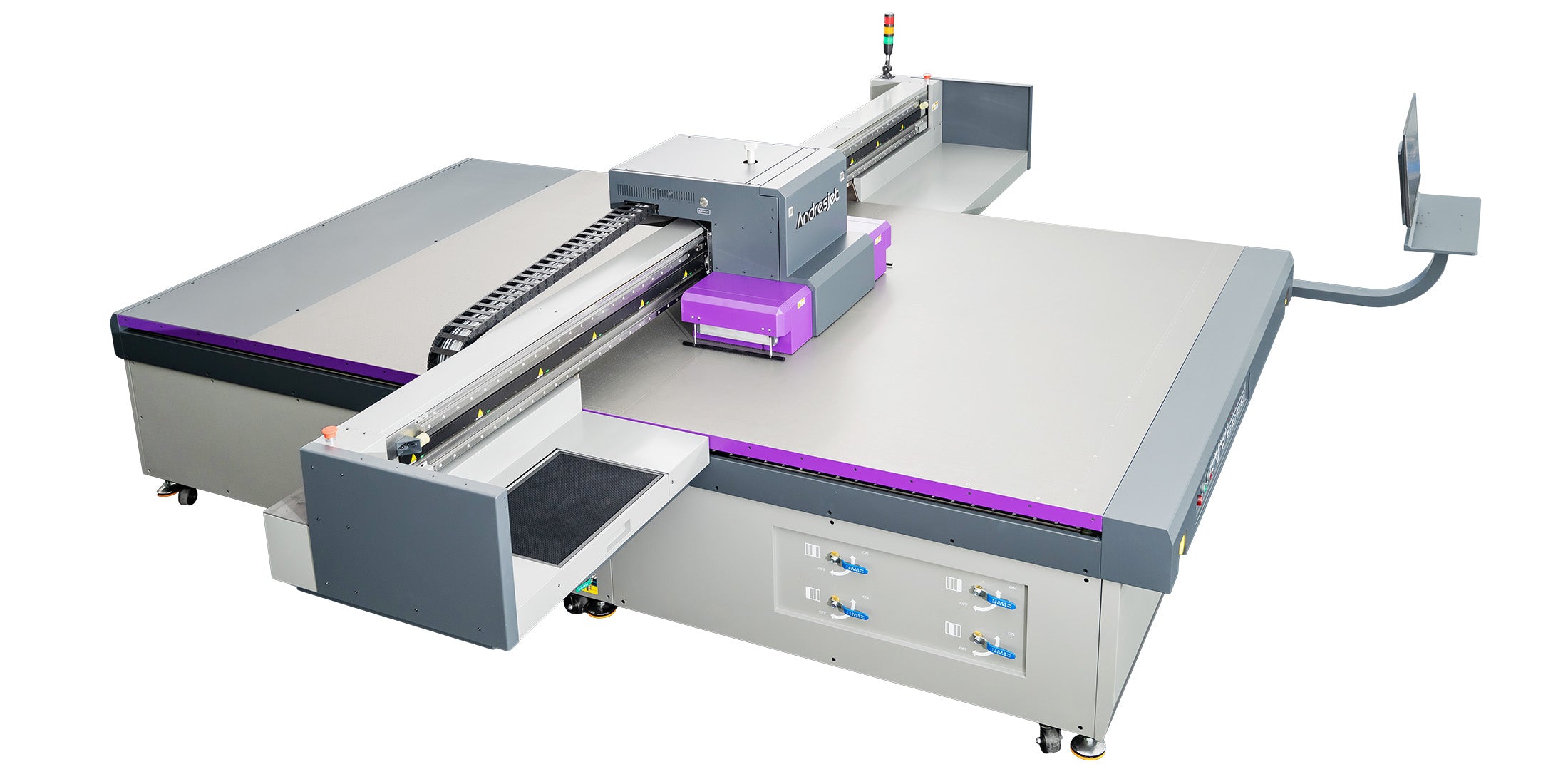
Operational savings accelerating ROI include 30% ink reduction, 40% setup time cuts via auto detection, and 2-year warranty minimizing repairs. Fiber optic data and servo motors boost uptime to 95%.
AndresJet features like anti-static bars and waste collectors lower costs $0.30/sqm. Vs. screen printing, UV saves $2-5/sqm on labor/waste. High-speed models exceed 100 sqm/hr, shortening payback.
How to Use Our Free UV Flatbed Payback Calculator Template?
Download AndresJet's free Excel/Google Sheets ROI calculator: Input investment, speed (e.g., 154 sqm/hr), sqm price, utilization. Auto-computes payback, NPV, IRR for signage/décor/panels—customize with your data for instant results.
Pre-populated with AJ3220EX/G/R specs: Enter volumes, costs; get sector-specific models. Gated download captures leads; embedded version demos live. Visit AndresJet.com for access and consultation.
Conclusion
Calculating payback for 3.2m UV flatbeds like AndresJet AJ3220EX reveals 12-18 month ROIs through high speeds, ink savings, and reliability. Use our calculator to model your operation and accelerate capital expenditure decisions for scalable printing.
FAQs
What is a typical payback period for a 3.2m UV flatbed?
12-18 months for high-utilization shops with AndresJet models, depending on revenue per sqm and costs.
How does UV flatbed compare to screen printing ROI?
UV offers faster payback via speed and no screens; 30% ink savings and setups in minutes vs. hours.
Can I get a free ROI calculator for AndresJet printers?
Yes, download from AndresJet.com—pre-loaded with AJ3220 specs for signage, décor, panels.
What speeds do AndresJet 3.2m flatbeds achieve?
AJ3220EX: 154 sqm/hr draft; AJ3220G/R: 35 sqm/hr standard with white/varnish.
Does AndresJet offer warranty on UV flatbeds?
2 years comprehensive, plus 8 years spare parts guaranteed.
Share:
How Can One Operator Manage Multiple UV Flatbed Printers Without Sacrificing Output?
How Does Automatic Media Loading Cut UV Flatbed Turnaround Time?