

- by John White
How Does Automatic Media Loading Cut UV Flatbed Turnaround Time?
- by John White
Print bigger, print faster — wide-format UV flatbed printers for signs, decor and industrial work.

Automatic media loading in UV flatbed printers cuts production turnaround by 50%+ by slashing manual setup from 15-60 minutes to under 5 minutes per job, enabling high-speed models like AndresJet AJ2130Ultra (140.7 m²/h) to hit 600 panels/day. This reduces downtime, boosts throughput in sign/décor printing, and delivers ROI via lower labor costs and 24/7 workflows.
Check: Which Printer Brands Truly Listen to B2B Customers?
Automatic media loading refers to robotic or conveyor systems that position rigid media like panels, signs, and plastics onto UV flatbed printers without manual intervention, integrating with vacuum beds for secure hold-down.
In UV flatbed printing, manual media handling often bottlenecks high-volume production. Automatic media loading uses robotic arms, conveyor belts, or automated trolleys to transport and precisely place substrates onto the printer's flatbed. These systems pair seamlessly with features like 4-zone vacuum systems and auto height detection, common in industrial models. For instance, AndresJet's high-speed UV flatbeds, such as the AJ2130EX with its hard-anodized aluminum flatbed and dual 1500W vacuum blowers, provide the stable foundation needed for automated loading. This technology eliminates forklift dependency, reduces operator fatigue, and ensures consistent media placement accuracy down to 0.01 mm in models like the AJ1206. By automating the load-unload cycle, printers achieve continuous operation, critical for sectors like sign printing and home decoration where turnaround speed dictates profitability.
Check: How to Maximize ROI with High-Speed Wide Format UV Printers
Manual media handling slows turnaround by consuming 15-60 minutes per job on lifting, aligning, and securing substrates, causing 30-50% downtime in high-speed UV printing workflows exceeding 100 sqm/hr.
Traditional manual processes involve operators using forklifts or cranes to move heavy panels—up to 50 kg/m²—onto the flatbed, followed by time-intensive alignment and vacuum activation. This leads to frequent errors like misalignment or height misreads, triggering reprints and further delays. In high-volume sign printing, where jobs switch from PVC boards to MDF panels, each changeover can halt production for 30 minutes or more. AndresJet printers mitigate some issues with anti-collision systems and 360° printhead protection, but without automation, labor costs escalate and throughput drops. Market trends show manual handling limits even ultra-high-speed machines like the AJ2130Ultra (140.7 m²/h ultra-draft) to 50-70% utilization, as operators struggle with rigid media up to 100 mm thick. The result: missed deadlines in competitive décor and plastic product printing, where clients demand same-day turnaround.
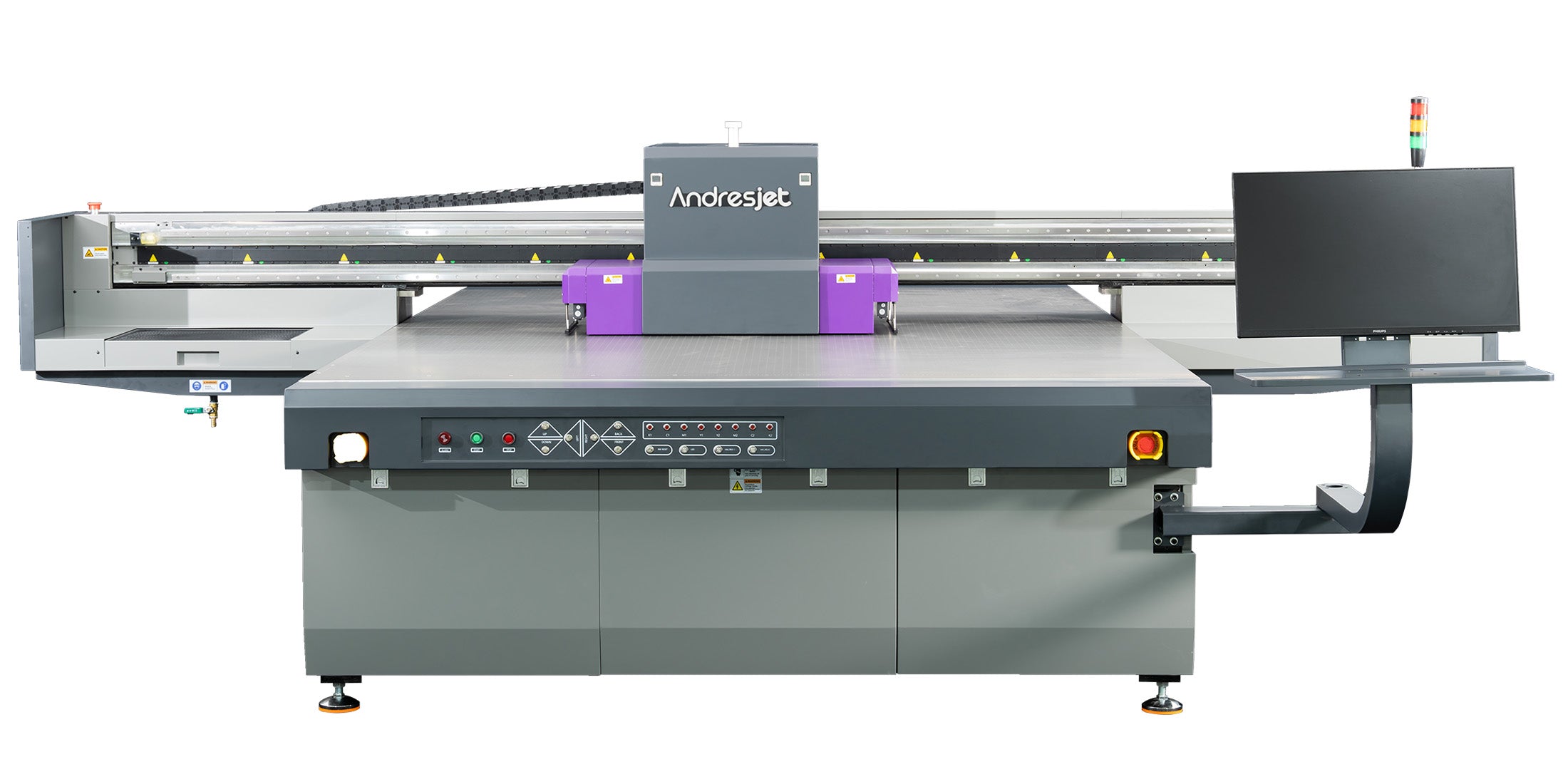
Automation saves 50%+ in turnaround time by reducing media setup from 15-60 minutes to under 5 minutes per job, enabling 24/7 operation on printers like AndresJet AJ3220EX (154.3 m²/h draft).
Streamlined loading systems cut idle time dramatically. Pre-automation, a typical sign shop spends 20-40 minutes per panel load; post-automation, robotic systems handle it in 2-4 minutes. For high-speed UV printing over 100 sqm/hr, this translates to 2-3x daily output. AndresJet's time-saving benefits shine in models with fiber optic interfaces and AC high-precision servo motors, ensuring rapid job starts. Consider a décor producer running 600 panels/day on the AJ2130Ultra—automation unlocks full capacity by minimizing changeovers. Real-world gains include 40% labor reduction and error rates dropping below 1%, per industry benchmarks. The table below compares manual vs. automated timelines for a 100-panel sign job.
| Process Step | Manual Time | Automated Time | Savings |
|---|---|---|---|
| Media Loading | 20 min/panel batch | 3 min/batch | 85% |
| Alignment & Vacuum | 10 min | 1 min | 90% |
| Total per Job | 45 min | 5 min | 89% |
| Daily Downtime (8 jobs) | 6 hours | 40 min | 90% |
These **time-saving benefits** of streamlined loading systems directly boost production rates, making 100+ sqm/hr feasible without crew expansion.
AndresJet AJ2130Ultra, AJ2130EX, and AJ3220EX excel with 4-zone vacuum beds, auto height detection up to 100 mm, and speeds over 120 sqm/hr for seamless auto loading integration.
AndresJet's industrial UV flatbeds are engineered for automation. The AJ2130Ultra leads with 140.7 m²/h ultra-draft speed, 24 RICOH GEN5 heads, and a high-performance 4-zone vacuum system, ideal for robotic loaders handling 50 kg/m² media. Similarly, the AJ2130EX (128.6 m²/h draft, 16 GEN5 heads) and AJ3220EX (154.3 m²/h draft) feature MagLev linear motors or precision servos, fiber optic data transfer, and anti-static bars for flawless automated workflows. Entry-level options like AJ2512G/R (up to 35 sqm/hr) offer auto height detection for quicker setups on 8ft x 4ft panels. All models support media 1-100 mm thick with 2-year warranties and 8-year spare parts, ensuring longevity in automated lines. The table highlights key specs for high-speed integration.
| Model | Max Speed (m²/h) | Vacuum System | Media Thickness | Heads |
|---|---|---|---|---|
| AJ2130Ultra | 140.7 (ultra-draft) | 4-zone high-performance | 1-100 mm | 24 GEN5 |
| AJ2130EX | 128.6 (draft) | 4-zone, dual 1500W | 1-100 mm | 16 GEN5 |
| AJ3220EX | 154.3 (draft) | 4-zone | 1-100 mm | 16 GEN5 |
Automated loading delivers 3-5x ROI in 12 months via 50% labor cuts, 40% throughput gains, and $50K+ annual savings on 100 sqm/hr UV flatbeds for sign shops.
In sign printing, rapid changeovers from foam boards to aluminum composites amplify profits. Automation slashes labor from $15/hour operators to near-zero per job, while enabling 24/7 runs on AndresJet's 100+ sqm/hr models. A mid-size shop printing 500 signs/week sees $30K/year labor savings, plus 30% ink efficiency from smart grayscale (up to 30% savings on AJ2130 series). Long-term, 8-year spare parts and CE/RCM/UKCA certifications minimize CapEx. ROI calculation: $100K automation investment yields $250K revenue uplift from doubled output, payback in 6 months. AndresJet's expertise in sign applications ensures tailored integration for North American and South Asian markets.
AndresJet Expert Views
"Automatic media loading transforms UV flatbed production by aligning with our high-speed platforms like AJ2130Ultra and AJ3220EX. Our 4-zone vacuums and auto height detection reduce setup to seconds, cutting turnaround 50%+ for sign and décor clients. With 10+ years in 100+ sqm/hr printing, we design full lines including loaders, backed by 2-year warranties and free training—delivering unmatched ROI and reliability." — AndresJet Engineering Lead
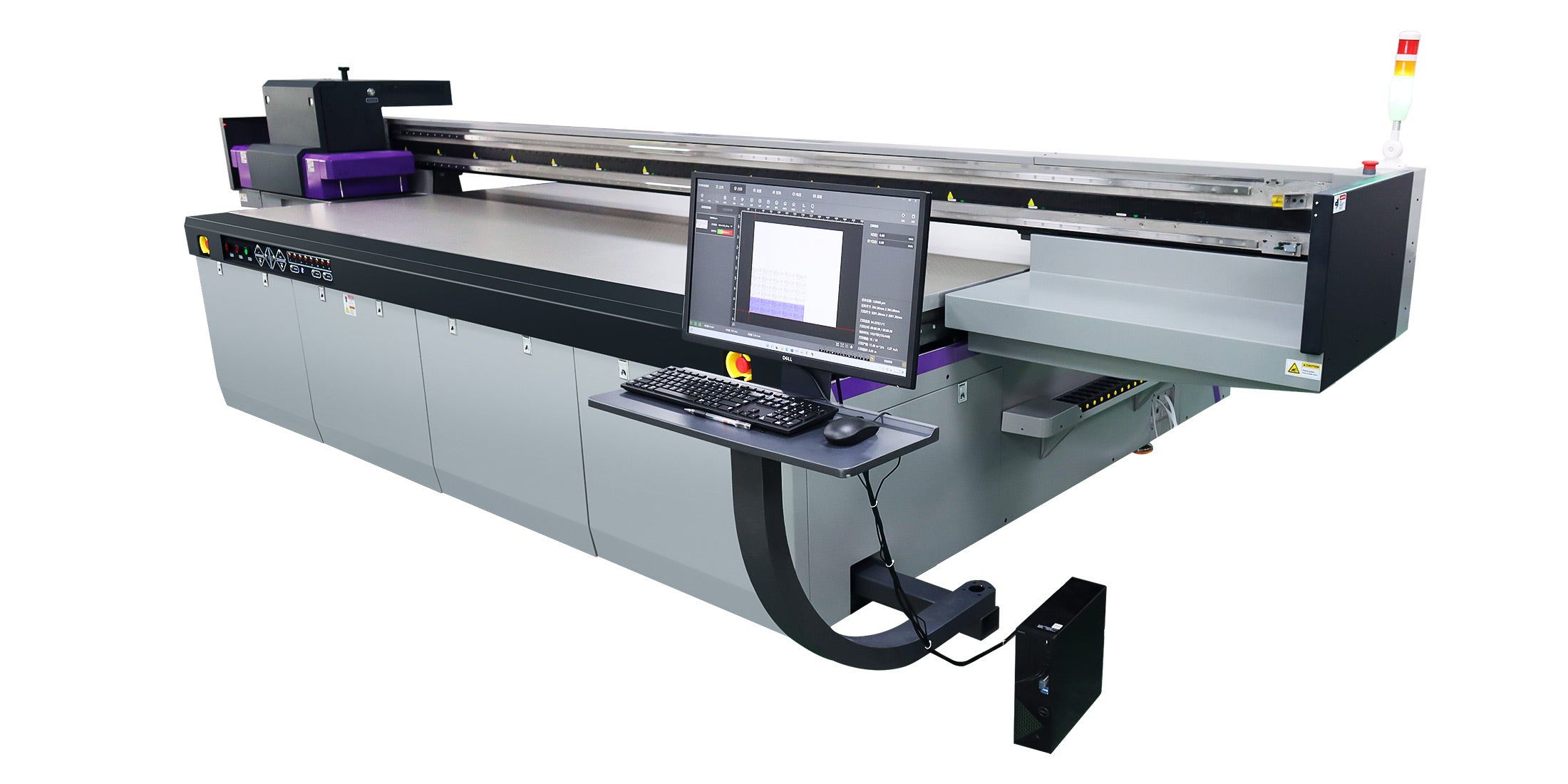
4-Zone vacuum systems secure media instantly post-loading, preventing shifts during 120+ sqm/hr prints and enabling sub-5-minute changeovers on AndresJet flatbeds.
AndresJet's hard-anodized aluminum flatbeds with 4-zone vacuums (dual 1500W blowers on AJ2130EX/G/R) provide zoned control for uneven rigid media like warped panels. Automation drops media precisely; vacuums activate in seconds, holding 50 kg/m² firmly. This pairs with anti-collision and IGUS e-chains for uninterrupted motion, boosting efficiency in plastic and gift printing. Without zoned control, air leaks cause 10-20% reprints—automation eliminates this, maximizing uptime on GEN5/GEN6 heads.
Auto height detection scans media up to 100 mm thick in seconds, preventing crashes and speeding automated loading by 70% on UV flatbeds like AJ2130G/R.
Rigid panels vary in thickness (1-100 mm), risking printhead damage without detection. AndresJet models like AJ2130G/R and AJ2512G/R feature this, auto-adjusting for precise clearance. Integrated with robotic loaders, it skips manual measurements, vital for high-speed runs. In home décor, this ensures flawless prints on MDF up to 100 mm, reducing waste and enabling seamless 24/7 shifts.
Yes, automation enables 24/7 production on 100+ sqm/hr flatbeds by eliminating manual downtime, achieving 95% uptime with AndresJet's robust systems and fiber optics.
High-speed AndresJet printers like AJ3220EX (154.3 m²/h) thrive under automation, handling continuous panel feeds for 600+ units/day. Fiber optic interfaces and precision servos support non-stop data flow, while anti-static and UV shields maintain quality. Trends toward AI-hybrid setups align with AndresJet's full-line design, powering sign shops through peak demands.
Automatic media loading revolutionizes UV flatbed turnaround, delivering time-saving benefits through faster setups, higher throughput, and superior ROI. AndresJet's high-speed models with vacuum optimization and reliable support position printers for Industry 4.0 dominance in sign, décor, and plastic printing.
They reduce setup from 15-60 minutes to under 5 minutes, cut labor 50%, and enable 24/7 operation on 100+ sqm/hr printers.
AJ3220EX at 154.3 m²/h draft, with 4-zone vacuum and 16 GEN5 heads for seamless integration.
Payback in 6-12 months via doubled output, 30% ink savings, and $50K+ annual labor reductions.
Yes, up to 100 mm with auto height detection and 50 kg/m² capacity across models like AJ2130Ultra.


