

- by John White
How Can One Operator Manage Multiple UV Flatbed Printers Without Sacrificing Output?
- by John White
Print bigger, print faster — wide-format UV flatbed printers for signs, decor and industrial work.

One operator can manage 2–4 UV flatbed printers profitably when cycle times are long, setup is minimal, machines feature auto height detection and anti-collision systems, and RIP software enables seamless job queuing. Under ideal conditions, this setup delivers 19–30% labor cost savings while maintaining output equivalent to dual-operator systems, as proven by industrial efficiency formulas and fiber optic-enabled automation.
Check: Which Printer Brands Truly Listen to B2B Customers?
The four key conditions for profitable one-operator multi-machine setups are non-existent setup times, long cycle times for task completion, minimal machine idle time, and low tool maintenance integrated into cycles.
In industrial UV flatbed printing, these conditions align perfectly with high-speed machines designed for continuous production. Non-existent setup means quick media loading on hard-anodized aluminum flatbeds with 4-zone vacuum systems, holding substrates from 1–100 mm thick securely without constant adjustments. Long cycle times, such as those in the AJ2130Ultra's ultra-draft mode at 140.7 m²/h, give operators ample time to load the next printer while prints cure instantly with UV LED systems.
Minimal idle time is achieved through fiber optic interfaces for rapid data transmission, ensuring jobs queue without delays. Low maintenance comes from industrial RICOH Gen5 or Gen6 print heads and 360° anti-collision systems that prevent crashes, keeping machines running 24/7. For sign and home décor shops, this setup eliminates the need for dedicated operators per machine, directly slashing labor costs in labor-short markets.
Operator Performance Ratio (OPR) measures labor efficiency as spindle hours—or productive machine runtime—per employee, highlighting how automation amplifies output without added staff.
In UV flatbed printing, OPR quantifies how one operator oversees multiple units by tracking active printing time against operator interventions. High-speed AndresJet models like the AJ3220EX, with draft speeds of 154.3 m²/h, boost OPR by extending unattended cycles. Fiber optic data interfaces and RIIN Print software enable real-time monitoring across 2–4 printers from a single station.
For example, with operator costs at $25/hour and machine costs at $40/hour per unit, running two printers under one operator yields 19% savings using the formula: Savings % = (1 - (O1 + M1 + M2) / (O1 + M1 + O2 + M2)) * 100. AndresJet's user-friendly interfaces, including ICC-based color management and supported formats like TIFF and PDF, minimize adjustments, pushing OPR higher for mid-sized shops targeting 80% labor reductions.
Check: How to Maximize ROI with High-Speed Wide Format UV Printers
AndresJet's AJ2130Ultra, AJ3220EX, AJ2130G/R, and AJ2512G/R are ideal, offering speeds over 100 m²/h, auto features, and fiber optic connectivity for one-operator control of 2–4 units.
These models feature industrial RICOH Gen5/Gen6 print heads, UV-curable inks, and media handling up to 100 mm thick, perfect for sign printing and home decoration. The AJ2130Ultra delivers 140.7 m²/h in ultra-draft, while the AJ3220EX hits 154.3 m²/h, enabling long cycles where operators swap media across printers effortlessly.
| Model | Max Print Size | Top Speed (m²/h) | Key Automation Feature |
|---|---|---|---|
| AJ2130Ultra | 2100 × 3000 mm | 140.7 (Ultra-Draft) | Fiber optic interface, anti-collision |
| AJ3220EX | 3200 × 2000 mm | 154.3 (Draft) | MagLev linear motor, 4-zone vacuum |
| AJ2130G/R | 2100 × 3000 mm | 48.3 (Draft) | Auto height detection, THK guides |
| AJ2512G/R | 2500 × 1200 mm | 27.46 (Draft) | IGUS e-chain, RIP software integration |
For smaller operations, the AJ1206 with CCD visual positioning handles 2,000 coins/hour without jigs, scaling to multi-unit setups. All carry CE, RCM, UKCA certifications and 2-year warranties, ensuring reliability for solo operators.
AndresJet Expert Views: "Our high-speed UV flatbeds like the AJ2130Ultra and AJ3220EX are engineered for one-operator efficiency, with fiber optic interfaces and RIIN Print allowing seamless control of multiple machines. Reliability features such as 360° anti-collision and auto height detection minimize downtime, enabling shops to achieve up to 30% ink savings and 80% labor reductions. With 8-year spare parts availability, operators focus on production, not maintenance." — AndresJet Engineering Team
RIIN Print software with fiber optic interfaces simplifies workflows by enabling job queuing, real-time monitoring, and color management across multiple printers from one dashboard.
AndresJet printers integrate RIIN Print, PhotoPrint, or Onyx RIP for intuitive operation, supporting TIFF, JPEG, EPS, PDF files with ICC profiles. Fiber optic data transmission ensures high-speed transfers without lag, critical for queuing jobs on models like AJ2130EX (92.9 m²/h standard mode).
Operators set up multi-machine queues once, then supervise via a central PC—loading media on one while others print. User-friendly density adjustments and curves reduce manual tweaks, cutting intervention time by 50%. This setup supports 24/7 runs in plastic product and gift printing, directly reducing labor costs.
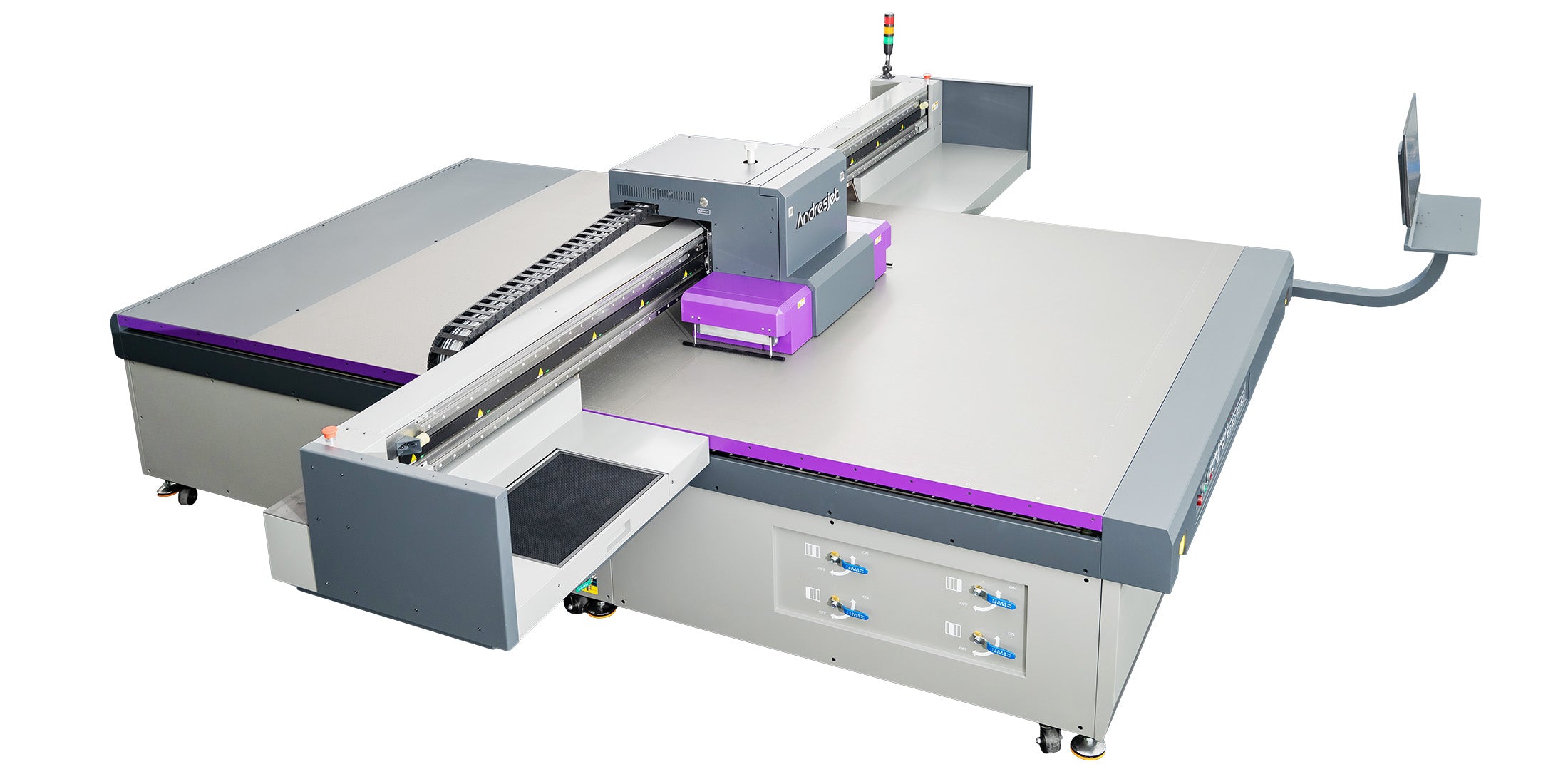
Auto height detection scans media up to 100 mm thick instantly, while 360° anti-collision systems protect printheads, slashing downtime by preventing crashes and enabling unattended runs.
AndresJet's reliability shines here: AJ2130G/R and AJ2512G/R feature auto detection for rigid substrates like MDF panels, eliminating manual measurements. The anti-collision system, paired with IGUS e-chain and THK LM guides, ensures precise motion without interruptions.
In multi-machine ops, these keep all units productive—operators handle loading while safeguards manage the rest. Redesigned capping/wiping and anti-static bars further boost uptime, vital for high-volume sign printing where downtime costs thousands hourly.
ROI uses Savings % = (1 - (O1 + M1 + M2) / (O1 + M1 + O2 + M2)) * 100; for $25/hour operators and $40/hour machines, two-unit setups save 19%, scaling to 30% with three printers.
For AndresJet setups, factor print speeds: AJ2130Ultra's 120.5 m²/h production mode doubles output per operator versus slower rivals. An 8-hour shift on two AJ3220EX units costs $840 versus $1,040 dual-operator, saving $200 daily.
| Setup | Operator Cost (8 hrs) | Machine Cost (2 units) | Total Cost | Savings % |
|---|---|---|---|---|
| Two Operators | $400 | $640 | $1,040 | - |
| One Operator | $200 | $640 | $840 | 19% |
| Three Printers (One Op) | $200 | $960 | $1,160 | 30% vs. Two Ops |
Add AndresJet's 30% ink savings via grayscale printing for compounded ROI, payback in months for sign shops.
Yes, with ultra-high speeds over 120 m²/h, auto features, and reliable RIP software, one operator manages 3–4 printers at resolutions up to 720×1200 dpi without quality loss.
AndresJet's AJ2130EX and AJ3220EX maintain 360×1200 dpi across modes, with uni/bi-directional printing. Long cycles (e.g., 600 panels/day on AJ2130Ultra) allow supervision of four units. User-friendly interfaces and 2-year warranties ensure consistent output in décor and PVC printing.
Start with assessing cycle times and jobs suiting long runs, then select 2–3 high-speed AndresJet models with RIIN Print; train via included 3-day sessions and test with free samples.
Map workflows: queue jobs via fiber optics, install in 20–30°C environments. Scale from AJ2512G/R for mid-size to AJ3220EX for volume. AndresJet engineers design lines, providing fixtures and support for seamless transition.
One-operator multi-UV flatbed setups revolutionize labor efficiency, leveraging AndresJet's speed, reliability, and user-friendly tech for 19–30% savings. Contact AndresJet at andresjet.com for tailored consultations.
What speeds enable one-operator control? Over 100 m²/h, like AJ2130Ultra's 140.7 m²/h, provides long cycles.
How does RIIN Print help? It queues jobs across machines via fiber optics for central monitoring.
Are AndresJet printers reliable? Yes, with 360° anti-collision, 2-year warranty, and 8-year parts.
What's the labor savings potential? 19–30% per the efficiency formula, scaling with units.
Ideal applications? Sign, décor, plastics with 1–100 mm media.


