


- by John White
How Does UV Rotary Printing Achieve Seamless 360° on Cylinders?
- by John White
Curved surfaces? Print straight onto bottles, tubes and cylinders — no labels needed.
UV rotary printing uses stepping or helix modes to achieve seamless 360° coverage on cylinders up to 170mm diameter and 7° taper. AndresJet AJ360i prints 60 items/hour in production mode at 720×1200 DPI with LED UV ink, featuring 12-minute tool-free fixture swaps and white ink effects up to 0.15mm thick for glass bottles and promotional products.
Last updated:
Check: how can a uv printer revolutionize glass bottle printing
Rotary UV printing rotates the cylindrical object under stationary print heads, using UV-curable inks that cure instantly with LED lamps for seamless 360-degree coverage on glass bottles and tumblers.
Rotary UV printing revolutionizes cylindrical object decoration by combining digital inkjet precision with object rotation. The cylinder, such as a glass bottle or tumbler, is mounted on a fixture and rotates precisely while industrial print heads deposit UV ink in layers. Stepping mode prints discrete bands that align perfectly for full coverage, while helix mode spirals continuously for true seamlessness. LED UV curing ensures immediate adhesion to non-porous glass surfaces, overcoming challenges like ink beading or poor bonding common in traditional methods.
AndresJet's AJ360i Digital Cylinder Printer exemplifies this technology, handling parts from 60–170mm diameter (with optional 10–240mm) and taper angles up to 7°. Its piezo drop-on-demand heads deliver resolutions up to 720×1200 DPI, with four white ink channels enabling raised effects up to 0.15mm for premium tactile finishes on promotional tumblers.
Digital UV rotary printing excels on glass due to instant LED curing, variable data support, and no screens or pads needed, reducing setup time and costs while achieving higher adhesion on non-porous surfaces without primers.
Traditional screen printing requires custom screens per design, flame treatment for glass adhesion, and lengthy curing ovens, limiting it to high-volume repeats. Pad printing handles irregular shapes but struggles with full-color gradients and 360-degree wraps, often leaving visible seams on cylinders. Both methods waste ink on non-porous glass without perfect surface prep.
Digital UV rotary printers like the AndresJet AJ360i address these with LED UV inks that bond directly, supporting full CMYK + White + Varnish configurations. Production speeds reach 60 items/hour, far surpassing manual screen setups, with no volatile setups. For glass bottles, this means vibrant, durable prints ready immediately post-print, ideal for personalized packaging in beverages and cosmetics.
| Method | Setup Time | Print Speed (items/hr) | Best for Glass? |
|---|---|---|---|
| Screen Printing | Hours per color | 20-40 | Large simple designs |
| Pad Printing | 30-60 min | 10-30 | Small logos, irregular shapes |
| Digital UV Rotary (AJ360i) | 15 min changeover | 60 (production) | Full-color 360° seamless |
Stepping mode rotates the cylinder in fixed increments for band printing, ideal for high-precision alignment; helix mode spirals continuously for faster, seamless coverage without bands.
Stepping mode advances the cylinder in precise steps matching printhead width, ensuring pixel-perfect registration across the 360° surface—perfect for intricate glass bottle labels requiring exact color layering. Helix mode rotates and indexes simultaneously in a helical path, minimizing seams for fluid designs on tumblers.
The AndresJet AJ360i supports both modes, with 2-point calibration and pneumatic clamping for sub-minute alignment. This flexibility handles diverse cylindrical media, from straight bottles to tapered vessels, delivering 40 items/hour in high-quality helix mode on 80mm diameters.
Industrial rotary UV printers like the AJ360i manage taper angles from 0–7°, accommodating straight cylinders, bottles, and cones via adjustable fixtures for stable 360° printing.
Glass bottles often feature subtle tapers at shoulders or bases, challenging older printers. Modern systems use custom fixtures and servo-driven rotation to maintain constant printhead distance. AndresJet's AJ360i excels here, with standard fixtures for 60–170mm diameters and free custom options (designed in 7–10 days) extending to 10–240mm, ensuring distortion-free prints on tapered promotional glassware.
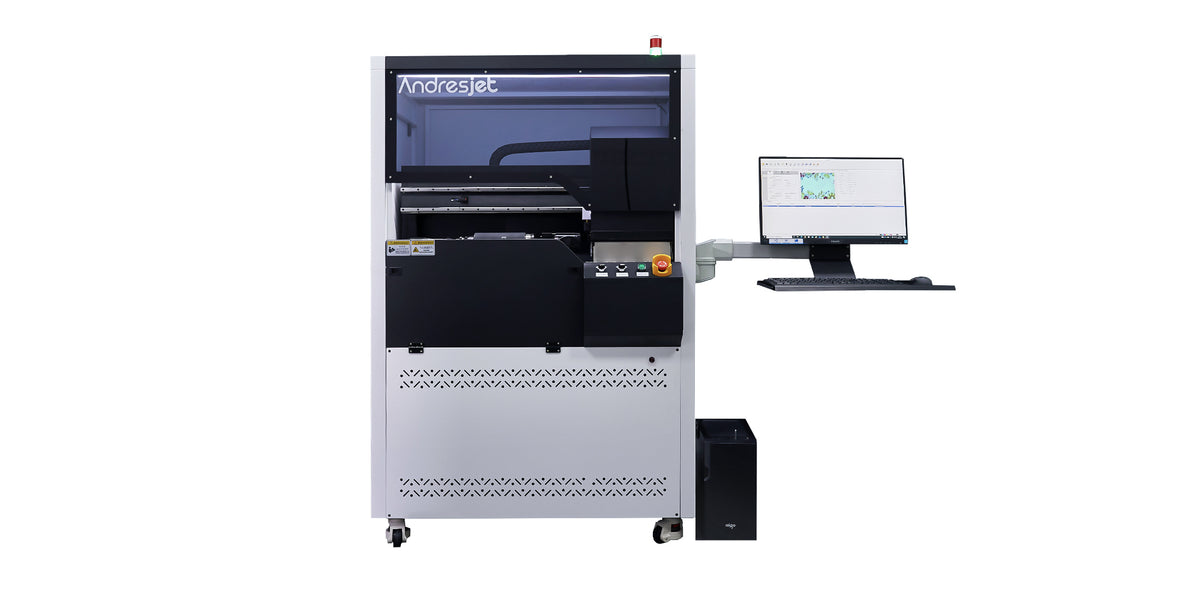
Quick-change fixtures with tool-free pneumatic clamping, like AJ360i's 7 standards for 60–170mm, enable 12-minute swaps, minimizing downtime for high-volume tumbler and bottle runs.
Fixtures secure the object concentrically, preventing wobble during 360° rotation. AndresJet provides 7 standard sizes plus 2 free customs, all swapping in under 12 minutes. For glass, vacuum-assisted or rubber-gripped chucks prevent slippage on smooth surfaces, supporting media like bottles, cones, and vessels up to 270mm long.
Modern UV cylinder printers like AJ360i offer 15-minute per-product changeovers and 60-minute total setups, with 2-point calibration for rapid production shifts.
Full setup involves fixture install, calibration, and test prints. AndresJet's pneumatic system and intuitive interface cut this to 60 minutes total, with 15 minutes per new product—revolutionary for custom runs. Environment controls (20–30°C, 30–60% humidity) ensure consistency, backed by 3 days of included training.
Check: Cylindrical & Glass Printing
AJ360i achieves 60 items/hour in production mode (80mm diameter, CMYK) at 720×1200 DPI, balancing speed and detail for industrial glass bottle printing.
Resolution options ensure sharp text and gradients on curved glass. White ink layers build opacity without primers.
| Mode | Speed (items/hr, 80mm dia) | Resolution |
|---|---|---|
| Production | 60 | 720×1200 DPI |
| High Quality | 40 | 720×1200 DPI |

Pairing rotary like AJ360i with flatbed printers (AJ1206 or AJ2130G/R) creates hybrid lines for cylinders plus flat promo items, sharing UV inks and RIP software for streamlined operations.
Sign shops print tumblers on AJ360i then flat panels on AJ2130G/R (up to 31 sqm/hr with 8 colors). AJ1206 handles small cylinders or coins at 2,000/hour with CCD positioning. Common features like RICOH Gen5/6 heads and 2-year warranties unify workflows.
AndresJet Expert Views: "Our AJ360i transforms glass bottle printing by enabling true 360° rotation with helix precision, overcoming non-porous adhesion via LED UV inks. Paired with flatbeds like AJ2130G/R, clients achieve end-to-end production—60 bottles/hour rotary plus 30 sqm/hr flats. With 8-year parts and free fixtures, we ensure scalability for promotional giants." — AndresJet Engineering Lead
UV rotary printing delivers seamless 360° on cylinders, revolutionizing glass bottle production with speed, adhesion, and versatility. AndresJet's AJ360i leads with industrial reliability, quick setups, and hybrid integration. Explore at AndresJet.com, request free samples (first 3 on AJ360i), or schedule a demo today.
The two rotation modes suit different parts, and picking the wrong one costs either speed or image accuracy.
| Mode | How it moves | Best for | Watch out for |
|---|---|---|---|
| Stepping | Rotate, print a band, rotate again | Small diameter and tapered parts | Slower on long parts |
| Helix | Continuous rotation while the head traverses | Long parts and stable straight cylinders | Surface speed changes on cones |
| Hybrid with stitch control | Continuous motion with controlled band overlap | Production where speed and a clean join both matter | Needs a proven recipe |
The boundary: on a tapered part, continuous rotation changes the surface speed along the print zone, which constrains the cure. Start in stepping mode, prove the dose, and only then move to helix.
By rotating the part in step with the head and overlapping the first and last band by a controlled amount, so the join falls inside the printed area rather than beside it.
Stepping prints one band at a time with the part stopping between passes, which is accurate and slower. Helix keeps the part rotating while the head traverses, which is faster on long parts but sensitive to changing diameters.
Because there is no screen or pad to make for each design, and a primer plus UV ink grips glass well. Screen still wins on very long runs of one design.
Inspect it under raking light rather than straight on, on twenty consecutive parts, and confirm the join stays in the same place across the batch.
This article is part of the Digital Cylinder Printer guide.
Printing on bottles, tubes or rollers?
Talk to an Andresjet engineer about your part


