

- by John White
How Do Piezo Inkjet Heads Power High-Speed UV Flatbed Printing?
- by John White
Print bigger, print faster — wide-format UV flatbed printers for signs, decor and industrial work.

Featured Snippet Piezo inkjet heads use piezoelectric crystals that deform when electrically charged, ejecting precise ink droplets on-demand with superior durability, variable drop sizes, and speeds up to 154 sqm/hr in industrial UV flatbeds like AndresJet's AJ3220EX with RICOH Gen5/Gen6 technology—ideal for sign printing, home decor, and custom products versus less precise thermal heads.
Check: what is a inkjet printer

Piezoelectric inkjet heads use tiny piezo crystals that change shape when voltage is applied, creating pressure waves that eject ink droplets from microscopic nozzles. This drop-on-demand technology offers precise control, variable droplet sizes, and high durability compared to thermal systems, making it the preferred choice for industrial production environments requiring consistent quality and speed.
Piezoelectric inkjet technology represents a fundamental shift in how industrial printers deliver ink to substrates. At the core of this technology are piezoelectric actuators—crystalline materials that physically deform when an electrical charge is applied. Unlike thermal inkjet systems that rely on heating ink to create bubbles, piezo heads use mechanical deformation to generate pressure waves that force ink through precision-engineered nozzles.
The mechanics are elegant: when voltage pulses through the piezo crystal, the crystal bends or flexes. This deflection changes the volume within an ink channel, transmitting pressure waves directly to the nozzle. The ink is then ejected in precise volumes determined by the amplitude and duration of the electrical pulse. This "bend mode" operation—as pioneered by manufacturers like Kyocera—maximizes control over droplet size and placement, enabling droplet volumes as small as one picoliter (one trillionth of a liter).
The nozzles themselves are marvels of micro-fabrication. Typically measuring around 10 micrometers in diameter (roughly one-tenth the width of a human hair), these orifices are fabricated with sub-micrometer accuracy using techniques such as photolithography, laser ablation, and anisotropic etching. A single printhead can contain thousands of nozzles arranged in precise arrays—often several hundred nozzles per color. This density enables both high-speed printing and exceptional color fidelity.
What makes piezo technology particularly valuable for industrial applications is its non-impact design. The printhead floats just above the substrate surface without mechanical pressure, eliminating wear on delicate materials and enabling printing on diverse media types—from rigid PVC and MDF panels to flexible substrates and cylindrical objects—without damage.
Check: Inkjet Tech & Piezo Heads
Piezo drop-on-demand offers superior precision, variable droplet sizes for better color gradation, lower operating costs, extended printhead lifespan, and compatibility with a wider range of inks including UV-curable formulations. Thermal systems, while cost-effective, generate heat that can degrade certain inks and offer less control over droplet placement, making piezo the standard for high-end industrial production.
The choice between piezo and thermal inkjet technologies hinges on production requirements, substrate compatibility, and total cost of ownership. Thermal inkjet systems—commonly used in consumer printers—work by rapidly heating ink inside a chamber to create a vapor bubble that expands and forces ink through a nozzle. When the bubble collapses, the chamber refills and the cycle repeats thousands of times per second.
While thermal systems are compact and affordable for entry-level applications, they introduce several limitations for industrial production. The heat-based mechanism restricts ink chemistry options; UV-curable inks and specialized formulations can degrade under thermal stress. Droplet size is largely fixed by the system design, limiting color gradation and tonal control. Thermal heads also experience faster wear due to repeated heating cycles, requiring more frequent replacement and increasing maintenance costs over time.
Piezo technology overcomes these constraints. By using mechanical deformation rather than heat, piezo heads are compatible with virtually any ink chemistry—including UV-curable, eco-friendly, and specialty inks. The electrical pulse duration can be modulated to produce variable droplet sizes, enabling smoother color transitions and superior image quality. Piezo crystals are inherently durable; they don't degrade under thermal stress, translating to extended printhead lifespan and reduced replacement frequency.
For high-speed production environments, piezo's precision advantage becomes decisive. The ability to control droplet placement with sub-micrometer accuracy ensures consistent registration across multiple passes, critical for applications like white ink layering, varnish effects, and multi-color overlays. This precision directly impacts product quality and reduces waste—a key ROI driver for sign printing, home decoration, and custom product manufacturing operations.
RICOH Gen5 and Gen6 piezo heads are engineered for industrial-scale production with advanced nozzle arrays, optimized pressure control, and thermal stability. Gen6 represents the latest evolution, offering improved droplet consistency, faster firing rates, and better compatibility with extended ink color sets including white and varnish—making them ideal for high-volume UV flatbed applications requiring precision and reliability.
RICOH's Gen5 and Gen6 piezoelectric printheads have become the industry standard for industrial UV flatbed printers, and for good reason. These heads represent decades of refinement in micro-fabrication, materials science, and pressure dynamics optimization.
The Gen5 platform delivers robust performance across a wide range of production speeds and substrate types. With thousands of precisely aligned nozzles, Gen5 heads can achieve consistent droplet placement and uniform color density. The heads are engineered for thermal stability—critical in production environments where ambient temperature fluctuations can affect ink viscosity and droplet behavior. RICOH's proprietary pressure control algorithms ensure that each nozzle fires consistently, regardless of position within the array or operating duration.
Gen6 represents the evolution of this technology, introducing refinements that address the demands of 2026 production environments. Enhanced nozzle geometry improves droplet circularity and reduces satellite droplets (unwanted ink particles that can degrade print quality). Faster firing rates enable higher throughput without sacrificing precision. Gen6 heads also demonstrate superior compatibility with extended color sets—particularly critical for applications requiring white ink and varnish channels alongside CMYK.
AndresJet leverages both Gen5 and Gen6 technology across its product portfolio. The AJ2130Ultra, designed for ultra-high-speed production, employs 24 RICOH Gen5 heads to achieve speeds up to 140.7 m²/h in ultra-draft mode, enabling production of up to 600 panels per day. The AJ3220EX similarly utilizes 16 Gen5 heads to deliver large-format printing at 154.3 m²/h in draft mode. For applications requiring extended color capabilities, the AJ2130G/R and AJ3220G/R models feature RICOH Gen6 heads configured for 8-color printing (CMYK plus light cyan, light magenta, white, and varnish), enabling sophisticated decorative effects for home décor and premium signage applications.
Modern piezo UV flatbed printers achieve speeds from 27 to 154 sqm/hr depending on resolution, color configuration, and printhead count. Production-grade systems like AndresJet's AJ3220EX reach 154.3 m²/h in draft mode, while quality-focused models deliver 30–50 sqm/hr, balancing throughput with image fidelity for sign printing, home décor, and custom product applications.
Speed performance in UV flatbed printing depends on multiple interdependent factors: printhead count, nozzle density, firing frequency, resolution setting, and substrate characteristics. Understanding these variables is essential for production planners evaluating equipment for specific workflows.
Entry-level and mid-range piezo systems typically operate in the 15–35 sqm/hr range. The AJ1206 small-format printer, for example, achieves speeds up to 2,000 coins per hour for specialty items like medals and buttons, demonstrating how piezo precision enables high-volume production of small, detailed objects. The AJ2512G/R, positioned for 8ft×4ft standard format work, delivers up to 35 sqm/hr in draft mode, with quality modes operating at 17.71 m²/h for applications where image fidelity takes priority.
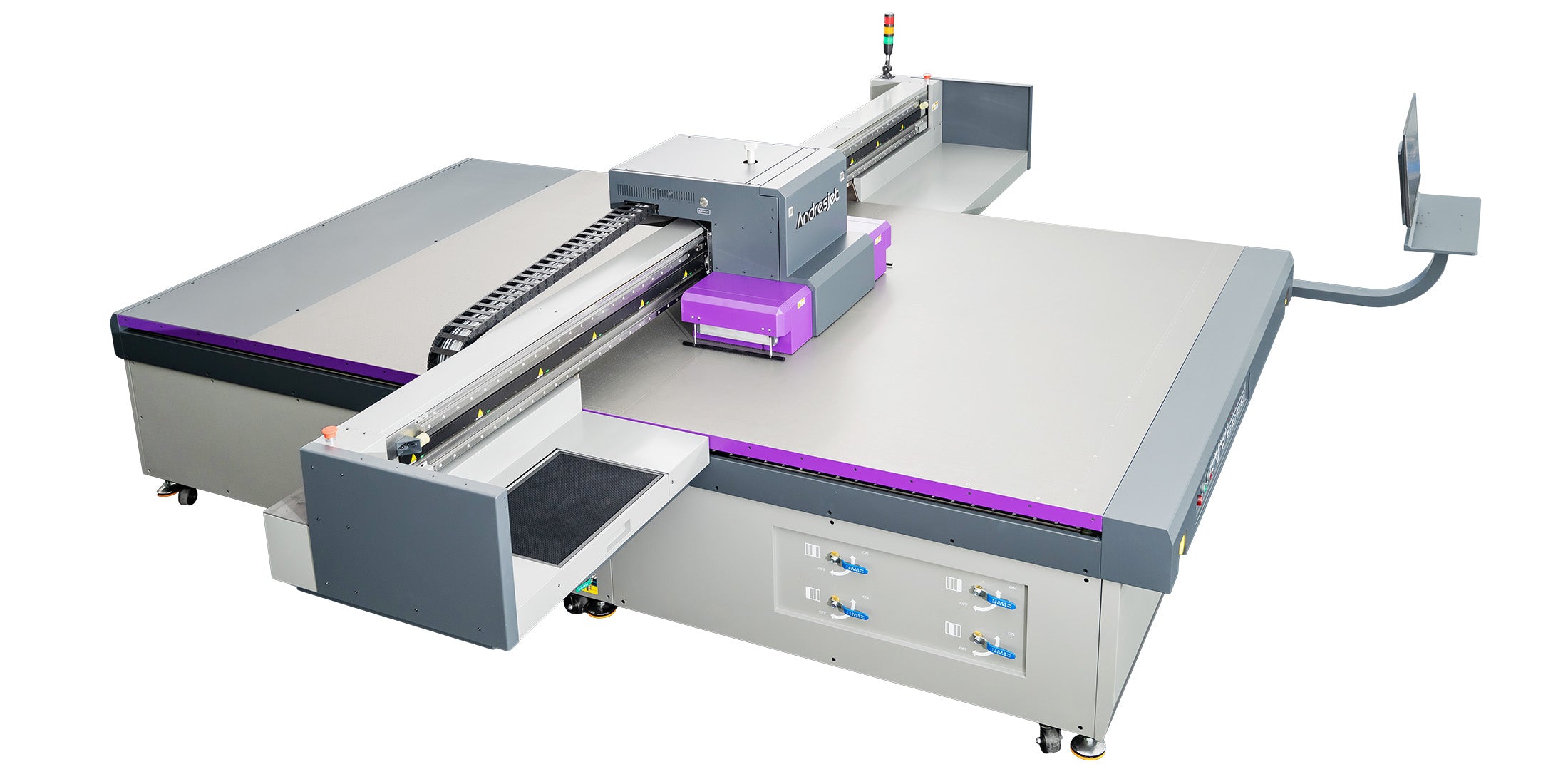
High-speed production systems push into the 100+ sqm/hr range that defines modern industrial capacity. The AJ2130EX achieves 128.6 m²/h in draft mode with 16 RICOH Gen5 heads, while the AJ2130Ultra—optimized for maximum throughput—reaches 140.7 m²/h in ultra-draft mode with 24 Gen5 heads. The AJ3220EX, designed for large-format work (3200×2000mm), delivers 154.3 m²/h in draft mode, making it one of the fastest piezo-based systems available for sign and décor printing.
These speeds translate directly to production capacity. The AJ2130Ultra's 140.7 m²/h capability enables production of approximately 600 panels per day (assuming standard 2.1m×3.0m panels), fundamentally changing economics for high-volume operations. Quality modes operate at 30–50% of draft speeds, reflecting the additional passes and precision required for premium output.
| AndresJet Model | Print Size (mm) | Printhead Count | Draft Speed (m²/h) | Quality Speed (m²/h) | Primary Application |
|---|---|---|---|---|---|
| AJ1206 | 1200×600 | 4–8 | N/A (2,000 items/hr) | N/A | Medals, coins, small objects |
| AJ2512G/R | 2500×1200 | 3–8 | 27.46 | 13.02 | 8ft×4ft panels, signage |
| AJ2130EX | 2100×3000 | 16 | 128.6 | 74.6 | High-speed production |
| AJ2130Ultra | 2100×3000 | 24 | 140.7 | 104.5 | Ultra-high-speed production |
| AJ3220EX | 3200×2000 | 16 | 154.3 | 89.6 | Large-format high-speed |
All AndresJet UV flatbed and cylinder printers feature industrial RICOH piezo drop-on-demand heads. The AJ2130Ultra (24 Gen5 heads, 140.7 m²/h), AJ3220EX (16 Gen5 heads, 154.3 m²/h), and AJ2130G/R (6–8 Gen6 heads, up to 31 sqm/hr) are optimized for high-volume production in sign printing, home décor, and custom product manufacturing with speeds exceeding 100 sqm/hr or extended color capabilities.
AndresJet's commitment to piezoelectric technology is comprehensive. Every system in the product lineup—from compact specialty printers to ultra-high-speed production platforms—employs industrial-grade RICOH piezo heads, ensuring consistent quality, durability, and precision across all applications.
For maximum throughput, the AJ2130Ultra stands as the flagship high-speed solution. Configured with 24 RICOH Gen5 piezo heads, this 2100×3000mm printer delivers ultra-draft speeds of 140.7 m²/h while maintaining quality modes at 104.5 m²/h. The system's dual 1500W vacuum blowers and hard-anodized aluminum flatbed with 4-zone vacuum control ensure reliable substrate grip even at extreme speeds. For production shops handling high-volume orders of panels, signs, and decorative items, the AJ2130Ultra's capacity of 600 panels per day represents a game-changing throughput multiplier.
The AJ3220EX, designed for large-format work (3200×2000mm), pushes speed even further: 154.3 m²/h in draft mode with 16 Gen5 heads. This system excels for sign printing, outdoor décor, and applications requiring maximum panel size without speed compromise. The large format, combined with high-speed capability, makes it ideal for production environments handling custom signage, architectural panels, and home decoration projects where both scale and throughput matter.
For applications requiring extended color capabilities—particularly white ink and varnish for decorative effects—the AJ2130G/R and AJ3220G/R models feature RICOH Gen6 heads configured for 8-color printing. The AJ2130G/R offers up to 31 sqm/hr with 6–8 Gen6 heads, enabling sophisticated white layering, metallic effects, and varnish applications essential for premium home décor and specialty signage. The AJ3220G/R similarly supports extended color sets at speeds up to 35 sqm/hr, making it ideal for high-quality decorative production.
For specialized applications, the AJ360i digital cylinder printer demonstrates piezo versatility beyond flatbed work. This system employs piezo drop-on-demand technology to print on cylindrical objects (60–170mm standard diameter, expandable to 10–240mm with custom fixtures) at production speeds of 60 items/hour in production mode. The AJ360i's ability to print with white ink and varnish on curved surfaces opens entirely new markets in gift printing, promotional items, and custom cylindrical product decoration.
Piezo heads' variable droplet control and precise nozzle placement enable accurate white ink layering and varnish application without clogging or registration errors. Unlike thermal systems, piezo technology handles the higher viscosity of white and varnish inks reliably, allowing decorative effects like raised white outlines, metallic overlays, and protective varnish coatings—critical for home décor and premium signage applications.
White ink and varnish have become essential tools for decorative printing, enabling effects ranging from subtle highlights to bold raised textures. However, these specialty inks present technical challenges that reveal piezo technology's advantages over thermal systems.
White ink and varnish formulations typically have higher viscosity than standard CMYK inks, making them prone to clogging in thermal systems where heat can cause premature evaporation and nozzle blockage. Piezo heads, operating through mechanical deformation rather than thermal stress, handle high-viscosity inks without degradation. The electrical pulse mechanism remains consistent regardless of ink chemistry, enabling reliable white and varnish printing without the maintenance burden that thermal systems require.
Precision placement becomes critical when layering white ink beneath or over CMYK colors. Piezo technology's sub-micrometer accuracy ensures that white droplets land exactly where intended, enabling clean registration and preventing color bleeding or misalignment. This precision is especially valuable for raised white effects—where multiple passes of white ink build up texture—and for metallic or specialty varnish applications that require exact overlay positioning.
AndresJet's extended-color models leverage these capabilities. The AJ2130G/R features dual negative pressure systems supporting both CMYK and white ink channels simultaneously, enabling sophisticated white-layering workflows without cross-contamination. The system's 8-color configuration (CMYK + light cyan + light magenta + white + varnish) opens possibilities for premium home décor applications: white outlines on colored backgrounds, varnish protection layers, and metallic effects that command price premiums in the market.
The AJ360i cylinder printer similarly supports white and varnish, with four dedicated white channels enabling raised effects up to 0.15mm on cylindrical surfaces. This capability transforms gift printing and promotional product decoration, allowing vendors to create dimensional, high-value finishes on mugs, bottles, and custom cylindrical items.
2026 trends accelerating piezo adoption include demand for 100+ sqm/hr production speeds, LED UV curing for sustainability and energy efficiency, expanded white ink and decorative capabilities for home décor, customization and short-run production workflows, and automation integration for seamless production line operation. Piezo technology's precision, durability, and ink versatility position it as the standard for these evolving market needs.
The industrial printing landscape is shifting rapidly, and piezoelectric technology sits at the center of these transformations. Several converging trends are driving accelerated piezo adoption across production environments globally.
Speed and Capacity Demands: Production shops face relentless pressure to increase throughput while maintaining quality. The 100+ sqm/hr threshold has become table stakes for competitive operations. Piezo systems like the AJ2130Ultra and AJ3220EX deliver this capacity, enabling shops to handle larger order volumes and tighter delivery schedules. This speed advantage translates directly to ROI, allowing printers to process more orders per day and improve equipment utilization.
Sustainability and LED UV Curing: Environmental regulations and customer preferences are driving adoption of LED UV curing over traditional mercury vapor systems. LED UV delivers faster cure times, lower energy consumption, and reduced heat output—all advantages for production environments. All AndresJet UV flatbed printers utilize LED UV curing, aligning with 2026 sustainability trends while reducing operational costs.
Decorative and Customization Markets: Home décor, personalized gifts, and custom signage represent explosive growth segments. These applications demand white ink, varnish, and extended color capabilities that piezo technology delivers reliably. The ability to produce high-quality, differentiated products in small to medium volumes—without thermal heads' limitations—makes piezo the preferred choice for shops targeting these profitable niches.
Automation and Production Line Integration: Modern production environments increasingly integrate printers into automated workflows. Piezo heads' reliability, consistent performance, and compatibility with automation systems make them ideal for continuous production lines. AndresJet's systems feature fiber optic data interfaces and high-precision servo motors designed for seamless integration into automated production environments.
Piezo UV flatbeds enable sign and décor shops to print directly on rigid substrates (PVC, MDF, acrylic, wood) at high speeds without pre-treatment, supporting white ink and varnish for premium finishes, reducing labor costs, and enabling short-run customization. The non-impact printing process preserves substrate integrity, while speeds exceeding 100 sqm/hr dramatically improve production capacity and profitability compared to traditional methods.
Sign printing and home décor production have historically relied on indirect methods: screen printing, vinyl cutting, or outsourced production. Piezo UV flatbed printers fundamentally change this economics by enabling direct-to-substrate printing with superior quality and speed.
Traditional sign production requires multiple steps: substrate preparation, screen setup, ink mixing, printing, curing, and finishing. Each step introduces labor costs and potential quality issues. A piezo UV flatbed printer consolidates this workflow. Design files go directly to the RIP software, substrates are loaded onto the vacuum flatbed, and printing begins immediately. LED UV curing happens in-line, eliminating separate curing steps. The result: faster turnaround, lower labor requirements, and higher margins.
The substrate versatility is transformative. Piezo UV flatbeds print on PVC panels, MDF boards, acrylic sheets, wood, metal, and composite materials—the full range of sign and décor substrates—without damage. The non-impact printhead never touches the surface, eliminating substrate deflection or marking issues that mechanical printers can cause. This compatibility opens new product categories: custom wooden signs, metal plaques, acrylic displays, and decorative panels that command premium pricing.
White ink and varnish capabilities elevate product quality and perceived value. A sign printed with white highlights on a dark background, or a home décor panel with protective varnish and metallic accents, justifies higher prices than flat CMYK printing alone. These effects are technically complex and expensive to achieve through traditional methods, but piezo UV flatbeds deliver them routinely.
AndresJet's product range directly supports these workflows. The AJ2512G/R, sized for standard 8ft×4ft panels, serves small-to-mid-size sign shops with speeds up to 35 sqm/hr and 8-color capability including white and varnish. The AJ2130G/R and AJ2130Ultra support larger operations with speeds reaching 140+ sqm/hr, enabling production shops to handle high-volume sign and décor orders profitably. The AJ3220EX, with its large 3200×2000mm format, accommodates oversized signage and architectural panels that command premium margins.
AndresJet Expert Views: "Piezo UV flatbed technology has fundamentally transformed how we approach sign and home décor production. Our AJ2130Ultra enables production speeds of 140.7 m²/h, allowing our customers to produce 600+ panels daily—a capacity that was impossible with traditional methods. The precision of RICOH Gen5 piezo heads ensures consistent white ink registration and varnish application, enabling our clients to deliver premium decorative finishes that command 30–50% price premiums. LED UV curing reduces energy costs by 40% compared to older systems, while the 8-color capability on our AJ2130G/R and AJ3220G/R models opens entirely new product categories in home décor and specialty signage. With 2 years comprehensive warranty and 8 years guaranteed spare parts availability, AndresJet systems provide the reliability that production shops need for mission-critical workflows. Our presence across North America and South Asia, combined with engineer-led support and free sample printing services, ensures customers maximize ROI from day one."
Piezoelectric inkjet technology represents the evolution of industrial printing, delivering precision, speed, and versatility that thermal systems cannot match. RICOH Gen5 and Gen6 piezo heads, now standard in production-grade UV flatbed printers, enable speeds exceeding 100 sqm/hr while maintaining exceptional image quality and substrate compatibility.
For sign printing, home décor, and custom product manufacturing, piezo UV flatbeds are no longer luxury equipment—they are essential tools for competitive production. The ability to print directly on rigid substrates, apply white ink and varnish effects, and achieve throughput of 600+ panels per day transforms business economics. Sustainability trends favoring LED UV curing, combined with market demand for customization and short-run production, ensure that piezo technology will continue driving industry growth through 2026 and beyond.
AndresJet's comprehensive product portfolio—from the precision-focused AJ1206 and AJ360i to the ultra-high-speed AJ2130Ultra and AJ3220EX—demonstrates the breadth of piezo technology applications. Every system leverages industrial RICOH piezo heads, backed by 2-year comprehensive warranties and 8-year spare parts guarantees. For production shops ready to upgrade their capabilities, AndresJet's piezo UV flatbeds represent the gold standard in speed, reliability, an
For the complete decision path, continue with the uv flatbed speed, precision & quality guide.


