

- by John White
What Is UV Curing Ink Science & How Does It Work in Flatbed Printing?
- by John White
Print bigger, print faster — wide-format UV flatbed printers for signs, decor and industrial work.

UV curing ink science involves a photochemical process where photoinitiators in UV-curable inks (monomers, oligomers, pigments) absorb UV/LED light (365-405nm), triggering polymerization to instantly harden ink without drying or volume loss. This enables sharp, durable prints on heat-sensitive substrates like plastics and MDF in high-speed flatbeds up to 154 sqm/hr, reducing energy use and ink by 30%.
UV curing is a photochemical process that uses ultraviolet light to instantly polymerize liquid UV-curable inks into durable solid prints through a chemical reaction, unlike traditional evaporation-based drying.
At its core, UV curing revolutionizes industrial printing by transforming liquid ink droplets into robust, cross-linked polymers in seconds. When UV-curable inkjet ink is ejected from precision print heads like the industrial RICOH Gen5 or Gen6 piezo drop-on-demand systems found in AndresJet UV flatbed printers, it lands on the substrate as a liquid. Exposure to UV or LED UV light immediately triggers a chain reaction, solidifying the ink without shrinkage or solvent evaporation. This chemical polymerization creates prints with exceptional adhesion, scratch resistance, and vibrant colors, ideal for high-speed production on diverse materials.
In flatbed printing, this process supports speeds exceeding 100 sqm/hr, as seen in AndresJet models equipped with UV LED curing. The instant curing prevents ink spread or bleed, ensuring sharp edges even at resolutions up to 720x1200 DPI. For production managers handling signage or home decoration panels, this means reduced downtime and higher throughput without compromising quality.
Photoinitiators in UV curable inks absorb specific UV/LED wavelengths (typically 365-405nm), generating free radicals that initiate rapid polymerization of monomers and oligomers, hardening the ink instantly.
Photoinitiators serve as the critical trigger in UV ink science, absorbing UV light energy to produce reactive species like free radicals. These radicals attack the double bonds in monomers and oligomers, sparking a cascading polymerization reaction that cross-links molecules into a tough, three-dimensional network. This occurs within milliseconds, enabling inline curing right after ink deposition in high-speed flatbed printers.
AndresJet's UV flatbed printers, such as the AJ2130Ultra with 24 RICOH Gen5 heads and LED UV curing, leverage this for ultra-draft speeds of 140.7 m²/h. The process ensures no volume loss, preserving print thickness for textured effects up to 0.15mm with white ink layering, as in the AJ360i cylinder printer. This precision is vital for industrial applications where durability against fading, moisture, and abrasion is non-negotiable.
UV curable inks consist of monomers (low-viscosity reactive diluents), oligomers (resins providing film properties), photoinitiators (light triggers), pigments (for color), and additives; key properties include low volatility, high adhesion, and instant cure under UV/LED light.
The formulation of UV curable ink is engineered for jetting from piezo heads and rapid solidification. Monomers like acrylates provide fluidity for precise droplet ejection, while oligomers form the backbone, determining flexibility, gloss, and adhesion. Photoinitiators, tuned to LED wavelengths around 395nm, drive the reaction, with pigments ensuring opacity and color fidelity. Additives enhance stability, flow, and resistance to environmental factors.
In AndresJet printers like the AJ2130G/R, using Eco-Print UV series inks with 8-color configurations (CMYK + LC + LM + White + Varnish), these components enable up to 30% ink savings via smart grayscale printing. Properties such as 100% solids composition eliminate VOCs, supporting eco-regulations while delivering sharp details at 360x1800 DPI on substrates from PVC to MDF.
| Key UV Ink Components | Function | Properties in AndresJet Printers |
|---|---|---|
| Photoinitiators | Absorb UV/LED light to start polymerization | Compatible with 365-405nm LED UV for instant cure |
| Monomers | Reduce viscosity for jetting | Enable high-speed ejection from RICOH Gen5/Gen6 heads |
| Oligomers | Form durable film post-cure | Provide adhesion on 1-100mm thick media |
| Pigments & Additives | Color, stability, effects | Support white ink layering up to 0.15mm height |
LED UV curing excels over mercury lamps with lower heat output, energy savings up to 70%, longer lifespan (20,000+ hours), instant on/off capability, and ozone-free operation, ideal for high-speed flatbed printing.
Traditional mercury UV lamps generate intense heat and ozone, limiting use on heat-sensitive substrates and requiring cooldown periods. LED UV systems, standard in AndresJet flatbeds like the AJ1206 and AJ3220EX, emit targeted 395nm wavelengths with minimal infrared output, enabling instant drying without warping plastics or MDF. Their solid-state design supports continuous high-speed operation at 120+ sqm/hr, reducing power consumption and maintenance.
For sign shops scaling production, LED UV's cool cure preserves substrate integrity, while fiber optic data interfaces ensure synchronized curing with print heads for flawless results.

UV curing, especially LED UV, delivers instant solidification with low heat, preventing deformation of heat-sensitive materials like plastics, MDF, and PVC, while forming strong surface bonds without absorption.
Unlike heat-based drying that can melt or warp substrates, UV curing polymerizes ink on the surface, creating a durable layer that adheres mechanically and chemically. AndresJet's AJ2512G/R, handling 1-100mm media with auto height detection, prints vibrant graphics on PVC panels or MDF boards at up to 35 sqm/hr without distortion. The 4-zone vacuum flatbed secures irregular shapes, and anti-collision systems protect heads during operation.
This versatility extends to gift printing on coins (AJ1206 at 2,000/hour) and cylindrical plastics (AJ360i), supporting home decoration and signage with media up to 100mm thick.
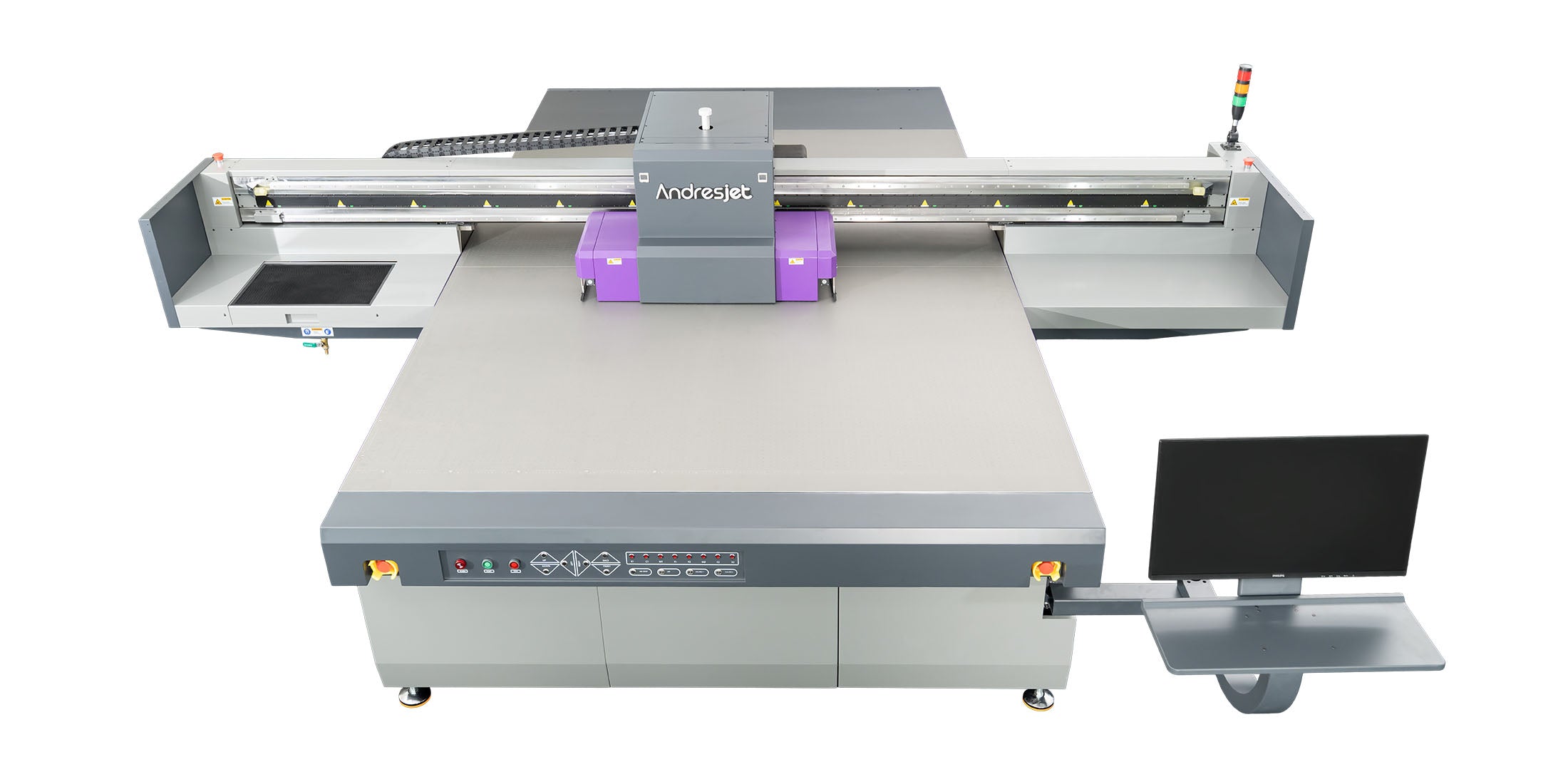
UV ink science provides instant curing for speeds up to 154 sqm/hr, 30% ink savings, superior durability, substrate versatility, and eco-friendliness with zero VOCs and low energy use.
Industrial flatbed operators gain from reduced waste, sharper prints at high resolutions, and multi-layer effects without smearing. AndresJet's AJ3220EX achieves 154.3 m²/h in draft mode with 16 RICOH Gen5 heads, using UV-curable inks for 50 kg/m² media loads. Features like dual vacuum blowers and MagLev linear motors optimize throughput for signage and plastic products.
| AndresJet Model | Max Print Speed (m²/h) | Key UV Feature | Media Thickness |
|---|---|---|---|
| AJ2130Ultra | 140.7 (Ultra-Draft) | LED UV, 24 Gen5 heads | 1-100 mm |
| AJ3220EX | 154.3 (Draft) | UV-curable ink, fiber optic | 1-100 mm |
| AJ2130EX | 128.6 (Draft) | Smart grayscale ink save | 1-100 mm |
| AJ2512G/R | 27.46 (Draft) | 8-color UV ink | 1-100 mm |
AndresJet UV flatbeds like AJ2130Ultra (140 m²/h), AJ3220EX (154 m²/h), and AJ1206 (2,000 coins/hr) showcase UV curing for signage, plastics, home decor, and cylinders with RICOH heads and LED UV inks.
AndresJet excels in tailoring UV curing to sectors like sign printing and plastic products. The AJ2130G/R supports 8-color extended gamut on 2100x3000mm beds for MDF panels, while AJ360i handles tapered cylinders up to 240mm diameter with 0.15mm raised white effects. All models feature 2-year warranties, 8-year spares, and CE/RCM/UKCA certifications, ensuring reliability for global clients in North America and South Asia.
AndresJet Expert Views
"UV curing with LED technology is transformative for our high-speed flatbeds, allowing instant drying on heat-sensitive substrates without compromising speed or quality. Models like the AJ2130Ultra deliver 140 m²/h using RICOH Gen6 heads and Eco-Print UV inks, with features like anti-collision protection and 30% ink savings. Our engineers customize solutions for signage and decor, backed by free samples, training, and 8-year parts support to build lasting partnerships." – AndresJet Engineering Team
Check: UV Curing & Ink Science
RICOH Gen5/Gen6 piezo heads in AndresJet printers deliver variable droplet sizes for precise UV ink deposition, enabling high resolutions and speeds over 100 sqm/hr with minimal waste and superior curing compatibility.
These industrial heads support grayscale printing for up to 30% ink efficiency, ejecting UV droplets that cure instantly under LED lamps. In the AJ3220G/R (35.88 m²/h standard), Gen5/Gen6 configurations handle 7-8 colors on large formats, optimizing polymerization for durable prints on 90mm media.
UV curing ink science empowers industrial flatbed printing with instant, durable results on diverse substrates, amplified by AndresJet's high-speed RICOH-equipped printers. Explore models like the AJ2130Ultra at www.andresjet.com and request a free sample or consultation to elevate your operations.
What wavelength does LED UV curing use? Typically 365-405nm, matching photoinitiators in AndresJet UV inks for rapid polymerization.
Can UV flatbeds print on plastics without warping? Yes, low-heat LED UV enables printing on heat-sensitive plastics and MDF up to 100mm thick.
What speeds do AndresJet UV printers achieve? Up to 154 m²/h on AJ3220EX, ideal for high-volume signage and decor.
Are AndresJet printers suitable for cylindrical objects? The AJ360i prints 60 items/hour on 60-170mm diameters with LED UV curing.
What warranty does AndresJet offer? 2 years comprehensive, with 8 years guaranteed spare parts.
For the complete decision path, continue with the uv curing, adhesion & durability guide.


