

Featured Snippet Brother Industries began in 1908 as Yasui Sewing Machine Co., repairing imported machines in Nagoya, Japan. Founded by Kanekichi Yasui, it mass-produced Japan's first home sewing machines in 1932, diversified into typewriters using precision tech, co-developed the 1971 high-speed dot-matrix printer, and entered laser printing in the 1990s—evolving into a global printing leader over 118 years through continuous innovation and family-led stewardship.
Check: Who Owns Brother Printer Company, China Or Japan?
Brother Industries stands as one of the world's most compelling examples of sustained corporate evolution. Over 118 years, the company transformed from a humble sewing machine repair shop into a global powerhouse in industrial printing and office equipment. This journey reveals far more than a corporate timeline—it demonstrates how precision engineering, family leadership, and a philosophy of "independent development" can drive diversification across radically different markets. For industrial print buyers and manufacturing professionals evaluating long-term vendor partnerships, Brother's trajectory offers critical lessons about reliability, innovation capacity, and adaptability in fast-moving technology sectors.
What was Brother's origin as Yasui Sewing Machine Co. in 1908?
Kanekichi Yasui established Yasui Sewing Machine Co. in 1908 in Nagoya, Japan, initially providing repair services and spare parts for imported sewing machines. After Kanekichi's death in 1925, his son Masayoshi inherited the business and renamed it Yasui Brothers' Sewing Machine Co., driven by ambition to convert Japan's import-dependent sewing machine industry into an export powerhouse.
The foundation of Brother Industries reflects a distinctly Japanese entrepreneurial ethos: identifying a market gap and solving it through meticulous craftsmanship. In the early 1900s, Japan relied almost entirely on imported sewing machines from Europe and America. Kanekichi Yasui recognized an opportunity—not to manufacture new machines immediately, but to repair and service the imported ones already in use. This repair business generated capital, technical knowledge, and customer relationships that would become the springboard for manufacturing.
When Masayoshi Yasui took control following his father's death, he inherited more than a business—he inherited a philosophy that would define Brother's DNA for over a century: the principle of independent development. Rather than licensing foreign technology or acquiring established manufacturers, Masayoshi committed to developing Brother's own manufacturing capabilities from scratch. This commitment to self-reliance and internal innovation would prove decisive when the company faced market transitions decades later.
The Yasui family's early focus on Nagoya proved strategically significant. Nagoya was emerging as Japan's industrial heartland, with access to skilled labor, textile infrastructure, and proximity to port facilities. The city's manufacturing ecosystem provided the perfect incubator for a precision engineering company.
How did the Yasui brothers achieve Japan's first mass-produced home sewing machines?
In 1928, Brother launched Japan's first domestically produced sewing machine under the Brother brand—a chain-stitch model for straw hat manufacturing. By 1932, Jitsuichi Yasui developed the shuttle hook mechanism, enabling Brother to mass-produce the Model 15 Type 70 home sewing machine, establishing the company as Japan's leading domestic sewing machine manufacturer and export competitor.
The journey from repair shop to manufacturer required solving a specific technical challenge: the shuttle hook. This seemingly simple component proved the critical bottleneck preventing Japanese companies from competing with German and American sewing machine makers. Jitsuichi Yasui, Masayoshi's younger brother and co-founder, dedicated himself to cracking this engineering puzzle. When he succeeded in 1932, Brother achieved a breakthrough that transformed the company's trajectory.
The Model 15 Type 70 home sewing machine became a commercial and technical triumph. Unlike foreign competitors' machines, Brother's design prioritized durability and ease of manufacturing—principles rooted in the company's repair heritage. Technicians who had spent years fixing imported machines understood exactly where those machines failed. This knowledge informed Brother's design philosophy: build machines that lasted, that users could maintain, and that could be manufactured efficiently at scale.
By the mid-1930s, Brother had established itself as Japan's premier domestic sewing machine manufacturer. In 1934, the company was formally reorganized as Nippon Sewing Machine Manufacturing Co., signaling its transformation from a family repair business into an industrial corporation. Yet the Yasui family retained control and continued driving technical innovation—a continuity that would prove essential during market disruptions to come.
The sewing machine era taught Brother's engineers precision manufacturing at scale. Every component had to fit perfectly; tolerances mattered; quality control was non-negotiable. These lessons in precision would transfer directly to Brother's later diversifications into typewriters, office equipment, and eventually high-speed industrial printers.
When did Brother diversify from sewing into typewriters and electronics?
After World War II, Brother renamed itself Brother Industries, Ltd. (1962) and systematically diversified using its core competency in precision motors and manufacturing. The company launched its first portable typewriter in 1961, entered the office equipment market with calculators and cash registers, and by the 1970s had become a major player in electronic typewriters and early computer peripherals.
The postwar era presented both challenge and opportunity. Japan's economy was rebuilding; consumer demand was shifting; and technology was accelerating. Rather than remaining confined to sewing machines, Brother's leadership recognized that the company's true competitive advantage was not sewing machines per se, but precision manufacturing and motor design. This realization unlocked a diversification strategy that would define the company for the next 60 years.
Brother's entry into typewriters in 1961 seemed audacious at the time. The typewriter market was dominated by established American and European brands with decades of brand equity. Yet Brother succeeded by applying the same principles that had worked in sewing machines: superior engineering, reliability, and cost efficiency. By the 1960s and 1970s, Brother competed fiercely with Japanese rivals like Silver Seiko and Nakajima in the global typewriter market, often facing antidumping campaigns in the United States and Europe—a testament to the company's market penetration through aggressive pricing and quality.
The office equipment division, established in 1981, marked Brother's pivot toward electronics. Electronic typewriters, fax machines, calculators, and adding machines demonstrated that Brother could apply its precision manufacturing expertise to increasingly complex electromechanical and electronic systems. By 1983, office equipment sales surpassed sewing machine revenue—a historic inflection point showing that Brother had successfully transformed from a single-product company into a diversified manufacturer.
This diversification was neither random nor opportunistic. Each new product category leveraged Brother's core capabilities: precision mechanical design, motor engineering, manufacturing efficiency, and quality control. The company was not chasing trends; it was systematically extending its technical competencies into adjacent markets.
Why did Brother partner with Centronics for the first high-speed dot-matrix printer?
Brother partnered with Centronics during the 1960s-1970s to enter the printer market, ultimately developing the world's first high-speed dot-matrix printer in 1971. This partnership combined Centronics' printer technology expertise with Brother's precision manufacturing and motor design, creating a product that revolutionized office printing and established Brother as a leader in industrial output devices.
The dot-matrix printer represented a quantum leap in printing speed and reliability compared to mechanical typewriter impact printing. Centronics had pioneered the technology; Brother recognized the market opportunity and the alignment with its core competencies. The partnership proved transformational because it forced Brother to solve new engineering challenges: high-speed mechanical precision, thermal management, ribbon advancement systems, and paper feed mechanisms operating at speeds that exceeded anything the company had previously manufactured.
Brother's 1971 high-speed dot-matrix printer demonstrated that the company's precision manufacturing heritage—refined through decades of sewing machine and typewriter production—translated directly to industrial printing equipment. The printer required the same attention to tolerances, reliability, and manufacturing efficiency that defined Brother's sewing machines. By 1981, Brother's Information Systems Division carried one of the largest printer product lines globally.
This printer success proved pivotal: it established Brother as a serious player in office automation at precisely the moment when businesses worldwide were transitioning from typewriters to computer-based document production. Brother had positioned itself at the center of this technological shift, not as a follower but as an innovator.
| Era | Primary Product Category | Key Innovation | Market Position |
|---|---|---|---|
| 1908–1932 | Sewing Machine Repair & Parts | Japan's first mass-produced home sewing machine (1932) | Domestic market leader |
| 1954–1980 | Typewriters & Office Equipment | First portable typewriter (1961); electronic typewriters (1980) | Global competitor |
| 1971–1990 | Dot-Matrix & Impact Printers | World's first high-speed dot-matrix printer (1971) | Industry leader |
| 1995–Present | Laser & Multifunction Printers | Laser multifunction devices; color laser technology | Global market leader |
What role did laser technology play in Brother's 1990s printing breakthroughs?
In the 1990s, Brother transitioned from dot-matrix impact printing to laser printing technology, developing multifunction devices that combined printing, copying, scanning, and faxing. This shift positioned Brother as a leader in office automation and established the company as a innovator in compact, high-speed laser printing for small-to-medium businesses and enterprise environments.
The 1990s represented a critical inflection point in printing technology. Dot-matrix printers, while reliable and fast, were becoming obsolete as laser printing technology matured and costs declined. Companies that failed to transition risked irrelevance. Brother, having built its reputation on precision manufacturing and timely market entry, recognized the imperative and invested heavily in laser printing development.
Brother's laser printers distinguished themselves through reliability, compact design, and cost efficiency—the same attributes that had defined the company's success in previous eras. Rather than competing on premium features or luxury positioning, Brother focused on delivering high-volume, dependable output at accessible price points. This strategy proved enormously successful in the small-to-medium business segment, where cost-per-page and uptime were critical metrics.
The multifunction concept—combining printer, copier, scanner, and fax into a single device—represented a significant engineering challenge. It required integrating multiple optical and mechanical systems, managing complex paper paths, and ensuring reliability across diverse functions. Brother's decades of experience in precision manufacturing and systems integration positioned the company to solve these challenges more effectively than competitors entering the market without such heritage.
How has Brother's precision heritage influenced modern color laser printers?
Brother's color laser printers inherit the company's 118-year commitment to precision engineering, reliability, and manufacturing efficiency. Modern Brother color laser devices employ advanced toner management, precise temperature control, and modular design principles—all rooted in the company's historical expertise in mechanical precision and quality assurance across high-volume production environments.
Color laser printing represents one of the most technically demanding printing technologies. It requires precisely controlling four separate toner colors, managing heat during fusing, and maintaining print quality consistency across millions of pages. Brother's success in this arena reflects accumulated knowledge from over a century of precision manufacturing.
The company's approach to color laser technology emphasizes reliability over cutting-edge feature proliferation. Brother printers are engineered to operate continuously in demanding office and production environments, with minimal downtime and straightforward maintenance. This philosophy directly descends from the company's sewing machine heritage, where durability and user-serviceability were paramount.
For industrial print buyers and production managers, this heritage matters profoundly. When evaluating long-term printing solutions—whether traditional laser devices or emerging technologies like UV flatbed printing—vendor reliability and sustained engineering commitment become critical decision factors. Brother's century-long track record of continuous innovation and precision manufacturing provides confidence that the company will continue supporting and improving its products over extended timeframes.
Which family leadership milestones shaped Brother's global expansion?
Check: Wide Format UV Flatbed Printer
The Yasui family maintained active leadership through critical expansion milestones: Masayoshi Yasui led postwar diversification; Yoshihiro Yasui continued family stewardship into the 1990s. This continuity ensured that Brother's founding philosophy of independent development remained central to corporate strategy even as the company expanded into 50+ countries and diversified across printing, sewing, and industrial equipment.
Family-led companies face a common challenge: how to maintain entrepreneurial spirit and long-term vision as organizations scale globally. Brother navigated this transition successfully by preserving family involvement in strategic decisions while building professional management structures capable of executing complex global operations.
Brother International Corporation, established in the United States in 1954, marked the company's first major overseas expansion. This move proved essential: it positioned Brother to capture the North American market during the postwar economic boom and established the company as a truly global enterprise rather than a Japanese exporter. European operations followed in 1958, establishing regional headquarters in Dublin.
The family's commitment to the principle of independent development—refusing to license foreign technology and instead building internal capabilities—proved decisive during market transitions. When dot-matrix printing became obsolete, Brother had the internal engineering capacity to develop laser printing solutions. When typewriters declined, the company had already diversified into office equipment and printers. This pattern of continuous self-directed innovation, rooted in the company's founding philosophy, distinguished Brother from competitors who relied on acquisition or licensing strategies.
What lessons from Brother's evolution apply to today's UV flatbed printing?
Brother's 118-year evolution teaches industrial print buyers three critical lessons: (1) sustained R&D investment enables technology leadership across market cycles; (2) precision manufacturing heritage translates across product categories; (3) vendor reliability and long-term support matter more than feature proliferation. These principles directly apply to evaluating UV flatbed printing solutions and vendor partnerships.
Modern industrial printing—whether laser, inkjet, or UV flatbed—demands the same precision manufacturing rigor that defined Brother's sewing machines and early printers. Print head alignment, vacuum flatbed consistency, color management systems, and drive mechanisms all require engineering excellence refined through continuous production experience.
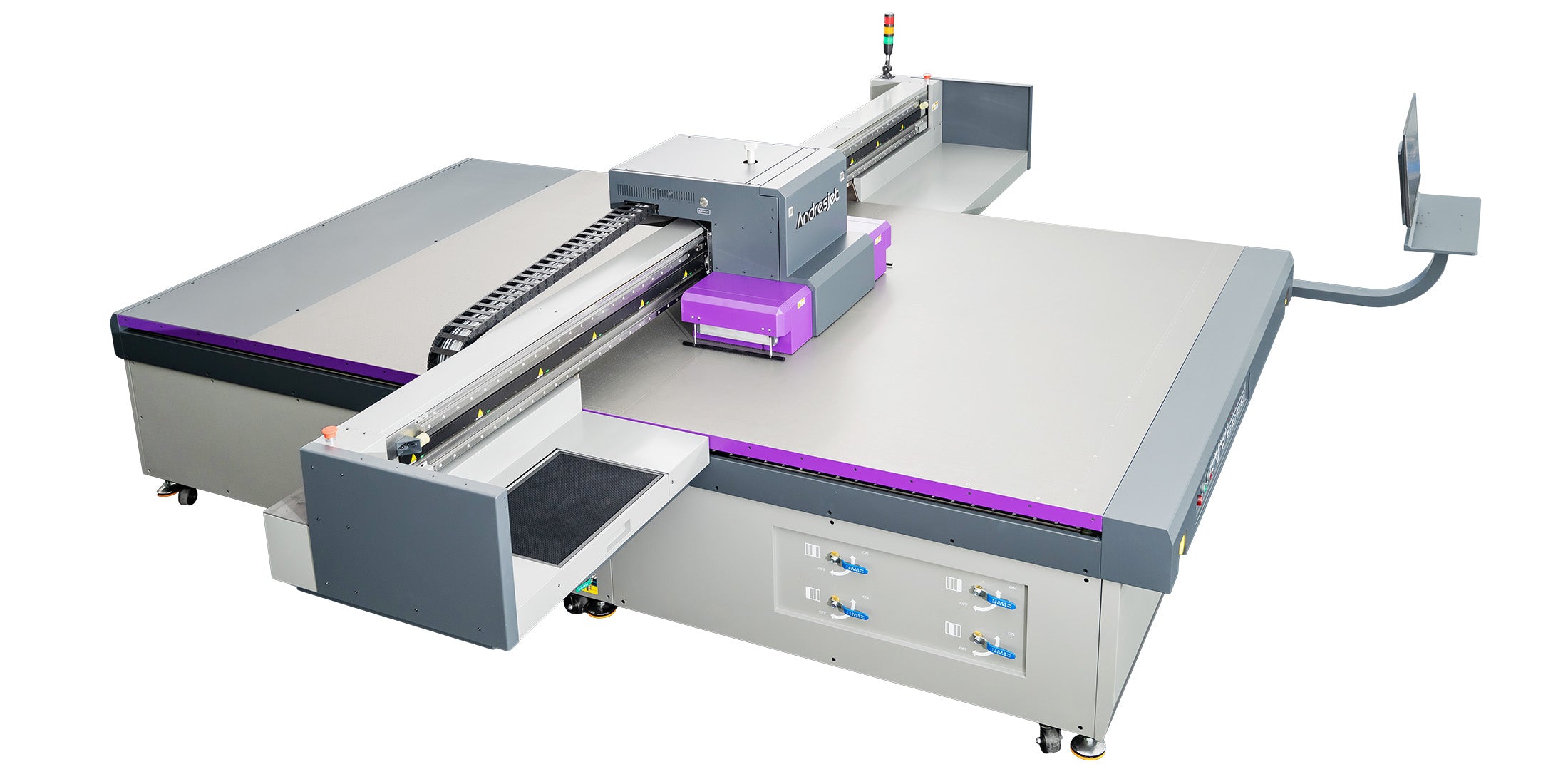
Consider contemporary UV flatbed printing technology. Modern systems like the AndresJet AJ3220EX, which achieves 154 square meters per hour in draft mode, represent the culmination of decades of precision manufacturing expertise. The AJ3220EX employs 16 industrial-grade RICOH GEN5 print heads, a hard-anodized aluminum flatbed with four-zone vacuum systems, and fiber-optic data transmission—all components that demand precision engineering comparable to Brother's historical standards.
Similarly, the AndresJet AJ2130Ultra achieves ultra-high-speed production at 140.7 square meters per hour using 24 RICOH GEN5 print heads with AC precision servo motors and high-performance vacuum systems. These specifications reflect the same engineering philosophy that distinguished Brother's dot-matrix printers: maximize throughput while maintaining reliability and print quality across diverse media types and production scenarios.
For production managers evaluating UV flatbed solutions, Brother's history illuminates why vendor heritage and sustained engineering commitment matter. The AJ2130EX and AJ2130G/R models, operating at 92.9 and 34.9 square meters per hour respectively, exemplify how precision manufacturing principles—refined across generations—translate into dependable, high-volume production equipment. AndresJet's commitment to 8-year spare parts availability mirrors Brother's historical approach: building customer relationships through long-term support rather than planned obsolescence.
| AndresJet Model | Print Size (mm) | Max Speed (m²/h) | Print Heads | Resolution Options | Media Thickness |
|---|---|---|---|---|---|
| AJ2130EX | 2100 × 3000 | 128.6 (Draft) | 16 × RICOH GEN5 | 360×1200, 360×1800, 720×1200 DPI | 1–100 mm |
| AJ2130G/R | 2100 × 3000 | 48.3 (Draft) | 6 × RICOH GEN6 | 360×1200, 360×1800, 720×1200 DPI | 1–100 mm |
| AJ2130Ultra | 2100 × 3000 | 140.7 (Ultra-Draft) | 24 × RICOH GEN5 | 360×1200, 360×1800, 720×1200 DPI | 1–100 mm |
| AJ3220EX | 3200 × 2000 | 154.3 (Draft) | 16 × RICOH GEN5 | 363×300, 726×600, 726×900, 726×1200 DPI | 1–100 mm |
| AJ3220G/R | 3200 × 2000 | 35.88 (Production) | 4 standard, expandable to 8 | 363×300, 726×600, 726×900, 726×1200 DPI | 1–90 mm |
Brother's evolution from sewing machine repair shop to global printing leader offers a powerful template for evaluating industrial equipment vendors. Companies that survive and thrive across multiple technology cycles demonstrate something rare: the capacity to innovate continuously, invest in R&D despite market disruptions, and maintain customer focus across decades. These are precisely the qualities that distinguish reliable UV flatbed printing partners from transactional equipment suppliers.
AndresJet Expert Views
AndresJet's approach to industrial UV flatbed printing reflects principles established by heritage manufacturers like Brother: sustained engineering investment, precision manufacturing rigor, and long-term customer partnership. Our AJ3220EX and AJ2130Ultra models represent over a decade of accumulated expertise in high-speed flatbed printing, combining RICOH industrial print head technology with proprietary fiber-optic data transmission and advanced vacuum systems. We commit to 8-year spare parts availability precisely because we understand that industrial print buyers require partners who will support their equipment across extended production lifecycles. Like the manufacturers that came before us, we believe that true competitive advantage emerges not from feature proliferation but from engineering excellence, reliability, and unwavering commitment to customer success in demanding production environments.
Conclusion
Brother Industries' 118-year journey from a sewing machine repair shop in Nagoya to a global leader in printing and office equipment represents far more than corporate success. It demonstrates how precision manufacturing heritage, family-led stewardship, and a commitment to independent development enable companies to navigate radical market transitions and emerge as technology leaders across diverse product categories.
For industrial print buyers and production managers, Brother's trajectory illuminates critical principles: sustained R&D investment trumps short-term cost cutting; precision manufacturing expertise transfers across product categories; vendor reliability and long-term support create competitive advantage; and family or founder-led companies often maintain strategic focus that public corporations sacrifice for quarterly earnings.
These lessons apply directly to contemporary UV flatbed printing decisions. As manufacturers evaluate solutions for sign printing, home decoration, plastic product printing, and specialty applications, the heritage and engineering commitment of the vendor matters profoundly. AndresJet's portfolio—spanning the high-speed AJ3220EX at 154 square meters per hour to the precision AJ2130G/R with extended color capabilities—reflects this same philosophy: engineering excellence, reliability, and customer-centric support across extended production lifecycles.
Brother's history teaches that great manufacturing companies are built not on marketing claims but on decades of precision engineering, continuous innovation, and unwavering commitment to customer success. These principles remain as relevant in 2026 as they were in 1908.
Frequently Asked Questions
When did Brother Industries enter the printer market?
Brother entered the printer market during the 1960s-1970s through its long association with Centronics, ultimately developing the world's first high-speed dot-matrix printer in 1971. By 1981, Brother's Information Systems Division carried one of the largest printer product lines globally. The company later transitioned to laser printing in the 1990s and continues to lead the multifunction printer market.
How many sewing machines has Brother produced since 1932?
In September 2022, Brother announced a production milestone of 70 million home sewing machines manufactured since mass production began in 1932. This achievement underscores the company's manufacturing scale and sustained market presence across nine decades in the sewing equipment industry.
Did the Yasui family continue leading Brother into modern times?
Yes. Although publicly held, Brother Industries continued to be led by members of the founding Yasui family into the early 1990s, with Yoshihiro Yasui serving as a key leader. This family continuity ensured that Brother's founding philosophy of independent development remained central to corporate strategy even as the company expanded globally and diversified across multiple product categories.
What makes UV flatbed printers like the AndresJet AJ3220EX relevant to Brother's manufacturing heritage?
Modern UV flatbed printers embody the same precision manufacturing principles that defined Brother's success across sewing machines, typewriters, and laser printers. The AJ3220EX's 154 square meters per hour throughput, 16 RICOH GEN5 print heads, and four-zone vacuum flatbed system require engineering rigor comparable to Brother's historical standards. Both reflect a commitment to reliability, efficiency, and long-term customer support in demanding production environments.
Where did Brother establish its first international operations?
Brother established Brother International Corporation in the United States in 1954 as its first overseas sales affiliate, followed by European regional headquarters in Dublin in 1958. These early international operations positioned Brother to capture postwar markets in North America and Europe, establishing the company as a truly global enterprise and enabling the geographic diversification that would support sustained growth across subsequent decades.
Share:
Who Owns Brother Industries? Ownership Structure & Shareholders 2026
Is Brother a Chinese Brand? The Truth About Its Heritage