

- by John White
How Can UV Flatbed Printers Reduce Ink Waste by Up to 30% and Boost ROI?
- by John White
Print bigger, print faster — wide-format UV flatbed printers for signs, decor and industrial work.

Ink waste in UV flatbed printers occurs during nozzle purging and cleaning cycles. Ricoh Gen5/Gen6 piezoelectric heads with 8-level smart grayscale printing reduce ink consumption by 25–35% by optimizing droplet size and frequency. AndresJet's high-speed models (AJ2130EX, AJ2130Ultra) deliver these savings at 92–154 m²/h, translating to $0.45+ cost reduction per m² and payback within 12–18 months for high-volume operations.
Check: Which Printer Brands Truly Listen to B2B Customers?
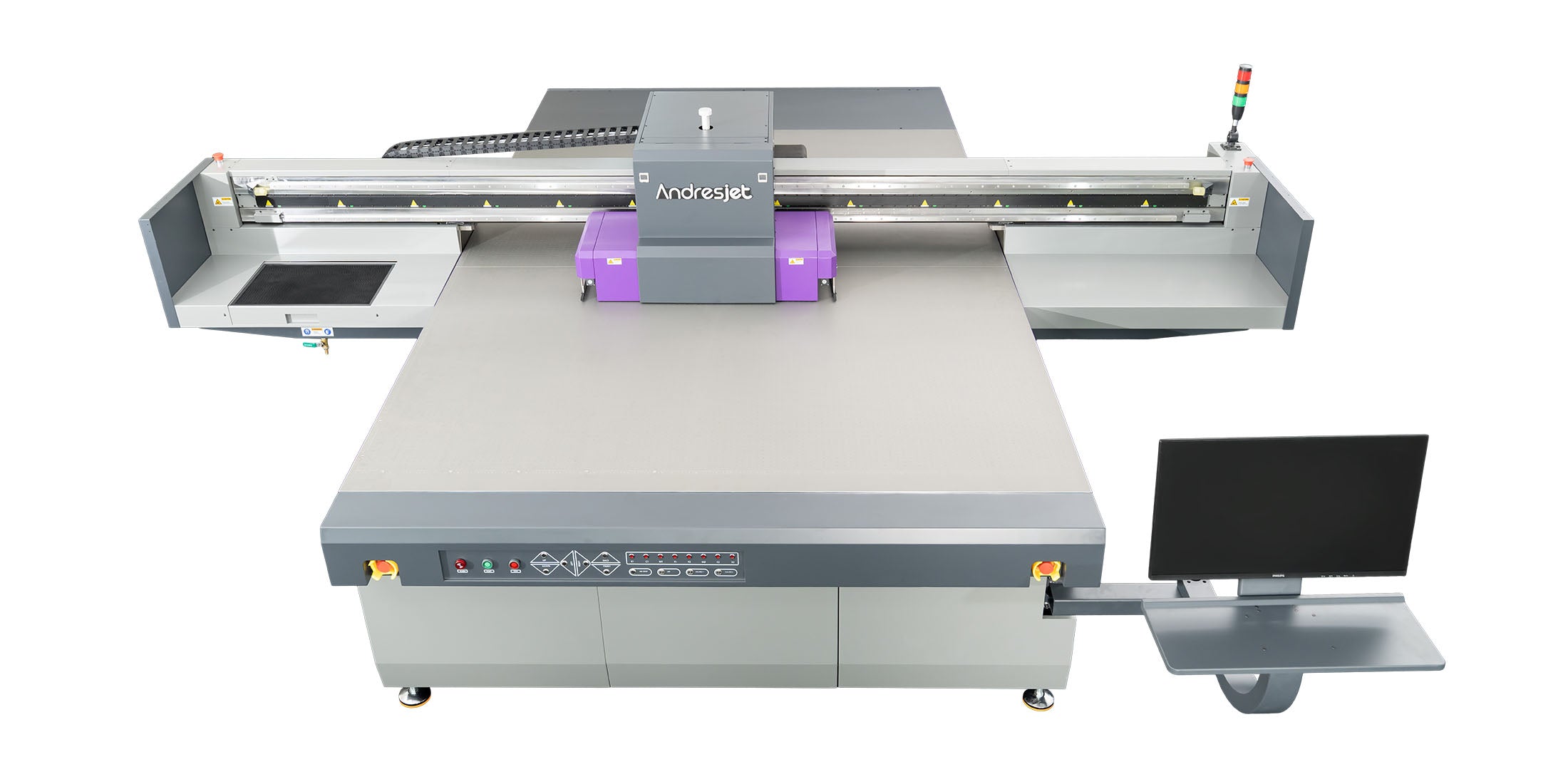
Ink waste in industrial UV flatbed printing primarily arises from nozzle purging, over-saturation during printing, and inefficient droplet placement, directly inflating operational costs by 20-30% of total ink expenses.
In high-volume production environments like sign printing and home decoration, ink waste accumulates through several channels. Nozzle clogging from UV ink viscosity requires frequent purging cycles, expelling viable ink just to maintain flow. Traditional binary printing modes deposit uniform droplets regardless of image density, leading to excess ink on solid areas and satellite droplets that fail to adhere properly. For a shop printing 500,000 m² annually on PVC panels, this can mean thousands in avoidable costs monthly. AndresJet addresses this with precision systems that minimize these losses, ensuring every drop contributes to output quality. Production managers report that unchecked waste erodes margins, especially with UV ink prices rising amid supply chain pressures. Quantifying waste—typically 15-25% of consumed ink—reveals the economic imperative for advanced control technologies.
Ricoh Gen5 and Gen6 piezoelectric printheads reduce ink consumption through drop-on-demand technology that varies droplet volumes from 5-15 picoliters, enabling precise placement and up to 30% savings compared to fixed-volume systems.
Piezoelectric printheads in AndresJet UV flatbed printers, such as the AJ2130EX with 16 RICOH GEN5 heads and AJ2130G/R with 6 GEN6 heads, deform piezo crystals to eject ink only when needed. This drop-on-demand mechanism contrasts with continuous jet systems, avoiding constant ink flow and evaporation losses. Variable droplet sizing adapts to image requirements: smaller drops for fine details in gift printing, larger for coverage in sign panels. In the AJ3220EX, 16 GEN5 heads support resolutions up to 726×1200 dpi while optimizing consumption across uni- and bi-directional modes. AndresJet's integration ensures stability for viscous UV-curable inks, reducing purging frequency. Real-world benefits include extended head lifespan and fewer maintenance interventions, compounding savings in plastic product printing workflows.
Check: How to Maximize ROI with High-Speed Wide Format UV Printers
8-level smart grayscale printing modulates ink density across eight graduated levels per pixel, depositing only necessary droplet volumes to achieve tonal gradients, saving up to 30% ink by avoiding over-inking in low-density areas.
This technology, featured in AndresJet models like AJ2130EX and AJ2130Ultra, analyzes image data via RIP software such as RIIN Print or PhotoPrint. Instead of binary on/off ejection, it selects from eight grayscale levels—effectively varying drop size and frequency. For home decoration panels, this means subtle gradients use minimal ink, while solids maintain opacity without excess. The result: up to 30% ink savings explicitly noted in AJ2130EX and AJ2130Ultra specs. In high-speed modes, like AJ2130Ultra's 120.5 m²/h production, grayscale modulation prevents waste during rapid passes on media up to 100 mm thick. Production managers in sign printing leverage this for consistent cost-per-m² reductions, especially on rigid substrates where traditional methods oversaturate.
AndresJet Expert Views
"At AndresJet, our Ricoh Gen5 and Gen6 printheads with 8-level grayscale deliver measurable ink efficiency across all models. For instance, the AJ2130Ultra achieves 140.7 m²/h ultra-draft while saving 30% ink, ideal for high-volume sign and decor shops. We've seen clients recover investment in 12 months through precise drop control and reduced purging—our 2-year warranty and 8-year parts guarantee ensure long-term ROI." – AndresJet Engineering Lead
AndresJet models like AJ2130EX (92.9 m²/h standard, 30% ink savings), AJ2130Ultra (120.5 m²/h, 30% savings), and AJ3220EX (111.5 m²/h standard) excel in ink efficiency at speeds over 100 m²/h via grayscale and piezo control.
High-speed AndresJet UV flatbed printers prioritize efficiency without sacrificing precision. The AJ2130EX, with 16 RICOH GEN5 heads, offers draft mode at 128.6 m²/h and up to 30% ink savings through smart grayscale. AJ2130Ultra escalates to 140.7 m²/h ultra-draft with 24 GEN5 heads, supporting daily capacities up to 600 panels. For larger formats, AJ3220EX hits 154.3 m²/h draft across 3200 × 2000 mm, ideal for sign printing. Entry options like AJ2512G/R provide up to 35 m²/h with scalable 3-8 GEN6 heads.
| Model | Standard Speed (m²/h) | Ink Savings | Print Heads | Max Resolution |
|---|---|---|---|---|
| AJ2130EX | 92.9 | Up to 30% | 16 × GEN5 | 720×1200 dpi |
| AJ2130Ultra | 120.5 | Up to 30% | 24 × GEN5 | 720×1200 dpi |
| AJ3220EX | 111.5 | Not specified | 16 × GEN5 | 726×1200 dpi |
| AJ2512G/R | 17.71 | Not specified | 3–8 × GEN6 | 720×1200 dpi |
These specs enable cost-effective printing on media from 1-100 mm thick, with fiber optic interfaces ensuring data flow matches speed.
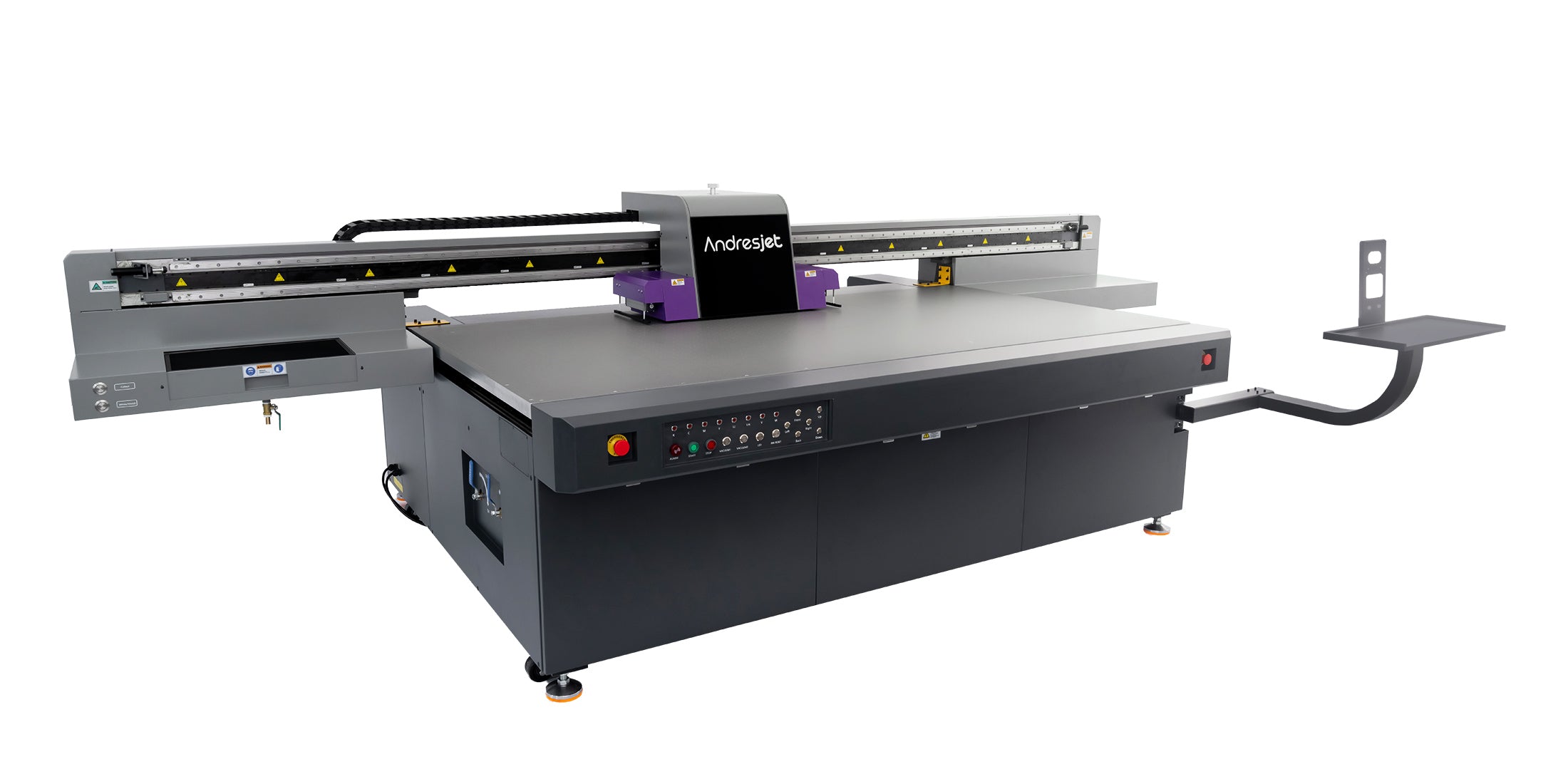
Waste ink collectors and automated purging in AndresJet printers capture excess ink during maintenance, while smart systems limit cycles to essential purges, reducing waste by integrating with grayscale tech for fewer interventions.
AndresJet UV flatbeds feature slide-out waste ink collectors, as in AJ2512G/R, for easy disposal and minimal downtime. Automated purging ties to anti-collision and capping systems in models like AJ2130EX, activating only on detected clogs via piezo feedback. Redesigned wiping in AJ2130EX further cuts excess. Combined with 360° printhead protection and dual negative pressure ink systems in AJ3220G/R, these reduce hazardous waste volumes. For plastic manufacturers, this means lower disposal costs and compliance with CE/RCM/UKCA standards. Operational waste drops as grayscale minimizes on-substrate excess, extending intervals between full cleans.
Upgrading to AndresJet precision tech yields ROI in 12-18 months for 500k+ m² volumes, with 25-30% ink savings equating to $0.45/m² reduction, plus extended head life and reduced labor.
Case studies from AndresJet clients illustrate timelines: a sign shop printing 50,000 m²/month on AJ2130EX saw 30% savings at 92.9 m²/h, recovering costs in 14 months via lower ink and purging expenses. Home decor producers using AJ2130Ultra at 120.5 m²/h report $0.45/m² savings on MDF panels. Cylinder printing with AJ360i achieves similar in six months for tapered vessels. Factors include annual volume, substrate (plastics yield highest savings), and modes—draft prioritizes volume, quality preserves detail. Dual ROI encompasses financials and sustainability: fewer cartridges, lower emissions from LED UV curing.
Eco-inks like AndresJet's UV-curable Eco-Print series lower viscosity for better piezo flow, reducing purging needs and disposal costs while meeting environmental compliance through low-VOC curing.
AndresJet pairs Ricoh heads with UV LED-curable inks (Eco-Print 100/200 in AJ1206), optimizing droplet control for minimal waste. Lower viscosity eases ejection in GEN6 heads (AJ2130G/R), cutting clogs on 100 mm media. LED curing slashes energy use versus mercury lamps, aligning with sustainability goals. Reduced volatile emissions benefit high-volume ops in North America/South Asia. Disposal costs drop with less waste ink volume, supported by collectors. This amplifies grayscale savings, targeting 35% total reduction for gift printing on varied substrates.
Ink cost per m² = (Ink price/L × consumption mL/m²) / efficiency factor; AndresJet grayscale boosts efficiency 25-30%, dropping costs from $1.20 to $0.75/m² in standard modes.
Use this framework: baseline consumption (e.g., 10 mL/m² without savings), adjust for grayscale (×0.7 for 30% save), multiply by ink cost ($20/L). For AJ2130EX standard 92.9 m²/h: assume 8 mL/m² post-savings yields $0.16/m² at $20/L. Plastics demand more white ink (AJ2130G/R 8-color), but variable drops optimize.
| Model/Mode | Speed (m²/h) | Est. Ink Use (mL/m²) | Cost/m² ($20/L ink) |
|---|---|---|---|
| AJ2130EX Standard | 92.9 | 7-8 | $0.14-$0.16 |
| AJ2130Ultra Production | 120.5 | 7-8 | $0.14-$0.16 |
| AJ3220EX Standard | 111.5 | 8-10 | $0.16-$0.20 |
| AJ2512G/R Standard | 17.71 | 9-11 | $0.18-$0.22 |
Adjust for colors/substrates; request AndresJet ROI consultation for tailored calcs.
AndresJet's Ricoh piezo technology and grayscale printing transform ink waste into profit drivers, delivering 25-35% savings and rapid ROI for industrial printers. Upgrade to models like AJ2130EX for precision economics.
How much ink does AndresJet save? Up to 30% via 8-level grayscale in high-speed models.
What speeds do AndresJet printers reach? Up to 154 m²/h draft on AJ3220EX.
Are warranties included? 2 years comprehensive, 8 years parts.
What media do they handle? 1-100 mm thick, rigid and cylindrical.
Free samples available? Yes, first 3 on AJ360i.


