Scale your print shop by upgrading when daily order volume exceeds your current printer's capacity. Entry-level shops (10–30 sqm/day) start with compact UV flatbeds like the AJ1206; mid-size operations (30–100 sqm/day) transition to wide-format systems like the AJ2512G/R or AJ2130EX; high-volume producers (100–150+ sqm/day) deploy ultra-high-speed models up to 154 sqm/hr. Payback occurs in 12–18 months at 60% margins.
Check: Which Printer Brands Truly Listen to B2B Customers?
How do you know when it's time to scale your print shop?
Upgrade when daily production demands exceed your current equipment's capacity, leading to bottlenecks, overtime labor, or lost orders. Signs include frequent delays, high maintenance costs, and inability to meet growing customer volumes in signage, home décor, or plastic products.
Print shop owners often face the dilemma of recognizing growth pains before they cripple operations. If your team spends more time waiting on prints than producing them, or if you're turning away jobs due to capacity limits, it's time to evaluate scaling. In the UV flatbed printing sector, entry-level desktop systems handle small runs effectively but falter under sustained mid-volume demands. Key indicators include processing over 10 sqm/day consistently, rising labor costs from manual handling, and customer complaints about turnaround times. Proactive scaling aligns equipment with business growth, ensuring agility for e-commerce-driven customization surges. AndresJet's progression from compact models like the AJ1206 to high-speed wide formats supports this transition seamlessly.
What production volume thresholds trigger equipment upgrades?
Upgrade at these daily thresholds: 10–30 sqm/day (entry-level), 30–60 sqm/day (mid-size), 60–100 sqm/day (high-speed), and 100–150+ sqm/day (ultra-high-speed). Match thresholds to printers offering speeds from 2,000 units/hour up to 154 sqm/hr for optimal throughput.
Production volume serves as the clearest benchmark for upgrades. Shops averaging 10–30 sqm/day on desktop printers hit limits quickly with rigid media like PVC panels or signs. At 30–60 sqm/day, mid-size UV flatbeds become essential to maintain quality without excessive shifts. Beyond 60 sqm/day, high-speed models prevent bottlenecks, while 100+ sqm/day demands ultra-high-speed systems for competitive edges in sign printing and home decoration.
| Daily Volume |
Recommended AndresJet Model |
Max Speed |
Key Benefit |
| 10–30 sqm/day |
AJ1206 |
Up to 2,000 coins/hour |
Compact entry-level for small runs |
| 30–60 sqm/day |
AJ2512G/R |
35 sqm/hr |
Mid-size 8ft × 4ft format |
| 60–100 sqm/day |
AJ2130EX |
128.6 m²/h (draft) |
High-speed wide format |
| 100–150+ sqm/day |
AJ3220EX |
154.3 m²/h (draft) |
Ultra-large format capacity |
This table maps volumes to AndresJet models, factoring in real-world applications like plastic product printing.
Which AndresJet UV flatbed printer fits your current business stage?
Select based on stage: AJ1206 for entry-level (small format, 1200 × 600 mm), AJ2512G/R for mid-size (2500 × 1200 mm, up to 35 sqm/hr), AJ2130EX/Ultra for high-speed (2100 × 3000 mm, 120–140 sqm/hr), and AJ3220EX for large-scale (3200 × 2000 mm, up to 154 sqm/hr).
AndresJet offers a tailored lineup for every growth phase. The AJ1206 Small UV Flatbed Printer excels in entry-level shops with its 1200 × 600 mm print size, handling up to 2,000 coins or medals per hour on media up to 35 mm thick. For mid-size operations, the AJ2512G/R provides 2500 × 1200 mm coverage at up to 35 sqm/hr, supporting 1–100 mm thickness with 3–8 RICOH GEN6 heads. High-speed needs are met by the AJ2130EX (up to 128.6 m²/h draft) or AJ2130Ultra (140.7 m²/h ultra-draft), both with 2100 × 3000 mm beds and industrial RICOH GEN5 heads. Large-format leaders like the AJ3220EX deliver 154.3 m²/h on 3200 × 2000 mm, ideal for high-volume sign and décor production. All feature hard-anodized aluminum flatbeds with 4-zone vacuum, ensuring versatility across applications.
AndresJet Expert Views: "With over a decade scaling print operations in North America and South Asia, we've seen shops transform from 20 sqm/day startups to 150 sqm/day powerhouses. Our progressive lineup—from AJ1206 entry models to AJ3220EX ultra-high-speed—ensures phased growth without quality loss. Features like 360° anti-collision protection, fiber optic interfaces, and 8-year spare parts availability minimize downtime, while 2-year warranties and 3-day training build operator confidence. AndresJet engineers design full production lines, delivering ROI in 12–18 months through automation and sustainability-focused UV LED inks." — AndresJet Engineering Team
Why does print speed matter less than quality consistency during scaling?
Check: How to Maximize ROI with High-Speed Wide Format UV Printers
Quality modes (27–89 sqm/hr across models) ensure consistent output on rigid media, proving high-speed draft modes (up to 154 sqm/hr) complement—not compromise—precision. Consistency builds repeat business in demanding sectors like signage.
While headlines tout speeds over 100 sqm/hr, scaling success hinges on quality consistency. AndresJet printers balance this with multi-mode operation: AJ2130EX offers 74.6 m²/h in quality mode alongside 128.6 m²/h draft, using 16 RICOH GEN5 heads at resolutions up to 720×1200 dpi. The AJ2512G/R maintains 13.02 m²/h high-quality on 720×1200 dpi, while AJ3220EX delivers 89.6 m²/h quality. Industrial piezo heads, ICC color management, and anti-static features preserve detail on MDF panels or ABS plastics, preventing scaling pitfalls like rework.
How can you calculate ROI before investing in high-speed printing equipment?
ROI = (Revenue gain - Equipment cost) / Equipment cost. For 60 sqm/day shops, high-speed models like AJ2130Ultra yield 12–18 month payback at 60% margins, factoring reduced labor and 30% ink savings via grayscale printing.
Simple math guides ROI: estimate current cost-per-sqm (labor + materials), subtract post-upgrade savings, and divide into revenue uplift. A shop at 50 sqm/day upgrading to AJ2130EX (92.9 m²/h standard) cuts labor 40% via automation, with UV-curable inks saving 30% through smart grayscale. At $20/sqm margin, 60 sqm/day generates $360k/year extra revenue against a capital investment yielding payback in 14 months. AndresJet's 8-year parts guarantee and free samples de-risk decisions.
| Model |
Draft Speed (m²/h) |
Quality Speed (m²/h) |
Ink Savings |
Est. Payback (60 sqm/day) |
| AJ2130EX |
128.6 |
74.6 |
Up to 30% |
12–15 months |
| AJ2130Ultra |
140.7 |
104.5 |
Up to 30% |
12 months |
| AJ3220EX |
154.3 |
89.6 |
N/A |
14–18 months |
What automation features reduce labor costs and operator burden at scale?
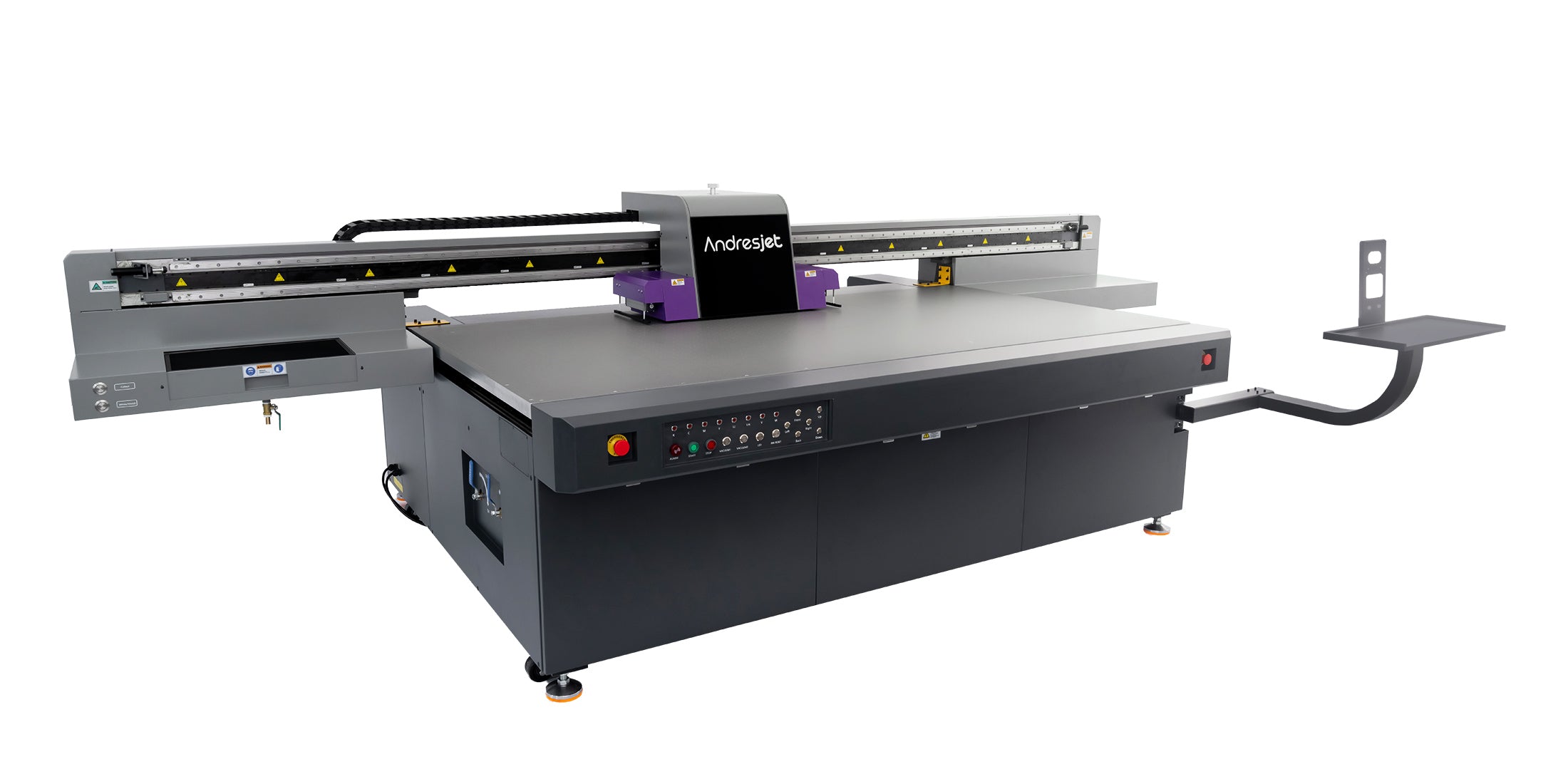
Features like 4-zone vacuum systems, 360° anti-collision, fiber optic data transfer, and auto height detection cut manual intervention by 50%, enabling 24/7 operation with minimal staff on models like AJ2130G/R and AJ3220EX.
Automation is scaling's backbone. AndresJet's hard-anodized flatbeds with dual 1500W vacuum blowers secure media 1–100 mm thick. Anti-collision systems protect 24-head setups on AJ2130Ultra, while fiber optic interfaces and AC servo motors (or MagLev on AJ2130EX) ensure precision. CCD visual positioning on AJ1206 eliminates jigs, and quick-change fixtures on AJ360i reduce setup to 15 minutes. These slash labor from 4 operators to 1–2 per shift.
How should you design a modular production line for phased growth?
Start single-printer (AJ1206), add multi-head configs (AJ2512G/R to 8 heads), then multi-machine lines (AJ2130EX + AJ3220EX). AndresJet engineers provide custom designs with 8-year parts support for seamless expansion.
Modular design de-risks investment: begin with AJ1206 for proofs, scale to AJ2512G/R (scalable 3–8 heads), integrate AJ2130 series for volume, and cluster AJ3220 models for 600 panels/day. Fiber optic RIP software (RIIN Print, Onyx) unifies workflows. AndresJet offers production line blueprints, training, and spares, supporting growth in gift printing or cylindrical objects via AJ360i integration.
Can you maintain quality while doubling production volume?
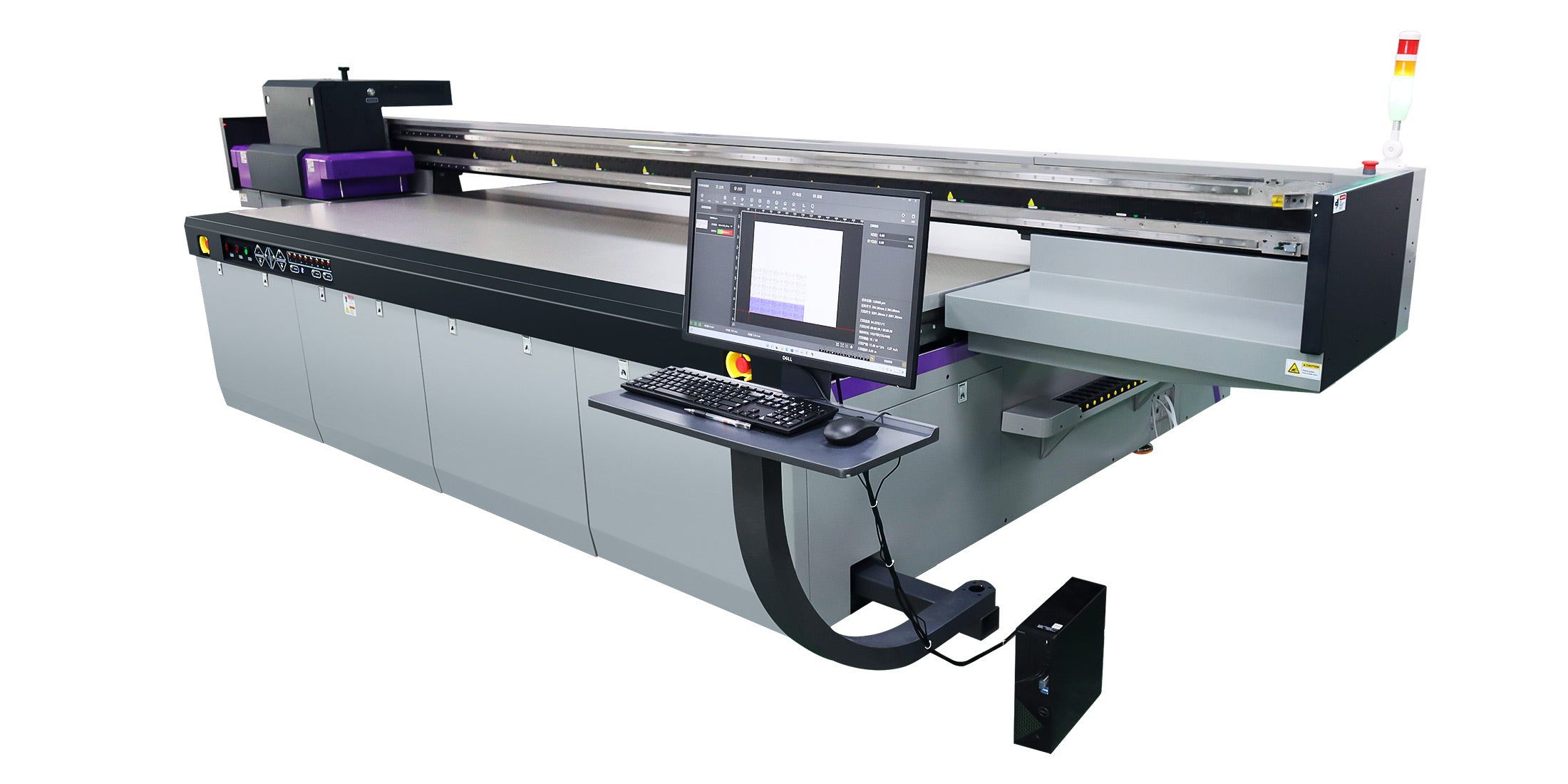
Yes, via quality modes (27–104 sqm/hr), RICOH GEN5/6 heads, and UV LED curing ensuring 720×1200 dpi consistency. Shops double output on AJ2130G/R without rework, backed by 2-year warranties.
Doubling volume demands unwavering quality. AndresJet's industrial heads deliver 360×1200 to 720×1200 dpi across modes, with white ink channels (AJ2130G/R) for raised effects up to 0.15 mm. UV-curable inks and anti-static bars prevent defects on 100 mm media. Operators report zero quality drop scaling to 120 sqm/day, thanks to density adjustments and certifications like CE, RCM, UKCA.
Conclusion
Scaling from entry-level to high-speed UV flatbed printing transforms print shops into efficient powerhouses. AndresJet's reliable progression—AJ1206 to AJ3220EX—delivers speed, quality, and support for sustained growth in competitive markets.
Frequently Asked Questions
1. What media thickness do AndresJet printers handle? Most models support 1–100 mm, ideal for panels, signs, and plastics.
2. How long is the warranty? 2 years comprehensive, with 8 years guaranteed spare parts.
3. Are free samples available? Yes, first 3 samples free on AJ360i; contact for others.
4. What RIP software is used? RIIN Print, PhotoPrint, or Onyx, supporting TIFF, JPEG, EPS, PDF.
5. Can I get training? 3 days included; full production line design available.


