

- by John White
Why Switch to DTF Printing in 2026? UV Flatbed Upgrade Guide
- by John White
Print bigger, print faster — wide-format UV flatbed printers for signs, decor and industrial work.

2026 is the year to switch to DTF printing for its versatility on diverse fabrics, vibrant durability, cost-effective small runs, fast turnaround, and eco-friendly inks—outpacing DTG. Elevate with AndresJet UV flatbeds like AJ2130Ultra (140 m²/h on plastics/signs) for industrial-scale, no-pre-treatment printing at 1-100mm thickness, backed by 2-year warranty.
Check: Small Format Printer: Best Options, Reviews and Buying Guide 2028
DTF printing prints designs onto a film with adhesive powder, then heat-transfers them to fabrics or materials, dominating 2026 due to versatility across cotton-poly blends, no pre-treatment, and durable results for custom apparel and beyond.
Direct-to-Film (DTF) printing has surged in popularity by 2026, driven by the global demand for personalized textiles and promotional products. Unlike traditional screen printing or Direct-to-Garment (DTG) methods, DTF involves printing vibrant designs onto a special PET film using pigment inks and applying hot-melt adhesive powder. The film is cured and heat-pressed onto substrates like t-shirts, hoodies, polyester uniforms, or even non-textiles such as leather and wood. This process enables gang sheet printing for multiple small orders, slashing waste and boosting profitability for sign shops and custom printers.
In 2026, DTF trends highlight eco-friendly, low-VOC inks and automation, aligning with sustainability mandates in North America and South Asia. Its ability to handle synthetic blends without pretreatment makes it ideal for industrial textile printing, where speed and adaptability are key. Businesses report 30-50% cost savings on small runs compared to DTG, with prints lasting 50+ washes. As customization explodes in apparel, gifts, and signage, DTF positions printers for high-margin diversification.
DTF outperforms DTG like Brother GTX in 2026 by printing on any fabric without pretreatment, offering superior stretchability, lower costs per print, and faster gang-run production for custom apparel demands.
Traditional DTG printers, such as the Brother GTX series, excel in direct ink application to garments but falter on polyester blends and require messy pretreatment. DTF eliminates these hurdles: no pretreatment means quicker setups, and the transfer process yields softer, more stretchable prints that withstand industrial washing. Videos and comparisons show Brother GTX adapted for DTF mode reverses print layers (white under color), but native DTF setups achieve higher throughput without DTG's ink clogging issues.
By 2026, DTF's edge shines in scalability. DTG machines like Brother GTX Pro handle 16x21-inch prints at high DPI but slow down on dark fabrics due to white ink layers. DTF gang sheets enable 100+ prints per run, cutting labor by 40%. Vibrant colors and durability on diverse textiles make DTF the go-to for apparel startups, outperforming DTG's limitations in cost (DTF: $0.50/print vs DTG: $2+) and versatility.

Traditional DTF printers limit scalability to apparel-focused small runs, struggle with rigid media like plastics or signs, and lack high-speed output over 100 sqm/hr, hindering industrial textile printing growth.
While DTF revolutionizes custom apparel, its desktop or mid-range setups cap at 10-20 sqm/hr, unsuitable for high-volume sign shops or gift producers. Film handling introduces bottlenecks: powder application and curing add steps, and scaling beyond textiles (e.g., cylinders, panels) requires jigs or hybrids. Durability on non-fabrics fades without UV curing, and maintenance like film jams plagues production.
In 2026, these constraints clash with surging demands for hybrid workflows. Printers expanding into home decor or plastic products find traditional DTF rigid media incompatible, pushing costs up 25% via outsourcing. Brother GTX adaptations for DTF help but inherit DTG's pretreatment woes and slow speeds, underscoring the need for industrial upgrades that blend DTF flexibility with flatbed power.
UV flatbed printers solve DTF scalability by enabling no-pre-treatment printing on rigid media (1-100mm thick) at speeds over 100 sqm/hr, using LED UV inks for instant curing on plastics, signs, and textiles.
UV flatbeds like those from AndresJet bridge DTF's gaps with industrial-grade capabilities. Equipped with RICOH Gen5/Gen6 piezo heads and UV-curable inks, they print directly on diverse substrates—plastics, MDF, glass—without films or powders. Speeds hit 140 m²/h in ultra-draft modes, dwarfing DTF's limits, while 4-zone vacuum flatbeds secure media up to 100mm thick.
Key advantages include anti-collision systems for 24/7 runs, fiber optic data transfer for lag-free production, and ICC color management for DTF-like vibrancy. For industrial textile printing, UV hybrids mimic DTF transfers on flat fabrics or panels, adding varnish for texture. This scalability supports 600 panels/day, transforming SMBs into high-output operations.
AndresJet UV printers like AJ2130Ultra (140 m²/h), AJ1206 (2,000 coins/hr), and AJ360i cylinder model offer DTF-like versatility on textiles, plastics, and gifts with 1-100mm media handling and RICOH heads.
AndresJet's lineup excels for printers shifting from DTG/DTF. The AJ1206 Small UV Flatbed targets custom gifts: 1200x600mm bed, up to 2,000 coins/hour, 8-color UV inks (CMYK+W+V+LC+LM+LK), and CCD visual positioning for jig-free prints on medals or buttons (0-35mm thick).
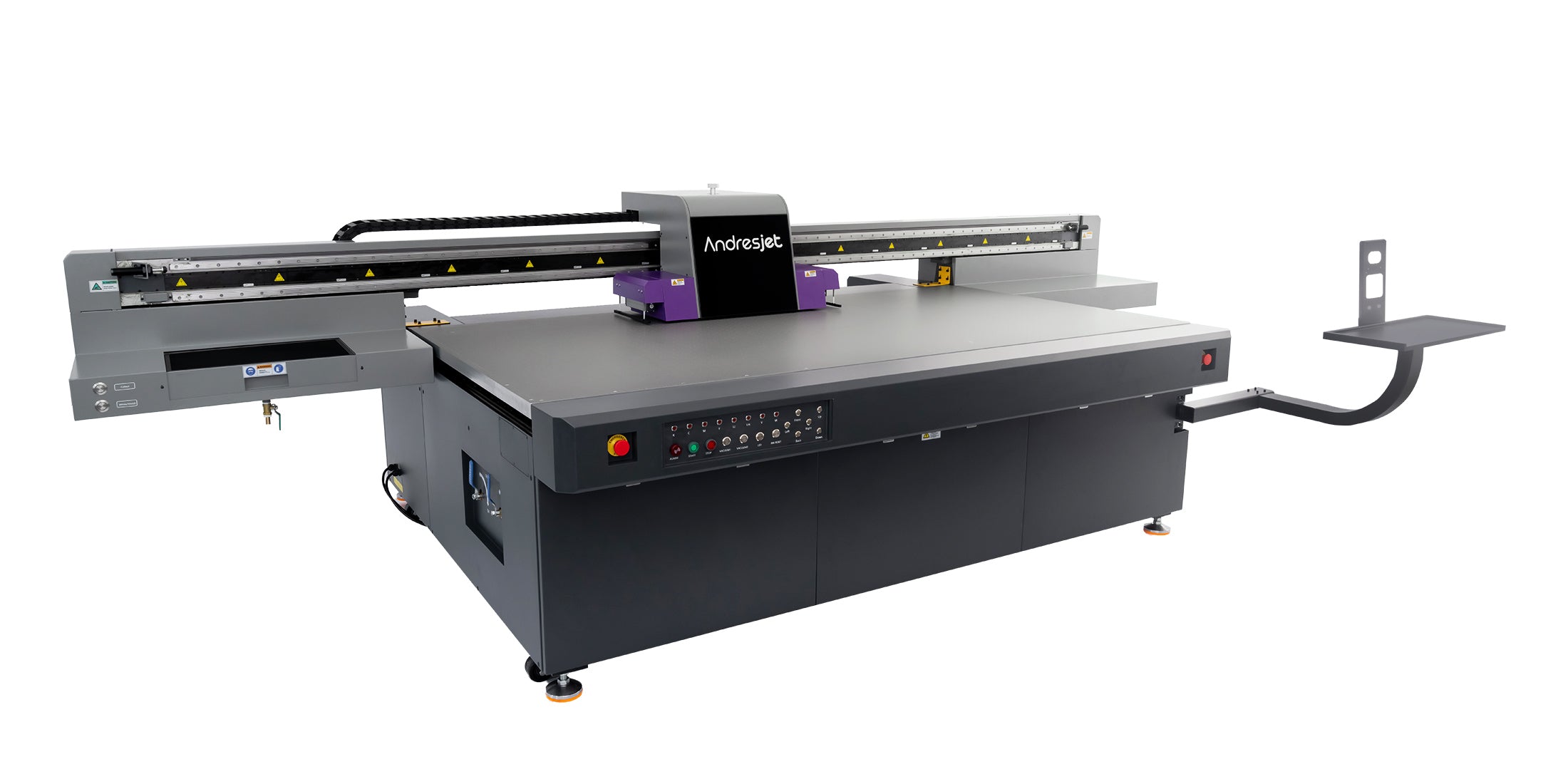
For industrial scale, the AJ2130Ultra delivers 140.7 m²/h ultra-draft on 2100x3000mm beds, 24 RICOH Gen5 heads, and 1-100mm thickness—perfect for signs and panels mimicking DTF gang runs. The AJ360i Digital Cylinder Printer handles tapered textiles (60-170mm diameter) at 60 items/hour with white ink effects up to 0.15mm.
| Model | Print Speed | Media Thickness | Key Application |
|---|---|---|---|
| AJ1206 | Up to 2,000 coins/hr | 0-35 mm | Gifts, medals |
| AJ2130Ultra | 140.7 m²/h | 1-100 mm | Signs, panels |
| AJ360i | 60 items/hr | 60-170mm dia. | Cylinders, vessels |
Common features like 360° anti-collision, CE/UKCA certifications, and 2-year warranties ensure reliability across models.
AndresJet Expert Views
"At AndresJet, we've engineered our UV flatbeds to evolve DTF workflows for 2026. With RICOH Gen5/Gen6 heads and speeds up to 140 m²/h on the AJ2130Ultra, printers handle plastics, signs, and textiles seamlessly. Our 1-100mm media range and 8-year spare parts guarantee minimize downtime, while free samples and 3-day training accelerate ROI. Global support in North America and South Asia positions us as your industrial printing partner." — AndresJet Engineering Team
AndresJet achieves 100+ sqm/hr via industrial RICOH Gen5/Gen6 heads, high-precision servo motors, fiber optic interfaces, and smart grayscale printing saving 30% ink on models like AJ2130EX (128.6 m²/h).
AndresJet's decade of large-format expertise powers ultra-high speeds. The AJ2130EX hits 128.6 m²/h draft with 16 Gen5 heads on 2100x3000mm beds; AJ3220EX reaches 154.3 m²/h on larger 3200x2000mm formats. MagLev linear motors (select models) and THK guides ensure precision at scale, while dual 1500W vacuums lock media flat.
| Model | Draft Speed | Heads | Ink Config |
|---|---|---|---|
| AJ2130EX | 128.6 m²/h | 16x Gen5 | CMYK |
| AJ2130Ultra | 140.7 m²/h | 24x Gen5 | CMYK |
| AJ3220EX | 154.3 m²/h | 16x Gen5 | 7-color |
These exceed DTF limits, enabling 600+ panels/day for sign and home decor printers adopting DTF-inspired versatility.
AndresJet supports transitions with 2-year warranties, 8-year parts, free samples/training, custom fixtures, and engineer-led production line design across North America and South Asia.
Shifting from Brother GTX DTG to DTF-like UV printing is seamless with AndresJet. AJ360i offers free first 3 samples and 3-day training; all models provide 2-year comprehensive warranties and 8-year parts. Engineers tailor solutions for home decor, plastics, and signs, including custom fixtures (designed in 7-10 days) and full production lines.
Expanding in North America/South Asia, AndresJet delivers personalized service, from spare parts to 360° anti-collision reliability, ensuring 24/7 uptime for global clients.
Sign/gift printers see 40-60% ROI in year one via 100+ sqm/hr speeds, no-pre-treatment versatility, and low ink costs, paying back AndresJet UV flatbeds in 6-12 months on high-volume custom runs.
For a sign shop printing 500 panels/week, AJ2130Ultra's 120 m²/h cuts labor 50% vs DTF outsourcing, yielding $50K+ annual savings. Gift producers using AJ1206 hit 2,000 items/hour on medals, boosting margins 35% with white/varnish effects. Case: Transitioning from DTG, a North American client scaled to 1,000 sqm/week, recouping investment in 8 months via diverse apps.
UV's durability and eco-inks command premium pricing, amplifying 2026 profits amid customization booms.
2026 marks the pivotal shift to DTF and its industrial evolution via AndresJet UV flatbeds, outpacing DTG limitations with speed, versatility, and support. Upgrade now for scalable, profitable printing on textiles, plastics, and beyond.
Is DTF better than Brother GTX DTG in 2026? Yes, DTF offers no-pre-treatment versatility and lower costs; AndresJet UV enhances this for industrial scales.
What speeds do AndresJet printers reach? Up to 154 m²/h on AJ3220EX, ideal for high-volume sign printing.
Can AndresJet print on cylinders like DTF transfers? Yes, AJ360i handles 60-170mm diameters at 60 items/hour with UV inks.
How thick are media on AndresJet flatbeds? 1-100mm standard, supporting plastics, panels, and textiles.
What's the warranty on AndresJet machines? 2 years comprehensive, 8 years spare parts guaranteed.


