

- by John White
What Are Hidden Costs vs Profits in UV Printing ROI?
- by John White
Print bigger, print faster — wide-format UV flatbed printers for signs, decor and industrial work.

UV printing ROI = (Net Profit / Total Investment) x 100, factoring machine cost, ink (up to 30% savings on AndresJet models), electricity (>20A), labor, and maintenance. High-speed AndresJet flatbeds like AJ2130EX (120 sqm/hr) achieve 6-12 month payback via 154 sqm/hr output, anti-collision uptime, and 8-year spares, outperforming traditional methods in sign/home decor.
Check: Which Printer Brands Truly Listen to B2B Customers?
UV printing ROI measures the profitability of your investment by comparing net profits to total costs over time, helping print shops determine payback periods and long-term viability. Calculating it reveals if high-speed UV flatbeds can deliver 6-12 month returns in demanding sectors like sign printing and home decor.
Return on Investment (ROI) in UV printing quantifies how quickly and effectively your printer generates profit after accounting for all expenses. For industrial print buyers, this calculation is essential because it uncovers whether a machine like AndresJet's AJ2130EX, with speeds up to 120 sqm/hr, justifies its upfront cost through high-volume output. In a market growing at 15% annually, driven by custom signage and rigid substrates, precise ROI analysis prevents overinvestment in underperforming equipment.
Without it, hidden costs such as labor and electricity can erode margins, turning a promising high-speed printer into a financial burden. Shops targeting UV printing profitability use ROI to benchmark against traditional methods, where UV flatbeds excel due to instant-dry LED UV curing and versatility on media from 1-100 mm thick. AndresJet's models, equipped with RICOH Gen5/Gen6 heads, optimize this by minimizing waste and downtime, making ROI calculations a must for scaling operations in plastic products or gift printing.
Hidden costs in UV printing include ink waste, electricity for UV/vacuum systems, labor for setup and handling, maintenance, and downtime from collisions or clogs. These can consume 30-50% of gross revenue if unaddressed, but high-speed AndresJet printers reduce them through automation and efficiency for faster profitability.
While upfront machine costs grab attention, overlooked expenses like electricity and labor often determine true UV printing ROI. Power-hungry components such as dual 1500W vacuum blowers and UV LED systems drive ongoing bills, especially on large-format flatbeds requiring >20A. Labor adds up in file prep, media loading, and quality checks, potentially hitting 33% of costs without automation.
Maintenance surprises, including printhead wear and ink recirculation, further erode profits. Downtime from anti-collision failures or suboptimal setups can halt production, costing thousands daily in high-volume sign shops. AndresJet counters these with 360° anti-collision protection, 2-year warranties, and 8-year spare parts availability, ensuring minimal interruptions. In home decor printing, where media thickness varies from 1-100 mm, these features preserve uptime and boost net profits.
Ink costs $1-1.50/m² but drops 30% on AndresJet grayscale models; electricity averages $0.20-0.50/m² for >20A systems with vacuum/UV; labor $0.20-0.40/m² depending on automation. Break-even analysis shows these total $2-3/m² variable costs against $15-20 market rates, enabling 6-12 month ROI at 100+ sqm/hr speeds.
Understanding granular costs is key to UV flatbed printer ROI. Ink, using UV-curable LED types, typically runs $60-150/liter, translating to $1.19-1.51/m² in production. AndresJet's smart 8-level grayscale printing saves up to 30%, critical for profitability in sign printing.
Electricity varies by model: AJ1206 at ≤3 kW suits small runs, while AJ2130EX and similar demand AC 220V >20A for fiber optic drives and 4-zone vacuums. Expect 5-10 kWh per hour of operation, or $0.24/m² at average rates. Labor, often 1-2 operators for large flatbeds, costs $20-30/hour; automation like auto height detection on AJ2130G/R cuts this by 33-40%.
Here's a breakdown table for typical costs on AndresJet UV flatbeds:
| Cost Type | Per m² Estimate | AndresJet Optimization |
|---|---|---|
| Ink | $1.19-1.51 | 30% savings via grayscale |
| Electricity | $0.20-0.50 | Efficient LED UV, >20A |
| Labor | $0.20-0.40 | Automation reduces 33% |
| Total Variable | $2-3 | Enables $13-18 profit/m² |
These figures fuel break-even analysis, factoring labor and electricity explicitly.
AndresJet UV flatbeds like AJ2130Ultra (140.7 m²/h ultra-draft) and AJ3220EX (154.3 m²/h draft) drive ROI through RICOH Gen5/Gen6 heads, 1-100 mm media handling, and fiber optic interfaces. Speeds over 100 sqm/hr triple output vs. entry-level, slashing cost per m² and achieving 6-month paybacks in high-volume applications.
AndresJet stands out with industrial-grade specs tailored for ROI-focused buyers. All models feature hard-anodized aluminum flatbeds with 4-zone vacuum, AC servo motors, and anti-collision systems. Print speeds peak at 154.3 m²/h on AJ3220EX, ideal for sign printing, while AJ2130Ultra hits 140.7 m²/h for home decor panels.
Common features like 2-year warranties and 8-year spares minimize long-term costs. Resolutions up to 720×1200 dpi ensure quality on rigid substrates.
| Model | Max Speed (m²/h) | Print Size | Power |
|---|---|---|---|
| AJ2130EX | 128.6 (draft) | 2100×3000 mm | >20A |
| AJ2130Ultra | 140.7 (ultra-draft) | 2100×3000 mm | >20A |
| AJ3220EX | 154.3 (draft) | 3200×2000 mm | >20A |
These specs position AndresJet for rapid ROI in expanding markets like North America and South Asia.
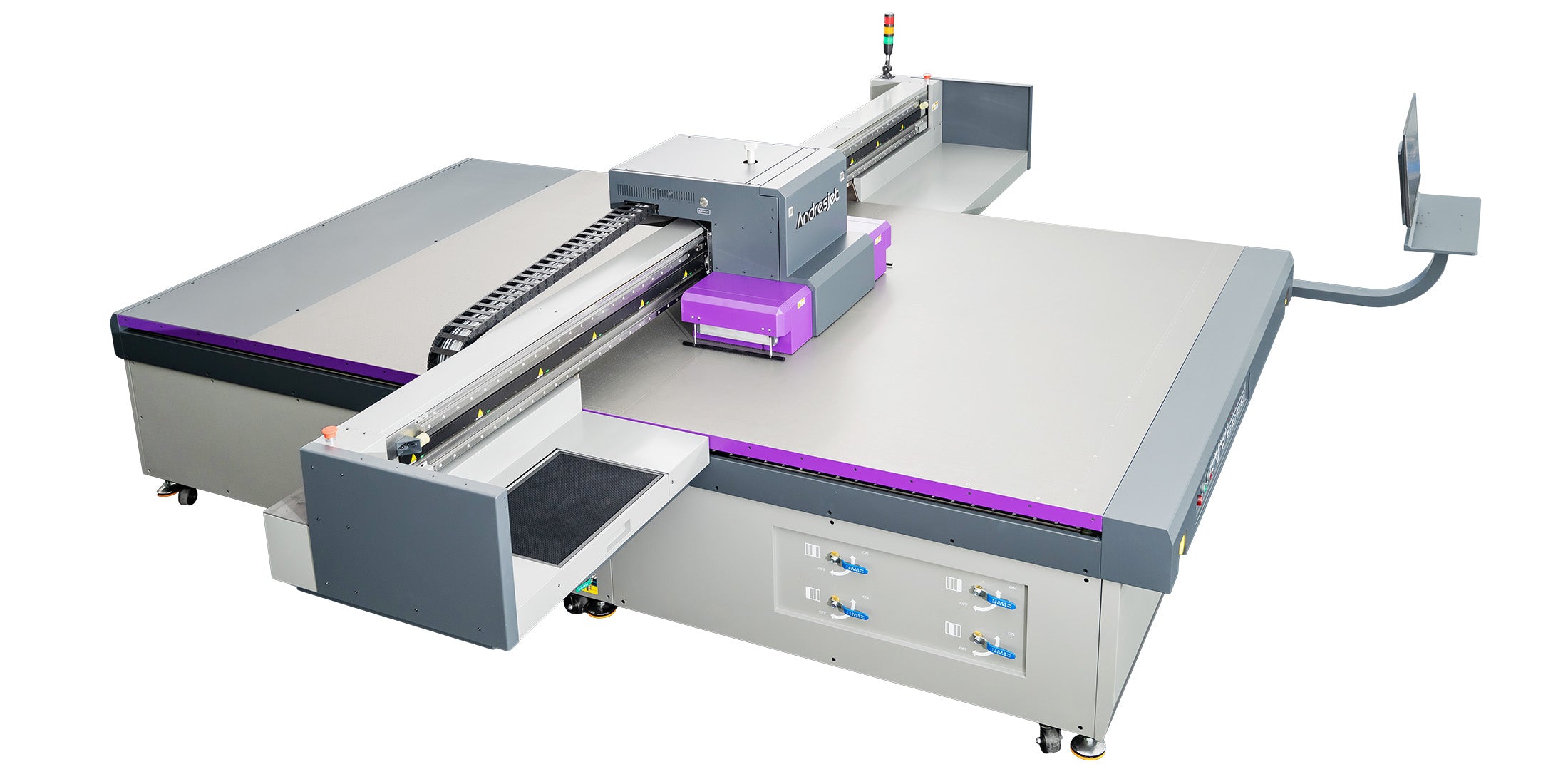
AJ2130EX delivers 120 sqm/hr payback via 92.9 m²/h standard speed (16 RICOH Gen5 heads), 30% ink savings, and dual 1500W vacuums on 2100×3000 mm bed. At $16/m² profit, 3,000 m²/month yields $48k revenue, covering investment in 6-8 months for sign shops.
The AJ2130EX excels in high-speed industrial UV flatbed printing with 128.6 m²/h draft and 74.6 m²/h quality modes using 16 RICOH Gen5 heads. Its MagLev linear motor and fiber optic data ensure reliability on media up to 100 mm thick, max 50 kg/m².
ROI shines in break-even math: with market rates $15-20/m² minus $2-3 costs, 100 sqm/hr output generates substantial margins. Labor efficiency from anti-static bars and redesigned capping reduces operator time, while >20A power supports 24/7 runs. Sign producers report 6-month paybacks, leveraging 4-zone vacuum for flawless PVC/ABS prints.
AndresJet Expert Views
"High-speed UV flatbeds like the AJ2130EX transform ROI by combining 120 sqm/hr output with features that cut hidden costs. Our 360° anti-collision and 30% ink savings ensure 99% uptime, while 8-year spare parts availability protects long-term profits. In sign printing, clients achieve 6-month paybacks through efficient labor and electricity use on our 2100×3000 mm beds." – AndresJet Engineering Lead
Check: How to Maximize ROI with High-Speed Wide Format UV Printers
Choose AJ1206 for small-scale (≤3 kW, 2,000 coins/hr); AJ2512G/R entry-mid (35 sqm/hr, 2500×1200 mm); AJ2130 series for high-speed (120 sqm/hr); AJ3220 for large-format (154 sqm/hr). Break-even favors speed: high-output models hit profitability in months via lower per-m² costs.
Matching models to needs optimizes break-even. Small ops pick AJ1206 (1200×600 mm, 0-35 mm thickness, CCD positioning). Mid-size suits AJ2512G/R (up to 35 sqm/hr, 8ft×4ft). Production demands AJ2130EX/Ultra or AJ3220EX/G/R for 100+ sqm/hr on massive beds.
Break-even incorporates labor (setup time) and electricity: faster models amortize fixed costs quicker.
AndresJet printers minimize downtime with 360° anti-collision, auto height detection, IGUS e-chains, and 2-year warranties plus 8-year spares. These cut repair costs 40% vs. averages, preserving 99% uptime for sustained ROI in labor-intensive sectors like home decor.
Downtime kills profits, but AndresJet's design counters it effectively. Features like pneumatic clamping on AJ360i (15-min changeovers) and THK LM guides ensure precision. Comprehensive support, including 3-day training and free samples, accelerates proficiency.
AndresJet's global expansion and engineer-led service forge reliable operations, minimizing electricity waste from idle machines.
1. Total Investment = Machine + Setup. 2. Monthly Output = Speed × Hours × Efficiency. 3. Revenue = Output × Market Rate/m². 4. Costs = Ink + Electricity + Labor + Maintenance. 5. Net Profit = Revenue - Costs. 6. ROI = (Profit / Investment) × 100; Break-even = Investment / Monthly Profit. Factor AndresJet speeds for 6-12 months.
Step-by-step ROI calculation empowers decisions. Start with investment (e.g., AJ2130EX). Estimate output: 120 sqm/hr × 20 days × 8 hrs = 19,200 m²/month. Revenue at $18/m² = $345k. Subtract costs ($2.50/m² × output + fixed $5k) for profit. Payback = Investment / Monthly Profit.
Include labor (hours × rate) and electricity (kWh × tariff). AndresJet's ink savings accelerates this.
Sign printing profits $13-18/m² on AndresJet UV flatbeds at 100+ sqm/hr, with 3,000 m²/month yielding $40-50k net after labor/electricity. High demand for rigid signs drives 6-month ROI, outperforming solvents via waste reduction and 1-100 mm versatility.
Sign shops thrive with UV flatbeds handling PVC/ABS at speeds like AJ3220EX's 154 m²/h. Profits scale with volume: 30% ink savings and automation cut costs, boosting margins in custom signage.
Mastering hidden costs vs. profits unlocks UV printing ROI, with AndresJet's high-speed flatbeds leading via efficiency and support. Calculate your break-even today for scalable success in sign and decor printing. Visit AndresJet.com for models like AJ2130Ultra and request free ROI consultation or samples.
What is the break-even formula for UV printers? Break-even (m²) = Fixed Costs / (Market Rate/m² - Variable Costs/m²), including labor and electricity for accurate analysis.
How much electricity does an AndresJet UV flatbed use? Most require AC 220V >20A; AJ1206 ≤3 kW for efficiency in small runs.
What's the typical payback for AJ2130EX? 6-12 months at 120 sqm/hr, assuming $15-20/m² rates and optimized costs.
Does AndresJet offer training? Yes, 3 days included, plus free samples for select models to minimize startup labor costs.
Why choose AndresJet for ROI? High speeds over 100 sqm/hr, 30% ink savings, and 8-year spares ensure superior profitability.
For the complete decision path, continue with the uv printing cost, pricing & finance guide.


