

Featured Snippet Create immersive large-scale exhibition booths by printing high-resolution graphics on rigid media using AndresJet AJ2130EX or AJ3220EX UV flatbed printers: 1) Design in RIP software like RIIN Print; 2) Load panels on 4-zone vacuum flatbed; 3) Print at 120–154 sqm/hr with RICOH Gen5 heads; 4) Cure with LED UV for instant durability; 5) Assemble for AR-enhanced displays—complete in under 24 hours.
Check: How Long Do UV Lamps Last and When Should They Be Replaced
What Makes Immersive Exhibition Stand Designs Stand Out?
Immersive exhibition stands combine elevated vertical structures, interactive technology, and strategic lighting with large-format graphics to engage visitors from multiple angles. They leverage height, dynamic visuals, and multi-sensory elements—such as LED panels, projection mapping, and touchscreen displays—to create memorable brand experiences that drive foot traffic and conversion rates at trade shows.
Modern trade show audiences expect more than static signage. Immersive booth designs use layered visual hierarchies, bold typography, and vibrant color palettes to capture attention across crowded exhibition floors. The key differentiator is combining architectural elements with high-impact printed graphics that maintain visual consistency across 360-degree sightlines.
Interactive experiences amplify engagement. Projection mapping and video walls convert flat surfaces into dynamic displays, while UV-printed rigid media panels serve as durable substrates for these technologies. When event planners integrate custom-printed backdrops, side panels, and floor graphics with lighting design and interactive touchpoints, the result is a cohesive environment that encourages visitors to explore deeper into the booth narrative.
Vertical space utilization is critical. Elevated booth designs draw the eye upward, making brands visible above competitor displays. Large-format graphics printed on PVC, ABS, or MDF panels—materials that withstand shipping and repeated assembly—form the visual backbone of these immersive environments. The durability of UV-curable inks ensures that graphics maintain color vibrancy and finish quality throughout multi-day events and across multiple shows.
Why Choose High-Speed UV Flatbed Printing for Booth Graphics?
High-speed UV flatbed printing delivers durable, vibrant booth graphics on rigid media in tight timeframes. UV-curable inks cure instantly under LED UV light, eliminating drying delays. Industrial-grade printers like AndresJet's AJ2130EX and AJ3220EX print at 100+ sqm/hr on media up to 100mm thick, enabling event planners to produce complete booth packages in under 24 hours while maintaining sharp detail and color accuracy.
UV flatbed printing addresses the core pain point of trade show production: speed without compromise. Unlike traditional screen printing or vinyl cutting, which require setup time and manual labor, UV flatbed systems automate the workflow from file to finished panel. This acceleration is critical when event timelines compress or design revisions occur close to show dates.
Durability is another decisive factor. UV-curable inks bond chemically to substrates, creating finishes that resist fading, scratching, and humidity fluctuations during shipping and assembly. For exhibitors reusing booth components across multiple events—a common practice in North America and South Asia—UV-printed graphics maintain their visual impact over months or years of handling.
Cost efficiency emerges through ink optimization. AndresJet's advanced RIP software supports smart 8-level grayscale printing, reducing ink consumption by up to 30% on photographic or gradient-heavy designs without sacrificing image quality. For large booth projects spanning hundreds of square meters, this ink savings directly improves project margins and ROI.
Substrate flexibility is unmatched. UV flatbed printers handle rigid media from 1mm to 100mm thick—including PVC, ABS, MDF, acrylic, and composite materials—on a single platform. Booth designers can print on panels of varying thicknesses, creating dimensional visual effects and structural components without outsourcing to multiple vendors.
Which AndresJet Printers Are Best for Large-Scale Booth Panels?
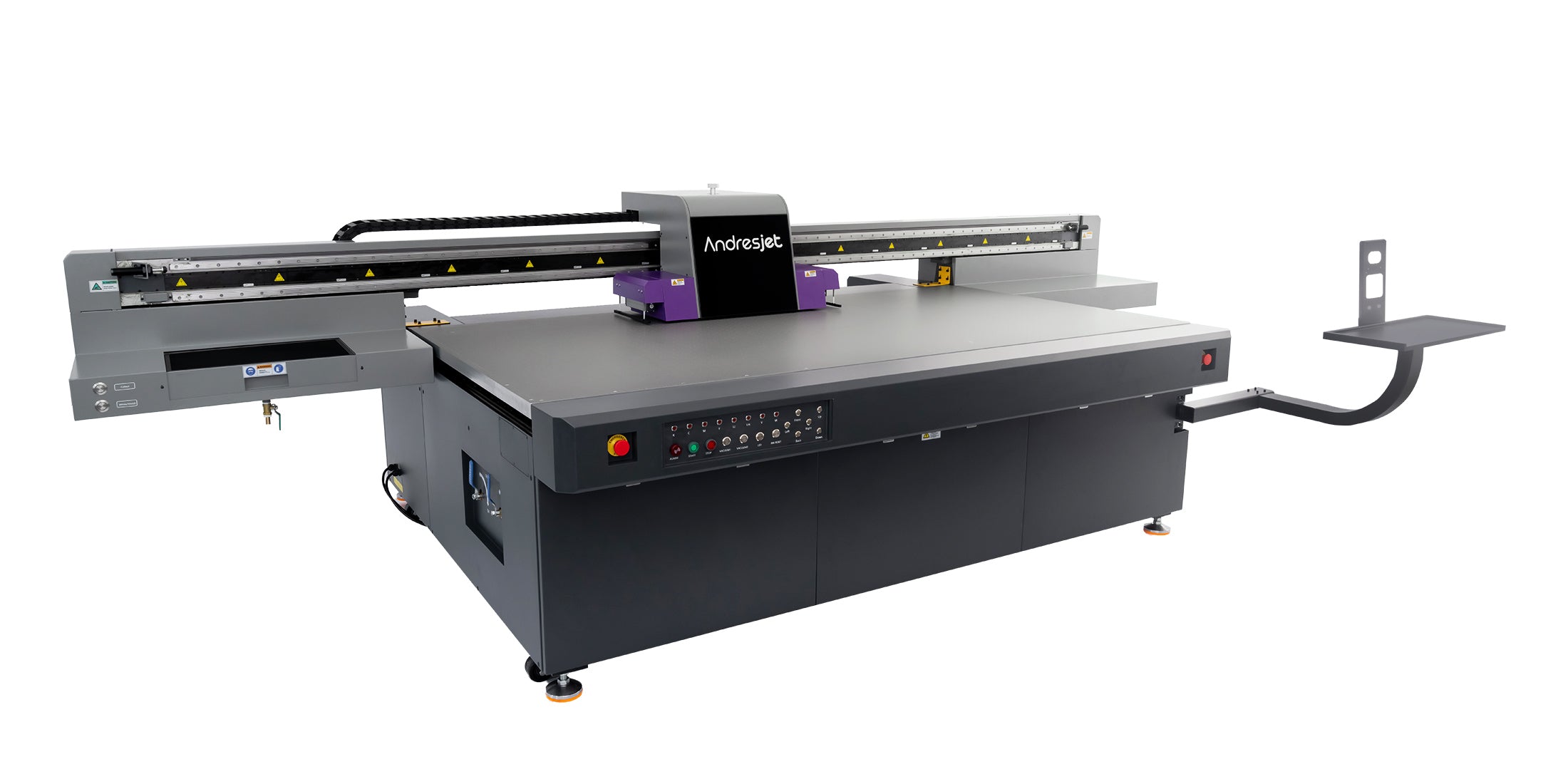
For large-scale exhibition booths, the AndresJet AJ2130EX and AJ3220EX UV flatbed printers are optimal. The AJ2130EX prints up to 2100 × 3000mm at 128.6 sqm/hr (draft mode), while the AJ3220EX handles 3200 × 2000mm at 154.3 sqm/hr. Both feature 16 RICOH Gen5 print heads, 4-zone vacuum flatbeds, and anti-collision systems for high-volume booth production with consistent quality and minimal downtime.
Selecting the right printer depends on booth dimensions, production volume, and turnaround requirements. The AJ2130EX excels for mid-to-large booths requiring tall vertical panels (up to 3 meters in length), while the AJ3220EX maximizes horizontal footprint for wide backdrops and modular booth systems.
| Model | Print Size (mm) | Max Speed (sqm/hr) | Print Heads | Best For |
|---|---|---|---|---|
| AJ2130EX | 2100 × 3000 | 128.6 (draft) | 16 × RICOH Gen5 | Tall vertical panels, modular booth systems |
| AJ3220EX | 3200 × 2000 | 154.3 (draft) | 16 × RICOH Gen5 | Wide horizontal backdrops, large-format graphics |
| AJ2130Ultra | 2100 × 3000 | 140.7 (ultra-draft) | 24 × RICOH Gen5 | Ultra-high-speed production (600 panels/day) |
For exhibitors managing multiple booth projects simultaneously or operating as service providers, the AJ2130Ultra represents the pinnacle of production capacity. Its 24 RICOH Gen5 print heads and ultra-draft mode of 140.7 sqm/hr enable production of up to 600 panels per day, transforming booth printing into a scalable revenue stream.
All three models feature hard-anodized aluminum flatbeds with 4-zone vacuum systems, ensuring consistent media grip across varying thicknesses and substrate types. The dual 1500W vacuum blowers maintain suction during high-speed passes, preventing media shift and maintaining registration accuracy—critical for multi-color booth graphics where alignment errors are visible at trade show distances.
How Do UV Flatbed Printers Handle Rigid Media Up to 100mm Thick?
UV flatbed printers handle rigid media up to 100mm thick through advanced vacuum clamping systems and precision media height detection. AndresJet's 4-zone vacuum flatbed maintains consistent substrate grip across the entire print area, while auto-height detection on models like the AJ2130G/R adjusts printhead clearance automatically. This enables printing on thick PVC, composite panels, and layered materials without manual adjustments or risk of head collision.
The mechanical architecture of industrial UV flatbeds is engineered for rigidity and precision. AndresJet's AJ2130EX and AJ3220EX feature hard-anodized aluminum flatbeds with segmented vacuum zones, allowing operators to activate or deactivate suction independently. This zone-based approach accommodates irregular substrate shapes and varying thicknesses on a single job—essential for booth projects combining thin accent panels with thick structural components.
The 360-degree anti-collision system is a critical safety feature for thick media. As the printhead carriage traverses the flatbed, proximity sensors detect substrate height variations and automatically adjust carriage elevation to maintain optimal nozzle-to-media distance. This prevents costly head crashes while enabling reliable printing on media up to 100mm thick without operator intervention.
Vacuum pressure management is equally important. The dual 1500W blowers on AndresJet's high-speed models generate sufficient suction to hold heavy composite panels and thick PVC sheets firmly in place during bi-directional printing. The 4-zone configuration allows operators to balance suction across the flatbed, preventing media warping or movement during high-speed passes at 100+ sqm/hr.
For booth projects using composite materials or multi-layer substrates, this capability eliminates the need for outsourcing to specialty print vendors. Exhibitors can manage the entire production workflow in-house, reducing costs and accelerating timelines.
What Are the Key Steps to Design and Print Booth Backdrops?
The workflow includes five steps: 1) Design graphics in Adobe Creative Suite or compatible software at 300+ DPI; 2) Import files into RIP software (RIIN Print, PhotoPrint, or Onyx) and apply ICC color profiles; 3) Load rigid media onto the 4-zone vacuum flatbed; 4) Execute print at optimal speed/quality mode; 5) Cure under LED UV and stage for assembly. Total turnaround: 2–4 hours for single panels, under 24 hours for multi-panel booths.
Design preparation begins with understanding the booth layout and sightlines. Event planners and designers should map out where graphics will be positioned relative to visitor eye level and movement patterns. This spatial awareness informs resolution requirements—graphics viewed from 10 feet away can tolerate lower DPI than close-proximity interactive panels.
File preparation is critical. All artwork should be converted to CMYK color space and saved in TIFF, JPEG, EPS, or PDF formats—all supported by AndresJet's RIP software. For designs incorporating white ink or varnish layers (available on models like the AJ2130G/R with 8-color support), create separate separations or use RIP software to auto-separate white underprints. This ensures opacity and durability on transparent or dark substrates.
RIP software configuration applies ICC color profiles tailored to the specific substrate. PVC panels, ABS sheets, and MDF boards each have unique ink absorption characteristics. AndresJet's RIIN Print and PhotoPrint software include pre-configured profiles for common booth materials, reducing calibration time and ensuring color consistency across multiple panels.
Media loading requires attention to alignment. Place rigid panels on the flatbed with at least 50mm clearance from all edges to allow vacuum access. The auto-height detection feature on select AndresJet models automatically measures substrate thickness and adjusts printhead height, eliminating manual setup steps.
Print mode selection balances speed and quality. For photorealistic booth backdrops, use Standard or Quality mode (92.9–74.6 sqm/hr on AJ2130EX) to maximize color gradation and detail. For geometric patterns or solid-color graphics, Draft mode (128.6 sqm/hr) delivers acceptable results while halving production time.
LED UV curing happens instantaneously as the printhead passes. No drying time is required—panels can be handled immediately after printing, enabling rapid assembly and staging for event transport.
How Can You Achieve 100+ sqm/hr Speeds for Trade Show Deadlines?
Achieve 100+ sqm/hr speeds by selecting ultra-high-speed printers like the AndresJet AJ2130Ultra (140.7 sqm/hr ultra-draft) or AJ3220EX (154.3 sqm/hr draft), optimizing file preparation with smart 8-level grayscale printing, and batching similar jobs to minimize setup changes. These strategies, combined with 4-zone vacuum automation and RICOH Gen5 industrial heads, enable production of complete booth packages in under 24 hours.
Speed optimization begins upstream with file preparation. The smart 8-level grayscale feature in AndresJet's RIP software analyzes photographic content and reduces color separations where possible, decreasing pass count and accelerating output. This 30% ink savings simultaneously improves speed and reduces material costs—a dual benefit for time-sensitive booth projects.
Machine configuration matters significantly. The AJ2130Ultra's 24 RICOH Gen5 print heads deliver ultra-draft mode at 140.7 sqm/hr, substantially faster than the 16-head AJ2130EX (128.6 sqm/hr). For service providers and high-volume exhibitors, this additional speed translates to 600+ panels per day, enabling same-day turnaround for urgent booth projects.
Job batching reduces changeover time. Group similar substrates, ink configurations, and color profiles together. For example, printing all CMYK-only panels before switching to 8-color white/varnish setups minimizes RIP software reconfiguration and flatbed cleaning between jobs.
Predictive maintenance prevents downtime. AndresJet's 2-year warranty includes comprehensive support, and the guaranteed 8-year spare parts availability ensures that component failures don't derail event-critical timelines. Scheduling preventive maintenance during off-peak hours maintains machine reliability during high-volume production windows.
| Print Mode | Resolution (DPI) | AJ2130EX Speed | AJ3220EX Speed | Best Use Case |
|---|---|---|---|---|
| Draft | 360 × 1200 | 128.6 sqm/hr | 154.3 sqm/hr | Solid colors, geometric patterns, tight deadlines |
| Standard | 360 × 1800 | 92.9 sqm/hr | 111.5 sqm/hr | Balanced quality/speed, most booth graphics |
| Quality | 720 × 1200 | 74.6 sqm/hr | 89.6 sqm/hr | Photorealistic images, close-proximity displays |
Why Use RICOH Gen5/Gen6 Heads for Durable Exhibition Signs?
RICOH Gen5 and Gen6 piezo drop-on-demand print heads deliver superior ink precision and durability for exhibition signs. These industrial-grade heads produce consistent dot placement at speeds exceeding 100 sqm/hr while maintaining nozzle reliability over millions of cycles. UV-curable inks from RICOH-compatible systems bond chemically to substrates, creating finishes that resist fading, scratching, and environmental stress during shipping and multi-event reuse.
The engineering behind RICOH Gen5 and Gen6 heads directly impacts booth graphic longevity. Piezo drop-on-demand technology uses electrical pulses to eject precise ink droplets, enabling variable dot sizes and superior color blending compared to thermal inkjet systems. This precision translates to sharper text, smoother gradations, and more vibrant colors—all critical for booth graphics viewed from multiple distances and angles.
Industrial-grade construction ensures reliability under continuous production. RICOH heads are engineered for durability in commercial environments, withstanding thermal cycling, pressure variations, and high-frequency operation. AndresJet's AJ2130EX and AJ3220EX feature 16 RICOH Gen5 heads, while the AJ2130Ultra employs 24 heads—providing redundancy and consistent output even if individual nozzles require periodic maintenance.
UV-curable ink chemistry amplifies durability benefits. When UV light cures ink droplets on rigid media, a cross-linking chemical reaction occurs, creating a hard, durable finish that resists fading from UV exposure, humidity, and mechanical abrasion. For booth graphics that travel between events or remain in storage for months, this durability ensures consistent visual impact across multiple deployments.
Color consistency across large booth projects relies on RICOH head precision. Multi-panel backdrops require seamless color matching where panels join. RICOH heads' precise dot placement and ink volume control enable ICC color profile accuracy that maintains consistency across hundreds of square meters of printing—a requirement that lesser print head technologies struggle to meet.
What After-Sales Support Does AndresJet Provide for Booth Projects?
AndresJet provides comprehensive after-sales support including 2-year machine warranties, 8-year guaranteed spare parts availability, engineer training, and production line design consultation. For booth projects, this means rapid troubleshooting, component replacement without downtime, and expert guidance on optimizing print workflows for trade show deadlines. Support extends across North America and South Asia, ensuring accessibility for global exhibitors.
The 2-year comprehensive warranty covers all mechanical and electronic components, reducing operational risk for exhibitors investing in UV flatbed printing. Should issues arise during critical production windows, AndresJet's technical team provides remote diagnostics and rapid parts dispatch to minimize downtime.
The 8-year spare parts guarantee is particularly valuable for booth printing operations. Unlike consumer-grade equipment that becomes unsupported after a few years, AndresJet ensures that replacement print heads, vacuum components, and control boards remain available throughout the machine's operational lifespan. This longevity protects booth printing investments and ensures consistent production capability across multiple trade show seasons.
Engineer training is included with machine purchase, typically spanning 3 days for cylinder printers and customized duration for flatbed systems. This training covers RIP software operation, media handling, color profile management, and preventive maintenance—enabling in-house teams to troubleshoot minor issues and optimize production workflows without external support.
Production line design consultation assists exhibitors and service providers in scaling booth printing operations. AndresJet's engineers evaluate facility layouts, power requirements, and workflow optimization to design integrated printing lines that maximize throughput and minimize material waste. This consultation is particularly valuable for sign shops and print service providers expanding into trade show graphics.
AndresJet Expert Views: "Large-scale exhibition booth printing demands more than speed—it requires reliability and precision under pressure. Our AJ2130 and AJ3220 series UV flatbed printers are engineered for exactly this use case. The combination of RICOH Gen5/Gen6 industrial print heads, 4-zone vacuum systems, and LED UV curing delivers booth-ready graphics in under 24 hours while maintaining color consistency across hundreds of square meters. Our 8-year spare parts guarantee ensures that booth printing operations remain productive across multiple trade show seasons, and our engineer support team provides real-time guidance for event-critical projects. For exhibitors and service providers managing tight timelines, AndresJet's high-speed UV flatbed technology transforms booth graphics from a procurement bottleneck into a competitive advantage." — AndresJet Production Engineering Team
Conclusion
Check: What Top 5 Industries Are Revolutionized by 3.2m UV Flatbed Technology?
Creating immersive large-scale exhibition booths requires the convergence of strategic design, advanced printing technology, and rapid production workflows. UV flatbed printing addresses the core challenge: delivering durable, high-impact graphics on rigid media within trade show timelines that leave no margin for error.
AndresJet's AJ2130EX, AJ3220EX, and AJ2130Ultra UV flatbed printers are purpose-built for this application. Their industrial-grade RICOH print heads, 4-zone vacuum flatbeds, and speeds exceeding 100 sqm/hr enable production of complete booth packages in under 24 hours. The 100mm media thickness capability accommodates the full spectrum of booth materials—from thin accent panels to thick structural components—on a single platform, eliminating the need for outsourcing and reducing project complexity.
For event planners, exhibitors, and sign shop owners across North America and South Asia, the ROI is clear: faster time-to-market, lower production costs through ink optimization, and superior durability that extends the lifespan of booth investments across multiple events. Combined with AndresJet's comprehensive 2-year warranty, 8-year spare parts guarantee, and expert engineer support, UV flatbed printing becomes a strategic asset rather than a logistical constraint.
Frequently Asked Questions
Q: What media types work best for immersive booth graphics?
A: PVC, ABS, MDF, and composite panels are ideal for booth graphics due to their durability, dimensional stability, and compatibility with UV-curable inks. These materials withstand shipping, repeated assembly, and environmental stress across multiple events. AndresJet's UV flatbed printers handle all these substrates up to 100mm thick.
Q: Can UV-printed booth graphics be reused across multiple trade shows?
A: Yes. UV-curable inks create durable finishes that resist fading and scratching, enabling graphics to maintain visual impact across multiple events and months of storage. Proper handling and storage in climate-controlled environments maximize lifespan.
Q: How does the 4-zone vacuum system improve booth printing quality?
A: The 4-zone vacuum system allows independent suction control across the flatbed, accommodating varying substrate thicknesses and irregular panel shapes on a single job. This prevents media shift and ensures consistent registration accuracy across large booth projects.
Q: What is the typical turnaround time for a multi-panel booth project using AndresJet printers?
A: For projects spanning 500–1000 sqm, the AJ2130Ultra can complete production in 12–24 hours at 140.7 sqm/hr ultra-draft speed, including design finalization, RIP software setup, printing, and UV curing. Actual turnaround depends on file complexity and color profile requirements.
Q: Does AndresJet provide support for booth printing workflows in North America and South Asia?
A: Yes. AndresJet's expanding presence across North America and South Asia includes comprehensive after-sales support, engineer training, spare parts availability for 8 years, and production line design consultation tailored to regional market needs.
Share:
What UV Flatbed Printers Print on Large PVC Wood for Flooring?
What 3.2m UV Flatbed Printer Revolutionizes Wall Murals?