

The five biggest mistakes when buying a small format UV flatbed printer are: (1) choosing non-industrial print heads over RICOH Gen5/Gen6, (2) ignoring CCD automation for faster changeovers, (3) mismatching media thickness to vacuum zones, (4) underestimating total cost of ownership and parts scarcity, and (5) overlooking fiber optic connectivity and regional support availability.
Check: Who Owns Brother Printer Company, China Or Japan?
What is small format printing and why does it matter for your business?

Small format printing refers to UV flatbed printers with bed sizes under 2.5m x 1.2m, ideal for customizing rigid media like panels, medals, coins, and gifts in sign shops and personalization studios.
These printers enable small businesses to produce high-margin custom items such as PVC/ABS panels for home decoration, personalized medals at up to 2,000 coins per hour, or cylindrical gifts without outsourcing. With the industrial UV digital printing market growing at 12-15% CAGR through 2026, small format models offer energy-efficient LED UV inks and automation for 50-500 units daily, boosting profitability amid e-commerce demand for localized customization. For shops handling items under 1200 x 600 mm, like the AndresJet AJ1206, this technology delivers professional results on plastics, wood, and glass, reducing waste and enabling quick turnarounds.
Why do most buyers fail by ignoring print head technology and build quality?
Buyers fail by selecting cheap clone print heads like modified XP600 over industrial RICOH Gen5/Gen6, leading to clogs, inconsistent output, and failure within 2-3 years, while robust builds with metal components ensure 8+ years of reliability.
Industrial-grade print heads, such as RICOH Gen5 or Gen6 piezo drop-on-demand used across AndresJet UV flatbed printers, deliver resolutions up to 720 x 1200 DPI and handle UV-curable inks without frequent maintenance. Cheap alternatives often feature plastic chassis and non-industrial heads that corrode from uncured inks, causing downtime and reprint costs exceeding $50K over five years.
Opt for hard-anodized aluminum flatbeds with AC high-precision servo motors and motion components like IGUS e-chain or THK LM guides. AndresJet models incorporate 360° anti-collision systems and fiber optic interfaces for stable, high-speed data transfer, preventing data loss in USB-based clones.
| Feature | Industrial RICOH Gen5/Gen6 (AndresJet) | Cheap Clones |
|---|---|---|
| Print Heads | RICOH Gen5/Gen6 piezo | Modified XP600/TX800 |
| Build | Hard-anodized aluminum, servo motors | Plastic chassis |
| Durability | 8-year parts guarantee | 2-3 year failure |
| Resolution | Up to 720x1200 DPI | Lower, inconsistent |
AndresJet Expert Views: "Over a decade in high-speed printing, we've seen clones fail due to inferior heads and builds. Our RICOH Gen5/Gen6 printers with 4-zone vacuum flatbeds and anti-collision protection deliver consistent quality on rigid media, backed by 2-year warranties and 8-year spare parts—ensuring your investment endures in demanding applications like sign and gift printing." — AndresJet Engineering Team
How does CCD positioning automation reduce your production costs?
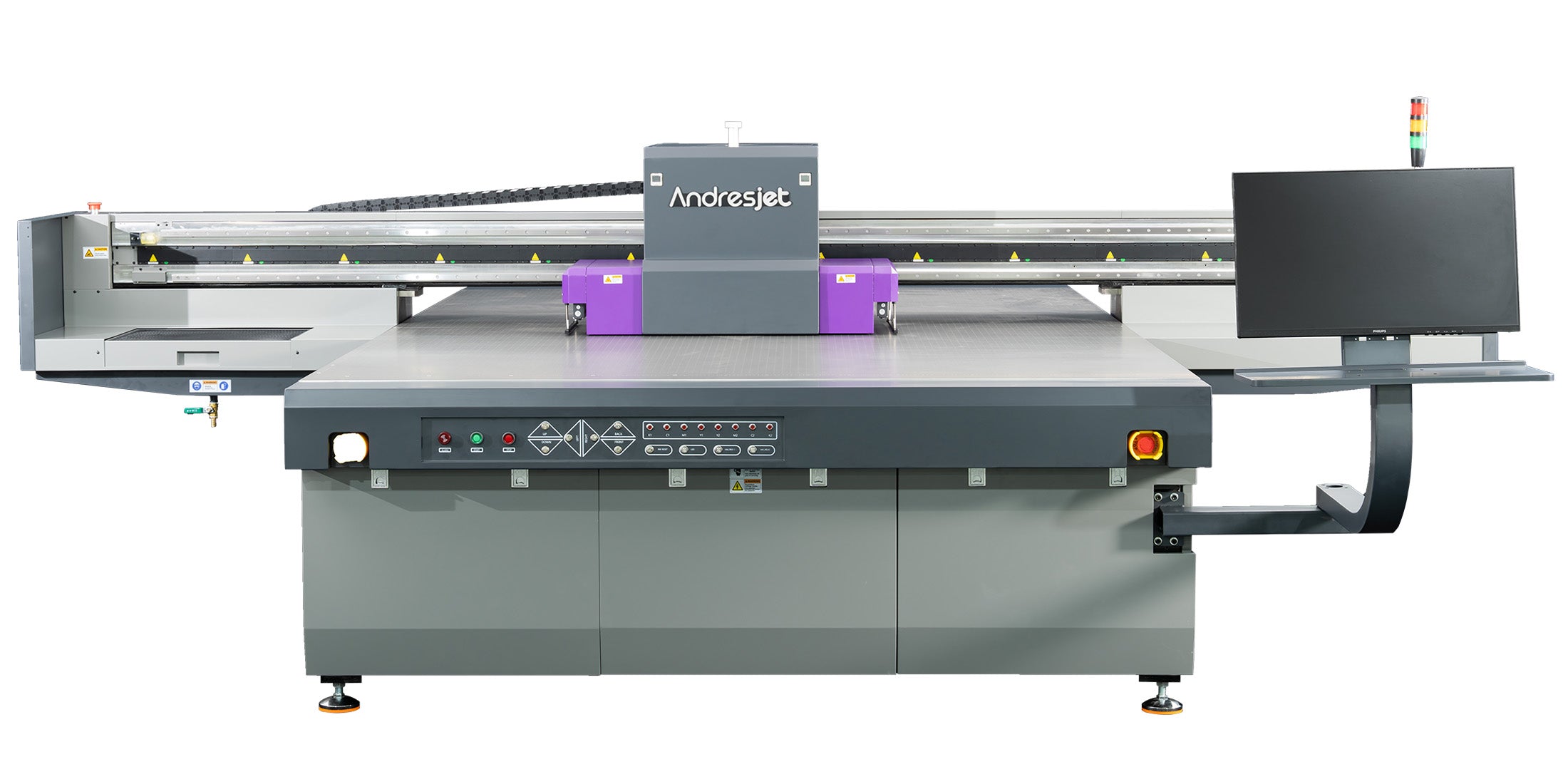
CCD visual positioning automates object alignment without jigs, cutting changeover time from 60 minutes to 15 minutes and boosting output to 2,000 items/hour, directly lowering per-unit costs for high-mix shops.
Manual jigs require custom setups per product, slowing workflows in gift printing or medal production. Wide-beam CCD cameras, like on the AndresJet AJ1206 Small UV Flatbed Printer, scan and position objects with 0.01 mm accuracy using dual Y-axis motors—no jigs needed for irregular shapes.
This automation suits small businesses printing 50-500 units daily on media up to 35 mm thick. Combined with tool-free fixtures in models like the AJ360i Digital Cylinder Printer (quick-change in under 12 minutes), it minimizes labor and waste, improving ROI in personalization shops.
Which media thickness and vacuum system specifications prevent adhesion failures?
Choose printers handling 1-100 mm thickness with 4-zone vacuum systems for secure adhesion on rigid media; under-spec models cause slippage, ink waste, and defects on uneven surfaces like panels or vessels.
Most small format needs fall under 100 mm, but verify max height and sectional vacuum for flat hold-down. AndresJet UV flatbeds feature hard-anodized aluminum beds with 4-zone systems and dual 1500W blowers, supporting media from 0-35 mm (AJ1206) to 1-100 mm across models like AJ2512G/R.
Poor vacuum leads to movement during printing, especially on glossy plastics or textured wood. Auto height detection and anti-static bars in AndresJet printers prevent issues, ensuring sharp output on PVC/ABS for home decor or signs.
What hidden costs in consumables and spare parts can derail your ROI?
Hidden costs include scarce spare parts after 2 years, inefficient inks wasting 30% more, and short warranties; prioritize 8-year parts guarantees and grayscale printing for 30% ink savings to protect long-term ROI.
Clones lack parts availability, stranding shops with $20K+ replacements. AndresJet guarantees 8-year spares with 2-year comprehensive warranties, using UV LED-curable inks like Eco-Print series. Smart 8-level grayscale in AJ2130EX saves up to 30% ink.
Factor power (≤3 kW for AJ1206), training (3 days included), and free samples (first 3 on AJ360i). Total ownership favors industrial models with circulating white ink systems preventing clogs.
| Model | Print Speed | Media Thickness | Ink Config | Warranty/Parts |
|---|---|---|---|---|
| AJ1206 | 2,000 coins/hr | 0-35 mm | 8 colors + W/V | 2 yr / 8 yr |
| AJ2512G/R | Up to 35 sqm/hr | 1-100 mm | CMYK + W opt. | 2 yr / 8 yr |
| AJ360i | 60 items/hr prod. | 60-170 mm dia. | CMYK + W/V | 2 yr / 8 yr |
How do fiber optic connectivity and RIP software impact print consistency?
Fiber optic interfaces ensure high-speed, error-free data transfer over USB, while RIP software like RIIN Print or Onyx provides ICC color management for repeatable quality across jobs.
USB limits speed in production, causing banding; AndresJet's fiber optic with Ethernet/USB 3.0 supports TIFF, JPEG, EPS, PDF formats. RIP options (RIIN Print, PhotoPrint, Onyx) offer curves, density adjustments, and uni/bi-directional modes for resolutions like 720x1200 DPI.
For North America and South Asia expansion, local support includes engineer training and production line design, ensuring seamless integration.
Which small format printer size is right for your shop: 1200×600mm or 2500×1200mm?
Choose 1200x600 mm (AJ1206) for entry-level coin/medal/gift printing up to 2,000/hr; scale to 2500x1200 mm (AJ2512G/R) for panels/signs at 35 sqm/hr matching 8ft x 4ft workflows.
AJ1206 (1200x600 mm, 400 kg) fits tight spaces with CCD for automation. AJ2512G/R (2500x1200 mm) handles larger rigid media with scalable 3-8 RICOH Gen6 heads, ideal for growing shops.
How can you verify warranty depth and regional support before committing to a purchase?
Verify 2-year comprehensive warranties, 8-year parts, CE/RCM/UKCA certifications, and regional presence in North America/South Asia; request free samples, training details, and engineer support proofs.
AndresJet provides full after-sales from spares to line design. Confirm environment specs (20-30°C, 40-60% RH) and power compatibility. Test with free samples on AJ360i to validate fit.
Conclusion
Avoiding these mistakes ensures a reliable small format UV flatbed printer that scales your business. Explore AndresJet's AJ1206 for compact automation or AJ2512G/R for mid-size production—contact for a free consultation or demo tailored to your needs.
Frequently Asked Questions
Is LED UV better than traditional UV for small format printers? Yes, LED UV cures instantly with lower energy (≤3 kW), eco-friendly inks, and no heat damage to media, as in AndresJet models.
Do I need CCD positioning? Essential for high-mix shops; it eliminates jigs, achieves 0.01 mm accuracy, and speeds changeovers on the AJ1206.
What's the difference between small and large format? Small (under 2.5x1.2m) suits personalization; large (3x2m+) for panels, like AJ2130 series at 120 sqm/hr.
How much does a small format UV printer cost? Entry industrial models start around \$40K+; factor TCO with AndresJet's 8-year parts for true value.
Can it print on cylindrical objects? Yes, AJ360i handles 60-170 mm diameters with helix mode for gifts and vessels.
Share:
How Much Do UV vs. Eco-Solvent Inks Cost for Small Format Printers in 2026?
What Are the Best Compact UV Printers for Limited Workshops?