

- by John White
How Can Industrial UV Flatbed Printers Deliver Giant Window Graphics in 48 Hours?
- by John White
Print bigger, print faster — wide-format UV flatbed printers for signs, decor and industrial work.

Industrial UV flatbed printers delivering 100+ sqm/hr enable sign shops to produce giant retail window graphics in 24–48 hours. Key workflow steps include substrate selection (transparent films or vinyl), white ink layering for depth, bi-directional printing for speed, UV curing, lamination, and installation. Machines with 4-zone vacuum systems and fiber optic data transmission handle rigid media seamlessly, supporting 1–100mm thickness while maintaining consistent quality across multiple retail clients simultaneously.
Check: How Long Do UV Lamps Last and When Should They Be Replaced
Retail window graphics demand industrial-speed printing because seasonal promotions and flash sales often require 24–48 hour turnarounds, which traditional printers cannot achieve at scale for giant formats.
Retailers rely on storefront windows as their primary visual hook to capture foot traffic in high-traffic urban areas. Eye-catching giant graphics—spanning full window heights up to 10ft or more—must announce sales, showcase products, or tell brand stories instantly. However, production bottlenecks arise from short campaign cycles: a luxury brand might need new displays for a weekend pop-up, or a department store could refresh for holidays overnight. Traditional solvent printers or mid-range devices top out at 20–30 sqm/hr, insufficient for multiple large panels per client.
Industrial UV flatbed printers change this dynamic. With speeds exceeding 100 sqm/hr, they process vast areas like 2100x3000mm sheets in minutes, enabling sign shops to handle 5–10 retail jobs daily. AndresJet's high-speed models, such as the AJ2130EX at 128.6 m²/h in draft mode, support bi-directional printing on rigid or flexible media, ensuring flawless output for double-sided applications. This capacity directly translates to meeting aggressive deadlines without overtime or outsourcing, keeping shops profitable amid e-commerce competition.
Transparent large-scale films and perforated vinyl excel for giant window graphics, offering visibility, durability, and light transmission for immersive effects in retail storefronts.
Selecting the right substrate is crucial for graphics that withstand weather, high traffic, and frequent changes. Transparent films, especially for double-sided printing, allow interior views while projecting bold exteriors—ideal for island displays or 360-degree visibility in flagship stores. These films, often 1–100mm thick, transmit light for backlit effects, enhancing depth when paired with white ink.
Vinyl options provide opacity for privacy or full coverage, while rigid panels suit framed installations. AndresJet UV flatbed printers accommodate this range with hard-anodized aluminum flatbeds and 4-zone vacuum systems, securing even flexible films without slippage. UV-curable inks bond permanently, resisting fading and peeling. For double-sided transparent films, print one side, flip, and align precisely—capabilities like the AJ2130Ultra's 140.7 m²/h ultra-draft mode make this efficient for large-scale production.
White ink layering on transparent films builds opacity and 3D-like depth by creating base layers that make colors pop, especially for backlit retail window displays.
Transparent films appear ethereal without a white underbase, but layering white ink transforms them into vibrant, high-contrast graphics. In UV flatbed printing, apply white in multiple passes—first as a solid blockout, then colored inks, followed by optional varnish for gloss or texture. This technique simulates depth, making product images leap forward, perfect for showcasing luxury goods or seasonal motifs.
AndresJet models like the AJ2130G/R support extended 8-color configurations including white and varnish, with resolutions up to 720x1200 dpi for sharp layering. The anti-collision system protects printheads during thick builds, while LED UV curing instantly fixes layers without heat distortion. For double-sided prints, mirror the design on the reverse with white backing both sides, ensuring visibility from street and store interior—elevating simple windows to immersive storytelling canvases.
AndresJet Expert Views: "Sign shops using our AJ3220EX and AJ2130Ultra printers report doubling output for retail windows by leveraging 100+ sqm/hr speeds and white ink capabilities. The 4-zone vacuum ensures perfect registration on transparent films, even at 100mm thickness. Our 2-year warranty and 8-year spare parts guarantee minimize downtime, letting clients focus on scaling for North American and South Asian markets." — AndresJet Engineering Lead
UV flatbed printers with 100+ sqm/hr speeds are essential for 48-hour deadlines, allowing sign shops to produce multiple giant graphics batches without compromising quality.
A single 3x2m window panel might require 6–10 sqm; multiply by 5 clients, and daily needs hit 50+ sqm. Printers under 50 sqm/hr force queues, missing deadlines. Industrial models hit 100–150 sqm/hr via multiple RICOH GEN5/Gen6 heads and optimized RIP software like RIIN Print.
| Model | Max Print Speed (Draft/Production) | Print Area | Ideal for Retail Windows |
|---|---|---|---|
| AJ2130EX | 128.6 m²/h / 92.9 m²/h | 2100x3000mm | High-volume transparent films |
| AJ2130Ultra | 140.7 m²/h / 120.5 m²/h | 2100x3000mm | Ultra-fast double-sided jobs |
| AJ3220EX | 154.3 m²/h / 111.5 m²/h | 3200x2000mm | Giant storefront coverage |
| AJ3220G/R | 35.88 m²/h (4-color) | 3200x2000mm | White/varnish depth effects |
AndresJet's lineup, powered by fiber optic interfaces and AC servo motors, delivers these speeds consistently. For 48-hour jobs, draft modes cover rough output, with quality modes finishing at 720x1200 dpi.
The workflow for double-sided graphics involves selecting transparent film, printing front with white base, flipping for back print, UV curing, laminating, and installing—achievable in under 48 hours with high-speed UV flatbeds.
Step 1: Choose transparent film (1–100mm thick) and design mirrored files in TIFF/EPS/PDF via Onyx RIP. Step 2: Load on 4-zone vacuum flatbed; auto-detect height. Step 3: Print front—CMYK over white, varnish optional—at bi-directional speeds. Step 4: Cure with UV LED. Step 5: Flip, realign (0.01mm accuracy on CCD models), print reverse. Step 6: Cure, inspect, laminate for protection. Step 7: Cut and install.
AndresJet printers streamline this: AJ2130G/R's THK guides ensure precision, while 360° anti-collision prevents damage. Total time per 2100x3000mm sheet: 15–30 minutes printing, enabling 100+ sqm daily.
Check: What Top 5 Industries Are Revolutionized by 3.2m UV Flatbed Technology?
Sign shops maximize ROI by using high-speed flatbeds to handle more retail clients, cut per-sqm costs via ink savings, and retain business through reliable 24–48 hour deliveries.
At 100+ sqm/hr, shops produce 600+ panels daily, serving multiple retailers without delays. AndresJet's 30% ink savings from grayscale printing lowers costs to under $1/sqm. Consistent quality via ICC profiles reduces reprints, boosting margins 20–30%. Long-term: 8-year parts availability minimizes CapEx surprises.
| Factor | Traditional Printer | AndresJet High-Speed UV | ROI Gain |
|---|---|---|---|
| Daily Output | 20–30 sqm | 100–150 sqm | 4–5x capacity |
| Ink Cost/sqm | $2–3 | $1–1.50 | 30–50% savings |
| Turnaround | 3–5 days | 24–48 hrs | Higher repeat orders |
| Warranty/Parts | 1 year | 2 years / 8 years | Lower TCO |
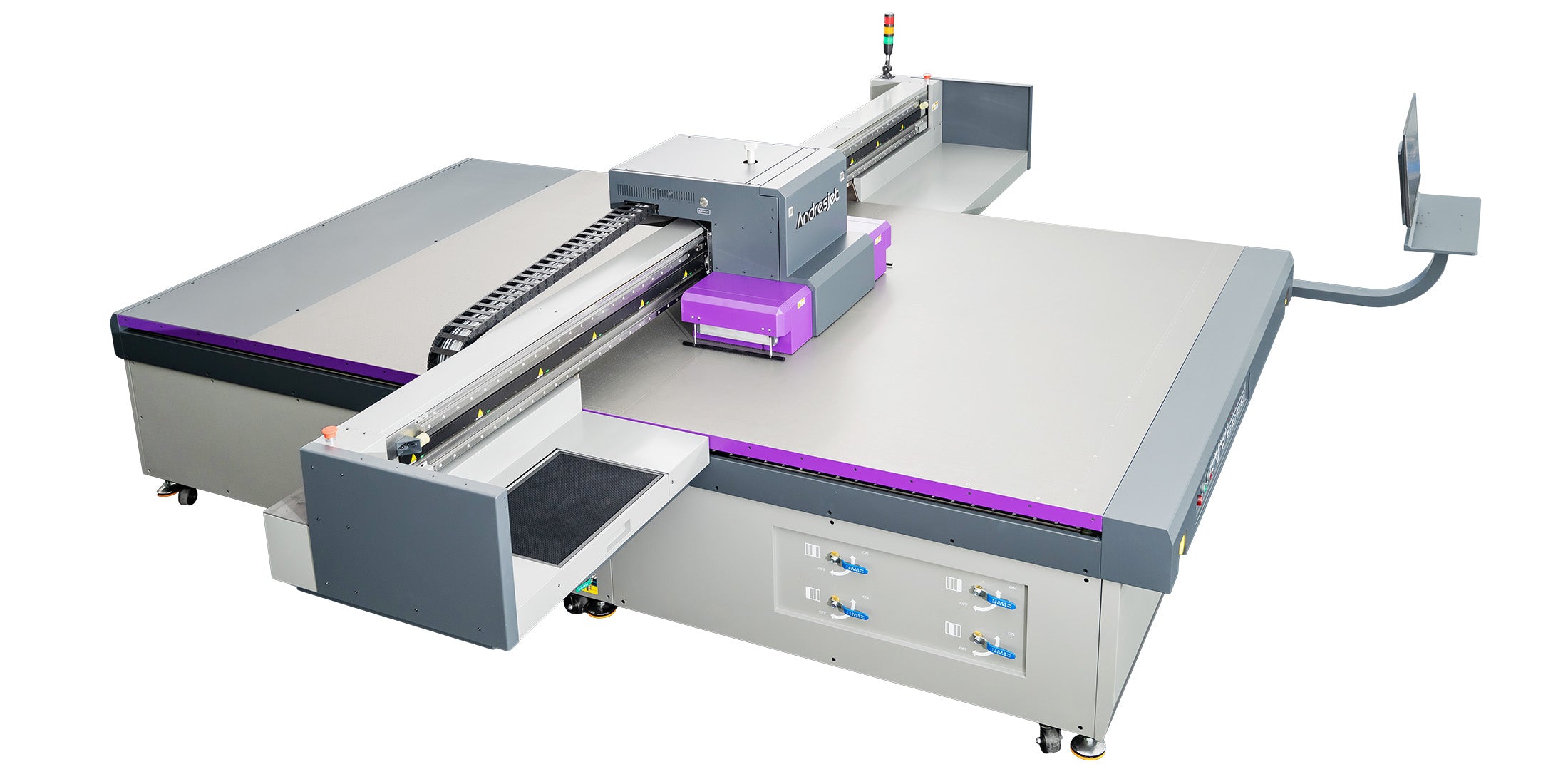
Key considerations include vacuum hold-down for film stability, anti-static features, precise media height detection up to 100mm, and fiber optic data for lag-free large files.
Transparent films warp under heat or static; AndresJet counters with dual 1500W vacuum blowers and ionizer bars. Printheads (up to 24 RICOH GEN5) handle 360x1200–720x1200 dpi without banding. Environmentals: 20–30°C, 30–60% humidity. Certifications like CE/UKCA ensure compliance for global shops.
Post-print steps include UV lamination for scratch resistance, edge sealing, precision cutting, and cable systems for tensioned installs, ensuring graphics last 6–12 months outdoors.
Laminate immediately after curing for UV/fade protection. Use automated cutters for clean edges on giant sheets. For island displays, integrate with cable-hung systems. AndresJet's varnish options add texture, mimicking glass etching without extra steps.
Industrial UV flatbed printers from AndresJet empower sign shops to dominate retail window graphics production, delivering giant, double-sided designs in record time. With unmatched speeds, robust features, and dedicated support, scale your operations profitably today.
What makes AndresJet printers ideal for double-sided transparent films? Their 4-zone vacuum flatbeds and white ink support ensure stable printing up to 100mm thick, with speeds over 100 sqm/hr for quick flips and alignments.
Can these printers handle backlit window effects? Yes, white ink layering and UV-curable inks create opaque bases on transparent films, optimizing light transmission for stunning depth.
How fast is production for a full storefront? Models like AJ3220EX print 154.3 m²/h in draft, covering 10.5x6.5ft panels in minutes for 48-hour jobs.
What support does AndresJet offer? 2-year warranty, 8-year parts, free samples (select models), and full production line design for lasting partnerships.
Explore AndresJet's industrial UV flatbed printers—engineered for high-speed retail graphics production—and request a consultation to discover how your sign shop can meet aggressive retail deadlines while scaling profitably.


