

A cylindrical UV printer may have a specified production speed, but the time required to print each bottle depends on more than the machine itself. Bottle diameter, print length, artwork coverage, white ink, varnish, resolution, surface preparation and fixture changeovers can all affect practical output.
This is why two bottle-printing jobs produced on the same machine may have very different cycle times and results. A simple logo on a white cylindrical bottle is not equivalent to a full 360-degree design printed with white ink and varnish on a dark tapered tumbler.
Businesses evaluating a digital cylinder printer should test representative products rather than relying on one speed figure for every application.
What Determines 360-Degree Bottle Printing Speed?
The complete production cycle includes much more than the time during which ink is deposited. A realistic calculation should include:
- Preparing and processing the artwork
- Installing or adjusting the fixture
- Loading and securing the bottle
- Calibrating the print position
- Printing and UV curing
- Unloading and inspecting the finished item
- Cleaning or preparing the next product
Printer speed should therefore be treated as one part of the workflow rather than the complete production rate.
How Does Bottle Diameter Affect Printing Time?
In 360-degree printing, the printable circumference increases as the bottle diameter increases.
The approximate circumference can be calculated as:
Bottle circumference = bottle diameter × 3.1416
An 80 mm diameter bottle has a circumference of approximately 251 mm. A 160 mm diameter object has a circumference of approximately 503 mm. If both designs cover the complete circumference, the larger object requires the printer to cover approximately twice the horizontal artwork distance.
Diameter can also affect:
- The required rotary fixture
- Rotational calibration
- Artwork dimensions
- Ink coverage
- The possibility of visible seam errors
For this reason, a speed stated for one bottle diameter should not automatically be applied to bottles of every size.
Why Does Print Length Matter?
Print length is the distance covered along the axis of the bottle. A small logo may use only part of the available printable length, while a full product decoration may extend across most of the container.
A longer printed area normally requires more printhead travel and greater ink coverage. It may also increase the effect of alignment errors, especially when text, borders or repeated patterns extend close to the edges of the product.
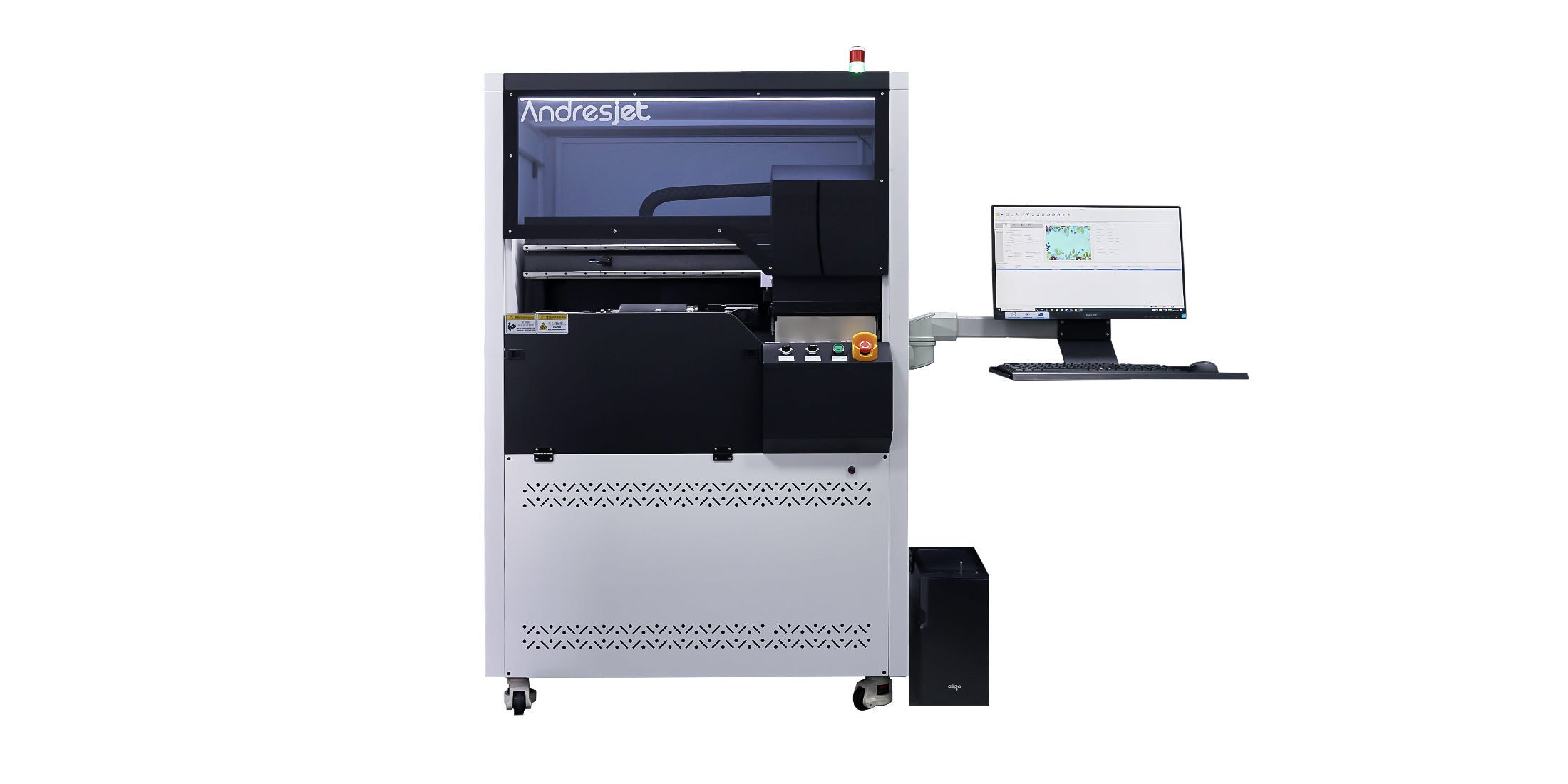
The AndresJet AJ360i supports print lengths from 40 to 270 mm. The actual usable design area must still be confirmed for the specific product shape, fixture and artwork.
How Does Artwork Coverage Change Output?
Not every 360-degree job covers the complete available surface. Artwork can generally be divided into several categories:
| Artwork type | Typical coverage | Production consideration |
|---|---|---|
| Small logo | Limited area on one side | Lower coverage but position must be precise |
| Partial wrap | Part of the circumference | Artwork width and start position must be controlled |
| Full wrap | Nearly the entire circumference | Seam placement and rotational calibration become critical |
| Full-coverage decoration | Large circumference and print length | Higher ink use and potentially longer cycle time |
A simple logo should not be used as the only test when the intended business mainly produces full-wrap graphics.
How Do White Ink and Varnish Affect Printing Speed?
White ink is often required when printing on transparent, colored or dark bottles. It may be used as a complete underbase or applied only beneath selected design elements.
Varnish may be added to create gloss, highlight specific areas or build a decorative raised effect. These additional ink layers can change both cycle time and ink consumption.
Separate expected orders into categories such as:
- CMYK only
- White plus CMYK
- CMYK plus varnish
- White, CMYK and varnish
- Multiple white layers or raised effects
The official AJ360i specification lists CMYK, white and varnish capability. For planning purposes, test each required layer structure using the actual product and approved quality setting.
What Is the Difference Between Production and High-Quality Modes?
The AJ360i product information lists approximately 60 items per hour in production mode and approximately 40 items per hour in high-quality mode. These figures are reference points, and speed varies according to product size and print coverage.
Higher-quality settings may be needed for:
- Small text
- Fine lines
- Detailed photographs
- Smooth gradients
- Close-view cosmetic packaging
- Premium drinkware and gifts
The fastest mode is not automatically the correct mode. Print quality should be approved at the intended viewing distance and under the lighting conditions in which the product will be used or sold.
Why Is Fixture Selection Important?
The fixture holds the product during rotation. If the bottle slips, vibrates or is mounted off-center, print alignment can change during the job.
A suitable fixture should:
- Hold the product without damaging it
- Maintain a consistent rotational center
- Prevent slipping during acceleration and curing
- Support repeatable loading
- Allow efficient changeovers
The AJ360i uses a pneumatic clamping system and provides standard fixtures for products within its standard diameter range. Products outside that range or objects with unusual necks, bases or internal shapes may require a different fixture.
Fixture changeover time must also be included in the daily output calculation. A factory printing one bottle model throughout a shift has a different workflow from a customization business changing between several products every hour.
How Does Taper Affect 360-Degree Print Quality?
A tapered product has different circumferences at its top and bottom. If flat rectangular artwork is applied without compensation, images and text may distort as the bottle rotates.
The AJ360i is designed for straight and tapered products and supports taper angles from 0 to 7 degrees. However, the exact bottle geometry should still be measured and tested.
Pay particular attention to:
- Changes in diameter across the printable area
- Artwork distortion near the top and bottom
- Seam alignment
- The distance between the surface and printheads
- Whether the base and neck are concentric

Why Does Surface Preparation Affect Quality?
Bottles can be manufactured from glass, coated metal and different types of plastic. Products that look similar may still have different coatings, surface energies or release agents.
Before production:
- Identify the exact product material and coating.
- Remove dust, grease and handling residues.
- Confirm whether pretreatment or primer is required.
- Print a representative sample.
- Allow the sample to stabilize according to the ink and material process.
- Perform an appropriate adhesion and handling test.
Increasing UV curing energy cannot correct every adhesion problem. Excessive curing may also make some ink layers brittle. Material preparation, ink compatibility and curing settings must be evaluated together.
What Causes Visible 360-Degree Seam Problems?
Full-wrap artwork must meet near the starting point after the product completes one rotation. A visible gap, overlap or misalignment may result from:
- Incorrect circumference measurement
- An inaccurate bottle diameter
- Product slippage
- Incorrect rotational calibration
- Artwork scaling errors
- A bottle that is not perfectly round
- Uncompensated taper
A test file containing alignment marks, circles, horizontal lines and a controlled seam area can help identify the cause before customer artwork is printed.
How Should Daily Bottle Output Be Estimated?
Calculate daily capacity using the complete cycle:
Approximate daily output = available production minutes ÷ average complete cycle time per product
The complete cycle should include:
- Loading
- Positioning and calibration
- Printing and curing
- Unloading
- Inspection
- Average changeover time
- Routine cleaning and maintenance
Measure several consecutive cycles rather than timing only one ideal product. A longer test is more likely to reveal the real effect of operator handling and product variation.
What Should Be Included in a Sample Test?
Send the actual product whenever possible, together with:
- Material and coating information
- Diameter and printable length
- Taper angle
- Product weight
- Artwork in the intended production format
- Required white and varnish layers
- Expected order quantity
- Required durability and adhesion tests
Request a production-style sample rather than only a visually attractive demonstration. The sample should use the intended ink structure, coverage and quality mode.
Final Recommendation
Practical 360-degree bottle-printing speed is determined by the complete combination of product geometry, artwork coverage, ink layers, quality settings, fixtures and operator workflow.
The AndresJet AJ360i Digital Cylinder Printer supports straight and tapered products, CMYK, white and varnish printing, and multiple production modes. Its suitability should be confirmed using representative bottles and artwork.
Explore the AndresJet digital cylinder printer solution, or send your bottle samples, dimensions and artwork requirements to AndresJet for a fixture review and sample-print evaluation.
Frequently Asked Questions
Does a larger bottle always take longer to print?
Not always, but a larger diameter or longer printable area usually increases the surface that must be covered. Artwork coverage, ink layers and print mode must also be considered.
Why is full-wrap artwork harder than printing a small logo?
A full wrap requires accurate circumference measurement and seam alignment. Small rotational or scaling errors can create a visible gap or overlap.
Does white ink reduce bottle-printing speed?
White ink adds another layer to the workflow and may increase cycle time. The effect depends on coverage, printing sequence and the selected configuration.
Can the same fixture be used for every bottle?
No. Fixture compatibility depends on diameter, neck, base, internal opening, weight and shape. Unusual products may require a custom fixture.
What is the most reliable way to estimate production capacity?
Run several representative products through the complete workflow, including loading, printing, unloading, inspection and average changeover time.
Follow AndresJet:
Share:
How Order Size and Artwork Variation Affect Compact UV Printer Selection?
How to Align Artwork Around Camera Holes and Phone Case Edges?