

- by John White
How Much Does a Digital Cylinder Printer Cost? CapEx, Ink and Per-Piece Math
- by John White
Curved surfaces? Print straight onto bottles, tubes and cylinders — no labels needed.
A useful price discussion starts with the part, production mix, and acceptance standard—not an unsupported machine number. This update keeps the existing URL and gives owners and plant managers a practical way to define configuration, compare total cost, and request a quote that can survive technical and financial review.
This guide is for owners, operations leaders, and sourcing teams evaluating direct digital printing on bottles, tumblers, or similar parts. It is useful when a real application and production forecast exist. Hobby buyers seeking a universal retail price, or teams without sample parts, should postpone machine comparisons.
You should already know the approximate diameter and length range, substrate family, decoration area, monthly good-piece requirement, and whether white ink or varnish is needed. A contract decorator may remain the better choice when demand is intermittent, artwork changes are rare, or staffing and maintenance ownership are unclear.
Treat the purchase as a production-cell decision. The printer, fixtures, pretreatment, curing behavior, operator time, inspection, and rework policy all affect the economic result. A low base quote that excludes a required fixture or application trial is not directly comparable with a configured proposal.
Buyers need a configured acquisition cost, a defensible cost per accepted piece, and a clear boundary around what the supplier includes. A single advertised price cannot answer those questions. Ask for configuration, consumables, fixtures, commissioning, training, freight, and application validation as separately identified quote lines.
The right output from price research is a comparable quote sheet. Normalize currency, taxes, delivery terms, installation scope, ink set, included fixtures, and optional equipment. Record price, MOQ, lead time, certifications, and exact warranty inclusions as unconfirmed until And.resJet confirms them in a current written quotation.
Also separate rated throughput from saleable throughput. Production cost depends on loading, alignment, surface preparation, print time, unloading, inspection, and rejects. A supplier’s maximum marketing rate can help frame a test, but it should not be copied directly into a financial model without a representative timed run.
Shortlist only machines that accept the real part envelope, ink build, image quality, adhesion target, and production workflow. Define measurable pass conditions before discussing price. Diameter range, printable length, taper, weight, seam behavior, fixture changeover, white opacity, varnish finish, and operator intervention are practical gates.
Create a one-page requirements sheet with three labels: required, preferred, and optional. Include the smallest and largest parts, artwork coverage, variable-data needs, color expectations, surface preparation, daily shift pattern, and available utilities. Note whether samples represent normal incoming variation rather than unusually easy blanks.
Use these commercial comparison fields:
| Quote field | Buyer requirement | Supplier response |
|---|---|---|
| Configured machine and ink channels | Application-specific | Confirm on quote |
| Fixtures and change parts | List by part family | Confirm on quote |
| Price, MOQ, and lead time | Written quote | Confirm on quote |
| Training and commissioning | Tasks, duration, location | Confirm on quote |
| Warranty and service scope | Inclusions and exclusions | Confirm on quote |
Reject a shortlist entry when the vendor cannot state what will be tested, who owns pretreatment selection, or how acceptance will be documented. Those omissions often become cost after purchase.
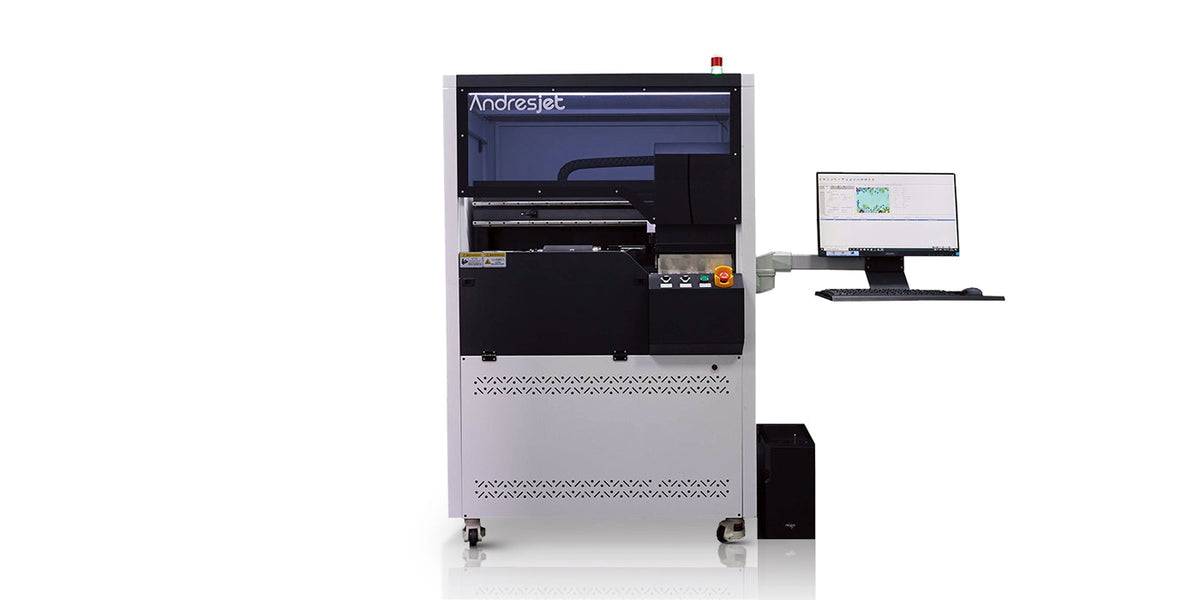
The AJ360i is the relevant AndresJet starting point for cylindrical and tapered parts within its stated envelope, while the broader cylinder range may reveal another configuration. The product page lists diameter, length, weight, ink, and speed claims; verify every requirement against current product documentation and the written quote.
The AJ360i digital cylinder printer lists cylinders and tapers from 60–170 mm diameter, length up to 270 mm, and part weight up to 3 kg in the product FAQ. It supports CMYK plus white and varnish. The stated marketing speed is up to 60 items per hour.
Those values are screening limits, not automatic application approval. Taper geometry, printable zone, handle clearance, surface condition, artwork orientation, and fixture design still require review. Ask AndresJet to identify the exact configuration used for the sample and whether the quoted scope matches it.
Review the digital cylinder printer collection when the AJ360i envelope or workflow does not fit. Do not force a part into a model because its nominal diameter fits; request a model recommendation tied to drawings, photos, and physical samples.
Machine fit changes with substrate chemistry, coating, shape, artwork, and required durability. Glass, coated metal, plastics, and painted surfaces can need different preparation and test methods. A successful image on one blank does not prove adhesion or appearance on another supplier’s nominally similar production lot.
Send representative production parts, including color and coating variants. Specify whether the decoration crosses a seam, approaches a shoulder, wraps a taper, or must align with molded features. Confirm whether white ink is an underbase, a spot layer, or both, and define varnish coverage and tactile expectations.
Agree on an end-use test protocol before the demo. It may include visual inspection, cross-hatch or tape adhesion, scratch exposure, wash cycles, chemical contact, and aging, but the applicable method and pass threshold must be confirmed in writing. for the buyer’s product. Regulatory or customer-specific requirements must be reviewed separately.
Upstream variation matters too. Measure actual diameter, roundness, and coating consistency across a lot. If the process requires pretreatment, include its labor, floor space, ventilation, consumables, cure or dwell time, and quality controls in the decision.
Total cost combines configured capital expenditure with fixtures, site preparation, ink, cleaning materials, labor, maintenance, utilities, scrap, and downtime. Calculate cost per accepted piece, not per print attempt. Until a quote and representative production trial exist for the proposed workflow, every commercial value and consumption assumption remains.
Use a transparent worksheet rather than a supplier’s headline savings claim:
Cost per accepted piece = (annual ownership cost + annual operating cost) / accepted pieces
Annual ownership cost can include depreciation or lease expense, financing, allocated installation, and planned service. Operating cost can include ink used in images and maintenance, cleaning fluid, pretreatment, labor, utilities, fixtures consumed, inspection, rework, and disposal. Finance should choose the accounting treatment.
| Input | Evidence required | Current value |
|---|---|---|
| Configured CapEx and freight | Written quote | Confirm on quote |
| Ink use per accepted piece | Logged representative run | Confirm on quote |
| Direct labor minutes | Timed full cycle | Confirm on quote |
| Scrap and rework rate | Pilot lot results | Confirm on quote |
| Planned uptime and volume | Buyer production plan | Confirm on quote |
Run sensitivity cases for volume, utilization, and scrap. Do not hide idle time by dividing only variable cost by theoretical output. Compare the resulting internal cost with a like-for-like outsourced quote that includes equivalent quality, packaging, freight, and turnaround.
Implementation cost depends on the delivered configuration and the work required before stable production. Confirm footprint, access route, electrical service, environment, ventilation, computer and RIP needs, ink storage, fixture inventory, safety responsibilities, training, commissioning, remote or onsite support, and final acceptance before issuing a purchase order.
Ask who performs installation, who approves the first application, and what the acceptance document contains. Request a list of buyer-supplied items and deadlines. Establish responsibility for artwork preparation, color targets, pretreatment, daily maintenance, nozzle checks, spare parts, waste handling, and escalation when output changes.
Fixture planning deserves its own review. Identify every active SKU, changeover frequency, duplicate fixture needs, and future part families. The quote should distinguish included and optional fixtures, with price and delivery recorded as. Training should cover both normal operation and recovery from common interruptions.
Build a launch plan with named owners, a sample approval gate, operator sign-off, a controlled pilot batch, and a handover to production. A machine that prints a good demonstration sample is not yet a repeatable production process.
The most revealing demo failures are poor adhesion, banding, weak white opacity, varnish inconsistency, visible seam transitions, distorted artwork, registration drift, and fixture marks. Inspect several consecutive pieces, not one selected sample, and repeat the agreed durability test after the stated conditioning period before approving the application.
Bring challenging artwork: fine reversed text, solid colors, gradients, white underbase edges, and varnish boundaries. Inspect under consistent lighting and compare pieces around the full circumference. Check the start-stop seam, shoulder area, taper compensation, small type, gloss uniformity, and alignment with physical features.
Ask the operator to stop, restart, change a fixture, and load a slightly varied part. Record setup and cycle time from an honest workflow. Note cleaning events and rejected pieces. If a defect appears, document the cause, corrective action, and whether that action changes labor or throughput.
The acceptance record should identify machine configuration, ink channels, software settings, pretreatment, fixture, substrate lot, artwork file, environmental conditions, and test results. Without that record, a good sample is difficult to reproduce or cost accurately.
Live PAA was not returned for this query, so these answers address common industrial purchasing risks rather than claiming search-derived questions. The recurring issues are quote comparability, real throughput, hidden process steps, application durability, and service scope. Recheck live PAA before publication and revise FAQ wording if reliable questions appear.
Can AndresJet give a digital cylinder printer price without samples?
A preliminary configuration may be possible, but a decision-grade quote should use part dimensions, material, artwork, volume, and finish requirements. Current price, MOQ, lead time, certifications, and warranty inclusions must be confirmed in writing.
Is the advertised maximum speed my production rate?
No. The AJ360i marketing claim is up to 60 items per hour, while actual accepted output depends on the part, coverage, layers, loading, preparation, inspection, and rejects. Validate a representative full cycle.
What is the largest hidden cost?
There is no universal answer. Fixtures, preparation labor, low utilization, cleaning, rejects, and downtime can each dominate. Model them separately with evidence.
Should I compare against outsourcing?
Yes. Match quality, turnaround, order flexibility, freight, inventory, and management time. Avoid comparing an incomplete internal variable cost with a fully burdened supplier price.
For a useful quote, send the part diameter and length, taper or drawing, substrate and coating, monthly pieces, artwork coverage, required ink colors, white or varnish needs, durability test, and target workflow. Request a representative sample, configuration recommendation, itemized specification, and written commercial quote through AndresJet’s contact page.
Use the contact form and attach clear part photos or drawings plus artwork when available. State the smallest and largest SKU, part weight, printable zone, feature-alignment needs, and whether you can send physical samples. Ask the response to separate included equipment, options, fixtures, training, commissioning, freight, and consumables.
For commercial review, request confirmation of price, MOQ, lead time, certifications, exact warranty inclusions, service terms, and quote validity; all must be confirmed in writing until wri.tten confirmation. For technical review, ask for a sample plan and acceptance criteria. That package makes digital cylinder printer cost comparable, auditable, and tied to your actual production requirement.
If cylinder printing is only one of several first-inquiry paths, use the AndresJet model map to confirm whether AJ360i is the right family before modeling CapEx.

