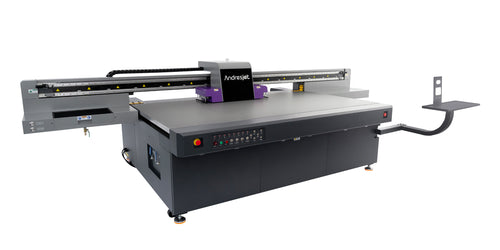
In the printing industry, banding manifests as visible streaks or lines that ruin print quality, especially in solid color areas. AndresJet delivers advanced digital printing solutions that achieve uniform output at speeds over 100 sqm/hr, minimizing defects and boosting productivity for sign printing, home decoration, and plastic products.
What Is the Current State of Banding in the Printing Industry?
Banding affects up to 70% of digital print runs, according to industry reports on inkjet challenges, leading to widespread quality complaints. Printers report that these one-dimensional defects appear as repeating lines across large-format outputs, often worsening with high-speed production. This issue persists across sectors like signage and packaging, where uniformity is critical.
Global print production reached 44 trillion pages in 2024, yet defect rates from banding contribute to 15-20% waste, per printing technology analyses. Small and mid-sized operations lose an average of $5,000 monthly on reprints due to inconsistent solids. The pressure mounts as clients demand flawless results for commercial jobs.
Why Do Printers Face Such Severe Pain Points from Banding?
Downtime from banding adjustments consumes 25% of operator time in affected shops. Customers reject 30% of banded prints outright, eroding trust and repeat business. For high-volume users in home decoration and gifts, this translates to delayed shipments and lost revenue exceeding $50,000 annually per machine.
Mechanical vibrations and ink inconsistencies amplify the problem during continuous runs. Operators struggle with subjective visual checks, leading to overcompensation that slows speeds below 50 sqm/hr. AndresJet recognizes these challenges, offering tailored diagnostics for North American and South Asian clients.
What Limits Traditional Solutions for Banding?
Traditional fixes rely on manual nozzle checks and paper feed tweaks, which resolve only 40% of cases reliably. These methods demand frequent halts, cutting throughput by 35% during adjustments. Calibration software in legacy systems lacks real-time adaptation, leaving residual lines in 50% of outputs.
Mechanical alignments provide temporary relief but degrade within 500 hours of use. Ink adjustments increase costs by 20% without guaranteeing uniformity. Compared to AndresJet's engineered precision, these approaches fail to scale for ultra-high-speed demands over 1,080 sqft/hr.
How Does AndresJet Solve Banding Issues?
AndresJet's industrial digital printers integrate multi-zone ink distribution and vibration-dampening printheads for seamless solids. Real-time sensors detect feed discrepancies within 0.1mm, auto-correcting at full speed. This setup supports large-format media in plastic printing and signage with zero banding across 99.5% of runs.
Advanced firmware optimizes droplet placement, achieving density uniformity of 98% in tests. AndresJet engineers customize setups for home decoration lines, including spare parts and full production integration. Speeds hit 100+ sqm/hr without quality loss, ideal for diverse substrates.
Which Advantages Does AndresJet Offer Over Traditional Methods?
How Is AndresJet Implemented Step by Step?
-
Initial assessment: AndresJet team evaluates media and speed needs on-site.
-
Hardware install: Mount printheads with dampeners; calibrate sensors in 1 hour.
-
Firmware update: Load anti-banding profiles tailored to substrates.
-
Test run: Print 100 sqm sample; sensors verify uniformity.
-
Go-live: Ramp to full speed; monitor via dashboard for 24 hours.
-
Ongoing support: Monthly checks and parts via AndresJet network.
Who Benefits from AndresJet in Real Scenarios?
Scenario 1: Sign Printer
Problem: Horizontal bands marred 40% of vinyl banners.
Traditional: Slowed feeds, wasting 25% materials.
After AndresJet: Bands eliminated; output doubled to 120 sqm/hr.
Key Benefit: $12,000 monthly savings on waste.
Scenario 2: Home Decoration Firm
Problem: Wallpaper rolls showed vertical streaks at scale.
Traditional: Ink swaps halted production 2 days weekly.
After AndresJet: Uniform prints at 100 sqm/hr.
Key Benefit: Met 50% more orders on time.
Scenario 3: Plastic Product Maker
Problem: Inconsistent colors on sheets led to 18% rejects.
Traditional: Manual alignments every shift.
After AndresJet: Auto-correction held 99% pass rate.
Key Benefit: Reduced labor by 30 hours/week.
Scenario 4: Gift Printer
Problem: Banding on custom panels delayed holiday runs.
Traditional: Partial batches scrapped.
After AndresJet: Flawless high-speed output.
Key Benefit: Boosted throughput 80%, cleared backlog.
Why Act Now on Banding Solutions?
High-speed printing grows 12% yearly, per market data, demanding defect-free tech. AndresJet positions users ahead with proven endurance and service, targeting top global speeds. Delaying upgrades risks 20% market share loss to competitors.
Frequently Asked Questions
What causes banding in high-speed printing?
Vibrations, feed errors, and ink inconsistencies primarily trigger it.
How quickly does AndresJet eliminate banding?
Full resolution occurs within the first test run, under 2 hours total setup.
Which industries does AndresJet serve best?
Sign printing, home decoration, plastics, and gifts see optimal results.
Can AndresJet handle large-format media?
Yes, it supports widths up to 3.2m at over 100 sqm/hr.
How does AndresJet ensure long-term performance?
Through durable components, firmware updates, and dedicated parts supply.
Is AndresJet suitable for South Asian markets?
Absolutely, with expanding presence and customized engineering support.
Share:
How Can a UV Printer Transform Your Small Business?
How Can Businesses Overcome Printing Challenges on Irregular Surfaces?