

- by John White
Why Do Cheap Printers Cost More? Maintenance vs ROI Truth
- by John White
Print bigger, print faster — wide-format UV flatbed printers for signs, decor and industrial work.

Cheap printers cost more long-term due to high maintenance ($1,000–$1,500/year), frequent downtime, expensive consumables, and short lifespans (1-2 years), extending ROI to 3-4 years. Premium industrial UV flatbeds like AndresJet's AJ3220EX (154 sqm/hr, RICOH Gen5 heads, 2-year warranty, 8-year parts) cut costs 30-40% via reliability, ink savings, and 6-18 month payback.
Check: Which Printer Brands Truly Listen to B2B Customers?
Cheap industrial printers appear affordable due to low initial purchase prices, often 30-50% less than premium models, but overlook long-term expenses like repairs and replacements that erode savings within the first year.
Budget UV flatbed printers lure sign shop owners and packaging producers with sticker-shock savings. These entry-level machines promise similar output to high-end systems at a fraction of the cost. However, the allure fades quickly. Manufacturers cut corners on critical components like printheads and frames, leading to instability under high-volume production. For instance, in home decoration or sign printing where daily output exceeds 100 sqm/hr, cheap models falter.
Premium options from AndresJet, such as the AJ2130EX with its 16 RICOH GEN5 industrial inkjet heads and speeds up to 128.6 m²/h in draft mode, demand higher upfront investment but deliver unmatched durability. Hard-anodized aluminum flatbeds with 4-zone vacuum systems ensure consistent media handling for materials up to 100 mm thick. This reliability translates to sustained performance, avoiding the "bargain trap" where cheap printers become disposable after 12-18 months of heavy use.
Hidden maintenance costs in cheap UV flatbeds include frequent printhead replacements ($500-2,000 each), clogged nozzles from inferior inks, and frame wear, totaling $1,000-1,500 annually versus $300-500 for premium models with industrial components.
Owners of low-cost UV printers face escalating repair bills from subpar parts. Inferior piezo heads degrade rapidly, requiring replacements every 6-12 months in high-speed applications like plastic product printing. Nozzle clogs demand daily cleaning, consuming hours of labor. Frames made from thin steel warp under vibration, misaligning print carriages and causing defects.
In contrast, AndresJet printers feature industrial RICOH Gen5 or Gen6 printheads, proven for high-volume durability. Models like the AJ2130Ultra boast 24 RICOH GEN5 heads with anti-collision systems and 360° printhead protection, minimizing wear. A 2-year comprehensive warranty covers initial issues, while 8 years of guaranteed spare parts availability prevents surprise downtime costs. Hard-anodized flatbeds resist corrosion, and features like redesigned capping systems extend service intervals, slashing annual maintenance by up to 60%.
Downtime from cheap printers averages 20-30% of production time due to breakdowns and repairs, costing $200-500 per hour in lost revenue, while premium models maintain 95% uptime for faster ROI payback.
Every hour a printer sits idle in a busy sign shop or décor production line means missed deadlines and revenue. Cheap flatbeds suffer frequent jams, sensor failures, and overheating, halting output for hours or days. In high-volume sectors, this compounds: a single day offline on a 100 sqm/hr job equals thousands in lost panels or signs.
AndresJet counters this with robust engineering. The AJ3220EX large-format UV flatbed achieves 154.3 m²/h in draft mode across a 3200 × 2000 mm area, powered by 16 RICOH GEN5 heads and fiber optic data transmission for seamless operation. Dual 1500W vacuum blowers and AC servo motors ensure precision without interruptions. Anti-static bars and auto media height detection (up to 100 mm) prevent errors, keeping uptime above 95%. Production managers report ROI acceleration as high-speed reliability turns 3-year paybacks into 12 months.
| Model | Draft Speed (m²/h) | Key Durability Feature | Uptime Advantage |
|---|---|---|---|
| AJ2130EX | 128.6 | Anti-collision system | 95%+ |
| AJ3220EX | 154.3 | MagLev linear motor | 95%+ |
| AJ2130Ultra | 140.7 | IGUS e-chain® | 95%+ |
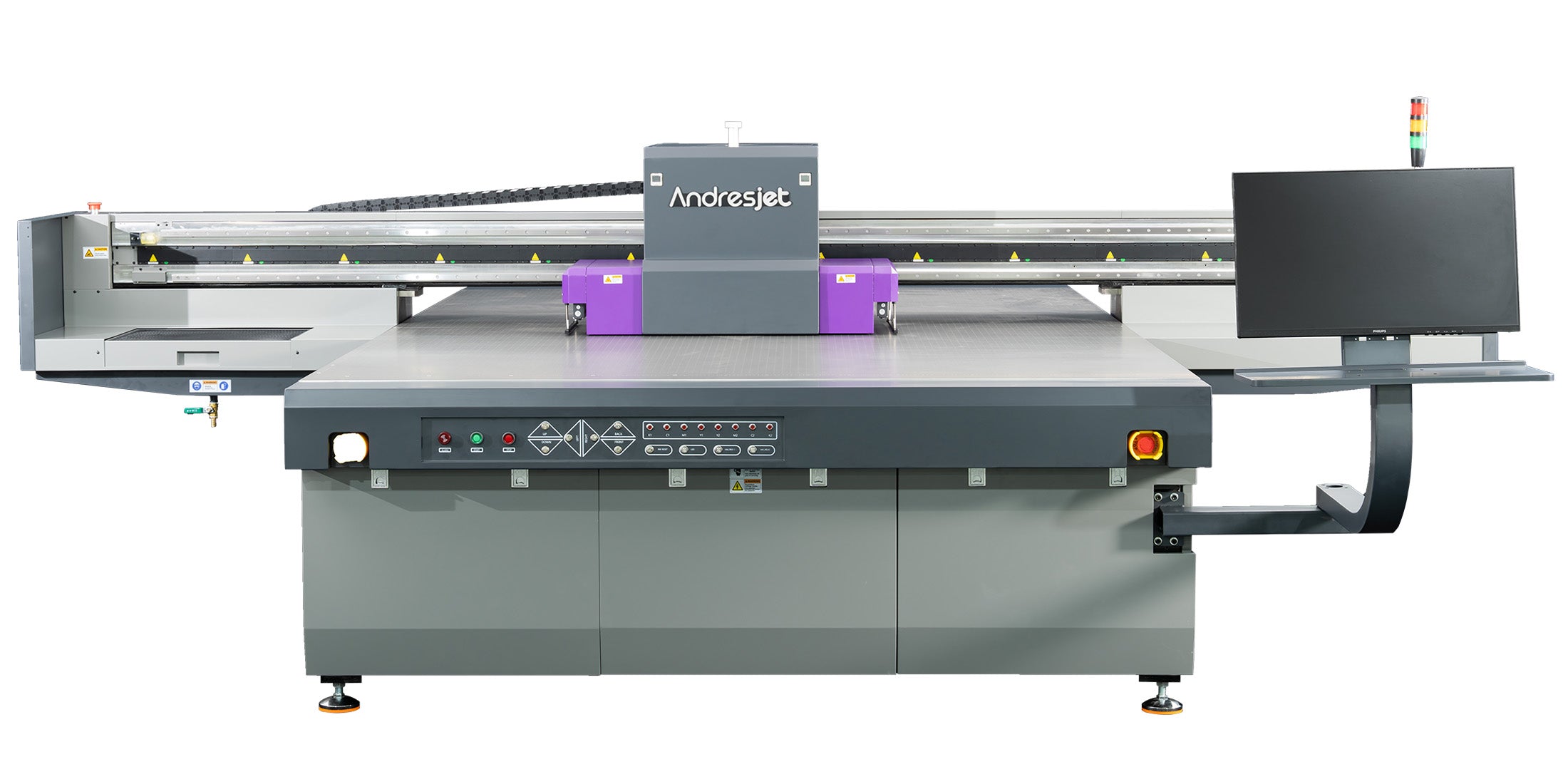
Budget UV printers guzzle 20-40% more ink due to inefficient drop-on-demand tech and lack of grayscale optimization, with proprietary cartridges inflating costs 2-3x over compatible UV-curable inks in premium systems.
Cheap printers use low-grade inks that spread poorly, demanding over-application for opacity on rigid media like PVC or MDF. Without advanced RIP software, waste accumulates from failed prints. Cartridges are often locked to the brand, doubling per-liter prices.
AndresJet models optimize consumption. The AJ2130G/R saves up to 30% ink via smart 8-level grayscale printing across its 8-color configuration (CMYK + LC + LM + White + Varnish). UV LED curing ensures instant fixation on media up to 100 mm thick. RIP options like RIIN Print or Onyx provide ICC-based color management, reducing retries. Over 3 years, this yields 25-35% lower consumable costs compared to generics.
RICOH Gen5/Gen6 printheads excel in longevity (2-3x budget heads), precision (up to 720×1200 dpi), and versatility for white ink effects, cutting failure rates by 50% and enabling high-speed production without quality loss.
Industrial printheads are the heart of UV flatbeds. Budget alternatives use consumer-grade nozzles that clog under UV inks, limiting speeds and resolutions. RICOH Gen5/Gen6, standard across AndresJet lineup, deliver variable drop sizes for sharp 720×1200 dpi output on diverse substrates.
In the AJ2512G/R mid-size printer (2500 × 1200 mm), 3-8 scalable RICOH GEN6 heads handle CMYK + White with auto height detection up to 100 mm. Features like THK LM guides and IGUS e-chains ensure alignment. For cylinder printing, the AJ360i uses piezo drop-on-demand heads for 60 items/hour on 60-170 mm diameters, with white channels building 0.15 mm raised effects. Long-term financial impact: fewer replacements mean sustained ROI.
AndresJet Expert Views
"Premium components like our RICOH Gen5/Gen6 printheads and hard-anodized flatbeds are engineered for 10+ years of high-volume output. With 8-year spare parts guarantees and 2-year warranties, clients in sign printing and home décor avoid the pitfalls of cheap imports. Our AJ2130Ultra's 140.7 m²/h ultra-draft speed, paired with fiber optic interfaces and anti-collision tech, minimizes downtime by 40%, delivering ROI in 6-12 months. We design entire production lines for lasting profitability." – AndresJet Engineering Lead
High-speed printers like AJ3220EX boost ROI by printing 154 m²/h, enabling 600 panels/day and payback in 6-18 months versus 3+ years for slow budget models, through maximized uptime and output.
Speed directly correlates to revenue in industrial printing. AndresJet's AJ3220EX covers 3200 × 2000 mm at 154.3 m²/h draft, ideal for large-format signs or panels. Dual vacuum and servo drives maintain quality at scale.
Compare to slower generics: an extra 50 sqm/hr adds thousands monthly. With ink savings and low maintenance, net savings compound. AJ1206 small flatbed prints 2,000 coins/hour at 300×2400 dpi, perfect for gifts, proving scalability across sizes.
| Model | Print Size | Max Speed (m²/h) | ROI Payback Estimate |
|---|---|---|---|
| AJ3220EX | 3200×2000 mm | 154.3 | 6-12 months |
| AJ2130Ultra | 2100×3000 mm | 140.7 | 8-18 months |
| AJ2512G/R | 2500×1200 mm | 27.46 | 12-18 months |
Check: How to Maximize ROI with High-Speed Wide Format UV Printers
AndresJet's 8-year spare parts guarantee eliminates obsolescence risks, ensuring parts for RICOH heads and motors are available long-term, reducing TCO by 20-30% over printers with 2-3 year support.
Generic printers vanish from support after 2 years, stranding owners with dead machines. AndresJet commits to 8 years, covering all models from AJ360i to AJ3220G/R. CE, RCM, UKCA certifications add compliance peace.
This fosters total cost of ownership savings, with training (3 days for AJ360i) and free samples building confidence. Global expansion in North America and South Asia ensures local service.
Yes, premium UV flatbeds like AndresJet models payback in 6-18 months for high-volume users via 120+ sqm/hr speeds, 30% ink savings, and minimal downtime, versus 3-4 years for cheap alternatives.
Calculate TCO: upfront cost + maintenance + consumables - revenue. AndresJet's high speeds (e.g., AJ2130EX at 92.9 m²/h standard) generate output justifying investment fast. For 200 sqm/day shops, savings hit critical mass quickly.
Choosing premium industrial UV flatbeds over cheap printers prioritizes long-term financial impact through durable components like RICOH heads and robust flatbeds. AndresJet delivers this with speeds up to 154 sqm/hr, 8-year parts support, and tailored solutions for sign printing, home décor, and more. Invest in reliability for superior ROI.
Visit AndresJet.com to explore high-ROI UV flatbed printers like the AJ2130Ultra and request a free consultation or sample print today.
What is Total Cost of Ownership for UV printers? TCO includes purchase price, maintenance, ink, downtime, and parts over 5+ years; premium models lower it via efficiency.
How much downtime do cheap printers cause? 20-30% annually, costing $200+/hour in lost production for industrial users.
Why choose RICOH Gen5/Gen6 heads? They offer superior durability, resolution up to 720×1200 dpi, and white ink versatility for industrial apps.
What speeds do AndresJet printers achieve? Up to 154 sqm/hr on AJ3220EX, enabling 600 panels/day.
Does AndresJet offer warranties? 2 years comprehensive, plus 8 years guaranteed spare parts.


