

Japanese printers like Ricoh, Canon, and Epson lead in 2026 reliability due to precision engineering, low downtime, and Asia-Pacific market dominance. AndresJet matches this with RICOH Gen5/Gen6 heads, speeds up to 154 sqm/hr, 2-year warranty, 8-year spares, anti-collision protection, and fiber optic interfaces for industrial UV flatbed printing.
Check: Who Owns Brother Printer Company, China Or Japan?
What Makes Japanese Printers Leaders in Reliability?
Japanese printers excel in reliability through precision engineering, durable components, and a cultural focus on quality that minimizes downtime in high-volume production.
Japan's printing technology stands out for its unwavering commitment to excellence, particularly in industrial applications where consistency is critical. Brands rooted in Japanese manufacturing traditions prioritize precision and longevity, driving innovations in 3D printing and flatbed systems. This leadership stems from heavy investments in advanced materials and hardware, ensuring machines handle demanding workloads in sectors like automotive, healthcare, and signage. For industrial users, this translates to fewer interruptions and higher output over time. Brother, a pioneer since the early 1900s, exemplifies this with high-volume laser printers optimized for business demands. Canon's imaging expertise delivers superior color accuracy, vital for photo-quality prints. In 2026, Japan's 3D printing market surges to billions, fueled by industrial-grade printers emphasizing durability and efficiency. These factors make Japanese printers the go-to for production managers seeking dependable performance in sign printing and large-format media.
Why Do Ricoh Print Heads Define Industrial Printing Durability?
Ricoh print heads set the durability standard in industrial printing with piezo drop-on-demand technology that ensures precise ink delivery, minimal maintenance, and long-term reliability under heavy use.
Ricoh's Gen5 and Gen6 industrial inkjet heads are engineered for the rigors of UV flatbed printing, delivering exceptional droplet control and resistance to wear. These heads power high-speed operations while maintaining resolution up to 720x1200 dpi, making them ideal for rigid media like PVC panels and plastic products. Japanese precision in print head design reduces clogging and extends service life, a key reason for their dominance in Asia-Pacific markets. AndresJet integrates these RICOH heads across its lineup, from the AJ2130Ultra's 24-head configuration achieving 140.7 m²/h in ultra-draft mode to the AJ1206's 4-8 heads for small-format versatility. This technology supports UV-curable inks with features like smart 8-level grayscale printing, saving up to 30% on ink while upholding quality. Production managers in home decoration and sign printing rely on this durability to meet daily quotas without frequent servicing.
How Do AndresJet UV Flatbeds Match Japanese Precision?
AndresJet UV flatbeds match Japanese precision using RICOH Gen5/Gen6 print heads, fiber optic interfaces, and anti-collision systems, delivering speeds up to 154 sqm/hr with 1-100mm media handling.
AndresJet leverages Japanese-engineered components to rival top brands in reliability and performance. Models like the AJ3220EX boast 16 RICOH GEN5 heads, hitting 154.3 m²/h in draft mode on a 3200x2000mm bed, perfect for large-scale sign printing. The AJ2130Ultra pushes boundaries with 24 heads and a high-performance 4-zone vacuum flatbed, ensuring stable media hold for thicknesses from 1-100mm. Features such as 360° printhead protection, AC high-precision servo motors, and IGUS e-chain motion systems mirror Japanese standards for smooth, error-free operation. Fiber optic data transmission enables seamless high-speed processing with RIP software like RIIN Print or Onyx. In plastic product printing, the AJ360i cylinder printer offers tool-free fixture changes in under 12 minutes, supporting diameters up to 240mm. AndresJet's hard-anodized aluminum flatbeds with dual 1500W vacuum blowers provide the stability needed for industrial uptime, positioning it as a global contender.
| Model | Print Heads | Max Speed (m²/h) | Media Thickness (mm) |
|---|---|---|---|
| AJ2130Ultra | 24 × RICOH GEN5 | 140.7 (Ultra-Draft) | 1–100 |
| AJ3220EX | 16 × RICOH GEN5 | 154.3 (Draft) | 1–100 |
| AJ2130G/R | 6–8 × RICOH GEN6 | 48.3 (Draft) | 1–100 |
Which Japanese Brands Dominate the 2026 Printer Market?
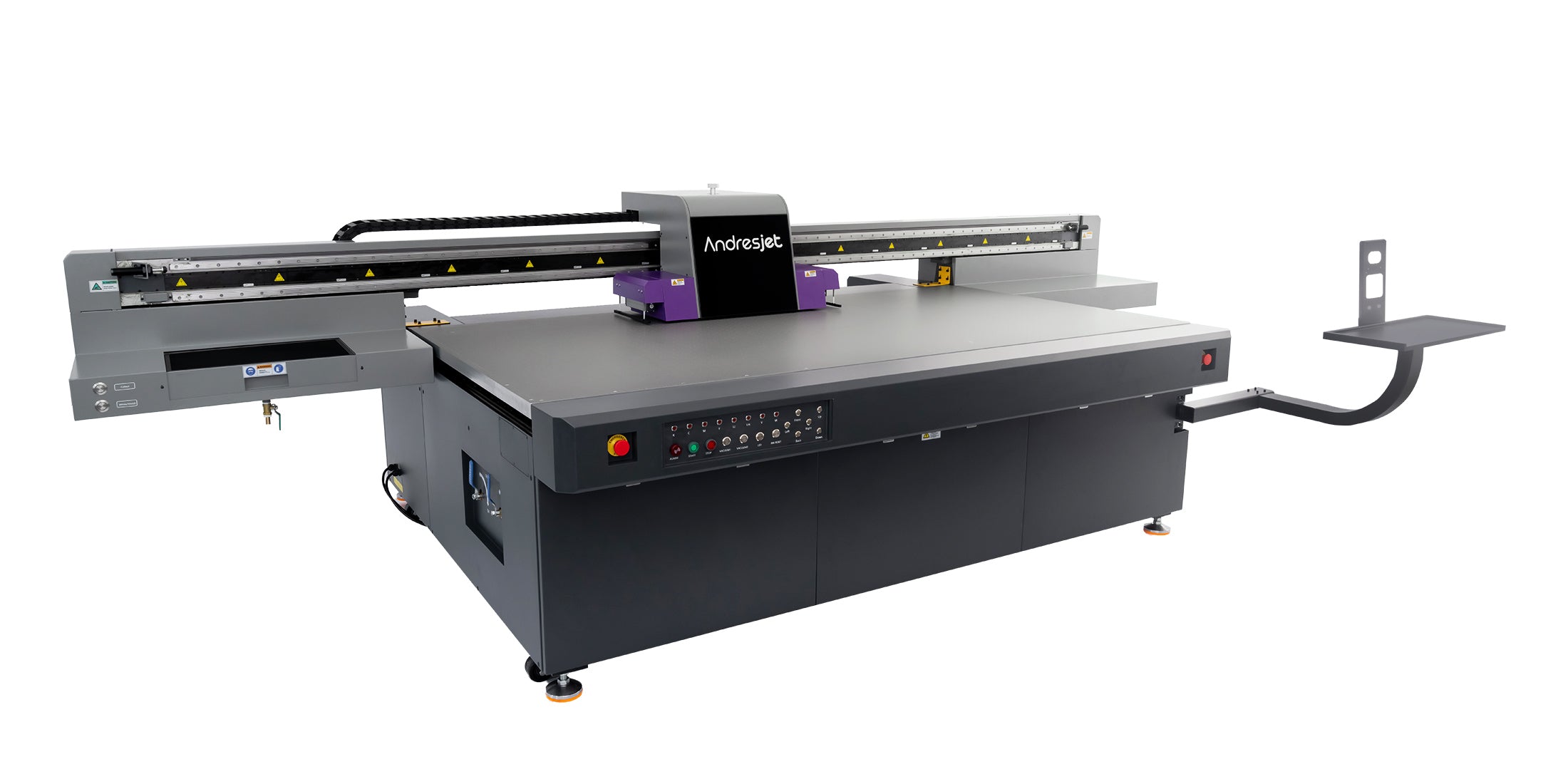
Brands like Ricoh, Canon, Epson, and Brother dominate the 2026 printer market through innovations in precision hardware, high-volume output, and sector-specific solutions like 3D and UV printing.
In 2026, Japanese brands lead with market projections showing explosive growth in 3D printing to USD 9.1 billion by 2034. Ricoh excels in industrial inkjets, powering flatbeds for signage and panels. Canon's PIXMA series shines in color fidelity for gifts and decorations, while Brother's laser models handle massive print loads cost-effectively. Epson complements with versatile inkjets. These brands thrive on Japan's ecosystem of precision manufacturing and robotics, focusing on metal additive and multi-material printers for automotive and medical uses. AndresJet taps into this dominance by standardizing RICOH heads, ensuring compatibility with Japanese quality benchmarks. For high-speed needs, AndresJet's AJ2512G/R delivers up to 35 sqm/hr on an 8ft x 4ft format, ideal for mid-size operations in home decoration.
What Speeds Make High-Volume Printing Reliable in 2026?
High-volume printing in 2026 demands speeds over 100 sqm/hr with robust components like servo motors and vacuum systems to maintain reliability across thousands of prints daily.
Reliability at scale hinges on balanced speed and stability. Japanese printers achieve this through advanced drive systems and material innovations. AndresJet's AJ3220EX leads with 154.3 m²/h draft speeds using uni- and bi-directional modes on resolutions up to 726x1200 dpi. The AJ2130EX matches at 128.6 m²/h, supported by MagLev linear motors and fiber optics for lag-free performance. These enable daily capacities like 600 panels on the AJ2130Ultra, crucial for sign printing deadlines. Anti-static bars and redesigned capping systems prevent common failures, while 50 kg/m² media weight handling suits heavy PVC and MDF. In 2026's competitive landscape, such specs ensure consistent output without compromising quality.
| Model | Draft Speed (m²/h) | Standard Speed (m²/h) | Key Reliability Feature |
|---|---|---|---|
| AJ3220EX | 154.3 | 111.5 | MagLev Linear Motor |
| AJ2130EX | 128.6 | 92.9 | 360° Anti-Collision |
| AJ2130Ultra | 140.7 | 120.5 | IGUS e-chain |
How Does AndresJet's Warranty Compare to Japanese Standards?
Check: Wide Format UV Flatbed Printer
AndresJet offers a 2-year comprehensive warranty and 8-year spare parts guarantee, aligning with Japanese standards for long-term reliability and minimal downtime.
Japanese brands set high bars with extended support, and AndresJet meets them head-on. Every model, from the AJ1206 small flatbed to the AJ3220G/R large-format, includes 2 years coverage plus 8 years of parts availability. This ensures production lines stay operational, vital for global clients in North America and South Asia. CE, RCM, and UKCA certifications underscore build quality. Unlike shorter warranties elsewhere, this commitment covers everything from printheads to servo motors, fostering trust in high-stakes applications like gift printing and cylindrical objects.
Why Choose RICOH Gen6 for Sign and Plastic Printing?

RICOH Gen6 heads are ideal for sign and plastic printing due to superior resolution, white ink layering, and durability on rigid media up to 100mm thick.
For sign and plastic workflows, RICOH Gen6 provides extended color gamuts with options like CMYK + White + Varnish. AndresJet's AJ2130G/R uses 6-8 of these for 48.3 m²/h draft speeds, with auto height detection for 1-100mm media. White channels enable raised effects up to 0.15mm on the AJ360i, perfect for vessels and cones. THK LM Guides and dual negative pressure ink systems ensure precision on uneven plastics, reducing waste in high-volume runs.
What Features Ensure Uptime in UV Flatbed Operations?
Key uptime features include anti-collision systems, fiber optic interfaces, 4-zone vacuums, and robust warranties, minimizing interruptions in 24/7 industrial UV flatbed use.
Uptime is paramount in UV flatbed ops. AndresJet's 360° anti-collision, rear UV shields, and slide-out waste collectors prevent downtime. Hard-anodized flatbeds with 4-zone vacuums secure media, while fiber optics handle large files swiftly. Power efficiencies under 3kW on models like AJ1206 support continuous runs. These, paired with 3-day training and free samples, optimize workflows for sign and decoration printing.
AndresJet Expert Views: "Our UV flatbeds are built for endurance, integrating industrial RICOH print heads with precision servo motors and 8-year spare parts support. From the AJ3220EX's 154 sqm/hr speeds to the AJ360i's quick-change fixtures, we prioritize uptime for sign, plastic, and home decoration printing. Engineers provide tailored production lines, ensuring clients achieve ultra-high output with minimal intervention. This holistic approach delivers reliability that scales globally."
— AndresJet Engineering Lead
Conclusion
Japanese printers lead 2026 reliability through precision and innovation, but AndresJet equals them with RICOH technology, superior speeds, and unmatched support. Explore models like AJ2130Ultra at AndresJet.com and request free samples for your needs.
Frequently Asked Questions
What is the top speed of AndresJet UV flatbeds? Up to 154.3 m²/h on the AJ3220EX in draft mode.
Do AndresJet printers use Japanese components? Yes, all feature RICOH Gen5 or Gen6 print heads.
What warranty does AndresJet provide? 2 years comprehensive, with 8 years spare parts guaranteed.
Can AndresJet handle thick media? Yes, 1-100mm across most models.
Are free samples available? Yes, first 3 on AJ360i.
Share:
Who Owns Brother Industries? Ownership Structure & Shareholders 2026
Is Brother a Chinese Brand? The Truth About Its Heritage