

- by John White
Which Industrial Inkjet Solution Scales Your Production Beyond 100 sqm/hr?
- by John White
Print bigger, print faster — wide-format UV flatbed printers for signs, decor and industrial work.

Industrial inkjet solutions combine piezoelectric drop-on-demand technology, UV-curable inks, and high-speed fiber-optic data transmission to print on rigid and flexible substrates (1–100mm) at speeds exceeding 100 sqm/hr. AndresJet's RICOH Gen5/Gen6 systems deliver up to 154 sqm/hr with 2-year warranties and 8-year spare parts guarantees, enabling short-run customization for home décor, signage, and plastic product manufacturing with minimal setup time.
Check: industrial inkjet printing systems
Featured Snippet Industrial inkjet solutions are digital printing systems that eject microscopic ink droplets onto various substrates to create high-quality images without requiring printing plates. Speed matters because production capacity directly impacts profitability—systems exceeding 100 sqm/hr enable manufacturers to meet tight deadlines, reduce per-unit costs, and scale operations without proportional labor increases.
Industrial inkjet technology represents a fundamental shift in how manufacturers approach custom and short-run production. Unlike traditional plate-based methods that demand setup time and minimum order quantities, inkjet solutions offer immediate output with zero plate waste. The technology works by using piezoelectric printheads to precisely eject UV-curable ink droplets at rates exceeding 100 million drops per second, creating photographic-quality images on substrates ranging from rigid panels to flexible media.
Speed is the commercial differentiator. A system printing at 100 sqm/hr can process approximately 600 standard panels (2100 × 3000mm) in a single production day, compared to 200–300 panels with slower alternatives. For sign shops and home décor manufacturers operating on thin margins, this throughput directly translates to revenue per square foot, faster client turnaround, and competitive pricing advantages. AndresJet's industrial solutions address this demand through systems engineered specifically for high-volume production environments where downtime and setup delays cascade into lost revenue.
Check: Industrial Inkjet Solutions
Featured Snippet RICOH Gen5 and Gen6 piezoelectric printheads use drop-on-demand technology with industrial-grade construction, delivering consistent dot placement, higher nozzle counts, and faster firing rates than budget alternatives. This translates to superior color accuracy, finer detail reproduction, and reduced downtime from head clogs—critical for production environments demanding reliability over cost-cutting.
Piezoelectric printhead technology operates on a simple but elegant principle: electrical pulses deform a ceramic chamber, ejecting precise ink droplets. RICOH Gen5 and Gen6 printheads represent the industrial standard because they combine high nozzle density (up to 1200 nozzles per head), firing rates exceeding 40 kHz, and robust mechanical tolerances designed for 24/7 production. Unlike budget thermal or continuous inkjet systems, piezoelectric drop-on-demand eliminates the need for complex ink recovery systems and reduces waste by up to 40%.
AndresJet's flagship models leverage these advantages strategically. The AJ2130EX integrates 16 RICOH Gen5 heads, enabling 360×1200 dpi resolution in standard mode while maintaining 92.9 m²/hr throughput. For ultra-high-speed applications, the AJ2130Ultra scales to 24 Gen5 heads, achieving 140.7 m²/hr in ultra-draft mode. The AJ3220EX, designed for large-format work, pairs 16 Gen5 heads with a 3200 × 2000mm flatbed, delivering up to 154 sqm/hr—the highest speed in AndresJet's portfolio. These configurations ensure that even at maximum speed, print quality remains consistent because RICOH heads maintain precise dot placement across millions of impressions.
Competitor systems often sacrifice nozzle count or firing rate to reduce cost, resulting in visible banding, color shifts, or frequent maintenance interruptions. RICOH-equipped systems avoid these pitfalls through industrial-grade construction, standardized inks that minimize clogging, and proven track records across sign shops, packaging facilities, and décor manufacturers worldwide.
Featured Snippet AndresJet offers five flatbed models scaled by volume and substrate size: the AJ1206 for small objects (coins, medals); AJ2512G/R for mid-size entry-level production (8'×4' format); AJ2130EX/Ultra for high-speed large panels (2100 × 3000mm); and AJ3220EX/G/R for ultra-large format (3200 × 2000mm). Selection depends on daily panel volume, substrate thickness (up to 100mm), and color requirements.
Selecting the right flatbed printer requires alignment between production volume, substrate specifications, and quality expectations. AndresJet's portfolio spans this spectrum:
| Model | Print Size | Max Speed | Print Heads | Best For |
|---|---|---|---|---|
| AJ1206 | 1200 × 600mm | 2,000 coins/hour | 4–8 (upgradeable) | Small high-volume items: medals, coins, buttons, gifts |
| AJ2512G/R | 2500 × 1200mm (8'×4') | 27.46 m²/h draft | 3–8 RICOH Gen6 | Entry-level sign shops, PVC/ABS panel printing, gift production |
| AJ2130EX | 2100 × 3000mm | 128.6 m²/h draft | 16 RICOH Gen5 | High-speed production: signage, home décor panels, PVC/MDF |
| AJ2130Ultra | 2100 × 3000mm | 140.7 m²/h ultra-draft | 24 RICOH Gen5 | Maximum throughput: large-volume sign and décor manufacturers |
| AJ3220EX | 3200 × 2000mm | 154.3 m²/h draft | 16 RICOH Gen5 | Ultra-large format: oversized signage, architectural panels, bulk production |
The AJ1206, with its CCD visual positioning system and 8-color capability (CMYK + White + Varnish + Light Cyan + Light Magenta), excels for high-precision small objects where speed and detail matter equally. Setup time averages 15 minutes per product changeover, and the machine can process up to 2,000 coins or medals per hour, making it ideal for gift manufacturers and promotional item producers.
Mid-market sign shops typically gravitate toward the AJ2512G/R, which combines an 8'×4' flatbed format (industry standard for sheet materials) with scalable print heads (3–8 RICOH Gen6 units) and speeds up to 27.46 m²/h in draft mode. This entry-level approach reduces capital investment while supporting 50–100 panel daily throughput, sufficient for small to mid-sized operations.
High-volume manufacturers—those processing 300+ panels daily—benefit from the AJ2130EX or AJ2130Ultra. The EX model's 16 Gen5 heads achieve 92.9 m²/hr in standard mode, balancing speed and quality. The Ultra variant, with 24 heads, pushes to 140.7 m²/hr in ultra-draft mode, delivering approximately 600 panels per day. Both support media thickness from 1–100mm, accommodating everything from thin vinyl to rigid MDF substrates.
For oversized applications—architectural panels, large-format signage, or bulk décor production—the AJ3220EX reigns supreme. Its 3200 × 2000mm flatbed and 16 Gen5 heads enable 154.3 m²/hr in draft mode, the highest speed in AndresJet's flatbed lineup. This printer is engineered for manufacturers already processing 500+ panels daily and seeking to double capacity without proportional labor increases.
Featured Snippet Yes. AndresJet's AJ360i Digital Cylinder Printer handles standard cylinders (60–170mm diameter), tapered parts (0–7° taper angle), and custom-diameter objects with quick-change fixtures (tool-free in under 12 minutes). Production speed reaches 60 items/hour in production mode, with setup typically requiring only 60 minutes total.
Not all production involves flat panels. Manufacturers of vessels, cones, tapered containers, and cylindrical products face unique challenges: traditional screen printing and pad printing demand separate screens for each design, while rotary offset printing requires expensive cylinders. Digital cylinder printing solves this through direct-to-object inkjet technology.
The AJ360i represents AndresJet's specialized solution for rotary applications. The system accommodates standard cylinders ranging from 60–170mm in diameter, with optional fixtures supporting 10–60mm (small) and 170–240mm (large) ranges. The taper angle capability of 0–7° means the printer handles true conical shapes—beverage containers, tapered cosmetic bottles, and truncated vessels—without custom engineering.
Fixture flexibility is critical for production agility. AndresJet includes 7 standard fixtures at no additional cost, covering the most common diameters. For custom applications, the company provides 2 additional custom fixtures at no extra charge, with design and fabrication completed within 7–10 business days. This rapid turnaround eliminates the weeks-long lead times typical of traditional rotary screen printing setups.
Production speed scales with print mode: 60 items per hour in production mode (CMYK on 80mm diameter objects) or 40 items per hour in high-quality mode. For a manufacturer producing 10,000 tapered containers monthly, this translates to roughly 200 production hours—a fraction of traditional methods requiring multiple screens and color stations. The AJ360i also supports white ink across four channels and varnish coating, enabling raised effects up to 0.15mm for premium finishes.

Featured Snippet AndresJet's 8-year spare parts guarantee ensures component availability at predictable costs, eliminating the risk of obsolescence or price gouging common with discontinued equipment. Combined with included 3-day training and ongoing technical support, total cost of ownership drops significantly because downtime decreases, operator errors decline, and unplanned capital expenditures vanish.
Industrial equipment purchases are evaluated not on machine price alone but on total cost of ownership (TCO)—the sum of capital investment, maintenance, downtime, labor training, and consumables over the equipment's productive life. AndresJet's commitment to long-term support fundamentally reshapes this calculation.
The 8-year spare parts guarantee is transformative for manufacturers. Printhead assemblies, vacuum motors, servo motors, and linear guides are wear items; in high-volume production, they require replacement every 2–5 years. Many competitors discontinue spare parts availability after 3–5 years, forcing operators to either cannibalize machines, source gray-market components at inflated prices, or invest in entirely new equipment. AndresJet's guarantee eliminates this risk. A manufacturer operating an AJ2130Ultra in 2026 can confidently order replacement RICOH Gen5 heads, vacuum blowers, or motion components through 2034, at published pricing, without supply chain anxiety.
Training compounds this advantage. Every AndresJet system includes 3 days of on-site engineer training, covering machine operation, maintenance protocols, RIP software configuration, and troubleshooting. This investment pays dividends immediately: trained operators reduce setup errors, minimize ink waste, and identify maintenance needs before they cascade into downtime. For the AJ360i cylinder printer, the 60-minute standard setup time assumes operator familiarity; untrained staff might require 3–4 hours, compounding over hundreds of changeovers annually.
Production line support extends this philosophy. AndresJet engineers work with clients to design integrated workflows—feeding systems, ink supply management, curing optimization—ensuring that the printer operates as part of a cohesive system, not an isolated machine. This holistic approach reduces bottlenecks and maximizes throughput, directly improving per-unit economics.
Featured Snippet Sign shops printing 300+ panels daily can expect 40–60% cost reduction per unit through elimination of setup time, plate costs, and labor overhead. A manufacturer operating an AJ2130Ultra (600 panels/day capacity) generating $15–25 per panel in revenue can achieve $9,000–15,000 daily throughput, with payback periods typically 18–36 months depending on initial volume and pricing strategy.
ROI calculations for high-speed UV flatbed printers require realistic production scenarios. Consider a sign shop currently managing 200 panels daily through traditional methods (screen printing, offset, or slower digital systems):
Current State: 200 panels/day × 250 working days = 50,000 panels annually. Average revenue per panel: $20. Annual revenue: $1,000,000. Labor: 3 operators × $50,000 = $150,000. Material waste and setup overhead: $80,000. Net margin: ~$270,000.
With AJ2130Ultra: The same shop can scale to 600 panels/day (180% increase) with only 2 operators because setup time drops from 2–3 hours to 15 minutes, and the printer runs unattended between jobs. 600 panels/day × 250 working days = 150,000 panels annually. Revenue per panel: $18 (competitive pricing enabled by lower per-unit costs). Annual revenue: $2,700,000. Labor: 2 operators × $50,000 = $100,000. Material waste and consumables: $120,000 (higher volume, but lower per-unit). Net margin: ~$1,280,000—a 374% increase.
Machine cost for an AJ2130Ultra is approximately $180,000–220,000 depending on configuration. Payback occurs within 18–24 months, after which the shop captures pure margin expansion. Plastic product manufacturers benefit similarly: a producer of PVC/ABS panels for home décor can scale from 250 panels/day to 600+ panels/day, capturing new customers and increasing production runs without facility expansion.
The 30% ink savings enabled by AndresJet's smart 8-level grayscale printing further improves margins. For a shop printing 600 panels daily, this translates to $8,000–12,000 monthly savings on consumables alone.
Featured Snippet Yes. LED UV inks reduce energy consumption by 60% compared to traditional UV lamps, lower heat output (critical for sensitive substrates), and eliminate mercury disposal costs. Smart grayscale printing reduces ink volume by 30% while maintaining color accuracy, directly lowering consumable costs and environmental impact—a dual ROI for cost-conscious manufacturers.
Sustainability in industrial printing was once a luxury; today, it's a competitive necessity. Retailers, brand owners, and corporate clients increasingly demand proof that suppliers operate responsibly. LED UV curing technology, integrated into AndresJet's systems, addresses multiple pain points simultaneously.
Traditional mercury-vapor UV lamps consume 400–600W per lamp and generate significant heat, requiring robust cooling systems and increasing facility air-conditioning loads. LED UV arrays, by contrast, consume 100–150W per unit, produce minimal heat, and activate only when the printhead is in motion, eliminating idle power waste. For a facility running an AJ2130Ultra 16 hours daily, LED UV switching reduces annual energy costs by $8,000–12,000 while eliminating mercury disposal compliance burdens.
Smart grayscale printing leverages RICOH Gen5/Gen6 printheads' precision to apply 8 levels of gray density instead of binary on/off. This approach reduces ink volume by 30% without perceptible quality loss because human perception integrates the grayscale pattern into uniform color. For a manufacturer consuming 50 liters of ink monthly, this represents 15 liters saved—approximately $3,000–5,000 monthly depending on ink type and supplier.
Eco-Print ink series (100, 200, 300) available on AndresJet systems are formulated to minimize VOC emissions and support recycling-friendly substrates, further enhancing sustainability credentials. For manufacturers targeting LEED-certified facilities or clients with ESG (Environmental, Social, Governance) procurement requirements, this capability becomes a differentiator that justifies premium pricing and attracts new business.
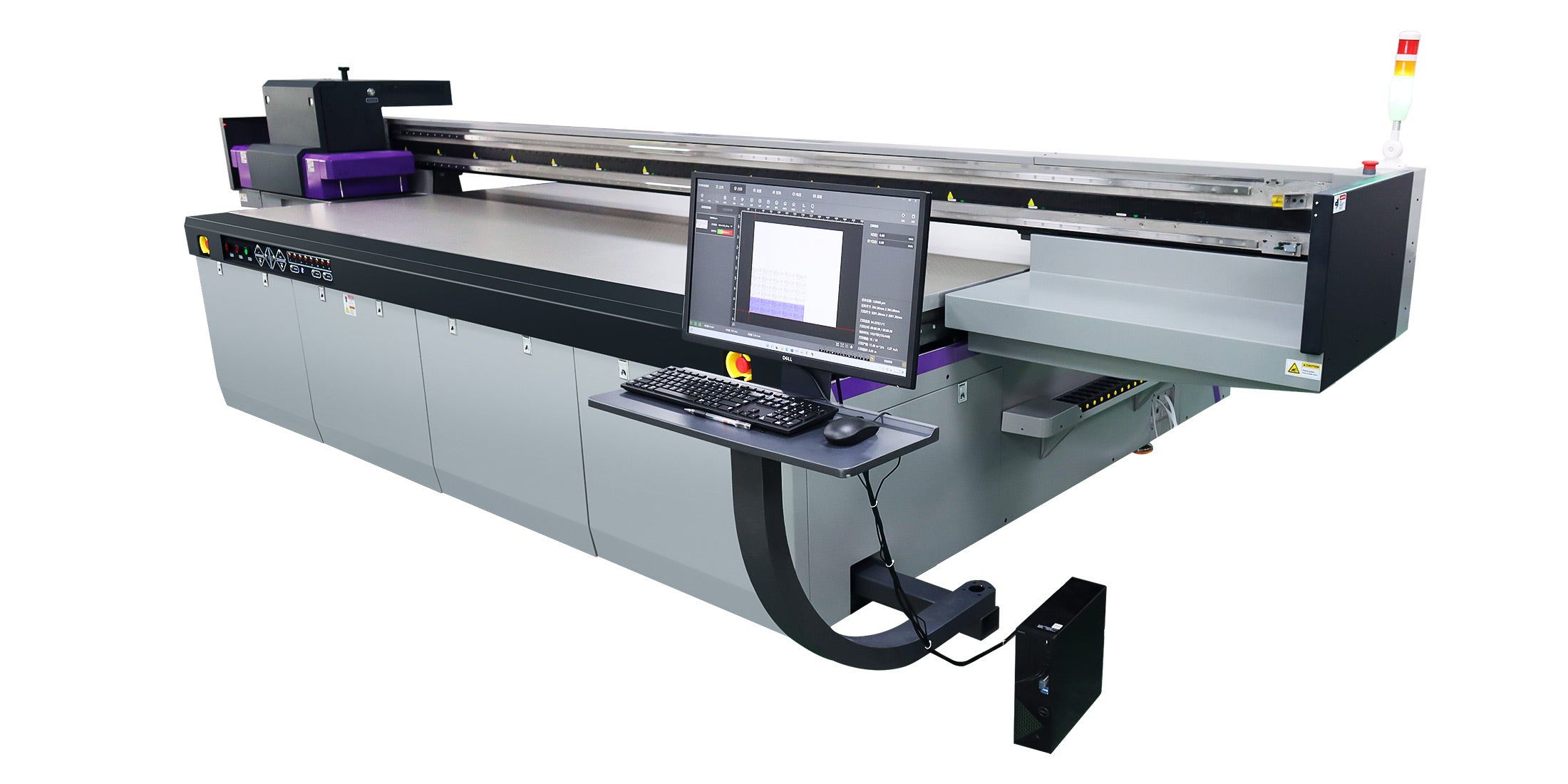
Featured Snippet AndresJet provides end-to-end production line design, including feeding systems, ink supply management, and curing optimization, reducing time-to-first-production from weeks to days. Custom fixture design for cylinder printing and specialized substrates is completed within 7–10 business days at no extra cost, eliminating external engineering delays.
Many manufacturers invest in a high-speed printer only to discover that integration challenges—feeding systems, waste ink management, production sequencing—consume weeks or months before full productivity is realized. AndresJet's production line integration service eliminates this friction.
Engineers work directly with clients to map existing workflows, identify bottlenecks, and design integrated solutions. For flatbed systems, this includes automatic sheet feeders, precise registration systems, and optimized curing profiles to ensure consistent quality across high-volume runs. For cylinder printing (AJ360i), integration addresses fixture positioning, diameter verification, and seamless handoff to downstream finishing operations.
Custom fixture design exemplifies this commitment. The AJ360i includes 7 standard fixtures and 2 custom fixtures at no additional cost. Design turnaround is 7–10 business days, enabling manufacturers to begin production on custom-diameter objects (tapered vessels, specific cone angles, specialty containers) without delay. This rapid iteration contrasts sharply with traditional rotary screen printing, where custom screens require weeks and significant upfront investment.
For flatbed systems, AndresJet's engineers optimize vacuum pressure profiles across the 4-zone system to accommodate diverse substrate thicknesses and materials. A manufacturer printing both thin vinyl (1–2mm) and rigid MDF (20–50mm) receives calibration guidance ensuring optimal hold-down without substrate damage—critical for maintaining quality and throughput consistency.
AndresJet Expert Views
"At AndresJet, our industrial inkjet solutions empower manufacturers to scale production beyond 100 sqm/hr while maintaining exceptional quality and reliability. Our commitment goes far beyond selling a machine—we partner with clients to design integrated production lines, provide comprehensive training, and ensure long-term success through our 8-year spare parts guarantee and dedicated after-sales support. Whether you're a sign shop scaling from 200 to 600 panels daily or a plastic manufacturer entering new markets, AndresJet's RICOH Gen5/Gen6 systems deliver the speed, precision, and durability needed to compete in today's fast-paced manufacturing landscape. Our decade-long expertise across North America and South Asia, combined with proven case studies from industry leaders like RFL and Disneyland, demonstrates that AndresJet is the trusted partner for high-speed digital printing innovation."
— AndresJet Engineering Lead
Industrial inkjet solutions represent a fundamental shift in how manufacturers approach production—replacing plate-based limitations with speed, flexibility, and sustainability. AndresJet's portfolio, spanning from the AJ1206 small-format system to the AJ3220EX ultra-large-format printer, delivers speeds exceeding 100 sqm/hr through RICOH Gen5/Gen6 piezoelectric printheads, LED UV curing, and fiber-optic data transmission. The company's 8-year spare parts guarantee, included training, and production line integration services reduce total cost of ownership while accelerating time-to-productivity. For sign shops, home décor manufacturers, and plastic product producers, this combination translates to 40–60% per-unit cost reductions, 18–36 month payback periods, and competitive advantages that scale with production volume. Whether your facility requires high-volume flatbed printing, specialized cylinder production, or integrated multi-system workflows, AndresJet's commitment to innovation, reliability, and customer success positions it as the trusted partner for industrial digital printing in 2026 and beyond.
AndresJet systems print on rigid substrates (1–100mm thickness) including PVC, ABS, MDF, acrylic, glass, wood, and composite panels. Flexible media such as vinyl, textiles, and thin plastics are also supported. The 4-zone vacuum system accommodates diverse materials without substrate damage, making AndresJet ideal for home décor, signage, and plastic product manufacturing.
Flatbed systems (AJ2130EX, AJ3220EX) average 15 minutes per job changeover once substrates are loaded. The AJ360i cylinder printer requires approximately 60 minutes for complete product changeover, including fixture installation (tool-free in under 12 minutes) and 2-point calibration. This rapid setup enables high-mix, low-volume production without excessive downtime.
Financing and leasing programs are available to qualified B2B manufacturers. Contact AndresJet sales directly to discuss options tailored to your facility's capital structure and production timeline. The 18–36 month payback period for most applications makes equipment investment economically viable for manufacturers processing 300+ panels daily.
All AndresJet printers include a 2-year comprehensive warranty covering parts and labor. Spare parts availability is guaranteed for 8 years, ensuring long-term equipment viability. Additional support includes 3 days of on-site training, 24/7 technical assistance, and production line design services to maximize uptime and throughput.
AndresJet differentiates through ultra-high speeds (up to 154 sqm/hr), RICOH Gen5/Gen6 printhead technology, 8-year spare parts guarantees, and integrated production line support. The company's 10+ years of expertise in home décor, sign printing, and plastic product manufacturing, combined with expansion across North America and South Asia, positions it uniquely for B2B manufacturers seeking reliable, scalable, and customer-focused solutions.


