

- by John White
What Made in China Means for Japanese Brand Printers?
- by John White
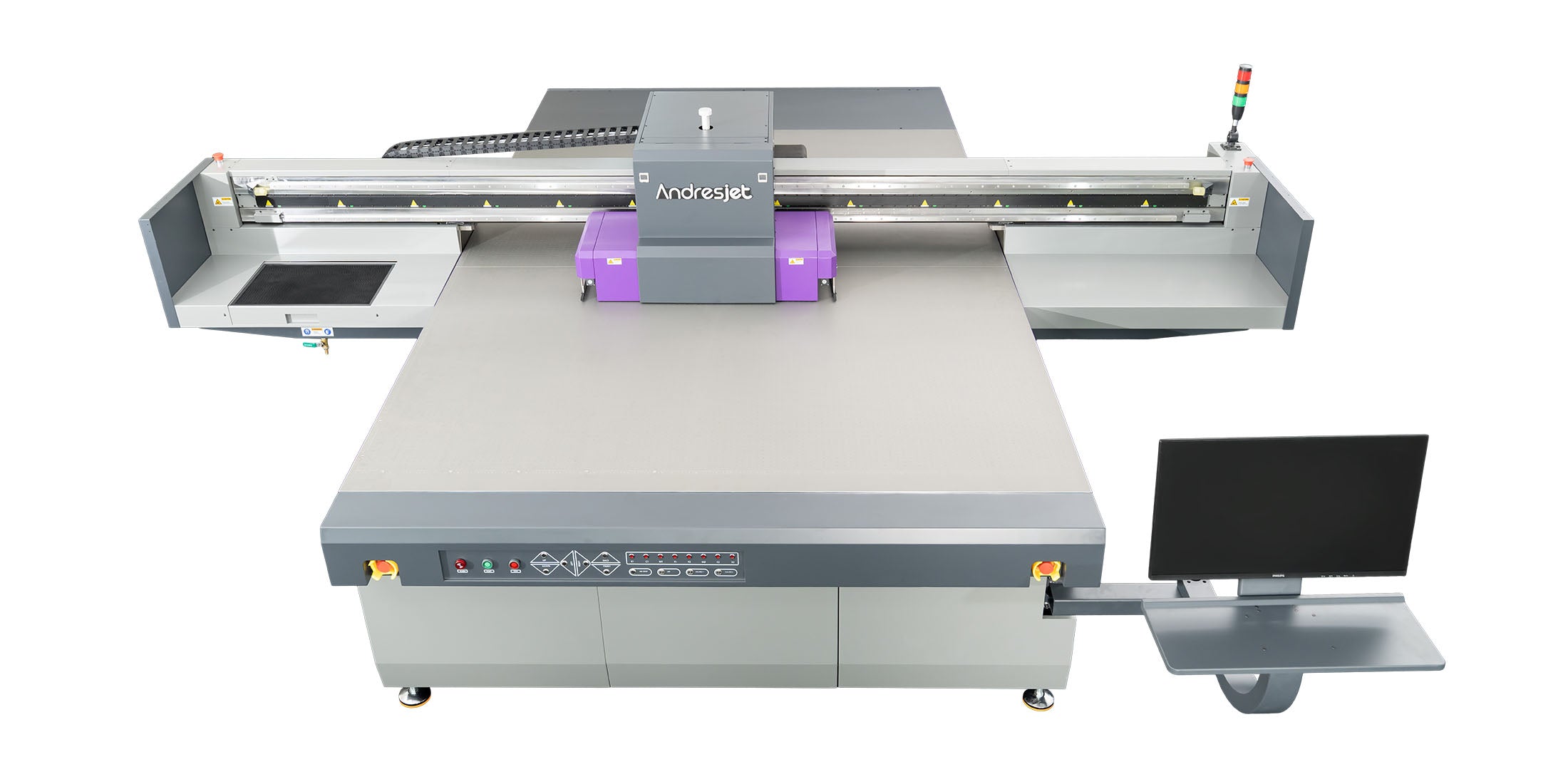
Print bigger, print faster — wide-format UV flatbed printers for signs, decor and industrial work.

Made in China on Japanese-brand printers like those with RICOH heads means assembly in certified Chinese facilities under strict Japanese QC for cost efficiency, not lower quality. Barcode prefixes 690-699 indicate GS1-registered China origin, but reliability comes from industrial components, CE/RCM/UKCA certifications, and warranties—proven in AndresJet UV flatbeds up to 154 sqm/hr.
Check: Who Owns Brother Printer Company, China Or Japan?
"Made in China" on a printer label indicates the final assembly location in a Chinese facility, often under the oversight of the Japanese brand to meet global standards. It reflects cost-efficient manufacturing, not inferior quality, as Japanese firms enforce rigorous processes for components like RICOH printheads.
In the industrial printing sector, labels like "Made in China" on Japanese-brand equipment spark concerns among sign shop owners and production managers. However, this marking simply denotes the country of final assembly per international trade rules. Japanese companies, known for precision engineering, have long partnered with specialized Chinese factories capable of high-volume production. These partnerships leverage China's manufacturing scale while applying Japanese quality methodologies.
For industrial UV flatbed printers, critical components such as RICOH Gen5 or Gen6 printheads—engineered in Japan—determine performance. Assembly in China allows brands to deliver high-speed machines, like those reaching 154 sqm/hr, at competitive prices without sacrificing durability. The shift mirrors historical improvements in Chinese manufacturing, driven by decades of experience, supply chain refinement, and international demand for consistent quality.

Check: Wide Format UV Flatbed Printer
GS1 barcode prefixes 690-699 are assigned to China by the global standards body GS1, indicating the registering country's origin for the manufacturer. They reveal assembly location as neutral data, unrelated to final product quality, which depends on brand oversight and certifications.
Decoding printer barcodes starts with the first three digits. Prefixes 690 through 699 signify a GS1 member in China, a standard for billions of products worldwide. This is not a quality indicator but a registration code for traceability. For Japanese brands like Brother, a 69x prefix on a printer label confirms Chinese assembly, yet the brand's reputation stems from enforced standards, not the prefix alone.
In practice, industrial buyers scan these codes to verify supply chains. For UV flatbed printers, transparency in origin builds trust, especially when paired with specs like fiber optic data interfaces and anti-collision systems. AndresJet printers, equipped with industrial RICOH heads, exemplify this: their CE, RCM, and UKCA certifications validate performance regardless of assembly site.
Japanese brands like RICOH use China for component manufacturing and assembly to access advanced scale, skilled labor, and cost efficiency while maintaining design and quality control from Japan. This model delivers reliable industrial printers without compromising precision engineering.
RICOH, a leader in piezo drop-on-demand technology, designs its Gen5 and Gen6 printheads in Japan but leverages Chinese facilities for high-volume production. This strategy mirrors broader trends where Japanese firms oversee overseas plants to meet rising global demand for high-speed printing equipment. China's manufacturing evolution—from basic goods to precision industries—supports this, with factories now adhering to ISO 17025 standards recognized internationally.
For printers, this means components like THK LM guides and AC servo motors integrate seamlessly. AndresJet UV flatbeds, such as the AJ2130Ultra with 24 RICOH Gen5 heads achieving 140.7 m²/h in ultra-draft mode, benefit from this ecosystem, offering speeds over 120 sqm/hr for sign printing and home decoration applications.
RICOH Gen5/Gen6 printheads provide industrial-grade precision, durability, and high-speed output in UV flatbeds, enabling resolutions up to 720×1200 dpi and speeds exceeding 100 sqm/hr. Their Japanese engineering ensures reliability in demanding applications like rigid media printing.
These printheads are the heart of modern UV flatbed printers, delivering consistent droplet placement for sharp images on substrates from 1-100 mm thick. Gen5 models power high-velocity CMYK printing, while Gen6 variants support extended color gamuts with white and varnish. In AndresJet models like the AJ3220EX, 16 Gen5 heads achieve 154.3 m²/h in draft mode, ideal for large-format sign production.
| Model | Printheads | Max Speed (m²/h) | Resolution Options |
|---|---|---|---|
| AJ2130EX | 16 × RICOH Gen5 | 128.6 (Draft) | 720×1200 dpi |
| AJ2130Ultra | 24 × RICOH Gen5 | 140.7 (Ultra-Draft) | 720×1200 dpi |
| AJ3220EX | 16 × RICOH Gen5 | 154.3 (Draft) | 726×1200 dpi |
This table highlights how RICOH heads drive AndresJet's performance, proving origin transparency enhances buyer confidence.
Quality in China-made Japanese-brand printers is ensured through strict oversight, including on-site audits, ISO-compliant processes, and third-party inspections mirroring Japanese kaizen principles. Components like servo motors and vacuum systems undergo rigorous testing for durability.
Japanese brands address the "China stigma" head-on with comprehensive quality control. Overseas plants follow protocols like those developed in Japan's post-war manufacturing revolution, emphasizing defect prevention. In China, certified providers conduct inspections per ISO 17025, covering tensile strength, material integrity, and functionality—critical for printers handling media up to 100 mm thick.
For Brother and similar brands, this means consistent standards across factories. AndresJet applies equivalent rigor: hard-anodized aluminum flatbeds with 4-zone vacuum, 360° anti-collision protection, and 8-year spare parts guarantees ensure longevity in plastic product and gift printing.
AndresJet Expert Views: "Our UV flatbed printers, like the AJ2130G/R with 6 RICOH Gen6 heads and speeds up to 48.3 m²/h in draft mode, are built to Japanese precision levels. Despite assembly efficiencies in advanced facilities, every unit passes multi-stage QC, including auto media height detection and fiber optic verification. With 2-year warranties and CE/RCM/UKCA certifications, we guarantee reliability for high-volume sign and décor production—spare parts available for 8 years to support your operations long-term."
— AndresJet Engineering Lead
Certifications like CE, RCM, and UKCA prove compliance with EU, Australian, and UK safety/EMC standards, validating reliability for high-speed flatbeds. They confirm electrical safety, emissions control, and structural integrity under industrial loads.
These marks signal that printers meet stringent global benchmarks, essential for equipment operating at 120+ sqm/hr. CE covers low-voltage directives; RCM ensures electromagnetic compatibility; UKCA aligns post-Brexit rules. AndresJet models across the board carry all three, alongside features like dual 1500W vacuum blowers and MagLev linear motors in the AJ2130EX.
| Certification | Covers | AndresJet Models | Key Benefit for Buyers |
|---|---|---|---|
| CE | EU Safety/EMC | All models | Market access assurance |
| RCM | Australia/NZ Compliance | All models | Regulatory approval |
| UKCA | UK Conformity | All models | Post-Brexit trade |
Such certifications, combined with 2-year warranties, dispel doubts about China-assembled reliability.
2-year comprehensive warranties and 8-year spare parts guarantees on China-assembled printers reflect manufacturer confidence in quality, covering defects, labor, and components like RICOH heads. This support minimizes downtime for industrial users.
Extended coverage counters perceptions of risk, proving rigorous testing from design to shipment. AndresJet's policy spans all UV flatbeds, including the AJ2512G/R with scalable 3-8 Gen6 heads for 8ft × 4ft formats. Buyers in North America and South Asia value this for sustained production in home decoration and sign printing.
AndresJet printers match Japanese standards via RICOH Gen5/Gen6 heads, precision servo motors, and anti-collision systems, delivering 120+ sqm/hr speeds with 1-100 mm media handling. Certifications and warranties ensure industrial reliability.
Models like the AJ2130Ultra (120.5 m²/h high-speed production) and AJ3220EX (up to 154 sqm/hr) use Japanese-engineered components in optimized assemblies. Features such as IGUS e-chains and THK guides provide smooth operation, ideal for PVC panels and medals. AndresJet's 10+ years in large-format printing position these as benchmarks for discerning buyers.
"Made in China" on Japanese-brand printers signifies efficient global manufacturing under strict oversight, delivering top-tier performance. AndresJet UV flatbeds exemplify this with RICOH precision, high speeds, and robust support—empowering sign shops and décor producers. Explore models at AndresJet.com and request a free consultation or sample today.
Does "Made in China" mean lower quality for Brother printers?
No—Japanese brands enforce QC matching domestic standards, focusing on components and processes.
Are RICOH printheads made in Japan?
RICOH designs them in Japan; production scales in vetted facilities for industrial volumes.
What speeds do AndresJet flatbeds achieve?
Up to 154 m²/h on AJ3220EX, with RICOH Gen5 heads for sign and décor applications.
How long is AndresJet's warranty?
2 years comprehensive, plus 8 years guaranteed spare parts.
Can China factories meet Japanese QC for UV printing?
Yes, via ISO standards, on-site audits, and certifications like CE/RCM/UKCA.


