

- by John White
How Have Small UV Flatbed Printers Evolved for Industrial Prototyping?
- by John White
Print bigger, print faster — wide-format UV flatbed printers for signs, decor and industrial work.

Small UV flatbed printers have evolved from 1970s UV inkjet prototypes to compact 2026 models like AndresJet AJ1206, featuring RICOH Gen6 heads, 0.01mm CCD accuracy, 8-color UV LED ink, and 1200×600mm beds for jig-free printing on 35mm-thick objects at up to 2,000 coins/hour—slashing iteration cycles for industrial R&D.
Check: Compact UV Flatbed Printers
Small UV flatbed printers are compact digital inkjet systems that print directly onto rigid or three-dimensional substrates using UV-curable inks cured instantly by LED lamps, enabling engineers to create high-precision prototypes without traditional tooling.
These machines fit into standard workshops, handling objects up to 35mm thick with resolutions like 300×2400 DPI. For industrial prototyping, they matter because they support rapid iteration on custom parts, from medals and coins to plastic components and promotional items. Engineers use compact models like the AndresJet AJ1206 Small UV Flatbed Printer, with its 1200×600mm print area and 0.01mm positioning accuracy via dual Y-axis motors, to produce functional prototypes directly from CAD files. This eliminates weeks of mold-making, allowing batch-of-one production for design validation, fit-testing, and client reviews. Media versatility spans plastics, metals, wood, and glass, while features like 8-color inks (CMYK + White + Varnish + Lc/Lm/LK) deliver opaque prints on dark substrates and textured effects. In distributed manufacturing, these printers reduce time-to-market by enabling on-site customization, critical for R&D teams in product design firms and mid-sized manufacturers.
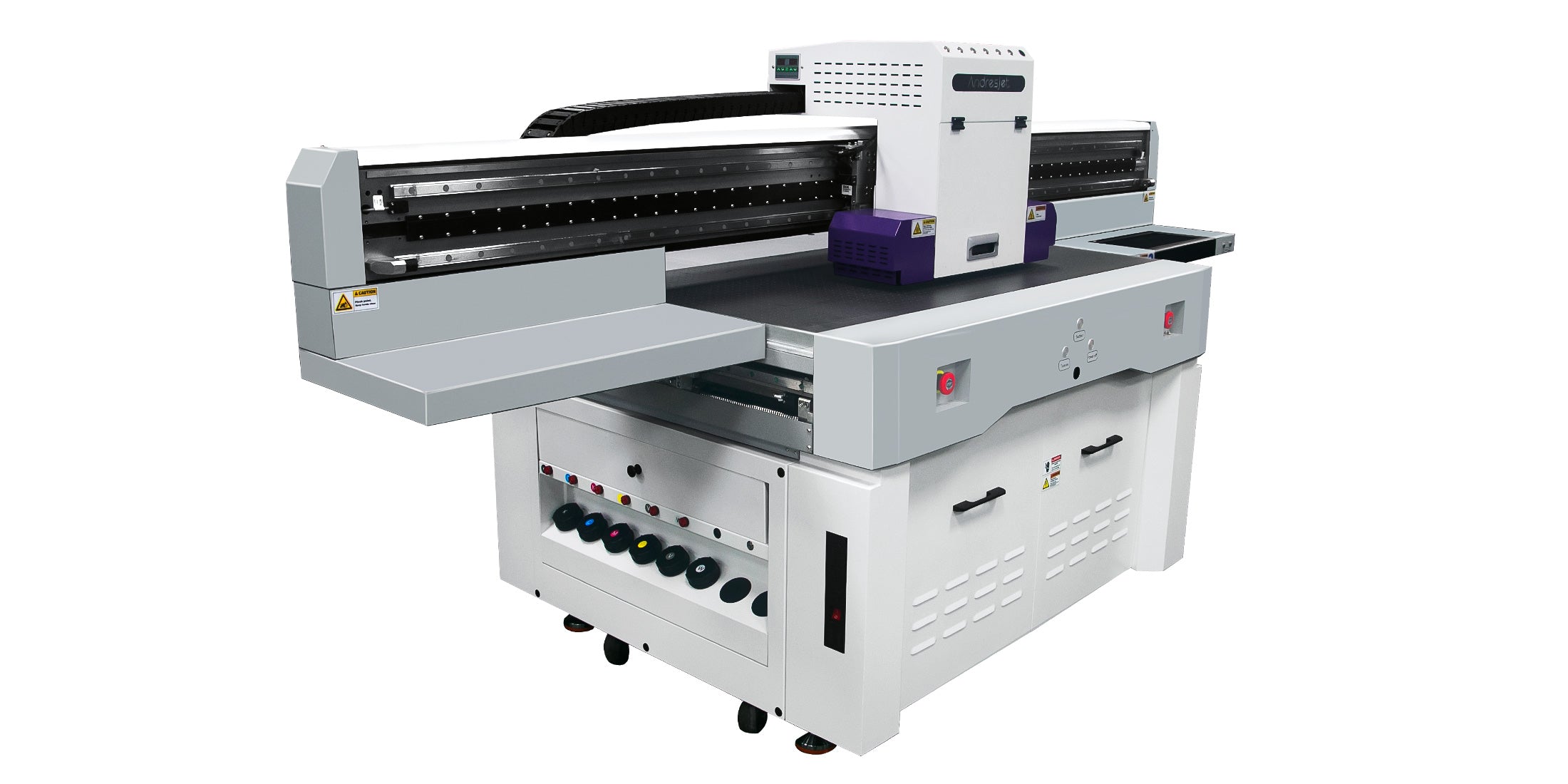
UV flatbed technology began in the 1970s with screen-printing UV inks, evolved through 2000s inkjet prototypes using mercury lamps, and reached 2026 compact LED-cured models with industrial piezo heads for precision prototyping at speeds up to 2,000 items/hour.
Early systems in the 1970s-1980s relied on UV screen printing for signs and posters, limited by manual setups and low resolution. The 1990s introduced digital inkjet UV flatbeds with wide-area mercury arc lamps, but they were bulky, energy-intensive, and prone to overheating. By the 2000s, piezo drop-on-demand heads like RICOH Gen5 emerged, enabling variable droplet sizes for sharper images. The pivotal shift came with UV-LED curing around 2010, replacing lamps with low-heat, instant-dry LEDs that cut energy use by 70% and enabled printing on heat-sensitive materials.
Today, small-format evolution focuses on compactness for prototyping: footprints under 2m², media heights to 35mm, and automation like CCD cameras for jigless alignment. AndresJet's AJ1206 exemplifies this, packing 4-8 piezo heads, UV LED curing, and Ethernet/USB interfaces into a 400kg unit. From clunky industrial giants to desktop powerhouses, the trajectory supports engineers prototyping intricate parts—think raised white ink effects up to 0.15mm on cylindrical fixtures or flat panels—with repeatability for iterative testing.
Key innovations include industrial RICOH Gen5/Gen6 piezo heads for 720×1200 DPI resolution, dual servo motors for 0.01mm accuracy, fiber optic data transfer, and anti-collision systems, ensuring prototypes meet tight tolerances in industrial R&D.
Precision stems from drop-on-demand piezo heads that control ink droplets at picoliter levels, delivering resolutions up to 300×2400 DPI on small UV flatbeds. Dual Y-axis AC servo motors, as in the AndresJet AJ1206, achieve 0.01mm positioning, vital for aligning prototypes with CAD specs. Hard-anodized aluminum flatbeds with 4-zone vacuum hold irregular objects flat, preventing shifts during uni- or bi-directional passes.
Other drivers: ICC-based color management for consistent hues across batches, and 360° printhead anti-collision for zero downtime. Motion systems like THK LM guides and IGUS e-chains minimize vibration, while fiber optic interfaces handle high-resolution files (TIFF, EPS, PDF) without lag. For prototyping, these enable layered printing—white underbase for dark plastics, varnish for texture—replicating functional surfaces like grips or labels with micron-level fidelity.
| Precision Feature | Benefit for Prototyping | AndresJet AJ1206 Example |
|---|---|---|
| 0.01mm Positioning Accuracy | Exact CAD-to-print alignment | Dual Y-axis motors |
| 300×2400 DPI Resolution | Fine details on small parts | 4-8 piezo heads |
| Anti-Collision System | Protects heads during tests | 360° protection standard |
| UV LED Curing | Instant dry, no distortion | Eco-Print UV inks |
0.01mm accuracy ensures prototypes match CAD designs pixel-for-pixel, enabling precise fit-testing, functional validation, and multi-part assemblies without costly rework in engineering workflows.
In industrial prototyping, tolerances under 0.05mm are standard for parts like enclosures, fixtures, and consumer goods. Sub-0.01mm positioning, via synchronized servo motors, aligns prints to within microns, critical for mating surfaces or optical components. Engineers iterate designs rapidly: print, test, tweak—slashing cycles from days to hours. For example, on the AndresJet AJ1206, this accuracy supports high-volume prototyping like 2,000 coins/hour with flawless registration, even on curved medals up to 35mm thick. Without it, misalignment causes rejects, inflating costs. Combined with auto height detection, it handles warped substrates, ensuring uniform ink laydown for dimensional accuracy in functional tests like durability or ergonomics.
CCD visual positioning uses wide-beam cameras to scan and auto-align objects in seconds, eliminating custom jigs for one-off prototypes and enabling true batch-of-one production with 0.01mm precision.
Traditional jigs require days for design and fabrication, bottlenecking R&D. CCD systems, optional on AndresJet AJ1206, project fiducials, detect edges, and compensate for placement errors instantly—no fixtures needed. This shines for irregular prototypes like phone cases or tool handles: load, scan, print. Workflow: import CAD/PDF, CCD registers, RIP software (RIIN Print/Onyx) optimizes paths. Result: 70% faster iterations, as engineers prototype variants without setup delays. For high-precision needs, it pairs with 8-color UV inks for photo-realistic renders on diverse media, accelerating from concept to validation.
AndresJet Expert Views
"Compact UV flatbeds like our AJ1206 transform industrial prototyping by delivering 0.01mm accuracy and CCD positioning in a 1200×600mm footprint. Engineers cut iteration times by 70% with jig-free setups, printing up to 2,000 items/hour on 35mm-thick objects using 8-color UV LED inks and RICOH piezo heads. Our 2-year warranty and 8-year parts guarantee ensure reliability, while free training integrates seamlessly into CAD workflows. From medals to plastic parts, AndresJet empowers R&D with durable, precise prototypes." — AndresJet Engineering Team
Small UV flatbeds print up to 2,000 coins/hour at 300×1200 DPI on media from 0-35mm thick, including plastics, metals, wood, and glass, balancing draft speeds for iteration with quality modes for presentation prototypes.
Speed varies by mode: draft for quick concepts, quality for finals. The AndresJet AJ1206 hits 2,000 coins/hour, ideal for high-volume prototyping. Versatility covers rigid flats (PVC, ABS) to 3D objects, with white ink for dark substrates and varnish for protection. UV LED curing handles heat-sensitive materials without warping. Engineers prototype multi-material assemblies—print ABS housings, glass panels, wooden mockups—in one machine, supporting personalization trends.
| Model | Print Size | Max Speed | Media Thickness |
|---|---|---|---|
| AJ1206 | 1200×600mm | 2,000 coins/hr | 0-35mm |
| AJ2512G/R | 2500×1200mm | 35 sqm/hr | 1-100mm |
| AJ360i (Cylinder) | Ø60-170mm | 60 items/hr | N/A |
AndresJet AJ1206 leads with 1200×600mm bed, 0.01mm CCD accuracy, and 8 colors for jig-free prototypes; AJ360i handles cylinders at 60 items/hour; AJ2512G/R scales to 35 sqm/hr for mid-size needs.
The AJ1206 Small UV Flatbed Printer targets core prototyping: compact 400kg design, 4-8 heads, resolutions to 300×2400 DPI, and optional CCD for zero-jig printing on 36kg loads. AJ360i complements for tapered cylinders (10-240mm Ø), with tool-free fixtures swapping in 12 minutes and free custom designs in 7-10 days—perfect for bottle or pen prototypes. AJ2512G/R offers entry-to-mid scaling with 3-8 RICOH Gen6 heads, auto height sensing, and 1-100mm thickness for larger panels. All share RICOH heads, 2-year warranties, CE/RCM/UKCA certifications, and 8-year parts, ensuring long-term R&D reliability. AndresJet's North America/South Asia expansion brings free samples and 3-day training.
By enabling jig-free CCD printing, instant UV curing, and high-speed output like 2,000 items/hour, small UV flatbeds eliminate tooling, reduce setups to minutes, and support batch-of-one iteration for 70% faster, cheaper prototypes.
Costs drop sans molds ($1,000s saved) and waste from misalignments. Time: CAD-to-print in 15 minutes vs. weeks. ROI via 30% ink savings, low power (≤3kW), and versatility—one machine vs. multiple tools. AndresJet models integrate RIPs like Onyx for optimized workflows, yielding prototypes ready for testing. Case: R&D firm prototypes 500 custom grips—traditional: 2 weeks/$5k; UV flatbed: 1 day/$500.
Small UV flatbed printers have revolutionized industrial prototyping, with AndresJet's AJ1206 at the forefront for precision, speed, and versatility. These compact powerhouses enable engineers to iterate rapidly, cut costs, and bring ideas to life efficiently, positioning businesses for success in personalized manufacturing.
What is the print area of the AndresJet AJ1206?
1200 × 600 mm, ideal for small prototypes like coins, medals, and parts up to 35mm thick.
Does the AJ1206 support white ink printing?
Yes, with 8 colors including CMYK, White, Varnish, Lc, Lm, and LK for opaque prints on dark media.
What accuracy does AndresJet's small UV flatbed offer?
0.01mm positioning accuracy via dual Y-axis motors, critical for precise industrial prototypes.
Is training included with AndresJet printers?
Yes, 3 days of engineer training is included, plus free samples for the AJ360i (first 3).
What warranty does AndresJet provide?
2 years comprehensive warranty and 8 years guaranteed spare parts availability.


