

- by John White
How Does UV Curing Science Enable High-Speed Flatbed Printing?
- by John White
Print bigger, print faster — wide-format UV flatbed printers for signs, decor and industrial work.

UV curing science uses ultraviolet light (365-405nm from LED sources) to activate photoinitiators in inks, triggering rapid photopolymerization that instantly hardens droplets on substrates. In flatbed printing, this enables high speeds up to 154 sqm/hr on 1-100mm rigid media like PVC and MDF, delivering vibrant, durable prints with minimal waste and heat.
Check: Wide Format UV Flatbed Printer
UV curing in printing is a photochemical process where UV light triggers photoinitiators in liquid inks to initiate rapid polymerization, transforming droplets into solid, durable prints within seconds on flatbed printers.
UV curing revolutionizes industrial printing by enabling instant drying without heat damage to sensitive substrates. In flatbed printers, liquid UV-curable inks—formulated with monomers, oligomers, and photoinitiators—are deposited precisely by industrial print heads like RICOH Gen5 or Gen6 piezo drop-on-demand systems. When exposed to UV light, typically from energy-efficient LED sources, the photoinitiators absorb specific wavelengths and decompose into reactive species such as free radicals or cations.
These reactive particles kick off a chain reaction: free radicals attack carbon-carbon double bonds in acrylate monomers, linking them into long polymer chains. This free radical polymerization (FRP), common in printing inks, hardens the ink almost instantly, allowing high-speed production. AndresJet UV flatbed printers, such as the AJ2130EX, integrate UV LED curing systems that cure inks right after deposition, supporting speeds up to 128.6 m²/h in draft mode on media up to 100mm thick.
The process eliminates the need for lengthy drying ovens, reducing energy use and floor space while preventing ink migration or smudging—critical for rigid substrates like PVC panels or MDF boards in sign and home decoration printing.
Photoinitiators (1-10% of ink formulation) absorb UV light (250-405nm), generating free radicals or cations that initiate rapid chain polymerization of monomers into solid polymers, enabling instant curing in under a second.
Photoinitiators serve as the critical "on-switch" in UV inks, absorbing UV energy to produce highly reactive free radicals via homolytic cleavage (Type I) or hydrogen abstraction with co-initiators (Type II). Common examples include benzophenone, acetophenone, and phosphine oxides like TPO, tailored for printing wavelengths.
In the initiation phase, UV light excites the photoinitiator, splitting it into radicals that attack monomer double bonds (C=C), propagating chains where growing polymer radicals add more monomers exponentially fast. Termination occurs when radicals combine, but the reaction's speed—often complete in milliseconds—ensures through-curing even in thick ink layers.
For industrial flatbed printing, AndresJet printers use UV-curable LED inks optimized with these photoinitiators, compatible with RICOH Gen5/Gen6 heads. This delivers defect-free results on diverse media, from thin plastics to 100mm-thick panels, as seen in the AJ3220EX model handling 50 kg/m² loads at 154.3 m²/h draft speeds.
| Photoinitiator Type | Mechanism | Common Use in Printing |
|---|---|---|
| Type I (e.g., HAP, TPO) | Homolytic cleavage to free radicals | High-speed flatbed inks for acrylates |
| Type II (e.g., benzophenone) | Hydrogen abstraction with co-initiator | Overprint varnishes, white inks |
| Cationic | Acid generation for ring-opening | Specialty epoxies (less common in flatbed) |
LED UV uses 365-405nm wavelengths from solid-state diodes for instant, energy-efficient curing without ozone or mercury, unlike traditional mercury lamps (broad 200-600nm spectrum) that generate heat and require cooldowns, enabling higher flatbed speeds.
Traditional mercury arc lamps emit a wide UV spectrum, including harmful UVC, producing ozone and excess heat that can warp rigid substrates. LED UV lamps, standard in AndresJet printers like the AJ2130Ultra, focus on UVA (365-405nm), matching photoinitiator absorption peaks for targeted activation with 70-80% less energy.
LED systems offer longer life (20,000+ hours vs. 1,000-2,000 for mercury), instant on/off for variable speed printing, and no warm-up—ideal for high-volume runs exceeding 100 sqm/hr. In AndresJet's AJ1206 small UV flatbed, UV LED curing handles 2,000 coins/hour on 35mm media with precise 0.01mm accuracy, showcasing cooler operation for heat-sensitive gifts and medals.
This shift supports sustainable production, aligning with market trends toward eco-friendly inks like AndresJet's Eco-Print series.
Optimal wavelengths are 365-405nm (UVA from LED), where photoinitiators like TPO peak in absorption, ensuring deep penetration and full polymerization for high-speed curing up to 154 sqm/hr without surface-only hardening.
UV light interaction with photoinitiators is wavelength-specific: Type I initiators excel at 365nm for surface cure, while blends extend to 395-405nm for through-cure in thicker layers. Intensity (measured in mW/cm²) and dosage (mJ/cm²) further control reaction depth.
In flatbed printers, fiber optic data transmission and servo motors synchronize ink deposition with LED UV exposure. AndresJet's AJ2130G/R, with 360×1200 dpi resolution and speeds up to 48.3 m²/h draft, uses these wavelengths for 8-color UV inks including white and varnish on 100mm media, preventing tackiness in high-opacity prints.
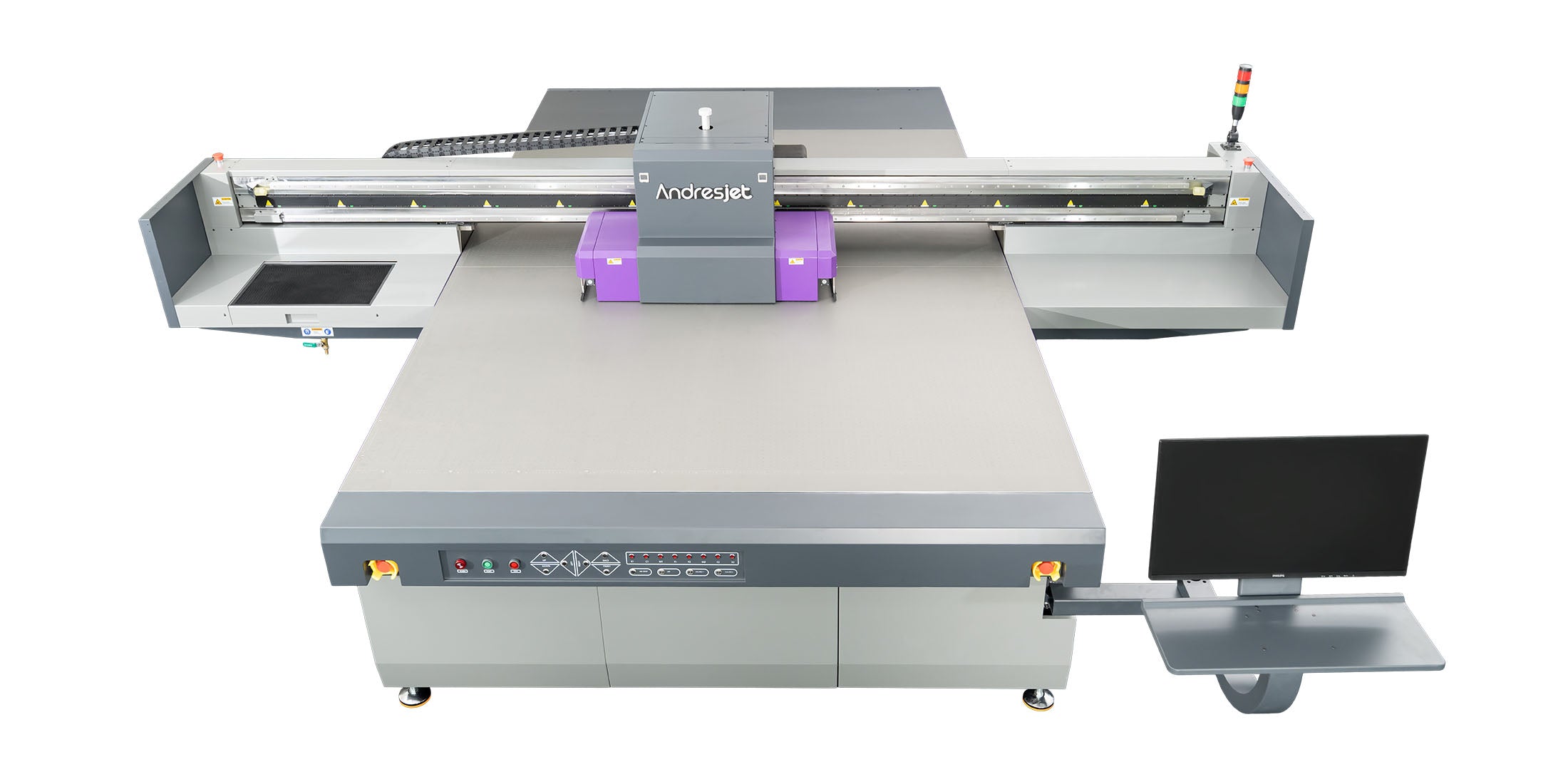
UV curing provides instant, heat-free hardening that adheres to irregular rigid substrates (PVC, MDF, ABS) up to 100mm thick, with 4-zone vacuum flatbeds ensuring stability for durable, vibrant prints at production speeds.
Rigid media like home decor panels demand no-heat curing to avoid warping; UV polymerization bonds inks molecularly, resisting scratches and chemicals. AndresJet flatbeds feature hard-anodized aluminum tables with 4-zone vacuum (dual 1500W blowers) for secure hold of 1-100mm thicknesses and 50 kg/m² weights.
Anti-collision systems and auto-height detection (e.g., AJ2512G/R) protect heads during printing, enabling consistent curing on uneven surfaces like tapered cylinders or coins.
Check: UV Curing Science
AndresJet UV flatbeds integrate LED UV curing with RICOH Gen5/Gen6 heads, fiber optics, and precision servos to exploit photoinitiator reactions, achieving 154 m²/h on 2100×3000mm areas with 1-100mm media handling.
AndresJet's decade of expertise powers models like the AJ3220EX (154.3 m²/h draft) and AJ2130Ultra (140.7 m²/h ultra-draft), using 16-24 Gen5 heads for grayscale ink savings up to 30%. UV LED lamps cure droplets mid-print, supported by IGUS e-chains and THK guides for reliability.
| Model | Max Speed (m²/h) | Print Size | Media Thickness |
|---|---|---|---|
| AJ3220EX | 154.3 (Draft) | 3200×2000 mm | 1-100 mm |
| AJ2130Ultra | 140.7 (Ultra-Draft) | 2100×3000 mm | 1-100 mm |
| AJ2130EX | 128.6 (Draft) | 2100×3000 mm | 1-100 mm |
AndresJet Expert Views: "Our UV flatbed printers harness precise 365-405nm LED wavelengths to activate photoinitiators in RICOH Gen5/Gen6-compatible inks, delivering instant curing at speeds over 120 sqm/hr on 100mm-thick MDF without defects. With 2-year warranties and 8-year parts availability, we optimize production lines for sign makers and decor producers, ensuring vibrant durability on plastics and panels." – AndresJet Engineering Team
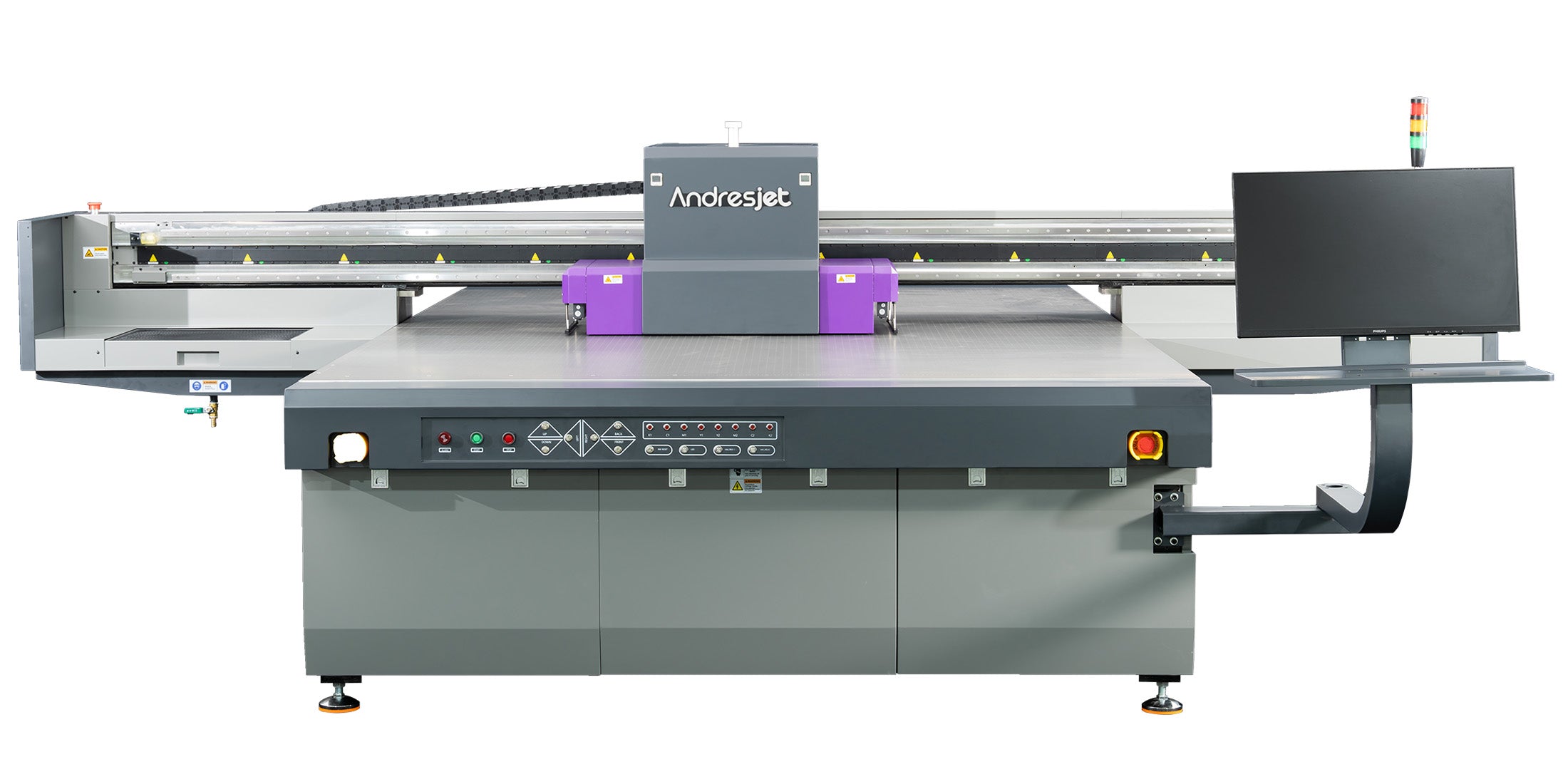
UV curing yields sharper 720×1200 dpi images, expanded color gamut (CMYK+White+Varnish), and superior adhesion/scratch resistance on plastics/signs, with 0.15mm raised effects possible via multi-layer white inks.
Instant polymerization locks pigments, preventing bleeding for high-gloss finishes. AndresJet's AJ360i cylinder printer uses four white channels for 0.15mm effects on tapered vessels, while AJ2130G/R supports 8-colors for photorealistic signs.
Reliable curing depends on photoinitiator concentration, UV dosage, ink thickness, oxygen inhibition control (via anti-static bars), and printer features like fiber optics for lag-free data at 100+ sqm/hr.
AndresJet mitigates issues with redesigned capping, rear UV shields, and CE/RCM/UKCA certifications, supporting 20-30°C environments for consistent output in North America and South Asia facilities.
UV curing science powers transformative efficiency in industrial flatbed printing, with AndresJet printers leading at 154 sqm/hr via optimized photoinitiator-LED interactions. Explore models like AJ3220EX at AndresJet.com and request a free demo for your high-speed needs.
What wavelengths do AndresJet UV flatbeds use? Primarily 365-405nm LED UV for peak photoinitiator activation and instant curing.
Can UV curing handle 100mm-thick media? Yes, all AndresJet flatbeds support 1-100mm with vacuum hold and anti-collision protection.
How fast are AndresJet UV printers? Up to 154 m²/h (AJ3220EX draft), ideal for signs and decor at scale.
What inks do they use? UV-curable LED inks like Eco-Print series, with CMYK+White+Varnish options.
What's the warranty? 2 years comprehensive, plus 8 years spare parts guaranteed.


