

- by John White
How Does Piezo Drop-on-Demand Inkjet Power UV Flatbed Printing?
- by John White
Print bigger, print faster — wide-format UV flatbed printers for signs, decor and industrial work.

Piezo drop-on-demand (DOD) inkjet printing ejects precise ink droplets on demand using piezoelectric crystals in RICOH Gen5/Gen6 heads, ideal for industrial UV flatbeds. Unlike continuous inkjet (CIJ), DOD produces droplets only when needed, enabling high-resolution (up to 720×1200 DPI) printing on rigid media 1–100mm thick at speeds over 120 sqm/hr with LED UV curing for instant dry.
Check: digital cylinder printer
Inkjet printing technology propels tiny droplets of ink onto substrates to recreate digital images with high precision. It operates by ejecting picoliter-sized ink drops from microscopic nozzles in a printhead, controlled digitally for text, graphics, or codes on diverse materials like paper, plastics, or rigid panels.
The core process begins with ink stored in reservoirs, fed to nozzles via channels. Digital signals dictate when and where droplets form, propelled by pressure mechanisms. In industrial applications, this enables non-contact printing on uneven surfaces, such as home decoration panels or sign boards up to 100mm thick. Rollers or flatbeds position the media, while high-precision motors ensure accurate advancement. For UV flatbeds, LED UV lamps cure droplets instantly, allowing multi-layer builds for raised effects.
AndresJet integrates this technology across its UV flatbed lineup, using fiber optic data interfaces and AC servo motors for seamless operation. Printheads scan uni- or bi-directionally, depositing ink in passes that build vibrant, durable prints on PVC, MDF, or glass.
Drop-on-demand (DOD) ejects ink droplets only when required, while continuous inkjet (CIJ) maintains a steady stream of droplets, deflecting them electrostatically to form images or recirculating unused ones. DOD excels in precision for variable data, ideal for industrial UV printing.
In DOD systems, nozzles fire droplets individually via piezo or thermal actuation, minimizing waste and enabling high-resolution output. CIJ, common in high-speed coding, pressurizes ink into a continuous jet broken into droplets by vibration—up to 165,000 per second—then charges and deflects them via electrodes. Unprinted drops return to the reservoir.
For UV flatbed printers handling rigid media, DOD dominates due to its on-demand efficiency. AndresJet's models, like the AJ2130EX, employ piezo DOD for speeds up to 128.6 m²/h in draft mode, supporting applications in sign printing and plastic products without the complexity of CIJ recirculation.
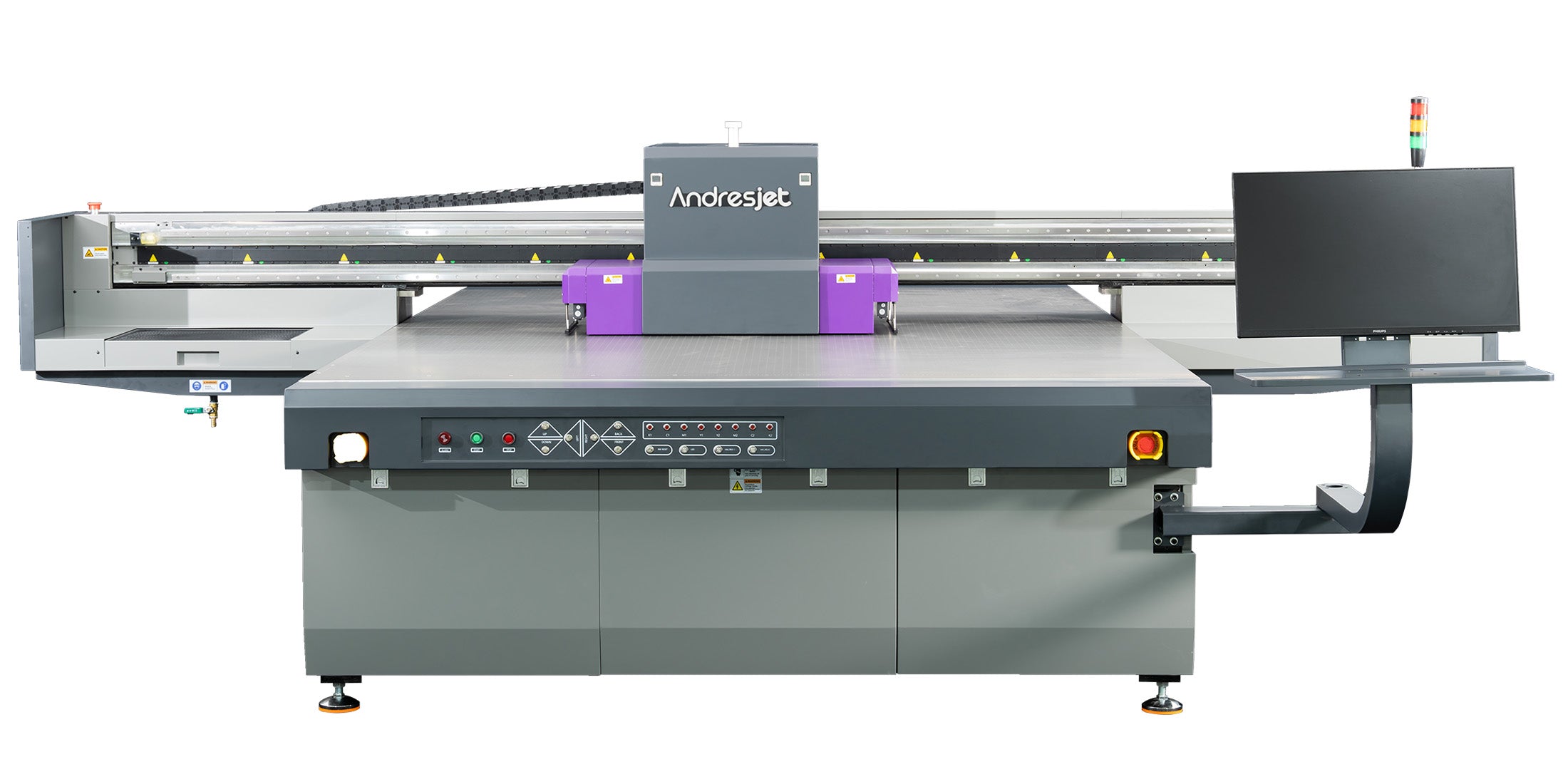
Check: Inkjet Printing Technology
Piezo DOD uses voltage-activated crystals to deform and squeeze ink from nozzles without heat, supporting diverse inks like UV-curable types. Thermal inkjet vaporizes ink via resistors to form bubbles that eject droplets, suiting water-based inks but risking clogs with non-volatile fluids.
Piezoelectric elements in DOD printheads contract precisely when electrified, generating pressure waves that propel ink drops of 1.5–30pl. This shear-mode or bend-mode actuation handles viscous, UV inks reliably, crucial for industrial durability. Thermal systems, like bubble jet, rely on rapid heating (hundreds of degrees) to expand vapor bubbles, pulling fresh ink via surface tension—but heat limits ink compatibility and nozzle life.
In high-volume UV flatbed printing, piezo's versatility shines. AndresJet's RICOH Gen5/Gen6 heads in the AJ2130Ultra deliver 140.7 m²/h ultra-draft speeds, far outperforming thermal for rigid substrates like 100mm-thick panels.
Piezo DOD supports thick, viscous UV inks with precise droplet control, enabling high-speed, high-resolution printing on rigid media up to 100mm thick without contact. Its durability and ink flexibility make it perfect for flatbed systems handling diverse substrates like wood, metal, or acrylic.
Industrial UV flatbeds demand reliability for 24/7 operation. Piezo heads withstand high-viscosity LED UV inks, curing instantly under UV lamps for scratch-resistant finishes. Features like anti-collision systems protect nozzles during scans over uneven media. Vacuum flatbeds secure objects, while servo-driven carriages ensure micron-level accuracy.
AndresJet's AJ3220EX exemplifies this, with 16 RICOH Gen5 heads printing 154.3 m²/h on 3200×2000mm areas, ideal for sign shops upgrading from screen printing.
| Model | Print Heads | Max Speed (m²/h) | Media Thickness (mm) |
|---|---|---|---|
| AJ2130EX | 16 × RICOH Gen5 | 128.6 (Draft) | 1–100 |
| AJ2130Ultra | 24 × RICOH Gen5 | 140.7 (Ultra-Draft) | 1–100 |
| AJ3220EX | 16 × RICOH Gen5 | 154.3 (Draft) | 1–100 |
RICOH Gen5/Gen6 piezo heads offer industrial-grade durability, high nozzle density, and grayscale capabilities for speeds over 120 sqm/hr with resolutions up to 720×1200 DPI. Their piezo DOD mechanics ensure consistent droplet placement across viscous UV inks.
Gen5 features 1280 nozzles per head with 360npl drop volumes, supporting bi-directional modes for efficiency. Gen6 advances with higher frequencies and wider swaths, reducing passes. Smart grayscale (8-level) saves up to 30% ink. In AndresJet printers, these heads power production on large formats, like the AJ2130G/R's 6–8 Gen6 heads for 8-color prints at 48.3 m²/h draft.
Combined with fiber optics and MagLev or servo drives, they achieve daily outputs like 600 panels on the AJ2130Ultra.
UV flatbeds use hard-anodized aluminum tables with 4-zone vacuum systems to secure rigid media 1–100mm thick. Auto-height detection and anti-collision sensors allow safe scanning over uneven surfaces, with LED UV curing droplets instantly.
Media loads via forklift or manually onto vacuum zones, holding up to 50 kg/m². Carriages with 360° protection rise to detect heights, printing multi-pass layers for texture. Dual blowers (1500W) ensure flatness. AndresJet's AJ2512G/R supports 2500×1200mm panels up to 100mm, perfect for MDF décor or PVC signs.
Industrial piezo DOD UV flatbeds reach 120–154 sqm/hr in production modes using multi-head arrays, uni/bi-directional passes, and grayscale optimization. Models like AJ3220EX hit 154.3 m²/h draft for high-volume sign and panel printing.
Speeds vary by mode: ultra-draft prioritizes throughput, quality emphasizes detail. RICOH heads fire thousands of drops/sec, boosted by servo or linear motors.
| Model | Draft Speed (m²/h) | Production Speed (m²/h) | Quality Speed (m²/h) |
|---|---|---|---|
| AJ2130EX | 128.6 | 92.9 | 74.6 |
| AJ2130Ultra | 140.7 | 120.5 | 104.5 |
| AJ3220EX | 154.3 | 111.5 | 89.6 |
AndresJet leads with over 100 sqm/hr across models, serving home décor and plastic printing.
AndresJet delivers RICOH Gen5/Gen6 piezo UV flatbeds with 2-year warranties, 8-year parts, and speeds over 100 sqm/hr for sign, décor, and gifts. Features like anti-collision, vacuum tables, and free training ensure production reliability.
With 10+ years in large-format printing, AndresJet tailors solutions for North America and South Asia. From AJ1206 for 2,000 coins/hr to AJ3220G/R for 10.5ft×6.5ft panels, all CE/RCM/UKCA certified. Free samples (first 3 on AJ360i) and line design build lasting partnerships.
AndresJet Expert Views: "Our piezo DOD systems with RICOH Gen5/Gen6 heads redefine industrial UV printing, achieving 154 sqm/hr on 100mm media without compromising resolution. The 4-zone vacuum and 360° protection minimize downtime, while 8-year parts guarantee longevity. We've empowered sign shops to triple output, transitioning seamlessly from screens to digital." – AndresJet Engineering Lead
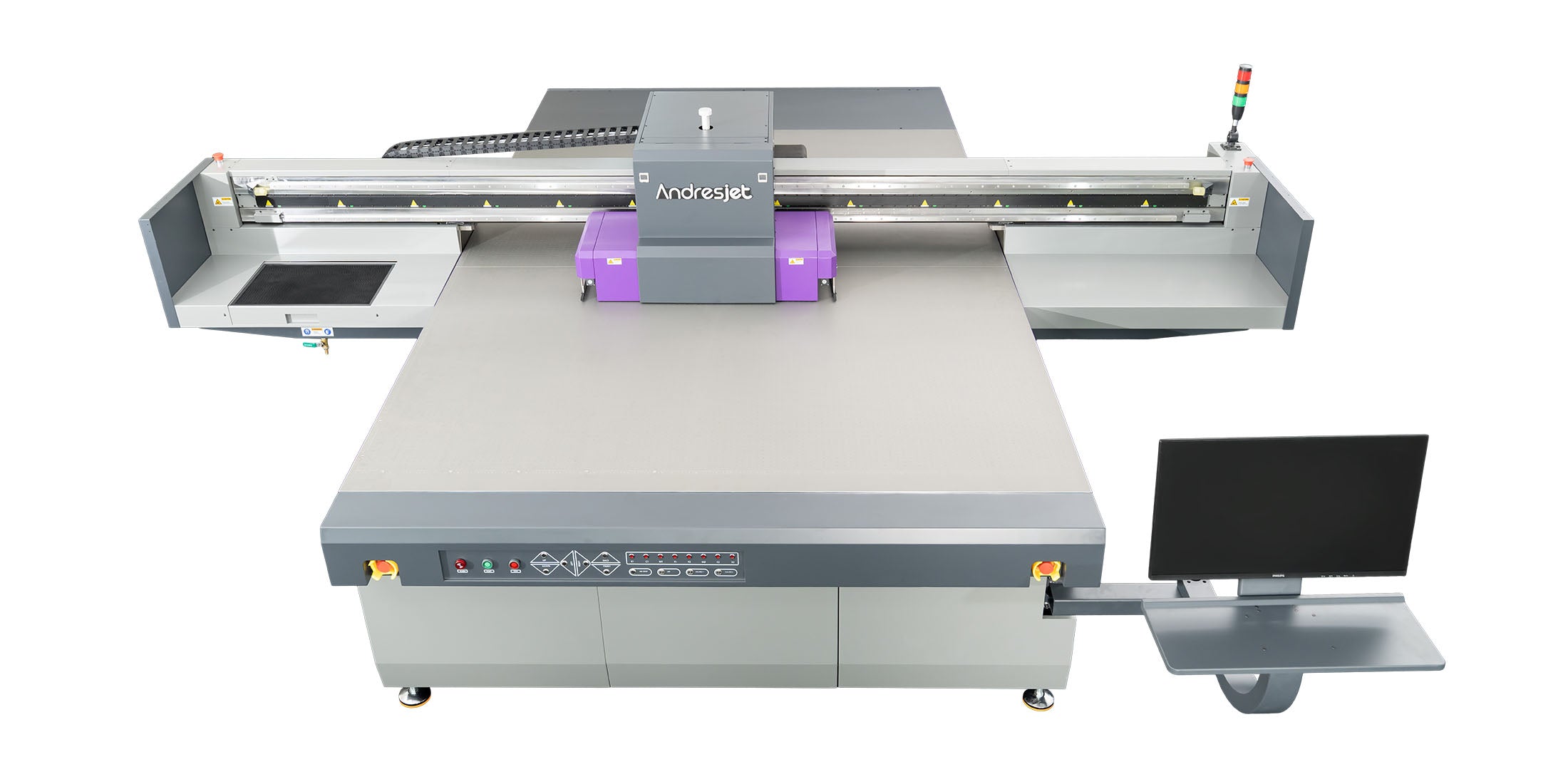
Piezo drop-on-demand inkjet, powered by RICOH heads in AndresJet UV flatbeds, transforms industrial printing with precision, speed, and versatility for rigid media. As 2026 demands sustainable customization, these solutions optimize efficiency in signage and décor.
What is the main advantage of piezo over thermal inkjet? Piezo handles UV inks without heat, ensuring longevity and versatility for industrial flatbeds.
Can AndresJet printers handle 100mm thick media? Yes, models like AJ2130EX support 1–100mm with auto-detection and vacuum hold-down.
What speeds do AndresJet UV flatbeds offer? Up to 154 m²/h draft on AJ3220EX, exceeding 100 sqm/hr for production.
Does AndresJet provide after-sales support? Yes, 2-year warranty, 8-year parts, training, and production line design.
Are AndresJet printers certified? All carry CE, RCM, and UKCA certifications.


