

A cylindrical inkjet printer rotates objects under piezo printheads to deliver seamless 360° UV prints on bottles and tumblers. The AndresJet AJ360i handles 60–170mm diameters (expandable to 10–240mm), 0–7° tapers, 720×1200 DPI resolution, and 60 items/hour in production mode with four white ink channels for 0.15mm raised effects, using LED UV curing.
Check: compact uv flatbed printers
What Is a Cylindrical Inkjet Printer and How Does It Differ from Flatbed UV Printers?
A cylindrical inkjet printer rotates cylindrical objects under stationary printheads to achieve seamless 360° printing, unlike flatbed UV printers that move printheads over stationary flat or rigid media. This enables full-surface coverage on bottles, tumblers, and tapered vessels without seams.
Cylindrical inkjet printers are specialized for rotary printing on curved surfaces, making them ideal for industrial applications like packaging, drinkware, and promotional items. The core mechanism involves securing the object in a rotating fixture while piezo printheads deposit UV-curable ink in precise droplets. As the cylinder spins, the printhead scans axially to cover the entire 360° surface seamlessly.
In contrast, flatbed UV printers, such as AndresJet's AJ2130EX or AJ1206 models, excel at printing on flat panels, boards, or small rigid items like coins and medals. Flatbeds use a vacuum-equipped aluminum table to hold media flat, with the printhead carriage moving in X-Y axes. They handle thicknesses from 1–100 mm but cannot natively print around curves without additional fixtures.
The key difference lies in motion: cylindrical printers rotate the object (rotary axis), while flatbeds translate the printhead. This makes cylindrical models perfect for short-run customization on vessels, replacing traditional screen printing. AndresJet's AJ360i Digital Cylinder Printer bridges this gap, complementing flatbed lines for hybrid workflows in home decoration and gift printing.
How Does 360° Rotary Printing Work in Stepping vs. Helix Modes?
Check: Cylindrical Inkjet Printer
360° rotary printing rotates the cylinder under printheads for seamless coverage; stepping mode prints discrete bands with axial steps, while helix mode uses continuous spiral paths for faster, smoother output on straight or tapered objects.
In stepping mode, the cylinder rotates fully (360°) while the printhead lays down a single circumferential band. The fixture then steps axially to the next position, repeating until the full length is covered. This method ensures high precision for detailed graphics but may show faint seams at band overlaps, ideal for high-resolution work up to 720×1200 DPI.
Helix mode, conversely, rotates the cylinder while the printhead moves axially in a continuous helical path, creating a seamless spiral print without stops. This boosts speed—up to 60 items/hour on the AJ360i—and suits production runs on bottles or tumblers. Both modes use LED UV curing for instant drying, preventing smudges on curved surfaces.
AndresJet's AJ360i supports both modes, with print lengths of 40–270 mm. Tapered objects (0–7° angle) are accommodated by adjustable fixtures, ensuring the surface stays parallel to the printhead. This versatility enables flawless 360° prints on cones and vessels, enhancing productivity in plastic product and sign printing sectors.
What Are the Key Specs of the AndresJet AJ360i Digital Cylinder Printer?
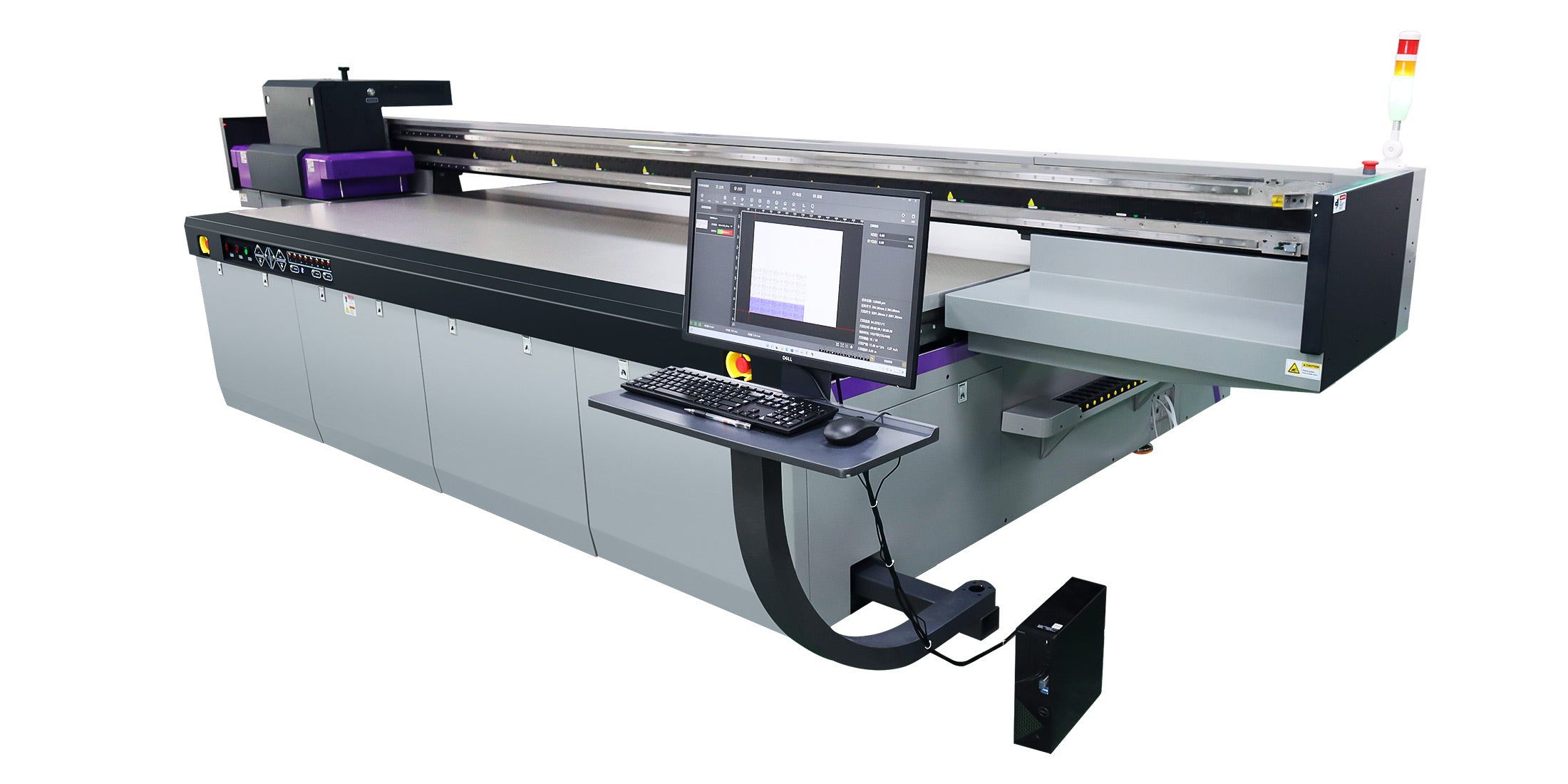
The AndresJet AJ360i features piezo drop-on-demand printheads, LED UV ink with CMYK + White + Varnish, 720×1200 DPI resolution, 60–170mm diameters (expandable to 10–240mm), and production speeds of 60 items/hour, with 7 standard quick-change fixtures and 2 free custom ones.
Designed for industrial 360° printing, the AJ360i weighs 350 kg with dimensions of 1160 × 870 × 1800 mm (L × W × H). It operates on AC 220/110V ±10%, 50Hz, >10A, in 20–30°C and 30–60% humidity. Calibration uses a 2-point pneumatic system, with setup under 15 minutes per changeover and total 60 minutes.
Key highlights include four white ink channels for raised effects up to 0.15 mm, supporting all cylindrical media like tapers and cones. Fixtures enable tool-free swaps in under 12 minutes, with free samples for the first 3 items and 3 days of training included. Certifications cover CE, RCM, and UKCA, backed by a 2-year warranty and 8-year spare parts.
| Specification | Details |
|---|---|
| Part Diameter | Standard 60–170mm; Optional 10–60mm, 170–240mm |
| Print Length | 40–270mm |
| Print Speed | 60 items/hour (production); 40 items/hour (high quality) |
| Resolution | 720 × 1200 DPI |
| Ink Configuration | K, C, M, Y, White (4 channels), Varnish |
| Net Weight | 350 kg |
Which Materials and Sizes Can a Cylindrical UV Printer Handle, Including Tapers?
Cylindrical UV printers like the AJ360i handle diameters of 60–170mm (expandable 10–240mm), lengths 40–270mm, and taper angles 0–7° on materials including plastics, glass, metal vessels, cones, and bottles for seamless 360° prints.
Versatile for industrial use, these printers process rigid cylindrical objects such as tumblers, cosmetic bottles, and promotional drinkware. The AJ360i's 7 standard fixtures cover Ø60–170mm, with 2 free custom designs (ready in 7–10 days) extending to 10–240mm. Tapers up to 7° are managed via pneumatic clamping, keeping surfaces parallel to printheads.
UV LED ink adheres to diverse substrates without pre-treatment, enabling short runs in home decor and gift printing. For smaller items like coins, pair with AndresJet's AJ1206 flatbed (up to 2,000/hour). Larger flatbed models like AJ2130Ultra support hybrid lines for panels and vessels.
How Do You Set Up and Calibrate a Cylindrical Inkjet Printer for Quick Changeovers?

Setup involves selecting a fixture, pneumatically clamping the object, performing 2-point calibration, and loading files via RIP software; the AJ360i achieves 15-minute changeovers and 60-minute total setups with tool-free fixture swaps under 12 minutes.
Begin by choosing from 7 standard or custom fixtures matching your object's diameter and taper. Secure the cylinder with pneumatic clamping for stability. Use the 2-point calibration system to align rotation and axial position, ensuring printhead-object distance is precise.
Load designs in TIFF, JPEG, EPS, or PDF via RIIN Print or compatible RIP, adjusting for helix/stepping modes. Test print, then run production. AndresJet's AJ360i minimizes downtime, supporting high-speed workflows over 60 items/hour. Training (3 days included) covers these steps for seamless operation.
AndresJet Expert Views
"At AndresJet, our AJ360i revolutionizes cylindrical printing with quick-change fixtures and four white channels for premium effects. Over 10 years, we've optimized for 60 items/hour speeds and 0–7° tapers, integrating seamlessly with flatbeds like AJ2130 series. Free custom fixtures and samples ensure zero-risk entry into high-speed UV production. Our engineers design full lines, guaranteeing 8-year parts support for enduring partnerships." – AndresJet Engineering Team
Why Use White Ink and Varnish in Cylindrical Printing for Raised Effects?
White ink provides opaque backings for vibrant colors on dark substrates and layers up to 0.15mm for tactile effects; varnish adds gloss protection. The AJ360i uses four white channels with CMYK + Varnish for durable, premium 360° finishes on tumblers and bottles.
White ink enables printing on colored or transparent cylinders, creating backlit effects or opacity. Multiple layers build raised textures, enhancing perceived value in gift and promo items. Varnish seals prints against scratches and UV fade, vital for drinkware.
AndresJet's LED UV system cures instantly, supporting these effects without distortion on curves. This differentiates short-run digital from screen printing, offering customization at production speeds.
What Print Speeds and Resolutions Achieve Production at 60 Items/Hour?
The AJ360i delivers 60 items/hour in production mode (80mm diameter, CMYK) at 720×1200 DPI, balancing speed and quality; high-quality mode hits 40 items/hour for detailed output on tapered cylinders.
Production mode prioritizes throughput via helix printing and optimized droplet sizes from piezo heads. Resolution ensures sharp graphics, comparable to flatbeds like AJ2130EX (up to 128.6 m²/h). Factors like diameter and mode affect speed, but AJ360i's design targets industrial volumes.
| Mode | Speed (80mm diameter, CMYK) | Resolution |
|---|---|---|
| Production | 60 items/hour | 720 × 1200 DPI |
| High Quality | 40 items/hour | 720 × 1200 DPI |
How Does the AJ360i Compare to Competitors Like Inkcups Helix or EPSVT XD-360?
The AJ360i outperforms with 60 items/hour speeds, 10–240mm expandable diameters, free custom fixtures, and 0.15mm white effects vs. competitors' narrower ranges and slower outputs; it includes 3-day training and free samples for superior value.
While others offer similar rotary UV tech, AJ360i's 0–7° taper support, four white channels, and 15-minute changeovers excel for diverse vessels. Competitors focus on benches or limited speeds (e.g., 15s/pcs single-color), but AndresJet emphasizes production scalability and support.
Conclusion
Cylindrical inkjet printers like the AndresJet AJ360i transform industrial printing with seamless 360° UV output on tapered objects. From quick setups to high speeds and effects, they enable efficient customization. Explore hybrid setups with AndresJet flatbeds for comprehensive solutions. Visit AndresJet.com to request free printing for your first 3 samples or schedule a demo.
Frequently Asked Questions
What diameters does the AJ360i support? Standard 60–170mm, optional 10–60mm and 170–240mm with free custom fixtures.
Can it print on tapered objects? Yes, up to 0–7° taper angle using adjustable pneumatic clamping.
What is the warranty? 2 years comprehensive, with 8 years guaranteed spare parts.
Is training included? Yes, 3 days of hands-on training.
Are samples free? First 3 samples are free.
Share:
Which UV Flatbed Printer is Best for Industrial Printing in 2026?
Which UV Flatbed Printer is Best for Industrial Printing in 2026?