

- by John White
Does Frequent On/Off Switching Shorten UV Lamp Life?
- by John White
Print bigger, print faster — wide-format UV flatbed printers for signs, decor and industrial work.

No, frequent on/off switching does not significantly shorten LED UV lamp life in modern industrial flatbed printers like AndresJet's AJ2130Ultra (up to 140 m²/h). Unlike mercury arc lamps, LED UV systems experience minimal ignition stress, enabling on-demand operation for variable production without reduced lifespan, backed by AndresJet's 2-year warranty.
Check: How Long Do UV Lamps Last and When Should They Be Replaced
UV lamp degradation in industrial printing stems primarily from electrode wear during ignition, heat buildup, and operational hours, with frequent starts accelerating filament erosion far more than steady runtime.
In high-volume UV flatbed printing environments, lamps endure intense demands from curing UV-curable inks on substrates like PVC panels or MDF boards. Traditional mercury arc lamps rely on electrodes that heat to vaporize mercury, creating plasma for UV output. Each startup delivers a high-voltage surge, sputtering electrode material and thinning the filament rapidly—often 10-20 times faster than continuous operation.
Heat management plays a role too; overheating from poor cooling shortens life by degrading phosphors or quartz envelopes. Dust accumulation blocks output, forcing lamps to run hotter. In contrast, modern LED UV systems, standard in AndresJet printers, use semiconductor diodes that switch instantly without electrode stress, maintaining stable output over 20,000+ hours.
For production managers running high-speed jobs—such as 92.9 m²/h on the AJ2130EX—understanding these mechanisms informs duty cycle strategies to minimize downtime.
Traditional mercury UV lamps suffer severe degradation from frequent on/off cycles, as each ignition erodes electrodes through sputtering, potentially halving lifespan compared to continuous duty cycles.
Mercury arc lamps, once common in older printing systems, ignite via a ballast delivering 5,000-20,000 volts to electrodes. This arc initiation bombards the cathode with ions, ejecting tungsten particles—a process called sputtering. A single start equates to hours of runtime wear; 100 daily cycles could consume 10% of electrode life in days.
Ballast compatibility exacerbates this; mismatched units cause voltage spikes, further stressing components. Lifespans typically hit 9,000 hours under ideal continuous use, but frequent cycling drops effective output to 50-70% sooner, raising replacement costs in sign shops or plastic printing facilities.
In variable-demand workflows, like switching between home decoration panels and gift items, mercury systems demand "warm-up" periods, wasting energy and increasing failure risk.
Check: Compact uv flatbed printers
LED UV lamps excel in frequent switching because they lack fragile electrodes and filaments, activating via solid-state diodes with negligible startup stress, achieving 20,000-25,000 hour lifespans even under high duty cycle variations.
Unlike mercury lamps' gas-discharge mechanism, LED UV employs arrays of semiconductors that emit UV light when electrified. Instant on/off incurs no thermal shock or sputtering—degradation occurs gradually from diode phosphor decay or junction heating, proportional to total hours rather than cycles.
Advanced thermal management in industrial LED systems, including active cooling, sustains peak irradiance (typically 8-12 W/cm² for printing). Ballast needs vanish; simple drivers handle power efficiently. This suits high-speed flatbeds where printers idle between jobs, preserving life without preheat delays.
The shift to LED UV aligns with 2026 market trends, slashing energy use by 70% and eliminating mercury disposal hazards.
Yes, AndresJet's LED UV curing across models like AJ2130G/R and AJ2512G/R eliminates on/off stress through solid-state technology, supporting variable production schedules without lifespan penalties.
AndresJet integrates LED UV curing in all flatbed printers, from the compact AJ1206 (up to 2,000 coins/hour) to ultra-high-speed AJ2130Ultra (140.7 m²/h ultra-draft). These systems cure Eco-Print UV inks instantly, with diodes designed for rapid cycling in demanding environments like sign printing or plastic products.
Paired with features like fiber optic interfaces and anti-collision systems, AndresJet printers enable on-demand operation. Operators can power UV modules per job—ideal for mixed runs of 100 mm thick media—without electrode wear. The 2-year warranty and 8-year spare parts guarantee underscore this durability.
| AndresJet Model | Print Speed (m²/h) | UV Curing Type | Media Thickness (mm) |
|---|---|---|---|
| AJ2130EX | 128.6 (Draft) | UV LED | 1–100 |
| AJ2130Ultra | 140.7 (Ultra-Draft) | UV-curable LED | 1–100 |
| AJ2512G/R | 27.46 (Draft) | LED UV | 1–100 |
LED UV lamps in flatbed printers last 20,000-25,000 hours with stable output, far outpacing mercury lamps' 9,000 hours; AndresJet systems leverage this for 2+ years of high-volume use under typical duty cycles.
Mercury lamps degrade UV intensity by 15% annually, necessitating annual swaps in continuous ops. LED UV maintains 80%+ output longer, suiting 24/7 potential in models like AJ3220EX (154.3 m²/h draft). Factors like power settings and cooling influence this; AndresJet's hard-anodized flatbeds with vacuum systems minimize dust.
In practice, a sign shop printing 100 sqm/hr daily might log 2,000 hours/year—LEDs endure 10+ years before noticeable drop.
AndresJet Expert Views
"In our high-speed flatbeds like the AJ2130 series, LED UV curing transforms duty cycle management. Operators cycle lamps dozens of times daily for variable jobs—from home decor panels to cylindrical gifts—without lifespan impact. Our engineers design with industrial RICOH Gen5/Gen6 heads and precise servo motors, ensuring thermal stability. Backed by 8-year parts availability, this minimizes TCO for North American and South Asian clients pushing 600 panels/day." – AndresJet Engineering Lead
Optimize UV duty cycles by using on-demand LED activation, grouping similar jobs, and monitoring via printer software—extending life while supporting 100+ sqm/hr throughput in AndresJet models.
Batch runs reduce cycles: print all 2100×3000 mm sheets on AJ2130G/R before idling. Leverage RIP software like RIIN Print for job queuing. Maintain 20-30°C environments to avoid thermal stress. For white/varnish configs, enable zoned curing to idle unused channels.
Modern ballasts in legacy systems help, but LED eliminates the need. Track hours via interfaces; schedule cleans quarterly.
AndresJet's AJ2130Ultra, AJ2130EX, and AJ3220EX excel in variable-demand setups, delivering 120-154 m²/h with LED UV that thrives on frequent cycling for mixed production like signs and plastics.
These workhorses handle 1-100 mm media with 360° anti-collision and auto-height detection, ideal for shifting from MDF panels to coins. Scalable heads (up to 24 in AJ2130Ultra) match volume fluctuations.
| Model | Print Size | Heads | Key for Variable Demand |
|---|---|---|---|
| AJ2130Ultra | 2100×3000 mm | 24 RICOH Gen5 | 140.7 m²/h, fiber optic |
| AJ3220EX | 3200×2000 mm | 16 RICOH Gen5 | 154.3 m²/h draft |
| AJ2512G/R | 2500×1200 mm | 3-8 RICOH Gen6 | Scalable, 35 sqm/hr max |
AJ1206 suits small-batch medals (2,000/hour) with CCD positioning.
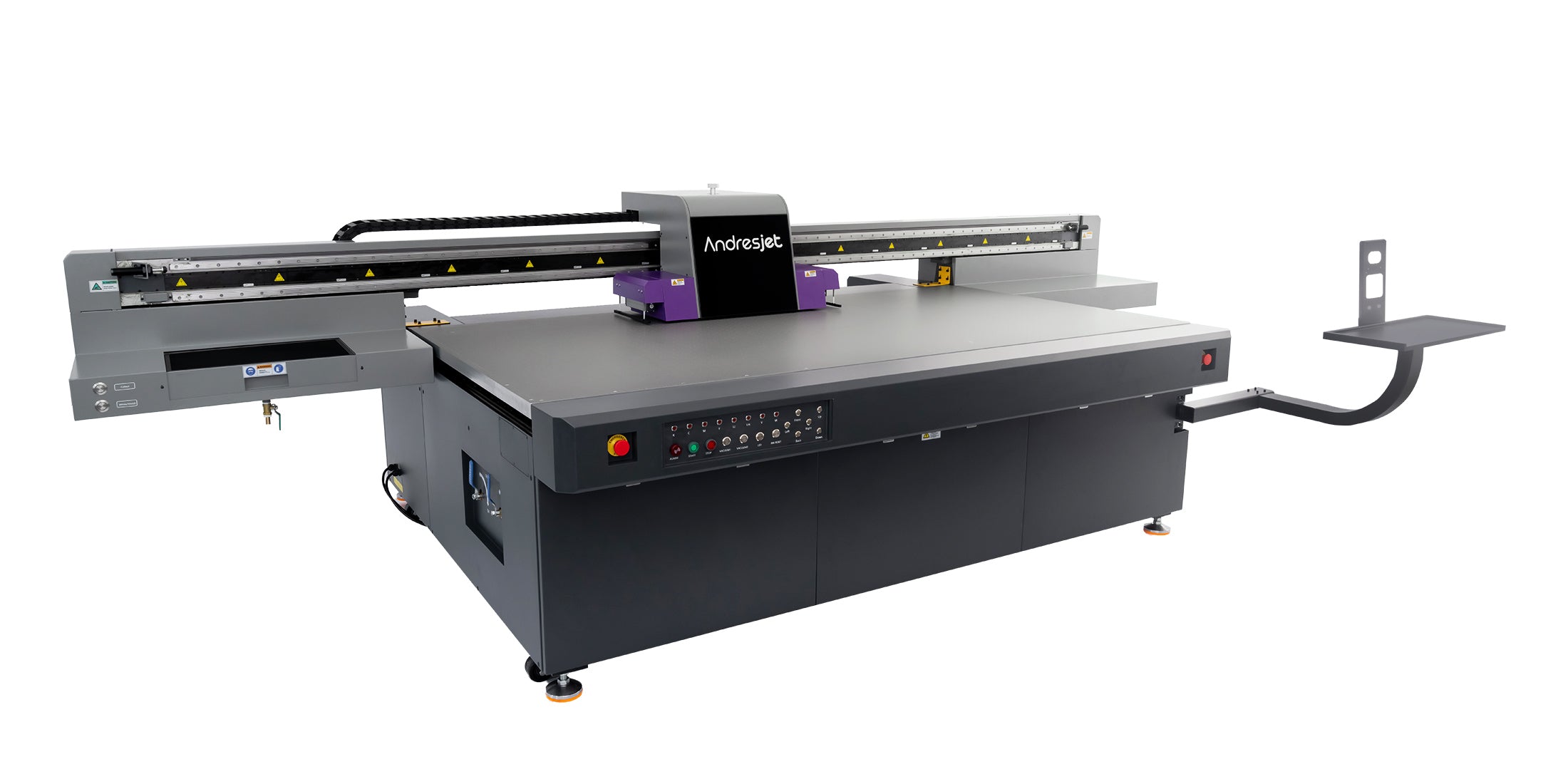
Extend UV lamp life by quarterly quartz cleaning, optimal environment control (20-30°C, 40-60% RH), and software-monitored duty cycles—proven in AndresJet printers for minimal downtime.
Wipe reflectors gently; avoid fingerprints. Use anti-static bars to curb dust. Verify power stability (>20A, 220V). AndresJet's 4-zone vacuums and IGUS e-chains aid cleanliness. Train via included sessions for setups under 15 minutes.
Frequent on/off switching poses no threat to LED UV lamps in AndresJet flatbeds, empowering efficient, high-speed production. Choose models like AJ2130Ultra for duty-cycle freedom, backed by comprehensive support. Optimize operations today for lasting ROI.
Yes, each ignition sputters electrodes 10-20x faster than steady use, slashing life in cycled ops.
20,000-25,000 hours typically, supporting years of 100 sqm/hr printing without cycle penalties.
Absolutely—LED UV and features like auto-height detection handle variable demand seamlessly.
2 years comprehensive, plus 8 years guaranteed spare parts for peace of mind.


