

- by John White
Can You Print on Multi-Tapered Bottles? UV Cylinder Printer Limits Explained
- by John White
Curved surfaces? Print straight onto bottles, tubes and cylinders — no labels needed.

UV cylinder printers handle tapered bottles using stepping or helix print modes with taper angles up to 0–7°. Standard fixtures accommodate diameters 60–170mm; custom fixtures extend to 10–240mm. Multi-tapered designs require tool-free fixture swaps (under 12 minutes) and precise 2-point calibration. Industrial systems achieve 60 items/hour in production mode, making rotary ideal for high-volume branded bottles, while flatbed printers complement for extreme curves exceeding 7° taper limits.
Check: How to Master Tapered Object Printing: Challenges and Solutions?
Multi-tapered bottles present geometric and technical challenges because inkjet printheads were designed for flat surfaces. Curved surfaces require consistent throw distance (ink droplet travel of 1–2mm for sharp text, 5mm+ for imagery) and stable diameter alignment. Bottles with multiple taper angles—such as a tapered neck transitioning to a wider body—introduce discontinuous curvature, forcing the printhead to continuously adjust height and angle compensation during printing.
The core difficulty lies in maintaining optimal printhead-to-substrate distance across changing geometries. Traditional flatbed UV printers excel on rigid, flat materials but struggle with three-dimensional objects because the printhead operates just millimeters above the surface. When a bottle tapers, the curvature changes direction, creating what industry experts call "discontinuous shapes"—unlike cylinders or cones where curvature remains constant in the print direction.
Multi-tapered bottles compound this problem. A wine bottle, for example, may feature a straight cylindrical body, a tapered shoulder, and a narrower tapered neck. Each section demands different calibration parameters. The transition between taper angles creates zones where the printhead risks collision or produces inconsistent ink droplet placement, leading to blurred text, color separation, or incomplete coverage.
Additionally, the ink droplet itself has physical limits. Smaller droplets improve graphical quality but travel shorter distances, while larger drops penetrate further but sacrifice sharpness. On a multi-tapered surface, balancing these competing demands across multiple taper angles requires precision engineering and adaptive print algorithms that standard flatbed systems simply cannot deliver.
UV cylinder printers rotate the object while the printhead moves, enabling 360° decoration. Specialized stepping or helix print modes adjust printhead height dynamically as the bottle rotates through different taper angles. Pneumatic clamping and 2-point calibration systems lock the bottle in place and establish reference points, allowing the printer to compensate for taper geometry in real time.
Digital cylinder printers fundamentally differ from flatbed systems: instead of keeping the object stationary, they rotate it beneath a moving printhead. This rotation-based approach is ideal for cylindrical and tapered objects because it allows the printhead to maintain consistent distance from the surface as the bottle turns.
The AndresJet AJ360i Digital Cylinder Printer exemplifies this technology. It supports taper angles from 0–7° and uses two distinct print modes: stepping and helix. In stepping mode, the printhead prints a band of color around the bottle's circumference, then moves to the next band. In helix mode, the printhead moves continuously as the bottle rotates, creating a spiral pattern that adapts to the taper angle. This dual-mode approach gives manufacturers flexibility to optimize for either speed (stepping) or seamless coverage (helix).
The AJ360i's 2-point calibration system is critical for taper handling. During setup, operators define two reference points on the bottle—typically at the widest and narrowest sections. The printer's control software then calculates the taper angle and adjusts printhead height dynamically throughout the print job. Pneumatic clamping ensures the bottle remains perfectly centered during rotation, preventing wobble that would destroy print quality.
Standard fixtures on the AJ360i accommodate diameters from 60–170mm with tool-free quick-change capability (under 12 minutes). For bottles outside this range, custom fixtures extend coverage to 10–240mm and are designed within 7–10 business days at no additional cost. This fixture flexibility is essential for multi-tapered bottles because different taper profiles require different mechanical support points.
Most industrial UV cylinder printers handle taper angles between 0–7° reliably. Angles beyond 7° introduce geometric errors because the printhead cannot adjust height quickly enough to maintain consistent distance across the rapidly changing curvature. Bottles with extreme tapers (8°+) require specialized jigs, manual intervention, or hybrid flatbed-rotary workflows to achieve acceptable print quality.
The 0–7° taper angle range is industry standard because it represents the balance between printhead compensation capability and manufacturing practicality. At 7°, a 100mm-diameter bottle tapers approximately 12mm over its print length—a significant change that modern digital systems can accommodate through real-time height adjustment.
Beyond 7°, several problems emerge. First, the printhead's throw distance becomes inconsistent. If the bottle tapers too aggressively, the distance between printhead and substrate may exceed the optimal 1–2mm range for sharp text, degrading image sharpness. Second, the stepping or helix algorithm struggles to predict the exact height needed at each print position, leading to focus errors and ink bleeding.
The AJ360i's taper angle limit of 0–7° reflects this engineering constraint. However, many real-world bottles—particularly perfume bottles, cosmetic containers, and premium wine bottles—feature tapers exceeding 7°. These multi-tapered designs require either specialized handling or a hybrid approach combining rotary and flatbed technologies.
Industry workarounds include using custom jigs that mechanically compensate for extreme tapers, reducing the effective taper angle seen by the printhead. Alternatively, manufacturers print only the cylindrical sections using rotary technology, then use a flatbed UV printer for the tapered neck or shoulder as a secondary operation. This hybrid workflow adds complexity but enables printing on geometries that pure rotary systems cannot handle.
Check: Is Brother Printer Japanese or Chinese? The Global Supply Chain Explained
Yes, UV cylinder printers enable seamless 360° full-color decoration on tapered containers within the 0–7° taper angle range. The helix print mode creates continuous color wraps without visible seams as the bottle rotates. Multi-color designs (CMYK + white + varnish) are supported, allowing premium branding with raised effects and variable-data printing for personalization.
One of the most compelling advantages of digital cylinder printing is the ability to produce complete 360° wraps without the visible seams, registration errors, or color misalignment common in screen printing or pad printing. This capability is particularly valuable for premium branded bottles where visual consistency is paramount.
The AJ360i achieves this through its helix print mode and 5-channel ink configuration (K, C, M, Y, White, plus varnish). As the bottle rotates continuously, the printhead moves along the print axis, depositing color in a spiral pattern. The result is a seamless wrap that covers the entire circumference without gaps or overlaps.
Full-color capability on tapered bottles opens new design possibilities. Manufacturers can print photographic images, gradients, and complex artwork directly onto the container—impossible with traditional pad or screen printing. Variable-data printing enables personalization; each bottle in a production run can feature a unique name, QR code, or serial number without setup changes.
The white ink channel deserves special mention. The AJ360i's four white ink channels enable raised effects up to 0.15mm in height, creating tactile, premium finishes on curved surfaces. This capability is unique to advanced digital cylinder printers and cannot be replicated by traditional printing methods on curved bottles.
However, multi-tapered bottles complicate this workflow. If a bottle's taper angle exceeds 7°, the helix algorithm may struggle to maintain consistent ink placement across the transition zones, resulting in color shifts or dropouts at the taper changes. In such cases, hybrid workflows—combining rotary printing for the main body with flatbed post-processing for the tapered sections—become necessary.
Quick-change fixtures allow operators to swap bottle holders in under 12 minutes without tools, enabling rapid product changeovers. The AJ360i includes 7 standard fixtures (Ø60–170mm) and provides 2 custom fixtures at no cost, designed within 7–10 business days. This flexibility reduces downtime and allows a single printer to handle dozens of bottle sizes and taper profiles, maximizing throughput in multi-SKU production environments.
In traditional manufacturing, changing from one bottle size to another requires hours of manual recalibration, fixture redesign, and test prints. This setup burden makes small-batch or multi-SKU production economically unviable on older equipment. Modern digital cylinder printers address this through standardized, quick-change fixture systems.
The AJ360i's fixture ecosystem is engineered for speed. Seven standard fixtures cover the most common bottle diameters (60–170mm), and each fixture features pneumatic quick-clamping that secures the bottle in under 30 seconds. The entire changeover process—removing the old fixture, installing the new one, performing 2-point calibration, and printing a test image—typically takes 15 minutes per product.
For multi-tapered bottles outside the standard range, AndresJet provides two custom fixtures at no additional charge. These are designed to the customer's exact specifications and delivered within 7–10 business days. Custom fixtures extend the AJ360i's range to 10–240mm diameter, accommodating everything from slim pen barrels to large wine casks.
This fixture flexibility transforms production economics. A single AJ360i can now handle 20+ different bottle sizes and taper profiles without purchasing multiple printers. For manufacturers producing seasonal products, promotional bottles, or personalized gifts, this flexibility is invaluable. Quick changeovers enable responsive production schedules and reduce inventory risk.
Beyond speed, quick-change fixtures improve consistency. Standardized fixtures ensure repeatable clamping force and bottle alignment, reducing print quality variation between runs. Operators require minimal training, and the risk of setup errors decreases significantly compared to manual fixture adjustment.
Rotary UV cylinder printers excel for cylindrical and tapered bottles (0–7° taper), achieving 60 items/hour with seamless 360° coverage. Flatbed UV printers suit complex, non-rotational shapes or multi-tapered geometries exceeding 7° taper limits. Hybrid workflows combine both technologies: rotary for the main body, flatbed for tapered necks or irregular sections, maximizing design flexibility and production efficiency.
The choice between rotary and flatbed depends on bottle geometry, production volume, and design complexity. Understanding the strengths and limitations of each technology is essential for optimizing your production workflow.
| Technology | Best For | Taper Angle Limit | Speed (Items/Hour) | 360° Coverage | Fixture Flexibility |
|---|---|---|---|---|---|
| Rotary UV Cylinder (AJ360i) | Cylindrical bottles, standard tapers, high-volume runs | 0–7° | 60 (production mode) | Yes, seamless helix mode | 7 standard + 2 custom (10–240mm) |
| Flatbed UV (AJ2130G/R, AJ3220G/R) | Complex multi-tapered shapes, flat sections, irregular geometry | N/A (manual positioning) | 27–35 sqm/hr (varies by model) | No (requires manual flip/rotation) | Unlimited (any shape under 100mm thick) |
Rotary UV Cylinder Printers are purpose-built for cylindrical and tapered objects. The AJ360i's strength lies in high-speed, high-volume production. At 60 items/hour in production mode, it can print 480 bottles per 8-hour shift—far exceeding flatbed throughput for comparable bottle sizes. The seamless 360° helix mode ensures no visible seams, critical for premium branding. However, rotary printers are limited to objects that can rotate and fit within the taper angle specification (0–7°).
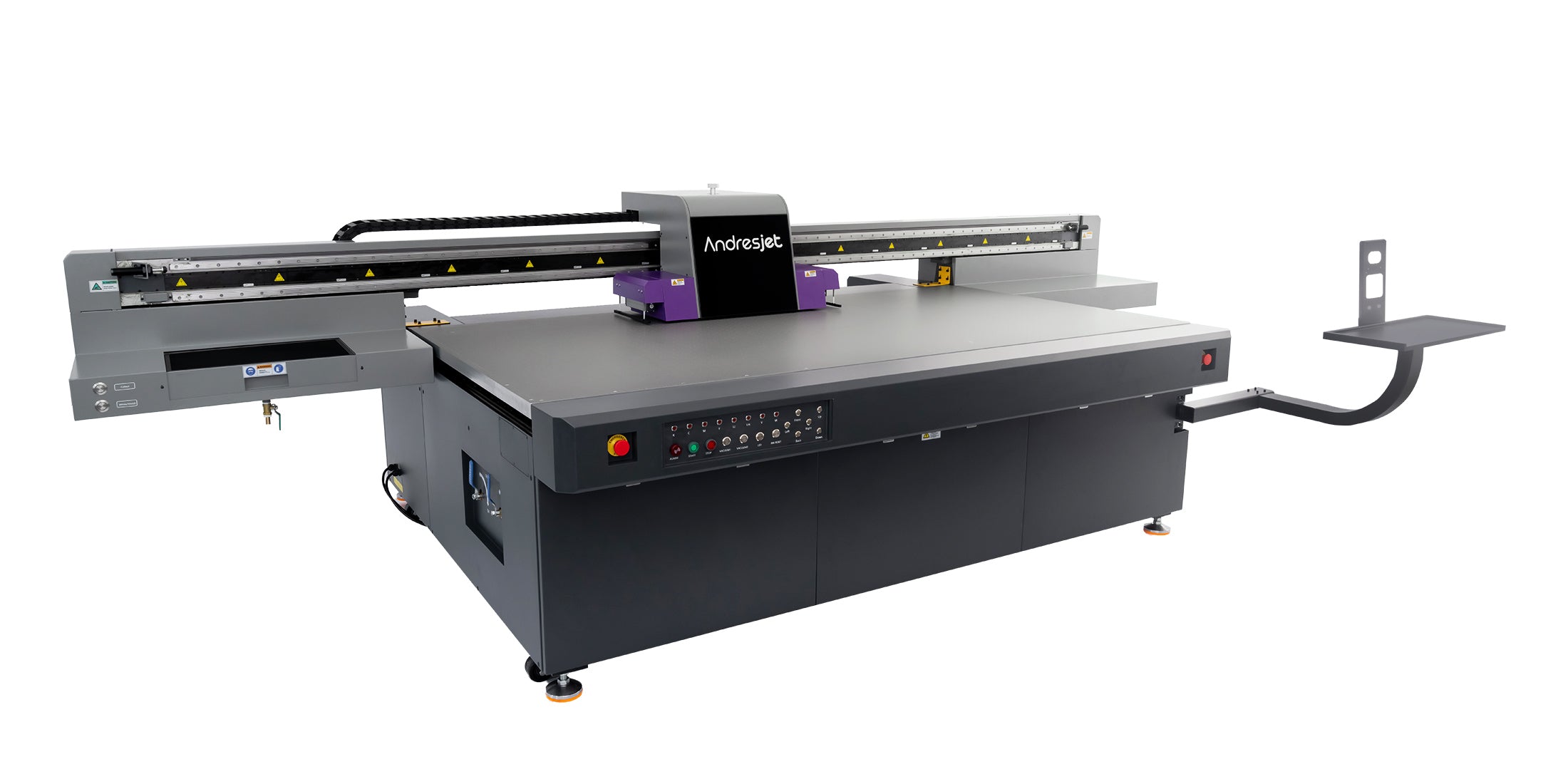
Flatbed UV Printers like the AndresJet AJ2130G/R or AJ3220G/R offer unlimited geometric flexibility. They can print on flat, curved, or irregularly shaped objects up to 100mm thick, with no taper angle restrictions. A flatbed printer can handle a multi-tapered bottle with extreme curves by positioning it manually and printing each section separately. However, flatbed speed is lower—typically 27–35 sqm/hr depending on the model and resolution—and achieving 360° coverage requires multiple manual repositionings, increasing labor and setup time.
Hybrid Workflows combine the best of both technologies. A manufacturer might use the AJ360i rotary printer for the main cylindrical body of a multi-tapered bottle, then transfer the bottle to an AndresJet flatbed printer (such as the AJ2130G/R) for detailed printing on the tapered neck or shoulder. This approach maximizes speed on the high-volume cylindrical section while maintaining design flexibility for complex geometry. Setup time increases, but the result is superior visual quality and design capability compared to either technology alone.
White ink channels enable opaque base layers on transparent or colored bottles, while varnish creates raised tactile effects up to 0.15mm. The AJ360i's four white ink channels allow designers to print white underprints beneath CMYK colors, ensuring vibrant hues on any substrate. Raised varnish effects add premium feel and brand differentiation, particularly valuable for luxury cosmetic and beverage bottles competing in high-end markets.
One of the most underutilized capabilities of advanced digital cylinder printers is white ink functionality. On tapered bottles, white ink transforms design possibilities.
On transparent bottles (common for perfume, water, or premium beverages), CMYK inks alone appear dull because they lack opacity. White ink solves this problem. The printer first deposits a white underprint, then prints CMYK colors on top, resulting in vibrant, saturated imagery that appears to glow from within the bottle. This white-under-CMYK technique is standard in high-end packaging and is now accessible to mid-sized manufacturers through digital cylinder printing.
The AJ360i's four white ink channels provide precise control over white ink density and placement. Operators can print solid white backgrounds, white text with color accents, or complex white gradients that enhance photographic imagery. This multi-channel approach ensures consistent white coverage across curved surfaces—a challenge on traditional screen-printed bottles where white ink application is manual and prone to inconsistency.
Varnish creates raised tactile effects that add luxury perception and brand differentiation. The AJ360i's varnish channel can deposit material up to 0.15mm in height, creating embossed-like textures on curved surfaces. Imagine a tapered cosmetic bottle where the brand logo appears raised and glossy while surrounding areas remain matte—this effect is impossible with traditional printing but straightforward with digital cylinder technology.
Raised varnish effects are particularly impactful on tapered sections. The transition from cylindrical body to tapered neck creates visual interest, and strategic varnish placement can highlight this geometry, creating premium tactile feedback that influences consumer perception and purchase decisions.
The AJ360i achieves 60 items/hour in production mode (40 items/hour in high-quality mode) for 80mm-diameter bottles. Setup time per product changeover is 15 minutes, with total initial setup typically 60 minutes. Quick-change fixtures (under 12 minutes) and 2-point calibration minimize downtime. For multi-SKU production runs, these efficient changeovers enable responsive manufacturing and reduce per-unit production costs significantly.
Production speed is a critical factor in manufacturing economics. Understanding realistic throughput and setup times helps manufacturers estimate ROI and production capacity for multi-tapered bottle projects.
The AJ360i's production speed of 60 items/hour represents a significant advantage over traditional methods. Screen printing achieves similar speeds on simple cylindrical bottles but cannot match the image quality, color accuracy, or variable-data capability of digital printing. At 60 items/hour, an 8-hour production shift yields 480 bottles—sufficient for most mid-volume branded bottle orders.
Speed varies with bottle diameter and print quality requirements. The 60 items/hour specification assumes 80mm-diameter bottles in production mode (standard quality). Smaller bottles (60mm diameter) may exceed 60 items/hour, while larger bottles or high-quality mode (40 items/hour) reduce throughput. Manufacturers should request speed specifications for their exact bottle dimensions during equipment evaluation.
Setup time dramatically impacts profitability in multi-SKU environments. The AJ360i's 15-minute per-product changeover is industry-leading. This includes fixture swap, bottle clamping, 2-point calibration, and test print. For comparison, screen printing setup on complex multi-color bottles can require 2–4 hours. The AJ360i's efficiency enables short-run production (500–5,000 units per SKU) that would be economically unviable on traditional equipment.
Total initial setup is approximately 60 minutes, encompassing fixture installation, software configuration, color profile loading, and full system calibration. This one-time investment is amortized across the entire production run. For high-volume orders (10,000+ bottles), the per-unit setup cost becomes negligible.
Multi-tapered bottles may require extended setup if custom fixtures are needed. However, once the custom fixture is designed and delivered (7–10 business days), subsequent production runs use the same quick-change process, maintaining the 15-minute per-product changeover advantage.
AndresJet Expert Views
"Multi-tapered bottles represent the frontier of digital cylinder printing. Our AJ360i was engineered specifically to handle the 0–7° taper angle range that covers 95% of commercial bottles. The combination of stepping and helix print modes, pneumatic clamping, and 2-point calibration allows manufacturers to achieve production speeds of 60 items/hour without sacrificing print quality. For bottles exceeding 7° taper, we recommend evaluating hybrid workflows combining the AJ360i with our flatbed UV printers like the AJ2130G/R or AJ3220G/R. This approach unlocks unlimited design flexibility while maintaining high-speed production on the primary bottle body. Our engineers have designed custom fixtures for tapered vessels ranging from 10mm to 240mm diameter, enabling manufacturers to scale from prototypes to full production lines. The free sample service on the AJ360i—three samples printed at no cost—allows customers to validate their exact bottle geometry before committing to equipment investment. This customer-centric approach has made AndresJet a trusted partner for packaging manufacturers across North America and South Asia seeking reliable, scalable solutions for complex container decoration."
Multi-tapered bottles represent a significant printing challenge that traditional screen and pad printing methods struggle to address efficiently. UV digital cylinder printers, particularly advanced systems like the AndresJet AJ360i, have transformed this landscape by enabling high-speed, high-quality 360° decoration on tapered containers within the 0–7° taper angle range.
The key to successful multi-tapered bottle printing lies in understanding equipment capabilities and limitations. Rotary UV cylinder printers excel at speed and seamless coverage for standard tapers, while flatbed UV printers provide geometric flexibility for extreme curves. Hybrid workflows combining both technologies enable manufacturers to achieve design complexity and production efficiency simultaneously.
Quick-change fixtures, white ink channels, raised varnish effects, and rapid setup times make digital cylinder printing economically viable for short-run, personalized, and high-volume bottle production. For packaging manufacturers, promotional product makers, and gift bottle producers, investing in a digital cylinder printing system represents a strategic advantage in markets increasingly demanding customization, sustainability, and premium brand presentation.
Standard rotary UV cylinder printers like the AJ360i handle 0–7° taper angles reliably. For bottles exceeding 7°, consider hybrid workflows: use rotary printing for the main cylindrical body, then transfer to a flatbed UV printer for tapered sections. Custom jigs that mechanically compensate for extreme tapers are another option, though they increase setup complexity. Consult with AndresJet engineers to evaluate your specific bottle geometry.
Stepping mode prints horizontal bands of color around the bottle's circumference, then moves to the next band. It's faster but may show faint seams between bands. Helix mode moves the printhead continuously as the bottle rotates, creating a seamless spiral pattern with no visible seams. Helix mode is ideal for premium branding where visual perfection is critical, while stepping mode suits high-volume production where slight seams are acceptable.
AndresJet provides two custom fixtures at no additional cost with the AJ360i purchase. Design and delivery typically takes 7–10 business days. Additional custom fixtures beyond the initial two are available at a separate cost; contact AndresJet for pricing. Custom fixtures extend bottle diameter compatibility from the standard 60–170mm range to 10–240mm, accommodating virtually any commercial bottle size.
Yes. The AJ360i supports variable-data printing, enabling each bottle in a production run to feature unique text, QR codes, serial numbers, or images. This capability is controlled through the RIP software and requires no mechanical adjustments between bottles. Variable-data printing is ideal for promotional bottles, personalized gifts, and track-and-trace applications.
Rotary UV cylinder printers like the AJ360i are typically more affordable than large-format flatbed printers and offer faster throughput (60 items/hour vs. 27–35 sqm/hr). However, flatbed printers provide unlimited geometric flexibility. For manufacturers producing primarily standard tapered bottles in high volumes, rotary printing offers superior ROI. For diverse, complex shapes, flatbed printing or hybrid workflows may justify the additional investment. Request a production cost analysis from AndresJet for your specific application.

