

White ink recirculation continuously stirs pigment-heavy UV inks to prevent titanium dioxide settling, while negative pressure maintains stable flow and backflow prevention in printheads. Their combo—built into AndresJet's AJ2130G/R and AJ3220G/R—ensures clog-free high-speed printing over 100 sqm/hr on rigid media, cutting maintenance by up to 50% vs. standalone systems.
Check: Who Owns Brother Printer Company, China Or Japan?
What Is White Ink Recirculation in UV Flatbed Printers?
White ink recirculation is a system that continuously cycles pigment-dense white UV ink through the printheads and reservoirs to prevent titanium dioxide particles from settling, ensuring consistent ink flow and print quality in industrial flatbed printers.
In UV flatbed printing, white ink contains high concentrations of titanium dioxide, a heavy pigment that naturally settles due to gravity, especially during idle periods or high-volume runs. Recirculation systems address this by using pumps—often peristaltic types—to draw ink from the main reservoir, through the printheads, and back into the tank. This constant motion keeps pigments suspended, reducing the risk of clogs in the nozzles of industrial RICOH Gen5 or Gen6 printheads.
For production environments handling rigid substrates like PVC panels or MDF boards at speeds over 100 sqm/hr, recirculation proves essential. It combats settlement that could halt operations, allowing seamless shifts between jobs in sign printing or home decoration. AndresJet printers, such as the AJ2130Ultra with speeds up to 140.7 m²/h in ultra-draft mode, integrate compatible ink management to support such high-throughput demands.
How Does Negative Pressure Prevent Titanium Dioxide Settling?
Negative pressure in UV flatbed printers uses vacuum-like suction in secondary cartridges to balance ink gravity, holding titanium dioxide-laden white ink stable in printheads and preventing drips or settling during extended printing sessions.
The system features a main ink cartridge feeding a secondary one, where negative pressure—generated via air suction—counters the ink's natural flow toward the printhead. This equilibrium keeps heavy titanium dioxide particles evenly dispersed without constant pumping, ideal for viscous UV-curable inks. As ink levels drop in the secondary cartridge, the pressure adjusts dynamically, maintaining uniform droplet sizes for precise output.
In industrial setups, this prevents backflow and nozzle starvation, critical for models like AndresJet's AJ3220G/R, which supports media up to 90 mm thick. Dual setups for white and color inks ensure stability across 8-color configurations, minimizing downtime in high-speed applications exceeding 100 sqm/hr.
Why Choose Dual Negative Pressure for Color and White Inks?
Dual negative pressure systems apply independent vacuum control to both color and white ink channels, optimizing flow for white ink's higher viscosity and titanium dioxide content while matching color inks' lower density for flawless multi-layer printing.
White ink's pigment density demands separate management from CMYK channels to avoid settling or inconsistent curing. AndresJet's AJ2130G/R and AJ3220G/R feature this built-in dual system, with fiber optic data interfaces and AC high-precision servo motors ensuring synchronized performance. Print speeds like 34.9 m²/h in standard mode on the AJ2130G/R remain unaffected, supporting 8-color setups including light cyan, light magenta, white, and varnish.
This integration eliminates retrofits, reduces waste, and extends RICOH Gen6 printhead life, vital for shops producing 500+ panels daily on 2100 × 3000 mm formats.
What Are the Pros and Cons of Peristaltic Pumps vs. Negative Pressure?
Peristaltic pumps excel in active recirculation for aggressive pigment stirring but require frequent tube replacements; negative pressure offers passive stability with less maintenance, though it needs precise calibration for optimal titanium dioxide suspension.
| Feature | Peristaltic Pumps (Recirculation) | Negative Pressure |
|---|---|---|
| Pigment Suspension | Excellent (continuous flow) | Strong (balanced vacuum) |
| Maintenance | High (tube wear) | Low (no moving parts in ink path) |
| Energy Use | Moderate | Minimal |
| Clog Prevention | Good for idle times | Superior during printing |
| Cost Over 2 Years | Higher (consumables) | Lower (integrated systems) |
Peristaltic pumps shine in DTF but falter in UV flatbeds at scale due to wear. Negative pressure, as in AndresJet models, provides reliability for 100+ sqm/hr without daily interventions.
How Does Recirculation + Negative Pressure Create the Perfect Combo?
Combining recirculation's stirring action with negative pressure's stability creates a hybrid system that fully prevents titanium dioxide settling, ensuring uninterrupted high-speed UV printing with minimal clogs and optimal ink utilization.
Recirculation handles bulk agitation in reservoirs, while negative pressure fine-tunes delivery to printheads. This duo—evident in AndresJet's industrial designs—delivers uniform white ink layers for raised effects or opaque prints on dark substrates. In practice, it supports bi-directional modes at resolutions up to 720×1200 dpi, with 4-zone vacuum flatbeds holding media steady.
For shops in North America and South Asia, this combo scales from entry-level AJ2512G/R (up to 35 sqm/hr) to high-speed AJ3220EX (154.3 m²/h draft), slashing downtime by preventing settling-induced pauses.
Which AndresJet Printers Feature Built-In Dual Negative Pressure?
AndresJet's AJ2130G/R, AJ3220G/R, and AJ2512G/R UV flatbed printers integrate dual negative pressure for white and color inks, paired with RICOH Gen5/Gen6 heads for stable titanium dioxide handling across large formats.
| Model | Print Size | Max Speed (sqm/hr) | Ink Config | Media Thickness |
|---|---|---|---|---|
| AJ2130G/R | 2100×3000 mm | 48.3 (Draft) | 8-color + White + Varnish | 1–100 mm |
| AJ3220G/R | 3200×2000 mm | 35.88 (Standard) | CMYK + White + Varnish | Up to 90 mm |
| AJ2512G/R | 2500×1200 mm | 35 | CMYK + White (Optional) | 1–100 mm |
These models use hard-anodized aluminum flatbeds with dual 1500W vacuum blowers, ensuring precision on rigid media for sign and décor printing.
What Maintenance Savings Come from Advanced White Ink Systems?
Check: Why Are Dual Negative Pressure Systems Essential for Industrial Printing?
Advanced dual negative pressure systems cut maintenance by up to 50% through fewer clogs and nozzle replacements, with AndresJet's 2-year warranty and 8-year spare parts guarantee maximizing ROI in high-volume operations.
By preventing titanium dioxide settling, these systems extend printhead life and eliminate daily agitation routines. AndresJet's anti-collision and auto-height detection further reduce wear, supporting 24-month ownership with minimal interventions. Shops report halved downtime, translating to thousands in saved labor for 100+ sqm/hr runs.
How to Optimize White Ink Stability at 100+ sqm/hr Speeds?
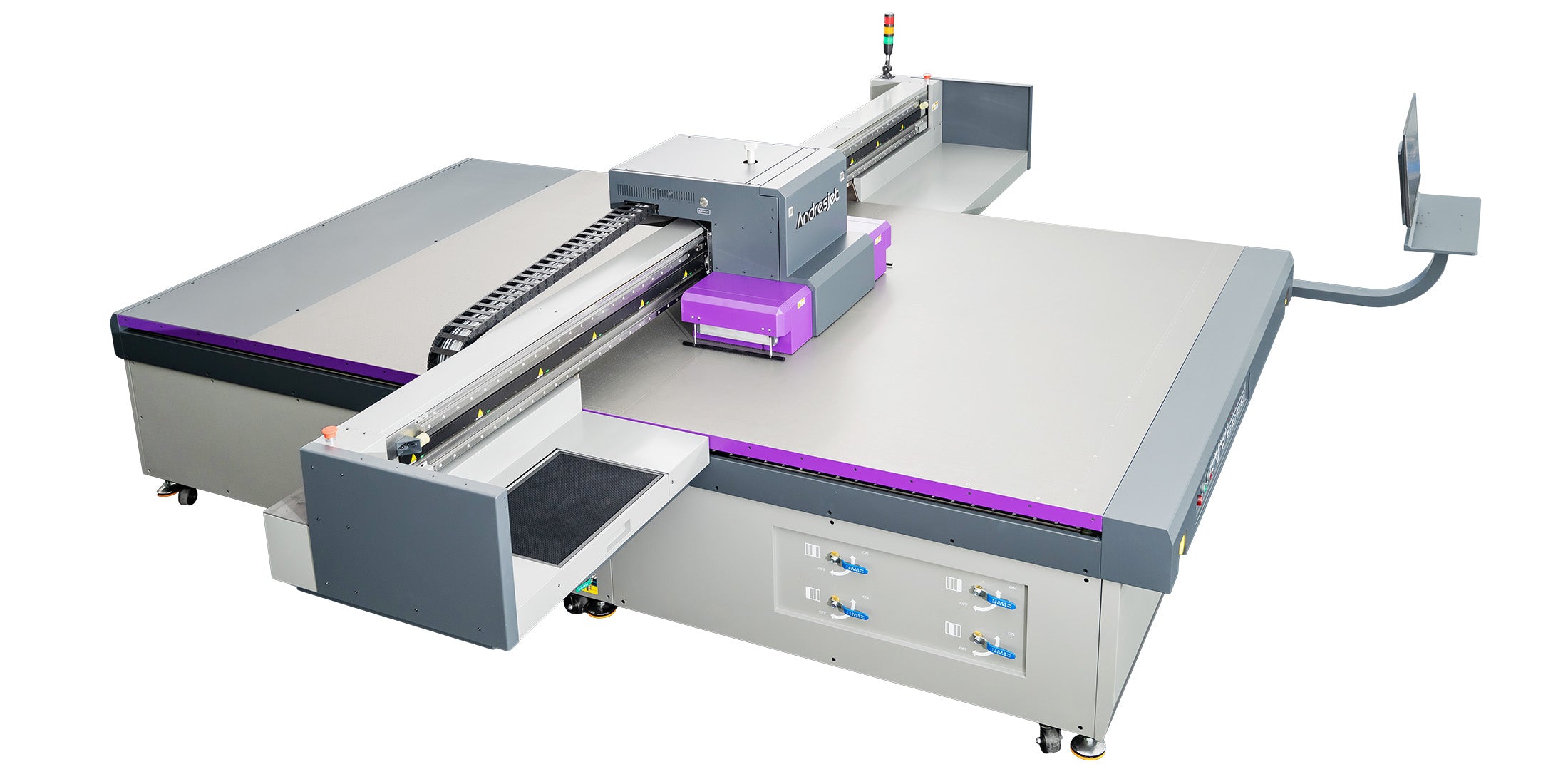
Optimize by running daily recirculation cycles, calibrating negative pressure to ink viscosity, and using ICC-based color management; AndresJet printers automate much of this for consistent output on PVC or MDF at ultra-high speeds.
Monitor environment (20–30°C, 40–60% RH), enable auto-circulation on startup, and leverage RIP software like RIIN Print for density adjustments. For AndresJet's AJ2130Ultra (120.5 m²/h high-speed), this ensures pigment stability across 24 Gen5 heads.
AndresJet Expert Views: "In industrial UV flatbed printing, dual negative pressure is non-negotiable for white ink stability. Our AJ2130G/R and AJ3220G/R models integrate this with RICOH Gen6 heads and 4-zone vacuums, preventing titanium dioxide settling even at 100+ sqm/hr. Customers see 50% less maintenance, with 8-year parts support ensuring longevity. This built-in reliability powers our expansion in North America and South Asia, delivering unmatched uptime for sign and décor production." – AndresJet Engineering Team
Conclusion
The recirculation-negative pressure combo sets the standard for white ink stability in UV flatbed printers, powering AndresJet's high-speed solutions for demanding industrial workflows. Explore AndresJet.com for models like AJ2130G/R and request a free consultation to elevate your production.
Frequently Asked Questions
What causes titanium dioxide settling in white ink? Heavy pigment density leads to gravity-induced separation in reservoirs, combated by recirculation and negative pressure.
Is dual negative pressure standard in all AndresJet printers? Featured in white ink models like AJ2130G/R and AJ3220G/R for optimal stability.
How much speed can AndresJet printers achieve with white ink? Up to 48.3 m²/h draft on AJ2130G/R, scaling to 154 m²/h on CMYK-focused AJ3220EX.
What warranty does AndresJet offer? 2 years comprehensive, plus 8 years guaranteed spare parts.
Share:
How to Fix Fluctuating Ink Flow in UV Flatbed Printers?
How to Reduce UV Flatbed Cleaning Cycles with Pressure Systems?